HCPCS Code G0296: Billing, documentation and Medicare coverage
HCPCS Code G0296: Definition and clinical purpose HCPCS Code G0296 is the Level ...

Last Updated: Nov 2, 2026
H2030 is the HCPCS Level II code for mental health clubhouse services, per 15 minutes. One unit covers 15 minutes of a member's participation in a clubhouse program, so a two-hour block bills as eight units.
Medicare doesn't pay H-series codes, so state Medicaid programs set H2030's coverage, rates and unit rules. Programs that pay clubhouse attendance as a daily rate use H2031, the per-diem version of the same service.
Let Pabau's smart automation suggest the right codes, reduce claim denials, and keep your practice compliant—effortlessly.
Automate repetitive tasks and focus on what matters most—your patients.
Reduce coding errors and ensure compliance with the latest regulations.
Clean claims, fewer denials, and faster reimbursements.
Powerful insights and reporting to help your practice thrive.
HIPAA compliant SOC 2 certified GDPR-compliant Trusted by 4,000+ clinics worldwide

HCPCS code H2030 bills mental health clubhouse services in 15-minute units, and H2031 bills the same service as a daily rate.
Medicare doesn’t pay H-series codes, so each state Medicaid program sets H2030’s coverage, rates and authorization rules.
Supported employment has its own codes, H2023 and H2024, while H2025 and H2026 cover ongoing support to keep a job.
A clean H2030 claim rests on time-stamped attendance records tied to a goal in the member’s service plan.
Unit math and authorization errors are avoidable denials that a check before submission catches.
HCPCS code H2030 is the Level II code for “Mental health clubhouse services, per 15 minutes.”
It bills the time a member spends taking part in a clubhouse program for adults with serious mental illness. One unit equals 15 minutes of participation.
The code sits in the H-series of HCPCS Level II, which the Centers for Medicare and Medicaid Services (CMS) maintains. State Medicaid agencies use these codes for mental health and substance use services. Medicare does not pay H-series codes, so coverage comes from state Medicaid plans, waivers and managed care contracts.
H2030’s closest neighbors, including H2031 and the supported employment codes, sit in the same H2000-H2041 range. Our searchable HCPCS code library lists every code in it.
H2030 covers psychosocial rehabilitation delivered through the Clubhouse Model. A clubhouse is a community program that members join voluntarily, with no time limit on membership. Members and staff run the clubhouse together during a “work-ordered day” that mirrors typical working hours.
Members are not paid for clubhouse work. The work gives them structure, skills and peer support that carry over into jobs, education and independent living. The Clubhouse International standards define the model, and some states require that accreditation before a program can bill.
Activities state clubhouse policies commonly count toward H2030 units:
Services that sit outside H2030 or belong on another code:
Each state writes its own clubhouse policy, so the list of countable activities varies. Check your state Medicaid manual before you build a billing workflow around it.
One H2030 unit covers 15 minutes of documented participation. Add up the minutes a member spent in billable clubhouse activities on a given day, then divide by 15.
Partial units follow state rules, not a national standard. Some states round a partial unit up after a set number of minutes, and others pay only for complete units. Your state manual also sets any daily or monthly cap on H2030 units.
H2030 and H2031 describe the same service with different units. A state picks one model for its clubhouse benefit, or defines when each applies. Never bill both codes for one member on the same date unless the state manual allows it.
Rates come from each state’s Medicaid fee schedule. MaineCare, for example, raised its H2030 rate from $7.31 to $8.67 per unit effective May 1, 2023. Pull your own state’s current schedule, and your managed care contracts, before you set budgets.
Only a provider enrolled with the state Medicaid program as a clubhouse provider can bill H2030. Enrollment rules differ by state, but they usually involve one or more of the following.
Member eligibility usually starts with a serious mental illness diagnosis, such as schizophrenia (F20) or bipolar disorder (F31). Most programs also require active Medicaid coverage and documented functional limits. A current service plan should name the clubhouse as part of the member’s care.
Time-based units make attendance records the core of every H2030 claim. Keeping up with medical billing compliance means each unit traces back to a record that shows who attended, when, and what they did.
Service plans need regular review, and many states set the interval in their manual. A note that points to an expired plan gives an auditor grounds to take back the payment.
Reconcile sign-in sheets against billed units every week. A member who signed in but has no activity note, or a note with no clock times, is a unit you can’t defend on audit.
Many state Medicaid programs and managed care plans require prior authorization for clubhouse services. The request usually includes the member’s diagnosis, the current service plan, and the number of units requested for the period.
Authorization periods and renewal rules are set by each payer. A managed care plan can apply different thresholds from the state’s fee-for-service program. Track the approved units against the units used, so you renew before the authorization runs out.
Place of service codes also follow state policy. Check which code your manual assigns to the clubhouse site before you file.
H2030 has no national modifier requirement, but many states require modifiers on behavioral health H codes. The table lists the modifiers state manuals most often call for.
H2030 is often confused with the supported employment codes, because clubhouses also help members find work. The codes describe different services. Check the descriptor wording in the current-year AAPC HCPCS code lookup or your state manual before billing.
Supported employment is the code choice that trips billers up most. A clubhouse member who also works with an employment specialist may receive both services. The specialist’s time goes on HCPCS code H2023 or H2024, while clubhouse attendance stays on H2030. Keep the two records separate so the same minutes never appear on both claims.
The decision path below sorts any block of member time onto the right code.
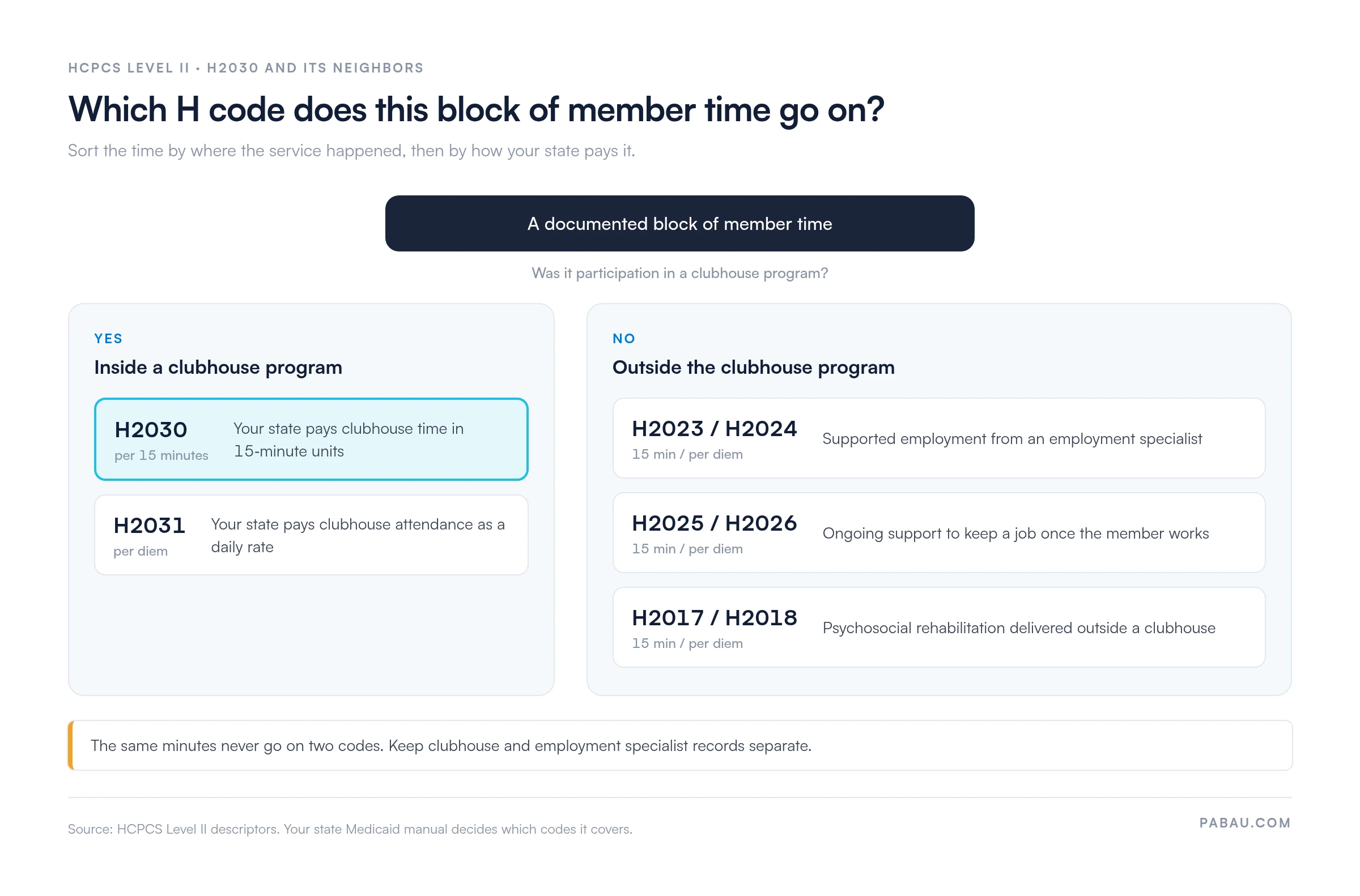
Strong denial management for H2030 starts before the claim leaves your system. The table maps frequent denial causes to the fix.
Appeal windows and processes are set by each state and managed care plan. Attach the attendance record, the service plan and the authorization when you appeal a documentation denial.
Not every state covers clubhouse services under Medicaid. Those that do choose between H2030, H2031 or both, and set their own provider standards. In 2017, Kansas clubhouse advocates told legislators that both H2030 and H2031 were available to certified clubhouses.
Before billing H2030, confirm five points in your state manual.
Clubhouse billing teams often juggle sign-in sheets, authorization letters and spreadsheets to work out each member’s units. Every handoff between those records is a chance for a unit to go unbilled or get billed twice.
Pabau, our scheduling and insurance billing software for practices, keeps those records together. Each payer authorization is stored as a case and attached when the member is booked. The authorization code then follows the visit through to the claim, and the case shows how many approved sessions are used.
Pabau’s claims management checks every claim for missing or invalid details before it goes out. In the US, it runs eligibility checks and submits CMS-1500 claims through Claim.MD. Your team spends less time chasing preventable denials and more time with members.

Pabau ties each authorization to the visit and checks every claim before submission, so H2030 claims go out complete.

H2030 pays for clubhouse participation by the quarter hour, so the claim is only as strong as the attendance record behind it. Settle three points with your state first. Confirm whether it pays H2030 or H2031, what accreditation it requires, and how it treats partial units.
Then keep clubhouse time and supported employment time in separate records. That one habit prevents the most expensive mistake on this code, which is billing the same minutes twice. Book a demo to see how Pabau tracks authorizations and checks claims before they reach the payer.

Need a framework for managing behavioral health claim denials? Denial management in healthcare covers the systematic approach to tracking, appealing, and preventing claim rejections across behavioral health billing.
Want to understand the full billing cycle for mental health services? Revenue cycle management for healthcare explains how each stage from eligibility check to payment posting affects your agency’s cash flow.
Does your state pay clubhouse attendance as a daily rate? HCPCS code H2031 covers the per-diem version of clubhouse services, with its own unit rules.
Billing an employment specialist’s time alongside clubhouse attendance? HCPCS code H2023 explains how supported employment is billed in 15-minute units.
HCPCS code H2030 is the Level II code for mental health clubhouse services, billed per 15 minutes. It covers a member’s participation in a clubhouse program for adults with serious mental illness. Medicare doesn’t pay it, so each state Medicaid program sets its coverage and rates.
H2030 and H2031 describe the same clubhouse service with different units. H2030 bills in 15-minute units, while H2031 bills one unit per day. Your state Medicaid manual sets which code applies to its clubhouse benefit.
No. Supported employment is billed with H2023 per 15 minutes or H2024 per diem. Ongoing support to keep a job uses H2025 or H2026. H2030 covers clubhouse participation only.
One unit equals 15 minutes of documented participation, so a two-hour block bills as eight units. Partial units and daily caps follow state rules. Record arrival and departure times so every unit can be recalculated.
Many state Medicaid programs and managed care plans require prior authorization for clubhouse services. The request usually includes the diagnosis, the service plan and the units requested. Check your payer’s rules before the first billed day.
Common causes are a missing authorization, billing more units than approved, and unit math errors. Others include using H2030 where the state pays H2031, or billing the same minutes under a supported employment code.