CPT Code 52352: Ureteroscopic stone removal billing guide
CPT Code 52352: Official descriptor and procedure overview CPT Code 52352 descri...

Last Updated: Oct 30, 2026
H0043 is the HCPCS Level II code for supported housing, per diem. State Medicaid programs use it to pay for housing-related supports that help a member find, move into, and keep stable housing. One unit covers one day of qualifying service.
H0043 is an H-series code, so Medicare does not pay it. Each state sets the eligible members, providers, modifiers, authorization rules, and per diem rate. Rent and room and board are never billed on it, and supported employment belongs on H2023 or H2024.
Let Pabau's smart automation suggest the right codes, reduce claim denials, and keep your practice compliant—effortlessly.
Automate repetitive tasks and focus on what matters most—your patients.
Reduce coding errors and ensure compliance with the latest regulations.
Clean claims, fewer denials, and faster reimbursements.
Powerful insights and reporting to help your practice thrive.
HIPAA compliant SOC 2 certified GDPR-compliant Trusted by 4,000+ clinics worldwide

HCPCS code H0043 bills supported housing per diem, so one unit covers one day of housing-related support for an eligible Medicaid member.
H0043 is a state Medicaid code. Medicare does not pay it, and each state sets the rate, modifiers, limits, and authorization rules.
Medicaid pays for the support, not the housing itself, so rent, utilities, and room and board never go on an H0043 claim.
Supported employment belongs on H2023 or H2024, and H0044 is the monthly supported housing code, so match the code to the service and unit.
HCPCS code H0043 is the Level II code for supported housing, per diem. State Medicaid programs use it to pay for services that help a member find, move into, and keep stable housing.
The H series was created for state Medicaid agencies, and CMS maintains the HCPCS Level II code set. The descriptor stays short, so each state defines the service, its limits, and its providers in its own billing manual.
H0043 covers housing-related supports delivered to a member, not the cost of the home itself. CMS set out these supports in a 2015 informational bulletin on housing-related activities and services for individuals with disabilities.
That bulletin groups the services into housing transition supports and tenancy-sustaining supports. Each state then decides which of them its supported housing service includes.
Each state decides which providers can bill HCPCS code H0043 and which members qualify for it. Billing entities are usually enrolled behavioral health agencies, community mental health centers, or housing support providers approved under a waiver or state plan option.
Target groups vary by state. Common ones include adults with serious mental illness, people with substance use disorders, and members who are homeless or at risk of homelessness. Some states offer the service only to members enrolled in a specific waiver or demonstration.
Staff who deliver the support may not need a clinical license, but many states set training or supervision standards. A claim from an agency that is not enrolled for this service on the date of service will deny.
A clean H0043 claim lines up four elements: the unit count, the modifiers, the place of service, and the service plan. If one of them is wrong for your state, the claim can deny even when the support was delivered.
H0043 is a per diem code, so you bill one unit for each day the member received a qualifying service. Several contacts on the same day still count as one unit.
Many states also define what makes a day billable, such as a minimum amount of service or a direct contact with the member. Some also cap the number of billable days per month or per authorization period.
Each state sets its own modifier rules for H0043, and some states require none. Where modifiers apply, they usually identify the program, the staff qualification level, or a state-defined service variant.
Treat every modifier rule as plan-specific. Pull the current billing manual for your state before you set modifiers in your claim templates. Some states require a program modifier and a staff modifier on the same claim line.
Supported housing happens where the member lives or is trying to live, so office codes rarely fit. Confirm each definition in the CMS place of service code set, then check which codes your state accepts for H0043.
Many states require prior authorization or a service authorization before H0043 days can be billed, but the rule is not national. Where it applies, the approval usually covers a set number of days over a fixed period tied to the service plan.
Managed care plans that run Medicaid behavioral health benefits can add their own authorization steps. Check both the state manual and the plan’s provider guide before you schedule the first billable day.
Auditors look for a clear line from eligibility to the service plan to each billed day. A note that lists activity without naming the housing goal it served will not support a per diem claim.
In Pabau, the practice management platform we build, digital forms can hold a daily housing-support note with required fields. Staff then record the plan goal on the day of service, not at month end. Good medical billing compliance habits treat each daily note as evidence for the claim.
An H0043 claim needs an ICD-10-CM code that supports the member’s eligibility for the service. Many states require a qualifying behavioral health diagnosis, and Z codes can record the housing situation behind the need.
Your state manual decides which diagnoses qualify and whether a Z code can stand as the primary diagnosis. The code on the claim must also appear in the member’s clinical record.
Reimbursement for HCPCS code H0043 is a per diem amount set in each state’s Medicaid fee schedule. There is no federal rate, and Medicare does not pay H-series codes.
States review their rates on their own cycles, and Medicaid managed care plans may contract at different amounts. A state can also pay different rates by program or modifier, so the fee schedule entry has to match the line you bill.
Pull the current fee schedule from your state Medicaid agency and load the per diem rate into your billing system before claims go out. For context on why H-code rates work differently from Medicare rates, see how medical billing works across payer types.
Add a fee schedule check to your billing calendar. When your state Medicaid agency publishes new rates, update the H0043 per diem in your billing system before the next claim batch goes out.
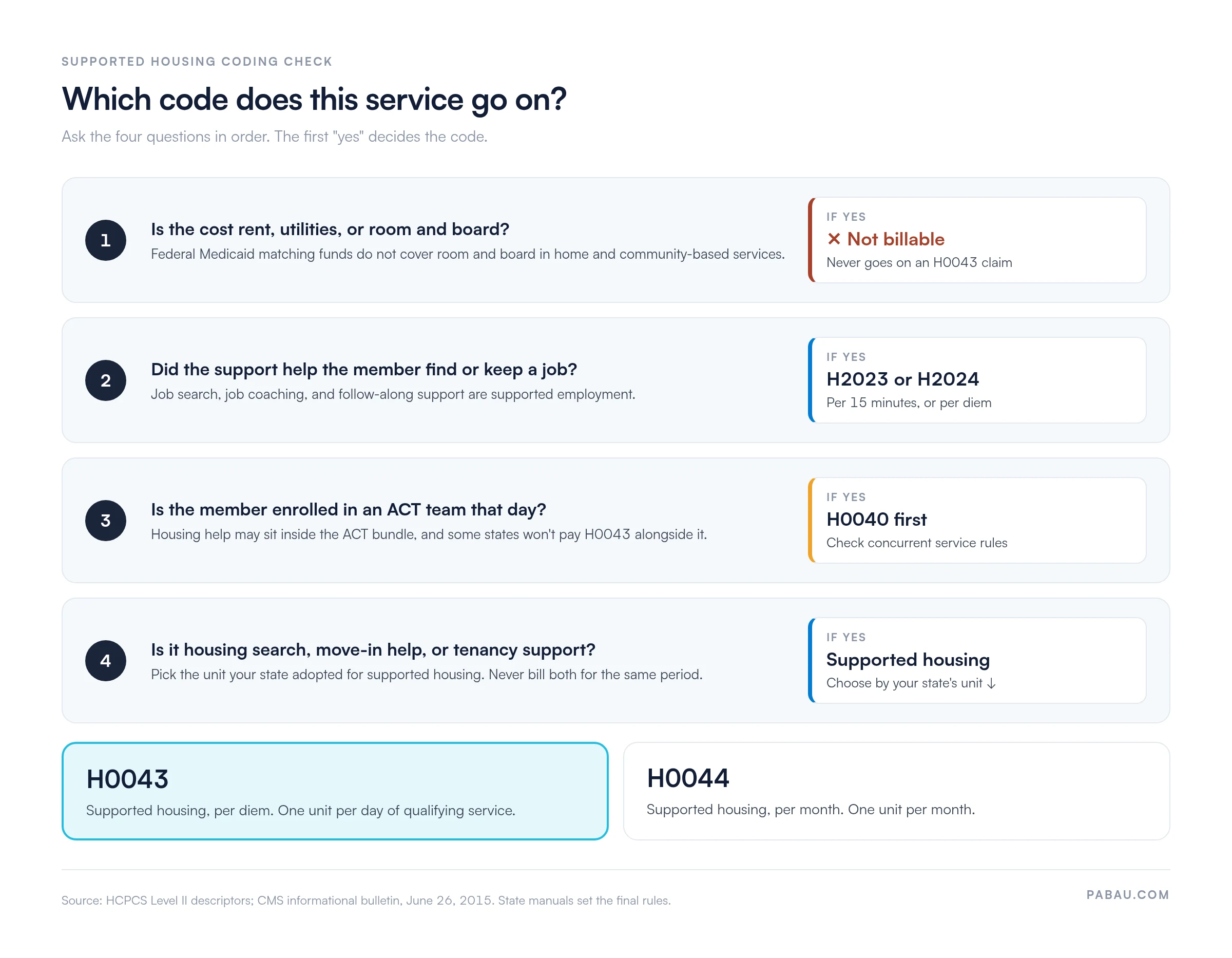
Coders confuse H0043 with nearby H codes because several describe community support for the same members. Each code has its own service and unit, so a swap is both a denial risk and an audit risk.
H0043 and H0044 describe the same service with different units. States usually adopt one of them for supported housing, so check which one yours uses and never bill both for the same member and period.
If the support helped a member find or keep a job, bill H2023 or H2024 instead. Members enrolled in an ACT team under H0040 may get housing help inside the ACT bundle, so check the concurrent billing rules before adding H0043. The NLM’s HCPCS Level II API lets you confirm each descriptor before you update your code lists.
Before you pick a code, run each service through the four checks below, in order.
Most H0043 denials trace to the per diem unit, eligibility, or documentation. The Claim Adjustment Reason Code (CARC) on the remittance points you to the cause. Good denial management processes fix each cause before the claim goes out.
When a day is denied for documentation, the note usually describes a contact without tying it to a housing goal. A required plan-goal field in the daily note template fixes this at the source. Store the notes under your HIPAA safeguards, and keep them retrievable by date so you can answer an audit request quickly.
Supported housing teams often keep service plans in one system, daily notes in another, and claims in a spreadsheet. Matching each billed day to a note then becomes a manual job at the end of the month.
Pabau keeps the member record, the service plan, and the daily notes together, with forms built around the fields your state requires. A biller checking a disputed day finds the plan goal and that day’s note on the same record.
For US claims, Pabau’s claims management connects to Claim.MD. It pulls the details already on the patient record into a claim, then submits it and tracks its status. Your team still confirms the code, units, and modifiers against the state manual.

Pabau stores service plans and daily notes on the member record, then submits and tracks claims through Claim.MD. Your team spends less time matching notes to billed days.

H0043 pays for the work that keeps a member housed, one day at a time. The code is simple, but each state writes its own rules for eligibility, modifiers, authorization, and rates.
Start with your state manual and fee schedule, then build your note template and claim settings to match them. A daily note that names the housing goal is what holds each billed unit up in an audit.
Book a demo to see how Pabau keeps service plans, daily notes, and claim submission in one place for supported housing teams.

Need a deeper look at denial prevention workflows? Denial management in healthcare covers the full cycle from root-cause analysis to appeal submission.
Billing supported housing by the month? HCPCS code H0044 explains the monthly supported housing code and how it differs from the per diem unit.
Appealing a denied H0043 day? The medical appeal form template gives you a structured letter for contesting a claim decision with the payer.
Want to understand what goes into a clean claim? What makes a clean claim breaks down the submission checklist that keeps H-code claims out of the denial queue.
HCPCS code H0043 covers supported housing, per diem. It pays for housing-related supports, such as housing search, move-in help, and tenancy-sustaining services, for an eligible Medicaid member. It does not pay for rent or room and board.
You bill one unit of H0043 per day of qualifying service, because the code is per diem. Several contacts on the same day still count as one unit. Your state may also set a minimum service level or a monthly cap.
H0043 is supported housing billed per diem, and H0044 is supported housing billed per month. Most states adopt one unit for the service, so check your state manual and never bill both for the same member and period.
No. Supported employment is billed with H2023 (per 15 minutes) or H2024 (per diem). H0043 is reserved for supported housing, so an employment service billed on H0043 is a coding error.
No. Medicare does not pay H-series codes. H0043 is billed to state Medicaid or the managed care plans that run it, at the per diem rate in the state fee schedule.
Common causes are extra units billed for one day, missing or used-up authorization, and a member outside the eligible group. An invalid place of service and notes that do not tie the day to a housing goal also cause denials. Most of these are preventable before submission.