CPT code 93503: Swan-Ganz catheter billing and modifiers
CPT code 93503: Official descriptor and procedure overview In the AMA CPT code s...

Last Updated: Oct 23, 2026
H1010 is the HCPCS Level II code for non-medical family planning education, per session. State Medicaid programs use it to pay for a session that teaches a patient about contraceptive methods and planning pregnancies. One unit covers one session.
H1010 is an H-series code, so Medicare does not pay it and there is no national fee. Each state sets who may deliver the session, how often it can be billed, and the rate. Contraceptive prescribing, exams, and device procedures belong on E/M or procedure codes, not H1010.
Let Pabau's smart automation suggest the right codes, reduce claim denials, and keep your practice compliant—effortlessly.
Automate repetitive tasks and focus on what matters most—your patients.
Reduce coding errors and ensure compliance with the latest regulations.
Clean claims, fewer denials, and faster reimbursements.
Powerful insights and reporting to help your practice thrive.
HIPAA compliant SOC 2 certified GDPR-compliant Trusted by 4,000+ clinics worldwide

HCPCS code H1010 is non-medical family planning education, per session. One unit equals one session.
H1010 covers education and counseling only. Contraceptive prescribing, exams, and device procedures belong on E/M or procedure codes.
H1010 is a state Medicaid code. Medicare does not pay it, and each state sets the fee, frequency limits, and eligible providers.
H1010 is often confused with the prenatal at-risk codes H1000-H1005, which cover pregnant patients rather than family planning.
Most denials trace back to the wrong payer, a second unit on the same date, or a note that doesn’t show what was taught.
Pabau’s claims management software checks insurance eligibility through Claim.MD before the visit and scrubs each claim for missing or invalid details before submission.
HCPCS code H1010 is the Level II code for non-medical family planning education, per session. It pays for a session in which a patient learns about contraceptive methods, natural family planning, and planning or spacing pregnancies. The session is educational. No exam, prescription, or procedure is part of it.
CMS lists H1010 in the CMS HCPCS quarterly update file with Medicare coverage code I, “not payable by Medicare.” The code took effect on January 1, 2003. H codes exist for state Medicaid agencies, so each state decides whether it pays for H1010 and on what terms.
H1010 covers the teaching and counseling a patient receives about family planning, delivered as its own session. The word “non-medical” is the boundary. Once a clinician examines the patient, prescribes a method, or places a device, the encounter becomes a clinical family planning visit. That visit needs a different code.
Topics a session typically covers:
Services that do not belong on H1010:
The state Medicaid agency decides which staff may deliver the session and which enrolled provider submits the claim. Depending on the state, the educator may be a health educator, a nurse, or a trained family planning counselor. The billing provider is often a family planning agency, a public health department, or a community health center.
Patients usually qualify through full Medicaid coverage. Some states also run a family planning-only program for people who earn too much for full Medicaid. Check which services that program covers, including H1010.
These are the rules that decide whether an H1010 claim pays. The state provider manual and each MCO’s billing guide always take priority over the general guidance below.
One unit of H1010 equals one session, whatever its length. The descriptor sets no minimum time, so a state that wants one writes it into its own manual. For dates of service before May 13, 2020, Wisconsin ForwardHealth covered H1010 only as a one-on-one, face-to-face session. It allowed one unit per member, per date of service, per provider.
Report the place of service where the session happened, such as 11 for an office or 71 for a public health clinic. Some states also require the FP modifier, which marks a service provided as part of a family planning program. Check the state fee schedule before you add or leave out a modifier.
The note has to show that an education session took place, what it covered, and who delivered it. An auditor reading the note should be able to tell the session apart from a clinical visit on the same day. Strong medical billing compliance starts with a session template that prompts for each item below.
The diagnosis code tells the payer why the education was given. For H1010, that reason is almost always contraceptive or procreative counseling. The Z30 and Z31 codes from the ICD-10-CM code set do most of the work. Pick the code that matches what the note says was taught.
The Z30.01- codes describe an initial prescription of a contraceptive. They belong on the clinical visit where the method was prescribed, not on the education session. Some states publish a list of diagnosis codes they accept with H1010, so check it before you rely on Z71.89.
Before you submit an H1010 claim, read the note against the descriptor. Does it describe teaching rather than examining or prescribing? Does the diagnosis code match the topics taught? If both answers are yes, the claim is far easier to defend in an audit.
H1010 sits in the same H1000-H1011 subgroup as prenatal at-risk codes such as H1000, which is why it gets mislabeled as a prenatal code. The prenatal codes cover pregnant patients. H1010 covers education about preventing or planning a pregnancy. The table below separates it from the codes billers mix it up with.
The practical test is who delivered the session and what happened in it. If a clinician assessed, prescribed, or performed a procedure, bill the E/M or procedure code. If staff taught the patient about family planning in a separate session, H1010 is the candidate, provided the state pays it. Where a payer wants CPT for the same counseling, 99401 covers about 15 minutes of individual preventive medicine counseling. The flow below runs these checks in order.
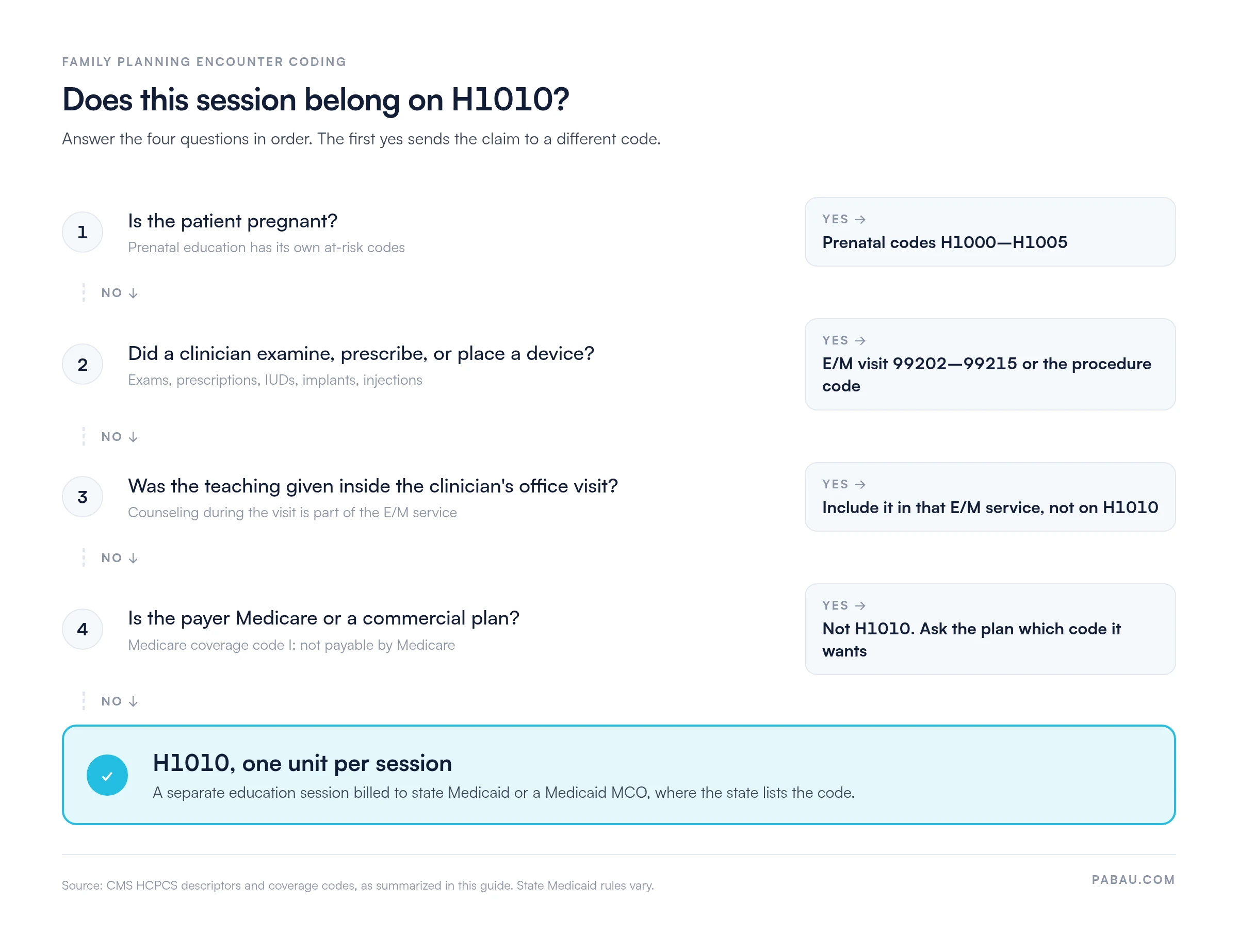
State Medicaid programs are the main payer for H1010, and acceptance still varies from state to state. Use this list before you choose the code.
A payer check at scheduling is the simplest way to avoid a non-covered service denial. Our guide to medical billing workflows covers where that check fits.
H1010 denials follow a small set of patterns, and most can be caught before submission. Good denial management in healthcare ties each denial reason to a process fix rather than a resubmission.
H1010 has no national fee. CMS lists it with pricing indicator 00, meaning Medicare Part B does not price it. Each state Medicaid agency sets its own rate, and Medicaid MCOs pay what their contracts with providers say.
To confirm the descriptor and status, use the CMS HCPCS quarterly update file, which is the official source. It downloads as an Excel/ZIP file from the linked page. AAPC’s H1010 entry shows where the code sits in the H1000-H1011 subgroup.
H1010 claims fail on small details: the wrong payer, a second unit on one date, or a note that reads like a clinical visit. Tracking those details by hand across Medicaid plans and MCOs is where claims slip through.
Pabau, the practice management platform we build, includes claims management software that checks insurance eligibility through Claim.MD before the visit. Your front desk sees which plan covers the patient before the H1010 session takes place. Pabau then scrubs each claim for missing or invalid details, such as a missing NPI, before submission.
Documentation matters as much as the claim. A session template in the patient record can prompt the educator for the topics covered, the session format, and the patient’s chosen method. The note then supports the claim when an auditor asks what was taught.

Pabau checks insurance eligibility through Claim.MD before the visit and scrubs each claim for missing or invalid details before submission. Your H1010 claims leave the practice with the payer and provider details they need.

H1010 pays for family planning education, not prenatal care, and that single fact decides most claims on this code. Bill it for a separate education session, to a payer that lists it, with a Z30 or Z31 diagnosis that matches the note.
The state manual still decides the details, so keep its current version open when you set up the session template and the claim. A practice that confirms the payer before booking and checks each claim before it leaves will see far fewer H1010 denials. Book a demo to see how Pabau checks eligibility and scrubs claims for the family planning sessions you bill to Medicaid.

Need to understand how denials get resolved? Denial management in healthcare covers the full workflow from denial identification through appeal and resubmission.
Billing a family assessment instead? HCPCS code H1011 covers who can bill a state-defined family assessment and what it pays.
Want to catch the wrong payer before the session? Insurance eligibility verification gives you a checklist for confirming coverage before the visit.
HCPCS code H1010 is the Level II code for non-medical family planning education, per session. It covers education about contraception and planning pregnancies, delivered as its own session. State Medicaid programs pay it, and Medicare does not.
No. H1010 is family planning education. The prenatal at-risk codes are H1000 through H1005, such as H1000 for an at-risk assessment and H1005 for the enhanced service package. They sit in the same subgroup, which causes the mix-up.
No. CMS assigns H1010 coverage code I, not payable by Medicare. Most commercial payers don’t recognize H codes either, so H1010 is billed almost only to state Medicaid programs and Medicaid MCOs.
Only if the state allows it and the education was a separate session. Counseling that happens inside the clinician’s E/M visit is part of that visit. Billing it again on H1010 risks a duplicate service denial.
Use the Z30 or Z31 code that matches the topics taught. Z30.09 covers general contraceptive counseling, Z30.02 natural family planning to avoid pregnancy, and Z31.69 counseling on planning a pregnancy. Some states accept Z71.89 when no Z30 or Z31 code fits.
The note should show the date, the session format, the topics covered, and the patient’s chosen method or plan. It should also name the educator and their credential. Add start and end times where the state sets a minimum length.
There is no national rate. Each state Medicaid agency sets its own fee, and MCO rates follow each provider contract. Check your state fee schedule for the rate, and use the CMS HCPCS quarterly update file to confirm the current descriptor.