HCPCS Code J1110: Dihydroergotamine mesylate injection billing guide
HCPCS Code J1110: Official descriptor and drug overview HCPCS Code J1110 is the ...

Last Updated: Oct 29, 2026
H0008 is the HCPCS Level II code for alcohol and/or drug services; sub-acute detoxification (hospital inpatient). It covers medically supervised withdrawal management for a patient admitted to a hospital inpatient unit who doesn't need acute or ICU-level care. Medicaid plans pay for most of it, and Medicare treats the code as not valid.
Denials on this code often trace back to an expired prior authorization, a progress note without daily CIWA-Ar scoring, or the wrong adjacent code.
Let Pabau's smart automation suggest the right codes, reduce claim denials, and keep your practice compliant—effortlessly.
Automate repetitive tasks and focus on what matters most—your patients.
Reduce coding errors and ensure compliance with the latest regulations.
Clean claims, fewer denials, and faster reimbursements.
Powerful insights and reporting to help your practice thrive.
HIPAA compliant SOC 2 certified GDPR-compliant Trusted by 4,000+ clinics worldwide

HCPCS Code H0008 covers sub-acute detox in a hospital inpatient unit. H0009, H0010 and H0007 cover acute hospital detox, residential detox and outpatient crisis care.
Daily CIWA-Ar or equivalent withdrawal severity scoring is the documentation standard that supports medical necessity.
Most Medicaid managed care plans require prior authorization before or within 24 to 48 hours of admission. A missed authorization is a frequent denial trigger.
Most Medicaid plans bill H0008 per diem, but the descriptor defines no unit, so confirm the billing unit with each payer.
Claims management software such as Pabau can help a practice check documentation and track authorizations before a claim goes out.
HCPCS Code H0008 is a Level II HCPCS code for alcohol and/or drug services, sub-acute detoxification, delivered in a hospital inpatient setting.
The code set is maintained by the Centers for Medicare and Medicaid Services (CMS). H0008 belongs to the temporary H-series, which CMS reserves for state Medicaid agencies that need separate codes for mental health, alcohol and drug treatment services.
Most Medicaid plans bill H0008 per diem (one unit per day), but the descriptor defines no unit, so confirm with the payer. Where a plan pays per diem, reimbursement for a detox episode depends on the number of inpatient days billed and authorized.
H0008 covers supervised medical withdrawal management for patients with alcohol or substance use disorders. The patient is admitted to a hospital inpatient unit at a sub-acute level of care. Sub-acute detoxification involves clinical monitoring, medication-assisted withdrawal protocols, and daily assessment of withdrawal severity. It does not require intensive care unit-level medical intervention.
Included services:
Not covered under H0008:
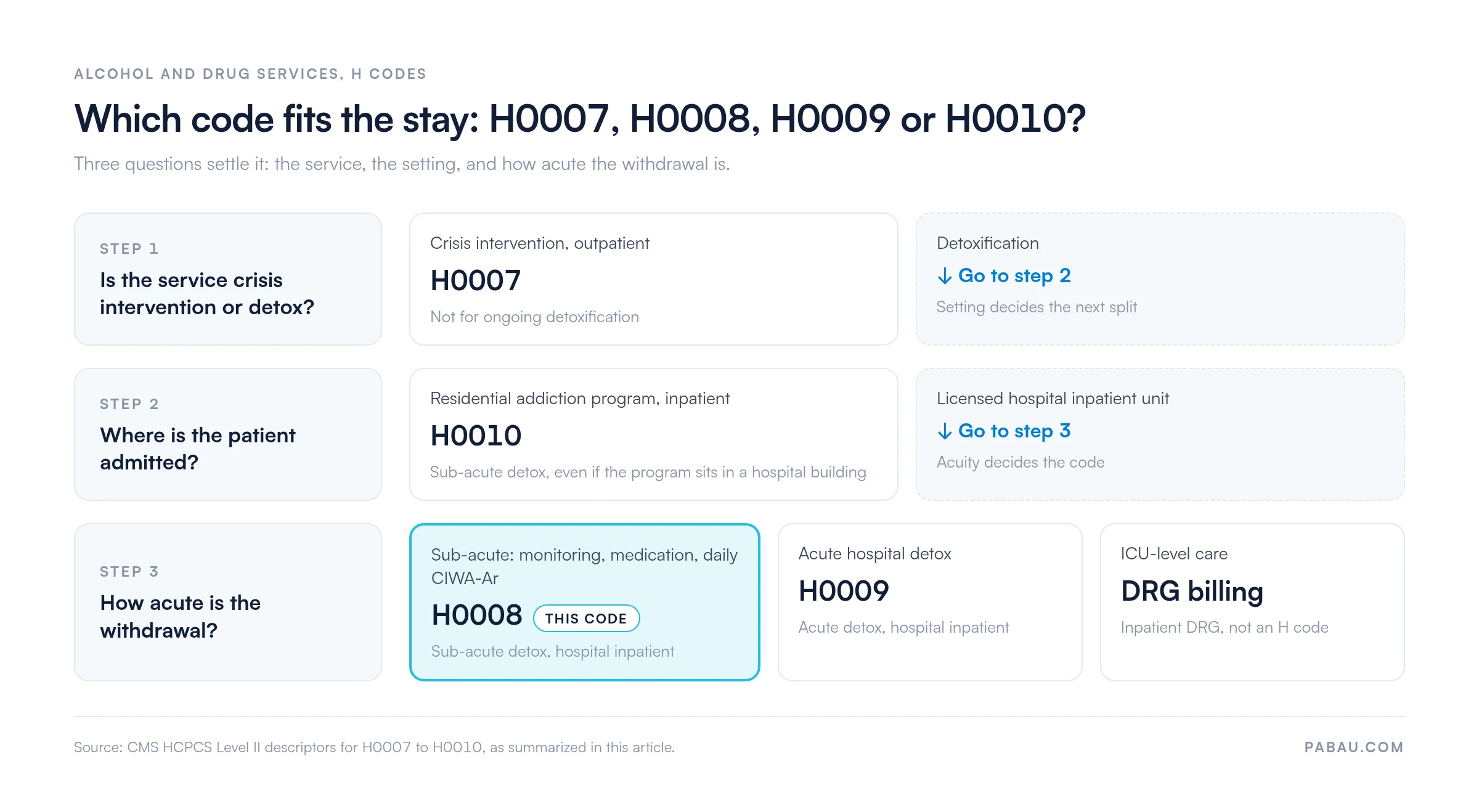
A frequent boundary error is billing H0008 for a patient who needed acute medical stabilization. When the record supports acute hospital detox, H0009 is the code. When it documents ICU admission or intensive medical management, DRG-based inpatient billing applies and H0008 does not.
Four adjacent H-series codes cover overlapping alcohol and drug service scenarios. Selecting the wrong one is a frequent denial cause on these claims.
The choice turns on the service, the setting, and how acute the withdrawal is:
The decision path below runs through those three questions in order. If a stay lands on H0009 or H0010, check that code’s own documentation rules before you rebill.
The supporting ICD-10-CM diagnosis must reflect a severity level that justifies hospital inpatient sub-acute detox. A diagnosis code that describes mild or uncomplicated use disorder is likely to be questioned by Medicaid managed care reviewers. Coders should select the most specific code available based on the substance, the severity specifier, and any physiological complications documented in the record.
Payer reviewers applying SAMHSA clinical guidelines and ASAM Level of Care criteria generally look for dependence with withdrawal, not mere use disorder. The diagnosis code selection must match the severity documented in the CIWA-Ar scores and physician notes.
Missing or incomplete documentation is a leading cause of H0008 denials. Medical billing compliance for behavioral health inpatient services requires a specific set of clinical records. A payer audit can still recoup a paid claim months later if any of them are missing.
Required documentation for every H0008 claim day:
Under 42 CFR Part 2, records for substance use disorder treatment carry additional confidentiality requirements beyond standard HIPAA. Before sharing records for a payer audit or records request, behavioral health billers should confirm their disclosure and authorization workflows meet Part 2 requirements.
Most Medicaid managed care plans and many commercial payers require prior authorization before or within 24 to 48 hours of hospital admission for H0008 services. Requirements vary by payer and state plan. Billers should verify each plan’s policy before assuming approval will follow automatically from an inpatient admission.
Checking insurance eligibility verification at the point of admission is the first step, but eligibility confirmation is not the same as prior authorization. A patient can have active Medicaid and still have a claim denied because the treating facility did not obtain separate PA for the detox admission.
Typical prior authorization steps for H0008:
Several behavioral health modifiers may be appended to H0008 depending on the payer and the service context. Always verify modifier requirements against the specific state Medicaid plan or commercial payer policy before appending.
Verify modifier requirements before the claim goes out, not after the denial. Call your state Medicaid managed care plan’s provider services line and ask for the current H0008 billing guide. Many state plans publish it as a downloadable PDF in their provider portal. It lists which modifiers are mandatory and which are optional for your facility type.
H0008 reimbursement rates are set at the state Medicaid level. There is no national Medicare fee schedule for this code, because Medicare assigns it status indicator I (not valid for Medicare purposes). CMS describes the Level II temporary H codes as codes for state Medicaid agencies, which is why each state sets its own rate.
Rates vary widely by state. They typically range from under $100 per day in low-rate states to several hundred dollars per day in states with higher Medicaid SUD reimbursement schedules. To find the exact 2026 rate, search your state Medicaid agency’s published fee schedule for “H0008”. Most state fee schedules are updated annually, often effective January 1.
Commercial plan rates, where H0008 is accepted, are typically negotiated independently and may differ significantly from the Medicaid fee schedule. Commercial coverage can also change. Ambetter from MHS Indiana has announced it will stop covering H0007 through H0010 from January 1, 2027. Always verify the applicable rate and coverage in your managed care contract before projecting reimbursement for a detox episode.
H0008 claims attract denials because they need concurrent review during the stay, precise documentation of medical necessity, and correct modifiers. Denial management workflows for inpatient detox facilities work best when each denial reason gets a systemic fix, not a one-off appeal. The reason codes on a remittance map to the rows below, and our guide to denial codes explains each one.
Correct H0008 billing follows a consistent workflow from admission through appeal. Understanding medical billing fundamentals for behavioral health inpatient services helps teams avoid the cascading errors that follow when one step is missed.
Billers verify code descriptors against references such as the AAPC HCPCS code reference. The NLM’s HCPCS Level II API gives programmatic access to the full H-code catalog for teams building billing integrations. Neither replaces state-specific payer verification.
H0008 claims carry more manual checkpoints than most HCPCS claims. Billers track daily documentation, concurrent authorizations, payer-specific modifiers, and code-specific denial patterns, often across spreadsheets and separate payer portals.
Pabau, the practice management platform we build, keeps patient records, clinical notes and billing in one system. Its claims management software can help a practice check documentation and track authorizations before a claim goes out.
That timing is where the saving sits. Adding a missing CIWA-Ar score before submission is a quick correction. After a denial, the same omission means an appeal, a resubmission, and a longer wait for payment.

Pabau’s claims management software helps your team check documentation and track authorizations before a claim goes out, so fewer detox claims come back denied.

H0008 is one of the more documentation-heavy codes in behavioral health billing, but its denials are predictable and preventable. Common causes are a prior authorization obtained too late, CIWA-Ar scoring skipped on a shift, or a modifier the billing system never prompted for.
Settle the setting and acuity first, because better notes can’t rescue a claim billed under the wrong code. Then make authorization tracking and daily scoring part of the admission routine instead of a scramble before submission.
Pabau’s claims management software can help a practice check documentation and track authorizations before a claim goes out. Book a demo to see how it fits your team’s billing workflow.

Need to reduce behavioral health claim denials? Denial management in healthcare walks through the systematic approach to tracking and resolving denied claims by root cause.
Billing H0008 alongside other behavioral health codes? Pabau’s claims management software helps your team check documentation and track authorizations before submission.
Want to understand the broader revenue cycle context? What is revenue cycle management explains the end-to-end workflow from eligibility check through payment posting.
Running sub-acute detox as an outpatient residential program? HCPCS code H0012 covers residential addiction program outpatient detoxification.
Handling a crisis visit rather than a detox stay? HCPCS code H0007 covers outpatient crisis intervention for alcohol and drug services.
HCPCS Code H0008 covers alcohol and/or drug services sub-acute detoxification delivered in a hospital inpatient setting. It includes medically supervised withdrawal management, daily clinical monitoring, medication-assisted withdrawal protocols, and physician oversight. Most Medicaid plans bill it per diem, but the descriptor defines no unit, so confirm with the payer.
Not exclusively. H0008 is mainly a Medicaid code. Medicare assigns status indicator I (not valid for Medicare purposes), and some commercial plans accept it. Commercial coverage and rates are negotiated separately and vary by plan and state.
H0008 applies to sub-acute detoxification in a hospital inpatient unit with direct physician oversight. H0010 applies to sub-acute detoxification in a residential addiction program, which may sit in a hospital building but runs as a residential service. The setting and level of clinical oversight determine which code applies.
Common modifiers include HF (substance abuse program), HH (integrated mental health and substance abuse program), and HK (specialty trained behavioral health staff). Many state Medicaid plans also define local modifiers using the U1-UD range. Always verify required modifiers against your state Medicaid plan’s billing guide before claim submission.
Common denial reasons are missing or expired prior authorization and insufficient medical necessity documentation, particularly absent CIWA-Ar scores. Others are the wrong code (H0007, H0009 or H0010 instead of H0008), a missing modifier, and a diagnosis that doesn’t support inpatient detox. Pre-submission workflow checks address each of these better than post-denial appeals.
Usually, yes. Most Medicaid plans bill H0008 per diem (one unit per day), but the descriptor defines no unit, so confirm with the payer. Each day billed must be supported by its own progress note, physician attestation, and CIWA-Ar or equivalent withdrawal severity documentation.