HCPCS Code J1110: Dihydroergotamine mesylate injection billing guide
HCPCS Code J1110: Official descriptor and drug overview HCPCS Code J1110 is the ...

Last Updated: Oct 29, 2026
G0249 is the HCPCS Level II code for the test materials and equipment a patient uses for home INR monitoring. It covers patients with a mechanical heart valve, chronic atrial fibrillation, or venous thromboembolism who meet Medicare coverage criteria. One unit includes 4 tests and the reporting of results to the physician.
Testing may not occur more than once a week. G0248 covers the face-to-face demonstration that comes first, and G0250 covers the physician's review. Mixing up the three codes is a frequent cause of denials.
Let Pabau's smart automation suggest the right codes, reduce claim denials, and keep your practice compliant—effortlessly.
Automate repetitive tasks and focus on what matters most—your patients.
Reduce coding errors and ensure compliance with the latest regulations.
Clean claims, fewer denials, and faster reimbursements.
Powerful insights and reporting to help your practice thrive.
HIPAA compliant SOC 2 certified GDPR-compliant Trusted by 4,000+ clinics worldwide

HCPCS Code G0249 covers home INR test materials and equipment plus reporting results to the physician, billed in units of 4 tests.
G0248 covers the face-to-face demonstration, and G0250 is billed separately by the managing physician for the same period.
Z79.01 is commonly reported alongside the indication code, so verify the MAC billing article before treating it as required.
Medicare covers home INR testing for mechanical heart valves, chronic atrial fibrillation, or venous thromboembolism after at least 3 months on warfarin.
Practice software such as Pabau validates each claim for missing or invalid details before it reaches the payer.
HCPCS Code G0249 is the Medicare HCPCS Level II code for the test materials and equipment a patient uses for home INR monitoring. The CMS long descriptor reads, clause by clause:
G0249 belongs to the G-code series, the temporary national codes for procedures and professional services. Medicare Part B pays for it when the patient meets the national coverage determination for home INR monitoring (NCD 190.11).
One unit of G0249 covers 4 tests, which is about one month of weekly testing. The code pays for the supplies and the reporting of results, not for a clinical act.
A G0249 unit typically includes:
These components are not billed separately. A separate test-strip code for the same tests duplicates what G0249 already pays for.
The following services sit outside G0249 and are billed under their own codes, if at all:
The three G-codes together cover a home INR monitoring program, but each has its own biller and timing. G0248 covers the demonstration, G0249 covers the materials, and G0250 covers the physician’s review. The table below sets them side by side.
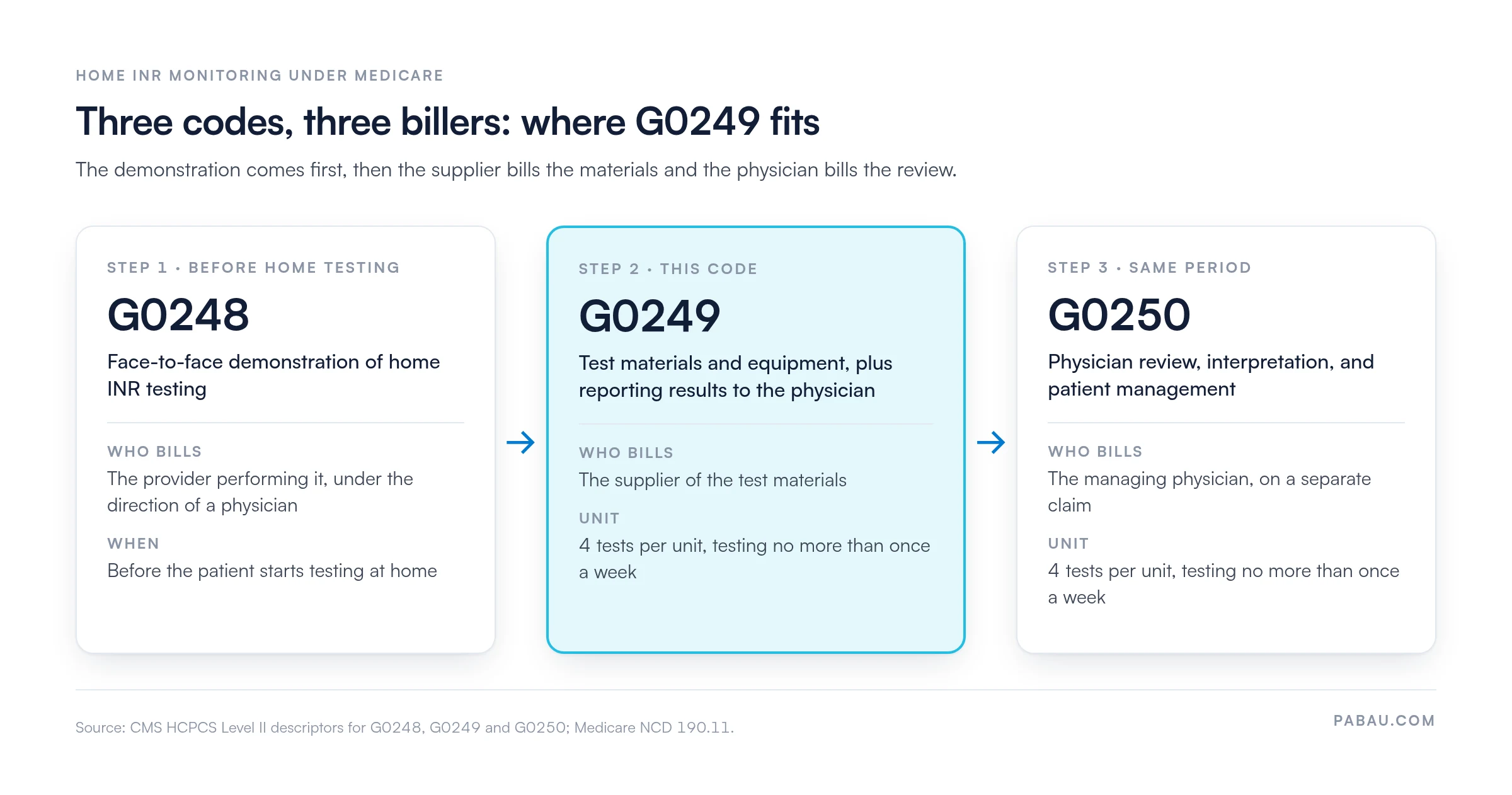
The demonstration comes before the first G0249 unit. After that, the supplier bills G0249 for the materials and the managing physician bills G0250 for the same period. The flow below shows who bills each step.
Medicare covers home INR monitoring under G0249 only when the patient meets every criterion in NCD 190.11. The main conditions are:
Porcine (xenogenic) heart valves are not a covered indication. Medicare Administrative Contractors (MACs) publish billing and coding articles that add claim-level detail, so check yours before billing.
A G0249 claim needs a primary diagnosis that matches a covered indication. Z79.01 (long-term anticoagulant use) is commonly reported alongside the indication code. Verify against MAC article A55756 before treating it as required.
ICD-10 codes update every year on October 1. Check code validity against the current FY2027 CMS ICD-10-CM tabular list.
The 2026 Medicare Physician Fee Schedule (MPFS) sets national relative value units (RVUs) for G0249. The Geographic Practice Cost Index (GPCI) then adjusts the payment by locality. Use the CMS Physician Fee Schedule lookup tool to pull the rate for your locality.
G0249 pays for supplies and result reporting, so its value sits in the practice expense component rather than physician work. Commercial plans negotiate their own rates and may set separate authorization rules. Run a locality-specific lookup before you quote expected reimbursement.
G0249 is billed in units of 4 tests. Claims management software can check claim details before submission, but billers still need to know the rules behind each check.
Before billing G0249 for a new patient, confirm the record documents the face-to-face demonstration. Without it, the coverage criteria are not met and the claim is at risk.
G0249 denials tend to trace back to the same billing errors. A denial management process catches them before they repeat. The CARC codes below are explained in our guide to medical billing denial codes.
Practices with repeated G0249 denials should audit their pre-submission checks. Clean claim submission checks for units, diagnosis codes, and documentation catch these patterns before the claim reaches the payer.
Under the CMS billing and coding article for home PT/INR monitoring (A55756), every G0249 claim needs documentation that supports medical necessity. Treat the list below as an audit-readiness checklist for an Additional Documentation Request (ADR).
Medical billing compliance programs work best when this checklist is part of patient enrollment. Practices that collect it at enrollment avoid rebuilding records after a denial.
CPT 85610 is the code for a prothrombin time test performed on a collected specimen. HCPCS Code G0249 is a supply code for home testing, not a test performance code. The table below sets out where each one applies.
In practice: A patient who comes to the office for an INR draw is billed with CPT 85610. Once enrolled in home monitoring with a physician order, the same patient generates G0249 claims for the home testing supplies.
Home INR billing splits one program across three codes and, often, two billers. Without a check before submission, a wrong unit count or missing indication code only surfaces when the denial arrives.
Pabau, the practice management platform we build, validates every claim for missing or invalid details before it leaves the system. US practices send claims to their payers through Claim.MD. If a claim comes back rejected, Pabau flags it as needing action and links straight to the field to correct.
The claims dashboard tracks each G0249 and G0250 claim from pending to paid. Your billing team sees which home monitoring claims are stuck without opening each one.

Pabau’s claim validation catches missing or invalid details before submission. Rejected claims show the field to fix, so anticoagulation billing gets paid faster.

G0249 pays the supplier for home INR materials and result reporting, in units of 4 tests. It does not pay for the demonstration or the physician’s review. Bill it only after the record shows the face-to-face education, 3 months of warfarin therapy, and a covered indication.
The trade-off is upfront work for fewer denials. Collecting the order, the education record, and the indication at enrollment means each later claim goes out complete. Book a demo to see how Pabau checks anticoagulation claims before they reach Medicare.

Need to understand medical billing fundamentals before diving into HCPCS specifics? What is medical billing covers the end-to-end claims lifecycle from charge capture through payment posting.
Dealing with a backlog of G0249 denials? Denial management in healthcare outlines a systematic workflow for identifying root causes and resolving claim rejections at scale.
Want to understand the revenue cycle context that G0249 billing sits within? What is revenue cycle management explains how supply provision codes like G0249 fit into the broader claims-to-payment workflow.
HCPCS Code G0249 covers the test materials and equipment for home INR monitoring, including the meter, test strips, lancets, and control solutions. It also covers reporting test results to the physician, and one unit includes 4 tests. The demonstration is billed under G0248 and the physician’s review under G0250.
G0248 is the face-to-face demonstration before home testing starts, done under the direction of a physician. G0249 is the supplier’s code for the test materials and result reporting. G0250 is billed separately by the managing physician for reviewing and acting on the results for the same period.
G0249 needs a primary diagnosis for a covered indication, such as I48.x (atrial fibrillation), Z95.2 (prosthetic heart valve), or I82.4x (acute deep vein thrombosis). Z79.01 (long-term anticoagulant use) is commonly reported alongside the indication code. Verify the MAC article before treating it as required.
One unit of G0249 covers 4 tests, which is about one month of weekly testing. Medicare covers self-testing no more than once a week, so units should match the tests the patient performed.
Common denial causes are a primary diagnosis that is not a covered indication and no documented face-to-face education. Others are units that exceed the weekly testing limit, a place of service the MAC does not accept, and a missing physician order.
Yes, Medicare Part B covers G0249 for patients with a mechanical heart valve, chronic atrial fibrillation, or venous thromboembolism. The patient must have been on warfarin for at least 3 months and completed a face-to-face education program. Testing may not occur more than once a week.
The 2026 rate for HCPCS Code G0249 comes from its national RVUs, adjusted by the Geographic Practice Cost Index (GPCI) for each locality. Use the CMS Physician Fee Schedule lookup tool with your locality to retrieve the current adjusted rate.