HCPCS code E0280: Bed cradle Medicare billing guide
HCPCS code E0280 describes the cradle frame, not the bed HCPCS code E0280 is the...

Last Updated: Oct 15, 2026
C1882 is the HCPCS Level II code for cardioverter-defibrillator, other than single or dual chamber (implantable). It reports multi-chamber implantable defibrillators, most often cardiac resynchronization therapy defibrillators (CRT-Ds) that pace three cardiac chambers.
The defining clause, "other than single or dual chamber," separates it from C1721, which covers dual-chamber ICDs. A documented left ventricular lead in the implant report is what makes a device a C1882 device. Hospitals report it on outpatient claims under OPPS, paired with the implantation CPT code.
Let Pabau's smart automation suggest the right codes, reduce claim denials, and keep your practice compliant—effortlessly.
Automate repetitive tasks and focus on what matters most—your patients.
Reduce coding errors and ensure compliance with the latest regulations.
Clean claims, fewer denials, and faster reimbursements.
Powerful insights and reporting to help your practice thrive.
HIPAA compliant SOC 2 certified GDPR-compliant Trusted by 4,000+ clinics worldwide

C1882 covers multi-chamber ICDs such as CRT-D devices, while single and dual-chamber units take their own device codes.
Pair C1882 with CPT 33249 for transvenous ICD system insertion, so the device and the implantation work appear as separate claim lines.
CMS covers these devices under NCD 20.4 only for listed indications, so a documented LVEF result is a billing requirement.
Billing C1721 instead of C1882, or the reverse, and missing device documentation are the two most frequent denial drivers on ICD claims.
HCPCS Code C1882 carries the official CMS descriptor: Cardioverter-defibrillator, other than single or dual chamber (implantable). In plain terms, it reports a multi-chamber implantable defibrillator, most often a cardiac resynchronization therapy defibrillator (CRT-D). The code belongs to the C-series of HCPCS Level II codes.
The Centers for Medicare and Medicaid Services (CMS) created that series for hospital outpatient device reporting under the Outpatient Prospective Payment System (OPPS). Because the descriptor defines C1882 by what it excludes, the lead count in the implant report decides whether it applies.
C-series codes exist only within OPPS. They report the device component of a procedure, while a paired CPT code reports the implantation work. The CMS HCPCS code set gets its annual update each January. Check the descriptor against the current-year release before you bill any C-series code.
C1882 applies when the implanted device uses three or more leads to pace or shock the heart. Cardiac resynchronization therapy defibrillators (CRT-Ds) are the most common device billed under this code.
A CRT-D delivers synchronized pacing to the right ventricle, left ventricle, and right atrium while retaining ICD shock capability.
The clinical note must specify the device model and lead configuration. A CRT-D implanted in a patient with dilated cardiomyopathy and left bundle branch block is a textbook C1882 scenario. A standard dual-chamber ICD implanted for the same underlying cardiac arrest history is not.
C1882 is an OPPS C-series code, which means it was designed for hospital outpatient billing. On an outpatient claim, it appears on the UB-04 form alongside the paired CPT procedure code. The device cost then flows through the OPPS ambulatory payment classification (APC) system.
For inpatient Medicare admissions, the ICD device cost folds into the MS-DRG payment rather than being itemized. Facilities may still use C-codes on inpatient claims for internal tracking or cost reporting.
They don’t generate separate Medicare reimbursement there. Matching the code to the claim type is a core step in medical billing, and it is settled before charge entry.
C1882 reports the device. A separate CPT code reports the implantation work. These are always submitted together on the outpatient claim.
CPT 33249 is the most common pairing. It covers transvenous insertion of a complete ICD system and maps to C1882 when the device is a multi-chamber unit. CMS once placed a temporary claims hold on the 33249/C1882 pair while it reviewed coverage criteria, and that hold has since been resolved.
Payers occasionally re-flag this pair during LCD updates. Watch remittance advice for any hold-related CO or PR adjustment reasons. The AAPC HCPCS code lookup carries current descriptor text and cross-reference notes for each C-series code.
C1721 covers dual-chamber implantable cardioverter-defibrillators. C1882 covers the multi-chamber devices that fall outside both the single and dual-chamber codes. That sounds simple. Coders still mix the two up, because operative reports often bury the chamber count deep in the procedure narrative.
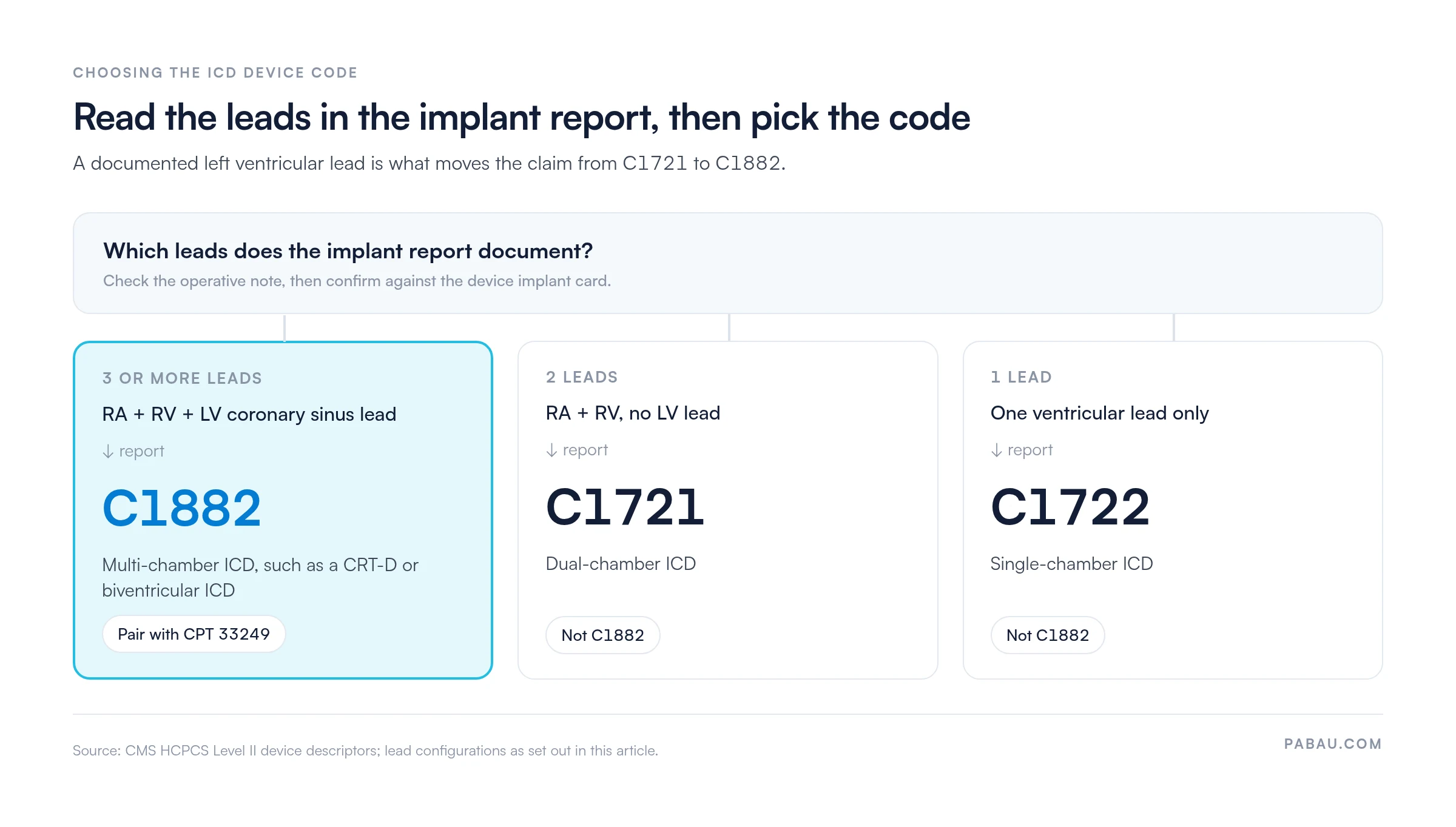
The operative key: look for the left ventricular (LV) coronary sinus lead in the implant report. If an LV lead is documented, the device is a CRT-D and C1882 applies. Without one, the device is dual-chamber or single-chamber, so C1721 or C1722 applies instead. The diagram below maps each lead configuration to its device code.
Manufacturer documentation is a second check. The device implant card or lot number identifies the exact model. Cross-reference that model against the manufacturer’s published specifications to confirm whether it is a two-lead or three-lead system. Make this a mandatory step in your facility’s ICD billing workflow.
Build a quick-reference cheat sheet for your cath lab billers. List the five CRT-D models your facility implants most, with their lead counts and HCPCS codes. When a new operative report arrives, the coder checks the model name against the sheet before opening the code lookup tool. This one step eliminates the most common C1882 vs C1721 swap error.
CMS covers implantable cardioverter-defibrillators under National Coverage Determination (NCD) 20.4 (Article ID 56340 in the Medicare Coverage Database).
Coverage is not automatic for every patient with a cardiac diagnosis. The NCD defines specific covered indications, and claims without a matching documented indication will be denied on medical necessity grounds.
Covered indications under NCD 20.4 (summary):
CRT-D devices, the most common C1882 device, have additional coverage criteria tied to QRS duration and heart failure functional class. Check the local coverage determination (LCD) for your Medicare Administrative Contractor (MAC) region, since it may narrow CRT-D indications beyond the NCD.
Before billing, confirm current payment and coverage status in the CMS Physician Fee Schedule lookup and the Medicare Coverage Database.
A technically correct HCPCS Code C1882 claim still fails if the medical record does not support medical necessity. The documentation package for a C1882 claim must include all of the following elements.
A missing element from this list is the main source of post-payment audit exposure. CMS Recovery Audit Contractor (RAC) auditors have targeted ICD device claims, and medical necessity documentation is the most commonly cited deficiency.
Strong medical billing compliance programs use a pre-submission checklist that maps each element to its NCD requirement.
C1882 claims generate denials for a predictable set of reasons. Track remark codes by denial category, and you can resolve most of these at charge entry or pre-authorization instead of on the back end.
Denials on high-value device claims like C1882 deserve their own tracking bucket in the revenue cycle. A facility implanting 20 CRT-Ds a month, each costing well over $25,000, loses serious money when one documentation step fails repeatedly.
Good denial management routes every C1882 denial to a senior coder for root-cause analysis instead of routine rework.
The remark codes that accompany device-related denials are listed in our denial codes reference.
The AHA Coding Clinic has addressed C1882 reporting in the context of updates to CPT 33249. Its guidance clarified that C1882 goes on the same outpatient claim as the implantation CPT code. It also confirmed the device HCPCS code is required when the facility incurs the device cost directly.
The CMS claims hold on the 33249/C1882 pair arose because CMS was updating its coverage criteria. It chose to review claims before adjudication rather than audit them retroactively. That hold has since lifted.
If your facility resubmitted held claims afterward, confirm they adjudicated correctly. Look for erroneous denials that aged past timely-filing limits without an appeal.
AHA Coding Clinic guidance is subscription-based, so it isn’t reproduced here. Coders at facilities that implant ICDs should reach the relevant issues through their coding reference library. Some HCPCS lookup tools also cross-reference AHA guidance notes.
On many cardiac billing teams, the implant report lives in one system and the device card in a scanned folder. The claim is built in a third tool. The coder then picks C1882 or C1721 from whichever document arrives first.
Pabau, the practice management platform we build, keeps the clinical note, the device documentation and the invoice on one patient record. With its claims management software, your coder checks the documented leads and the LVEF result from that record before the device line goes out.
The payoff is fewer claims sent with the wrong device code. Your team spends less time appealing denials on high-value implants and more time on clean first submissions.

Pabau keeps implant notes, device documentation and claims on one patient record, so your coders can confirm C1882 before the claim goes out.

Coding HCPCS Code C1882 correctly comes down to one habit. Confirm the lead configuration in the implant report before you choose between C1882, C1721 and C1722.
Build that check into charge entry and pair the device with the right CPT code. Then attach a dated LVEF result that matches an NCD 20.4 indication. Most C1882 denials then become preventable rather than appealable. The trade-off is a slower charge-entry step on every ICD case, and it costs far less than reworking a denied implant claim.
Book a demo to see how Pabau keeps implant documentation and device claims on one record for your cardiac billing team.

Replacing the generator on an existing CRT-D? CPT code 33264 covers CRT-D pulse generator replacement, the procedure C1882 most often rides on at a battery change.
Billing the left ventricular lead on a new CRT-D system? HCPCS code C1900 reports the left ventricular lead that makes a defibrillator multi-chamber.
Coding the work of placing that third lead? CPT code 33225 explains the add-on code for left ventricular lead insertion at the time of the device implant.
Reporting the shocking lead alongside the generator? HCPCS code C1895 covers dual coil endocardial defibrillator leads and when they bill with the device code.
HCPCS Code C1882 covers implantable cardioverter-defibrillators that are neither single nor dual chamber. Most are cardiac resynchronization therapy defibrillators (CRT-Ds) with three pacing leads. It is an OPPS device code that reports the device separately from the implantation procedure in hospital outpatient settings.
C1721 covers dual-chamber ICDs with two leads, in the right atrium and right ventricle. C1882 covers multi-chamber ICDs with three or more leads, such as CRT-Ds that also pace the left ventricle through a coronary sinus lead. The lead placement in the operative report decides which code applies.
Submit CPT 33249 for the transvenous ICD system insertion and C1882 for the multi-chamber device on the same outpatient UB-04 claim. C1882 reports the device cost, and 33249 reports the implantation work. Both need supporting documentation of the device model and medical necessity.
Yes, Medicare covers the multi-chamber ICDs reported under C1882 when the patient meets a covered NCD 20.4 indication. Examples include LVEF 35% or below with NYHA class II or III heart failure, or prior cardiac arrest from VF or VT. Coverage still requires documented medical necessity that matches the NCD criteria.
The most common reason is billing C1721 for a device that was a CRT-D. Missing LVEF documentation and no implant card on file come next. Diagnosis codes that match no NCD 20.4 indication also trigger denials. So does billing C1882 outside the hospital outpatient setting, where the C-code has no reimbursement route.
C1882 is an OPPS C-series code designed for hospital outpatient billing. In inpatient settings, the device cost is bundled into the MS-DRG payment and C1882 does not generate separate Medicare reimbursement. The code should only appear as a separately billable line item on outpatient UB-04 claims.
CMS NCD 20.4 covers ICDs for cardiac arrest survivors whose VF or VT had no reversible cause. It covers patients with a prior MI and LVEF of 30% or below. It also covers non-ischemic dilated cardiomyopathy with LVEF 35% or below and NYHA class II or III symptoms. Selected patients with sustained VT or inherited arrhythmia syndromes qualify too. CRT-D coverage also needs documented QRS duration and heart failure class.