HCPCS code E0280: Bed cradle Medicare billing guide
HCPCS code E0280 describes the cradle frame, not the bed HCPCS code E0280 is the...

Last Updated: Oct 15, 2026
33225 is the CPT add-on code for insertion of a pacing electrode into the cardiac venous system for left ventricular pacing. It is reported at the time of insertion of a pacing cardioverter-defibrillator or pacemaker pulse generator.
The code covers the left ventricular lead placed through the coronary sinus during a cardiac resynchronization therapy implant. It never stands alone, so a qualifying primary code must appear on the same claim. CPT 33225 carries 11.81 total RVUs in CY2026.
Let Pabau's smart automation suggest the right codes, reduce claim denials, and keep your practice compliant—effortlessly.
Automate repetitive tasks and focus on what matters most—your patients.
Reduce coding errors and ensure compliance with the latest regulations.
Clean claims, fewer denials, and faster reimbursements.
Powerful insights and reporting to help your practice thrive.
HIPAA compliant SOC 2 certified GDPR-compliant Trusted by 4,000+ clinics worldwide

CPT code 33225 is an add-on code (+33225) and cannot be billed as a standalone procedure. It must accompany an eligible primary pacemaker or ICD code.
Modifier 51 is never appended to 33225. Add-on codes are modifier-51 exempt by AMA rule, so appending it causes an automatic denial.
Medical necessity requires LVEF at or below 35% plus NYHA Class II or III symptoms, documented in the operative report and pre-procedure echo.
CPT 33225 carries 11.81 total RVUs in CY2026 and pays roughly $394.46, with no facility and non-facility split.
Pabau’s claims management software checks eligibility in real time, submits the claim, tracks its status, and reconciles the ERA remittance.
The American Medical Association defines CPT code 33225 as the insertion of a pacing electrode, cardiac venous system, for left ventricular pacing. That placement happens at time of insertion of pacing cardioverter-defibrillator or pacemaker pulse generator. The descriptor also covers an upgrade to a dual chamber system and a pocket revision. It closes by instructing coders to list 33225 separately, in addition to the primary procedure code. The leading plus sign (+33225) in the AMA CPT manual marks the add-on status, so the code has no independent billing existence.
The code sits within the 332xx cardiac implant series, which covers pacemaker and ICD insertion, replacement, revision, and removal procedures. Its role is to capture the extra work of placing a left ventricular (LV) lead through the coronary venous system. The primary procedure handles the device housing and the right-sided leads. 33225 captures the separate technical work of cannulating the coronary sinus and deploying the LV lead.
Because 33225 is an add-on code, it appears at the bottom of a claim line, always subordinate to its primary. Coders new to cardiology billing sometimes submit 33225 first or alone, which triggers an automatic rejection.
CPT 33225 covers transvenous left ventricular pacing lead placement via the coronary venous system during a cardiac resynchronization therapy implant. The LV lead is the defining element of CRT. It paces the left ventricle in synchrony with the right ventricle. That corrects the interventricular dyssynchrony driving heart failure progression in patients with bundle branch block.
The procedure follows this general sequence in the electrophysiology lab:
The code includes the fluoroscopic guidance used to cannulate the coronary sinus and position the LV lead. It does not include lead extraction, which has its own codes. It also excludes the primary generator implant and the right-sided lead work, both reported by the primary procedure code.
CMS requires the claim to carry an ICD-10-CM diagnosis that substantiates why CRT was medically necessary. The threshold criteria are an LVEF at or below 35% and NYHA Class II or III heart failure symptoms. Those criteria come from LCD L39080, Cardiac Resynchronization Therapy, and its billing and coding article A58821. The following diagnosis codes most commonly appear on 33225 claims:
Always pair the heart failure code with a cardiomyopathy or conduction disorder code where both apply. A claim listing only a broad heart failure code, with no etiology or conduction diagnosis, is a common audit trigger. The ICD-10-CM code library carries the official wording for each of these diagnoses. Document the LVEF measurement (echocardiogram or cardiac catheterization report) and the NYHA class in the pre-procedure notes, not just in the operative report.
Run an insurance eligibility check before scheduling the CRT implant. Many payers require prior authorization for CRT devices and will not cover 33225 without a precertification on file. Confirm LVEF documentation, NYHA class, and the duration of guideline-directed medical therapy in the authorization request. Payers flag those three items most often during medical necessity review.
Medicare reimburses 33225 under the CY2026 Physician Fee Schedule, which CMS updates every year. The code carries a ZZZ global indicator, so it holds one set of RVUs rather than separate facility and non-facility values. The figures below are national averages, and actual payment varies with the geographic practice cost index (GPCI). Check them against the 2026 RVU lookup tool or the CMS RVU file before billing.
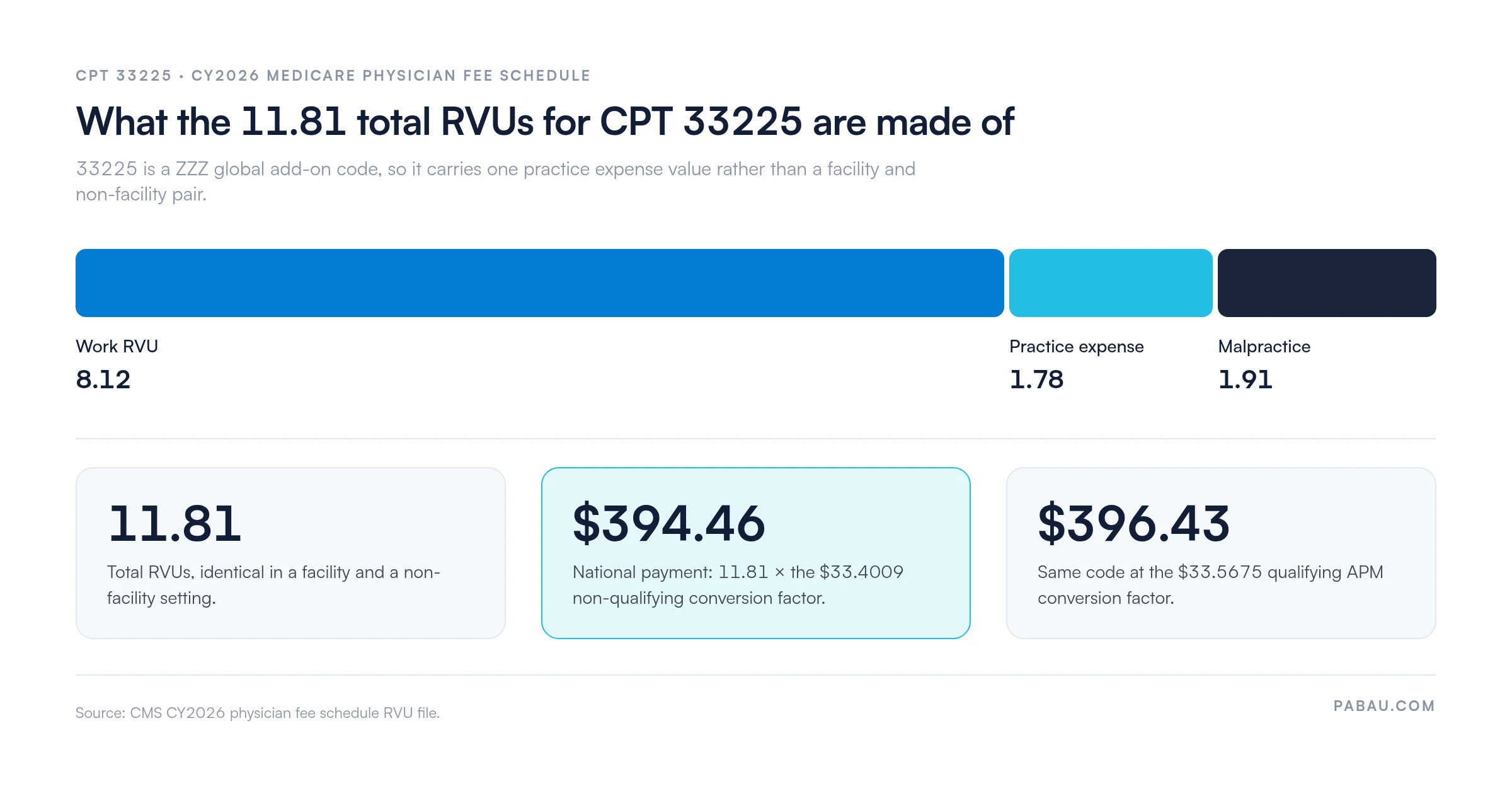
CY2026 publishes two conversion factors. At the $33.4009 non-qualifying factor the code pays about $394.46, and at the $33.5675 qualifying APM factor it pays about $396.43. Both reconcile against the same 11.81 RVUs.
Important: CMS publishes final RVU values in the MPFS final rule each November, so verify current rates before billing. Private payer rates differ from Medicare by contract. Never apply the Medicare rate as a proxy for commercial reimbursement without confirming your contracted fee schedule. Check the remittance advice on each paid 33225 claim to confirm the allowed amount applied.
Because 33225 is an add-on code, AMA CPT rules require a primary code on the same claim. The following primary codes are the approved pairings; billing 33225 without one of these present produces an automatic payer rejection.
CPT 33249 covers ICD insertion with defibrillation lead placement and stands alone. CPT code 33225 is the add-on for the extra LV lead placed during that same procedure. In a CRT-D implant both codes appear on the claim. 33249 reports the ICD generator plus the right-sided leads, and +33225 reports the LV lead placed through the coronary sinus. Billing 33249 alone when an LV lead was placed undercounts the work performed. Billing 33225 alone without 33249 produces a denial.
CPT 33208 covers dual-chamber pacemaker insertion and is the primary code for CRT-P (cardiac resynchronization therapy without defibrillator). When the electrophysiologist implants a biventricular pacemaker, the claim carries 33208 as the primary and +33225 as the add-on for the LV lead. Keep the two primaries apart. 33249 is the ICD primary and 33208 is the pacemaker primary. Whether the device is a CRT-D or a CRT-P decides which one is correct, so the operative report should say so explicitly.
Generator replacement sits outside both of those. CPT 33228 covers the swap of a dual-lead pacemaker pulse generator. An LV lead added at that same session upgrades the patient to CRT. Whether 33225 is separately payable alongside it varies by payer, so check the current CMS NCCI tables.
The ICD equivalent carries its own code. When the retained dual leads belong to a defibrillator rather than a pacemaker, the generator swap is reported with CPT 33263 instead. Once a new LV lead is connected at that same session, the system is three-lead and the replacement becomes CPT 33264.
Modifier rules for add-on codes differ from standard procedure codes. Getting these wrong is one of the fastest paths to a denial on an otherwise clean 33225 claim.
NCCI edits for 33225 update quarterly. Specific edit pairs should be verified against the current CMS NCCI Policy Manual before billing a modifier 59 override. Submitting modifier 59 without documented clinical justification for the separate encounter invites post-payment audit.
Medicare coverage for CRT devices billed under CPT code 33225 is governed by LCD L39080, Cardiac Resynchronization Therapy, and its billing and coding article A58821. Verifying the patient’s insurance before the procedure date shows whether the plan is Medicare Advantage or a commercial plan applying stricter criteria than original Medicare.
The core coverage requirements under CMS are:
Major commercial payers such as Aetna, UnitedHealthcare, Cigna and the BCBS plans generally follow CMS criteria, but may require prior authorization. Never assume a payer follows the CMS LCD without confirming the plan-specific policy in writing. Build a pre-authorization checklist covering LVEF documentation, rhythm strip, QRS duration, NYHA class and GDMT duration. Run it for every CRT implant scheduled in your EP lab, and carry the authorization reference number onto the claim itself.
The operative report is the single most important document for supporting a CPT code 33225 claim. Payers audit this code partly because the LV lead placement is an add-on to a high-value primary procedure. That makes it a target for reviews asking whether the lead was placed at all. The documentation package for a 33225 claim should include every one of the following elements:
Missing even one of these elements is a common audit finding. Build a pre-billing checklist and run it against every 33225 claim before submission. A reviewer who works through that list before the claim goes out catches the missing echo report while it can still be attached.
Denials on 33225 cluster around six predictable failure patterns. Each has a specific fix. Sound denial management strategies for cardiac procedure codes cut the revenue cycle lag that complex CRT cases create.
When appeals are necessary, the operative report and echo documentation carry the most weight. Cite LCD L39080 and its billing and coding article A58821 in the appeal letter. Map the payer’s CARC and RARC codes to their root causes first. The appeal then answers the reason for the denial rather than the label on it.
Audit your last 90 days of 33225 claims. Pull every denial, group them by CARC code, and map them to the six categories above. Standalone billing and modifier 51 errors usually dominate that list. Both come down to how the billing system is set up, so a single configuration session clears them.
Most cardiology practices find out that a 33225 claim failed when the remittance arrives weeks later. By then the operative report is buried, the coder has moved on, and the appeal window is shorter than it was. Practice management software like Pabau keeps the whole claim in one place instead, through faster claims management.
Pabau connects to Claim.MD, a US clearinghouse that reaches more than 4,000 payers, including Medicare, Medicare Advantage and the major commercial plans. Before the procedure the workflow pulls real-time eligibility, so the coverage question is settled at scheduling. After submission it tracks each claim’s status and routes the ERA remittance back into the same record.
Coding judgment on 33225 stays with your coder. What the software removes is the chasing. The biller sees which CRT claims are open, which were paid, and what the payer allowed against the $394.46 you expected.

Pabau’s claims management software checks patient eligibility in real time and submits claims straight to payers. It then tracks each claim’s status and reconciles the ERA remittance against the payment you expected on CPT 33225.

CPT 33225 rewards preparation more than it rewards coding skill. The pairing rule, the modifier-51 exemption, and the LVEF and NYHA evidence are all knowable before the patient reaches the EP lab. A practice that settles those three points at scheduling rarely has a 33225 denial to appeal at all.
The trade-off is where the work sits. Front-loading the authorization and the documentation check costs scheduling time on every CRT case, including the ones that would have sailed through. Against an add-on code worth roughly $394.46 on a procedure your EP lab books weekly, that time pays for itself quickly.
Pabau checks eligibility before the procedure, submits the claim, tracks its status, and reconciles the ERA remittance in the same record. Book a demo to see how your EP lab’s CRT claims would move through it.

Need a structured approach to medical billing compliance? Medical billing compliance requirements covers the documentation and workflow controls practices need to pass payer audits on complex procedure codes.
Confused about how denial codes map to root causes? Denial codes in medical billing explains CARC and RARC code structures and how to use them to route appeals to the right resolution path.
Want to understand how clearinghouses validate claims before submission? Medical claims clearinghouse explains how electronic claim validation works across payer networks and what happens when an edit fires.
CPT code 33225 describes the insertion of a pacing electrode into the cardiac venous system for left ventricular pacing. The placement happens at the same time as insertion of a pacing cardioverter-defibrillator or pacemaker pulse generator. It is an add-on code (+33225) and cannot be billed without a qualifying primary procedure code on the same claim.
CPT 33225 is an add-on code, designated +33225 in the AMA CPT manual. It must always appear on a claim alongside an approved primary pacemaker or ICD code such as 33249 or 33208. Submitting it without a qualifying primary code causes an automatic payer denial.
Five reasons dominate. They are billing 33225 without an eligible primary code, appending modifier 51, unresolved NCCI bundling conflicts, missing LVEF documentation, and no prior authorization. Standalone billing and modifier 51 errors together account for the majority of 33225 denials and are both preventable through billing system configuration.
Prior authorization requirements for CPT 33225 vary by payer. Medicare does not require prior authorization for most CRT procedures, but Medicare Advantage and commercial plans frequently do. Always verify authorization requirements with the patient’s specific plan before scheduling the procedure, and document the authorization number on the claim at submission.