

CCSD code G5100: Bypass of duodenum billing guide
CCSD code G5100 bills a bypass that leaves the duodenum in place CCSD code G5100...

Last Updated: Oct 16, 2026
Billable Code
C1786 is the HCPCS Level II code for pacemaker, single chamber, rate-responsive (implantable). It reports the generator as a device on hospital outpatient (OPPS) facility claims, including single-chamber leadless systems such as Micra and AVEIR VR.
C1786 is often confused with C1785, the dual-chamber code, and that mix-up is a frequent cause of device-code edits. Assignment turns on documentation confirming that a single-chamber, rate-adaptive generator was implanted.
Let Pabau's smart automation suggest the right codes, reduce claim denials, and keep your practice compliant—effortlessly.
Automate repetitive tasks and focus on what matters most—your patients.
Reduce coding errors and ensure compliance with the latest regulations.
Clean claims, fewer denials, and faster reimbursements.
Powerful insights and reporting to help your practice thrive.
HIPAA compliant SOC 2 certified GDPR-compliant Trusted by 4,000+ clinics worldwide

C1786 covers single-chamber, rate-responsive implantable pacemaker generators, including single-chamber leadless systems, but not leads or dual-chamber devices (C1785).
C1786 is reported on hospital outpatient (OPPS) facility claims, not on physician office claims.
The operative report must document the device make, model, serial number, and rate-response programming to support C1786.
Pabau, the practice management platform we build, checks claims for missing details before submission and posts electronic remittance advice (ERA) against each claim.
HCPCS code C1786 reports an implantable single-chamber, rate-responsive pacemaker generator on a hospital outpatient facility claim. That includes single-chamber leadless systems such as Micra and AVEIR VR.
It belongs to the C-series of Level II HCPCS codes maintained by the Centers for Medicare and Medicaid Services (CMS). C-series codes report the device separately from the procedure. That way, the device cost is tracked apart from the surgical work in the companion CPT code.
C1786 covers the implantable pulse generator itself, specifically a single-chamber, rate-adaptive (rate-responsive) pacemaker generator. That includes leadless single-chamber systems, where the generator and electrode sit in one capsule. Rate-responsive means the device adjusts its pacing rate in response to physiological signals, typically detected via an accelerometer or minute ventilation sensor.
Several device types fall outside C1786’s scope. Coders should verify exclusions carefully before assigning the code.
Mixing up C1785 and C1786 is a frequent cause of pacemaker device-code edits. The distinction is the number of chambers the implanted generator paces and senses.
Verify the generator model number in the implant log. Manufacturer device labels identify chamber configuration clearly. If the operative note says “dual-chamber system” but the biller assigns C1786, payer edits will often flag the mismatch with the companion CPT code. Leadless systems add a second fork, which the chart below maps.
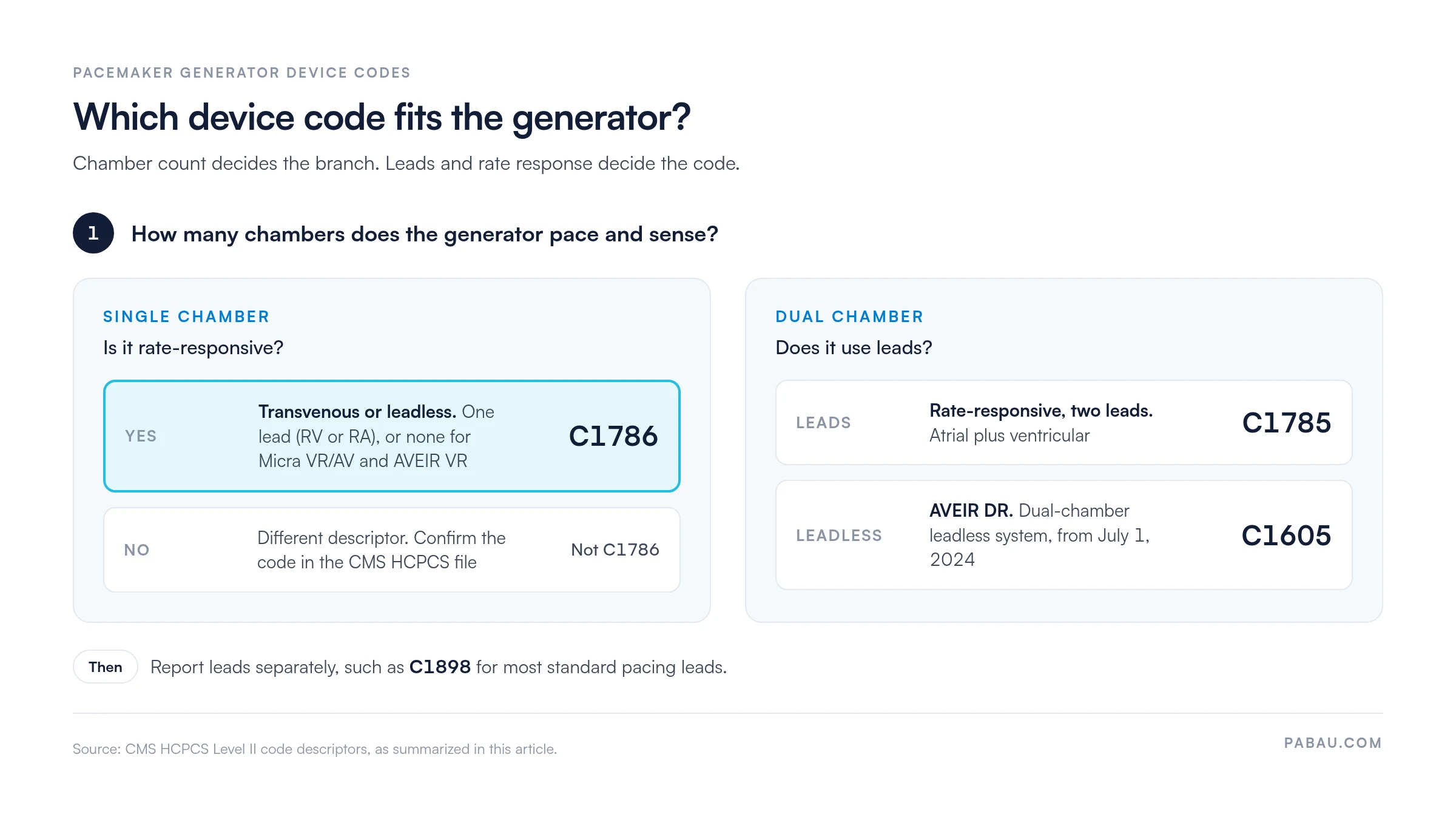
Single-chamber leadless pacemakers (Medtronic Micra TPS, Micra AV, Abbott AVEIR VR) report C1786. Only the dual-chamber AVEIR DR system reports C1605. Consult the manufacturer’s facility reimbursement guide to confirm the code for each leadless platform.
In the hospital outpatient setting, C1786 reports the device separately from the implantation procedure. The companion CPT code captures the surgical work and drives the APC assignment; C1786 captures the device cost on the same claim.
Cross-check the companion CPT code against C1786 before submitting. A claim pairing CPT 33213 (dual-chamber procedure) with C1786 (single-chamber device) will typically trigger an edit. The CPT descriptor implies two leads, while C1786 implies a generator without dual-chamber capability.
Medicare and commercial payers require a diagnosis code supporting medical necessity for a single-chamber rate-responsive pacemaker. The treating physician’s documentation must justify why a single-chamber (rather than dual-chamber) device was appropriate.
Confirm the ICD-10-CM code reflects the documented indication for the single-chamber device specifically. If the physician notes document sinus node dysfunction without AV conduction disease, I49.5 (sick sinus syndrome) is typically the primary code. Mismatching a diagnosis that typically warrants dual-chamber therapy with C1786 raises a medical necessity question.
Medicare covers single-chamber rate-responsive pacemaker implantation under National Coverage Determination (NCD) 20.8.3, Single Chamber and Dual Chamber Permanent Cardiac Pacemakers. The NCD lists covered indications, including symptomatic bradycardia from sinus node dysfunction and AV block. Medicare Administrative Contractors (MACs) may add jurisdiction-specific criteria. Check your MAC’s coverage articles for your region.
CMS billing article A54929 provides facility-level billing guidance for single and dual chamber pacemaker claims. Under Medicare OPPS, C1786 is processed as follows.
To verify current pass-through status and the exact payment rate, consult CMS OPPS Addendum B for the current calendar year. Rates change annually, and a device with pass-through status in one year may be packaged in the next.
Medicare does not require prior authorization for pacemaker implantation under the standard fee-for-service program. However, Medicare Advantage plans and commercial payers frequently do require pre-certification. Requirements vary significantly by plan year and individual payer contract.
Proceeding without required PA typically results in a claim denial that is difficult to appeal on clinical grounds alone. Obtain authorization before the procedure date wherever PA is required.
C1786 claims face a predictable set of denial patterns. Most are preventable with a pre-submission documentation review. Understanding the denial management strategies relevant to device codes reduces rework and protects revenue.
When appealing a C1786 denial, start with the denial codes on the remittance advice. The claim adjustment reason code (CARC) and remittance advice remark code (RARC) show what the payer’s edit rejected. That tells you which document the appeal has to supply.
Sound medical billing workflows for pacemaker device codes start in the procedure room, not the billing office. The operative report and device documentation packet must be complete before the claim can be submitted correctly.
Building a clean claim for device codes means charge capture and clinical documentation must be synchronized. A mismatch between the implant log and the claim is a frequent cause of device-code edits. Review the charge before it leaves the facility.
Run a pre-claim edit check that cross-references the HCPCS device code against the companion CPT code every time a pacemaker case closes. If your charge capture system allows, flag any case where C1786 is charged alongside a dual-chamber CPT code (33208, 33213) for manual review before submission.
C1786 Medicare reimbursement under OPPS follows one of two payment pathways depending on whether the code carries active pass-through status in the current calendar year. Verify the current status in CMS OPPS Addendum B before relying on any historical figures.
The AAPC’s HCPCS code lookup and the PGM Billing HCPCS tool both surface current payment and status information for C1786. Cross-reference these against the official CMS OPPS final rule for the current year before making charge-setting decisions. Commercial payer rates for C1786 are negotiated separately through individual hospital contracts and vary widely.
Device-claim rework often starts with a detail missed before submission. Typical culprits are a missing authorization number, an unattached invoice, or a CPT and HCPCS pair that doesn’t match.
Pabau includes error-checked claims management. Validation runs in the background and confirms membership numbers and authorization codes are present, so an incomplete claim isn’t sent. In the US, claims go electronically to thousands of payers through Claim.MD, with eligibility checks before the visit.
Each claim then moves through clear stages, from pending and submitted to paid or error. Remittances post back against the claim through the electronic remittance advice workflow. Your team can compare what was billed with what was paid without a separate spreadsheet.
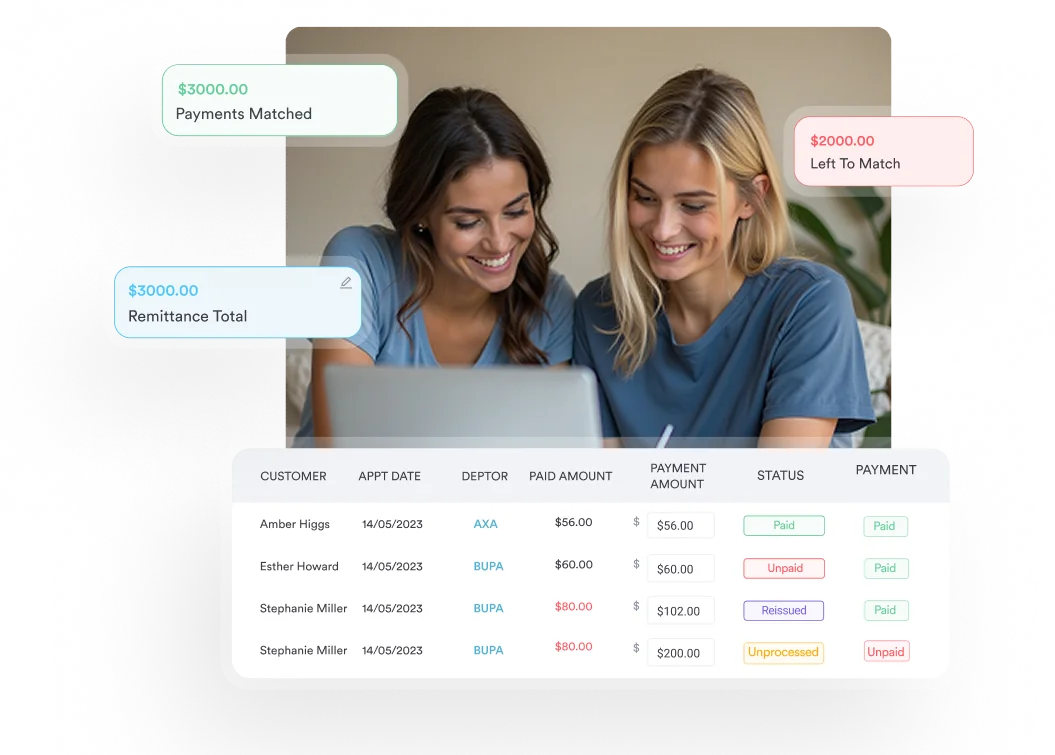

Pabau checks each claim for missing details before it’s sent and tracks it through to payment. Remittances post against the claim, so fewer claims come back for rework.

HCPCS code C1786 is a precise device code: It applies to one type of generator on one kind of claim. The generator is single-chamber and rate-responsive, with or without leads, and the claim is a hospital outpatient facility claim.
Its denials tend to share a root cause: Documentation did not confirm what the code claims, or the code was wrong for the device. So put the check where the error starts.
Review the implant log, the device sticker, and the companion CPT code together before the claim goes out. Send every leadless or dual-chamber case to manual review, since those are where C1786, C1785 and C1605 get swapped. A few minutes per case costs far less than a correction and resubmission later.
Book a demo to see how Pabau checks each claim before it’s sent and tracks it through to payment.

Need help understanding the medical billing process for device codes? What is revenue cycle management explains the end-to-end cycle from charge capture through payment posting.
Looking for guidance on building a clean claim submission workflow? Medical billing compliance covers the documentation and claim integrity requirements that protect against audits.
Want to reduce payer rejections on device codes? Insurance eligibility verification outlines how pre-visit eligibility checks confirm coverage before a claim is submitted.
Billing a dual-chamber system instead? HCPCS code C1785 covers the dual-chamber generator code, its companion CPT codes, and documentation.
Want the wider Medicare picture? Medicare billing walks through how Medicare claims are built, submitted, and paid.
HCPCS code C1786 covers a single-chamber, rate-responsive implantable pacemaker generator, reported as a device on hospital outpatient (OPPS) facility claims. It does not cover leads, remote monitoring devices, or dual-chamber generators.
C1786 is for single-chamber rate-responsive pacemaker generators (one lead, pacing in either the atrium or ventricle). C1785 is for dual-chamber rate-responsive generators (two leads, pacing both chambers). The operative report’s lead count and generator model number determine which code applies.
Yes, for single-chamber leadless systems such as Medtronic Micra and Abbott AVEIR VR. The dual-chamber AVEIR DR system uses C1605 instead, effective July 1, 2024.
Yes. Medicare covers single-chamber rate-responsive pacemaker implantation under NCD 20.8.3 when the documented indication, such as sick sinus syndrome or AV block, meets coverage criteria. Billing article A54929 adds facility guidance, and your MAC may add requirements.
Frequent reasons are the wrong device code (C1785 billed instead), missing device documentation, or a CPT and HCPCS mismatch. A diagnosis that does not support single-chamber therapy is another. Check the CARC and RARC codes on the remittance advice before appealing.
No. C1786 is a facility HCPCS code reported on hospital outpatient (OPPS) facility claims. A physician CMS-1500 claim carrying it will be denied.



