

HCPCS Code G0163: Skilled nursing observation and assessment
What is HCPCS Code G0163? HCPCS Code G0163 is a deleted Level II code for skille...

Last Updated: Oct 15, 2026
C1777 is the HCPCS Level II code for lead, cardioverter-defibrillator, endocardial single coil (implantable).
Coders confuse it most often with C1895, the dual coil equivalent, and that one wrong selection is a common cause of C1777 claim denials. The operative note must confirm the single coil configuration in writing. Without that language, a payer can deny the line or recoup it on audit.
Let Pabau's smart automation suggest the right codes, reduce claim denials, and keep your practice compliant—effortlessly.
Automate repetitive tasks and focus on what matters most—your patients.
Reduce coding errors and ensure compliance with the latest regulations.
Clean claims, fewer denials, and faster reimbursements.
Powerful insights and reporting to help your practice thrive.
HIPAA compliant SOC 2 certified GDPR-compliant Trusted by 4,000+ clinics worldwide

C1777 is a HCPCS Level II C-code reported on hospital outpatient and ASC claims, never on inpatient DRG claims.
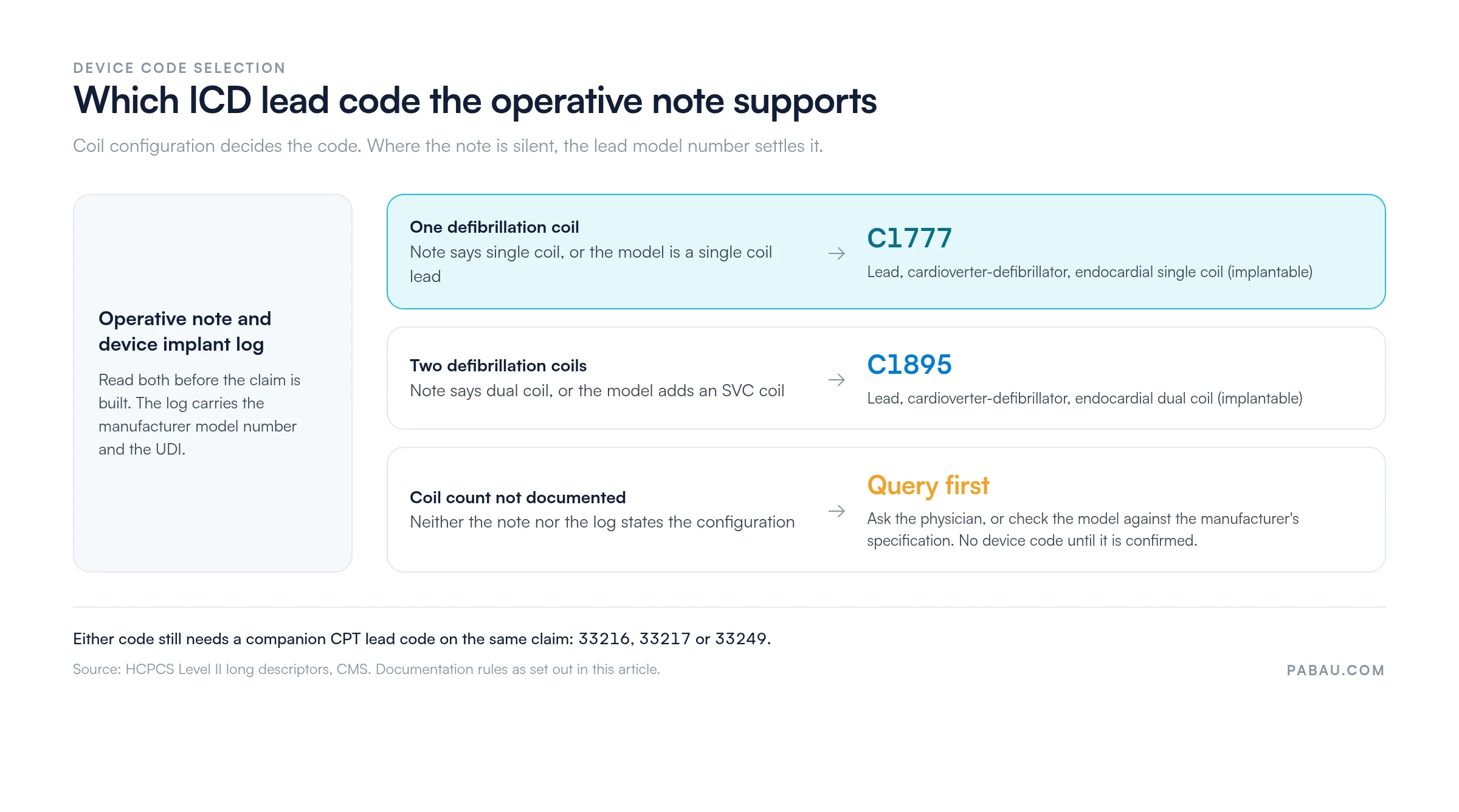
Single coil leads are coded C1777 and dual coil leads C1895, so the operative note has to name the coil configuration.
The device cost is packaged into the procedure payment, so C1777 captures cost data and satisfies device edits.
Every C1777 line needs a companion CPT lead insertion code, such as 33216, 33217, or 33249.
Pabau flags device code mismatches and missing documentation before a claim reaches the clearinghouse.
HCPCS Code C1777 is the official billing code for a lead, cardioverter-defibrillator, endocardial single coil (implantable). It sits in the C-series, the temporary HCPCS Level II codes CMS maintains for use with the hospital outpatient prospective payment system (OPPS). Facilities report them on ambulatory surgery center (ASC) claims too. The code is active for 2026 and has not been retired.
The device itself is the endocardial lead that is placed transvenously into the right ventricle. The “single coil” designation means the lead carries one defibrillation coil, usually positioned in the right ventricular apex.
That is what separates it from a dual coil lead, which adds a second coil in the superior vena cava for extra shock vector coverage.
Key classification facts for claim submission:
The endocardial single coil lead is one of three components in a complete ICD system: the pulse generator, the sensing/pacing lead, and the defibrillation lead. HCPCS Code C1777 captures the defibrillation lead specifically. Understanding its function helps coders verify that the operative note supports the code selected.
The lead does two jobs at once. It senses the heart’s electrical activity to detect ventricular fibrillation or ventricular tachycardia, and it delivers the shock when the detection algorithm fires. The single coil configuration routes that shock between the right ventricular coil and the pulse generator housing, known as the can.
Physicians choose a single coil lead when the patient’s anatomy supports an adequate defibrillation threshold (DFT) on that vector alone. They also choose one to avoid the superior vena cava coil, which simplifies any future lead extraction.
For the coder, the practical documentation anchor is the DFT testing note or the implant summary. If the physician documents “single coil lead placed” and names the lead model, C1777 is supportable. If the note says “dual coil lead” or lists a model number associated with a dual coil design, C1895 applies instead.
The split between C1777 (single coil) and C1895 (dual coil) is the most consequential coding decision in ICD lead billing. Payers check device implant logs and operative notes against the code submitted. A mismatch can cause a denial or a recoupment on audit.
When the operative note does not specify coil count, coders should query the physician or check the device implant log. That log lists the manufacturer model number. Cross-referencing it against the manufacturer’s product specification confirms single or dual coil status before submission.
The whole decision comes down to three readings of the record, set out below.
C1777 represents the device component only. The procedure that implants the lead is billed separately using a companion CPT code. Submitting C1777 without one will usually produce a rejection, because the procedure is what establishes clinical context for the device.
Note that CPT 33215 (repositioning) does not support a new C1777 charge unless the repositioning involved replacing the lead. The procedure must involve actual placement or replacement of the lead, not simply adjusting lead position.
Always verify that the companion CPT code reflects a lead insertion or replacement event, not a generator-only procedure. A generator change without lead replacement (CPT 33262 or 33264) does not support a concurrent C1777 charge. The exception is an operative note documenting that the old lead was abandoned and a new single coil lead placed.
Medicare covers HCPCS Code C1777 under the hospital Outpatient Prospective Payment System (OPPS), with the device cost packaged into the procedure APC. Coverage depends on the underlying ICD implantation meeting Medicare’s medical necessity criteria. The patient must have an approved indication for ICD therapy under National Coverage Determination (NCD) 20.4.
Major commercial payers maintain separate policies. Aetna Clinical Policy Bulletin CPB 0585 governs coverage for cardioverter-defibrillators and their components, leads included. Horizon Blue Cross Blue Shield maintains a Cardiac Services Procedure Code policy that governs ICD lead reimbursement in covered plans.
Prior authorization rules shift by plan year and carrier. Pabau, the practice management platform we build, includes software for billing teams that tracks those payer-specific requirements. The facility then knows what the plan wants before the lead is implanted.
C1777 does not generate a Medicare payment of its own. The device cost is packaged into the Ambulatory Payment Classification (APC) for the companion procedure. The line itself captures cost data and satisfies the payer’s device edits. Facilities still report the charge, because the cost they report feeds the APC rates CMS sets in later years.
Payment status can change from one year to the next. Verify how C1777 is treated in the current CMS OPPS Addendum B before you build a fee schedule expectation around it. The table below sets out the structure by setting rather than a dollar amount.
Commercial contracts often depart from Medicare. Some carriers reimburse device acquisition cost on a separate line, while others follow the OPPS structure and package it. The AAPC HCPCS code database is a quick way to confirm a code’s current status before you read the contract itself.
A complete C1777 claim requires specific documentation in the medical record. Missing or ambiguous documentation is another common denial trigger. Strong medical billing documentation starts in the operating room, not at the billing desk.
The medical record must contain:
Facilities that stay compliant keep device implant logs synchronized with the coding workflow. The diagnosis side of the claim carries as much weight as the device line. Our ICD-10-CM code library lists the cardiac codes that support medical necessity.
Reviewing billing compliance requirements for device-heavy service lines before each annual OPPS update reduces rework when payment rules change.
C1777 denials cluster around a small set of recurring errors. Knowing them in advance lets billing teams build pre-submission checks that intercept the issue before it reaches the payer. A systematic denial management workflow for device codes should address each of these by claim type.
Where the ICD procedure takes place determines whether C1777 belongs on the claim at all. Getting this wrong is a structural billing error. The only fix is voiding the claim and resubmitting it through the correct payer system.
ICD implantation is almost always performed in a hospital outpatient electrophysiology lab or a cardiac ASC. Physician office billing for C1777 is not a valid scenario. When a claim team is submitting a clean claim, the bill type has to match where the procedure happened. The place of service code has to match it too.
At the start of each calendar year, pull your facility’s C-series device code list. Check each code against the new OPPS Addendum B published by CMS. Payment status and device edits change between years. A code that was separately payable in the prior year may be packaged into the APC rate in the new one.
Today the device line and the note that supports it usually live in separate systems. A coder opens the operative record, reads the coil configuration, then rebuilds the claim somewhere else. Each hand-off is a chance to send C1777 when the record says dual coil.
Pabau keeps the two together. The treatment record, the attached documents, and the claim sit on one patient file. The coder reads the note and the code side by side, and claim rules check the device line against its companion CPT code before submission.
The result is fewer corrected claims. A C1777 line that leaves with its documentation attached is one your team is not reworking six weeks later, after the remittance arrives.

Pabau’s claims management tools check the device line against the companion CPT code and the documentation on file. A C1777 claim then leaves the facility complete.

C1777 is a documentation code more than a payment code. In most settings it earns nothing on its own. A wrong coil selection still costs the facility a corrected claim and an audit trail to defend.
So the work sits upstream of billing. Agree with the electrophysiology team on the exact wording the operative note will carry, and the coder stops reverse-engineering the configuration from model numbers.
Build that check into the submission step and device-line denials stop being a monthly surprise. Book a demo to see how Pabau checks a device line against its documentation before the claim goes out.

Need to understand how claim denials are tracked and resolved? Denial management in healthcare walks through the full workflow for identifying, appealing, and preventing recurring claim rejections.
Want a plain-language overview of how HCPCS fits into the broader billing system? What is revenue cycle management covers how HCPCS device codes, CPT procedure codes, and diagnosis codes work together through the claim lifecycle.
Looking for a checklist approach to outpatient billing compliance? Superbill documentation explains how to structure device and procedure lines so claims pass payer edits on first submission.
HCPCS Code C1777 is the HCPCS Level II device code for a lead, cardioverter-defibrillator, endocardial single coil (implantable). It is a C-series code used to report the device component of an ICD system on hospital outpatient and ASC claims. The device cost is packaged into the procedure payment rather than paid separately.
Single coil leads are billed under C1777 and dual coil leads under C1895. The difference is physical. A single coil lead has one defibrillation coil in the right ventricle. A dual coil lead adds a second coil in the superior vena cava. Submitting the wrong code when the operative note identifies the other coil type can cause a denial or a recoupment on audit.
The most common companion code is 33249, insertion or replacement of a permanent ICD with transvenous leads. Others are 33216 and 33217 for transvenous electrode insertion. CPT 33240 covers the pulse generator only, with an existing single lead. C1777 covers the device, and the CPT code covers the procedure.
Yes, C1777 is reported on ASC claims for the ICD lead, but the device cost is normally packaged into the ASC procedure payment. Medicare ASC claims go on the CMS-1500 or 837P, not the UB-04. Confirm C1777’s payment indicator in the CMS OPPS and ASC addenda before you assume a separate payment.
Common denial reasons are a wrong coil type, a missing device implant log or UDI, an inpatient claim, and a missing prior authorization. A wrong coil type means C1777 was submitted when the record describes a dual coil lead. Most of these are preventable with a pre-submission documentation checklist.
Medicare coverage is governed by CMS NCD 20.4 for ICD implantation. Aetna applies Clinical Policy Bulletin CPB 0585 to cardioverter-defibrillator components, leads included. Carelon Medical Benefits Management publishes cardiac device guidelines (updated 2026-01-01) that may apply to C1777 claims depending on the plan. Horizon Blue Cross Blue Shield maintains its own ICD coverage policy. Prior authorization requirements vary by plan, so always verify with the payer before the procedure.




