

HCPCS Code L0472: Hyperextension TLSO billing guide
HCPCS code L0472: Official descriptor and device definition HCPCS code L0472 des...

Last Updated: Nov 5, 2026
C1728 is the HCPCS Level II code for catheter, brachytherapy seed administration. Hospitals report it on the outpatient claim when catheters carry radioactive seeds or sources to the treatment site.
CMS assigns C1728 status indicator N under OPPS, so its cost is packaged into the placement procedure, such as CPT 55875. The radioactive sources are billed on their own lines and paid separately.
Let Pabau's smart automation suggest the right codes, reduce claim denials, and keep your practice compliant—effortlessly.
Automate repetitive tasks and focus on what matters most—your patients.
Reduce coding errors and ensure compliance with the latest regulations.
Clean claims, fewer denials, and faster reimbursements.
Powerful insights and reporting to help your practice thrive.
HIPAA compliant SOC 2 certified GDPR-compliant Trusted by 4,000+ clinics worldwide

HCPCS Code C1728 reports a catheter used to deliver brachytherapy seeds or sources, billed by hospitals on the outpatient UB-04 claim.
The October 2026 OPPS Addendum B lists C1728 with status indicator N, so its cost is packaged into the placement procedure.
Pass-through payment for C1728 expired on December 31, 2002, but CMS still expects hospitals to report the device code.
The radioactive seeds are billed on their own lines, per source, under codes such as C2638, and CMS pays them separately.
Pabau, the practice management platform we build, keeps device details, consent forms, and treatment notes on one patient record, so the claim matches the chart.
HCPCS Code C1728 is the Level II code for “Catheter, brachytherapy seed administration.” It reports the catheter used to carry radioactive seeds or sources to the treatment site during brachytherapy. Hospitals list it on the outpatient claim beside the procedure that placed the catheters.
The CMS HCPCS file gives C1728 an add date of April 1, 2001, and the short descriptor “Cath, brachytx seed adm.” Because C1728 describes a device, it always travels with the CPT code for the placement.
Check the current descriptor on CMS’s HCPCS code set page each quarter. Hospital coders can look up neighboring codes in our HCPCS reference for coders.
Brachytherapy treats cancer by placing radioactive sources inside the tumor or right next to it. The sources reach the site through needles or catheters placed by the radiation oncologist or surgeon.
A catheter is a flexible tube, so it can follow a path that a rigid needle cannot. C1728 covers the catheter. A brachytherapy needle has its own code, C1715.
Several CPT codes describe placing “needles or catheters” for interstitial radioelement application. The most common sites are these:
Each of those descriptors allows needles or catheters, so the CPT code never tells you which device to report. The operative note does, and it decides between C1728 and C1715.
C1728 belongs on the hospital outpatient claim, the UB-04 that OPPS hospitals submit under bill type 12X or 13X. Since January 1, 2005, CMS has required these hospitals to report device codes with the procedures that use them.
The physician who places the catheters bills the CPT code alone on a CMS-1500. C-codes describe the facility’s device cost, so they stay off the professional claim.
An ambulatory surgical center can report C1728 as well. The October 2026 ASC addenda list it with payment indicator N1, so the catheter is packaged and earns no separate ASC payment.
Inpatient stays follow different rules. Device costs on an inpatient claim roll into the MS-DRG payment, so C1728 has no line there.
C1728 earns no separate payment under Medicare OPPS. The October 2026 OPPS Addendum B lists it with status indicator N, so its cost is packaged into the procedure that used the catheter.
Pass-through payment expired on December 31, 2002, per Chapter 4 of the Medicare Claims Processing Manual. Hospitals must still report the code when they use the device. The placement procedures carry the payment instead, mostly through comprehensive APCs with status indicator J1.
These are national unadjusted Medicare rates. Wage index and commercial contracts shift what you are paid.
Sources are the exception. CMS pays brachytherapy sources separately under status indicator U, per section 61.4 of the claims manual.
Packaged does not mean optional. CMS uses device charges to set future APC rates, so a missing C1728 line understates what the procedure costs.
No edit will flag a missing C1728, either. The placement codes fall below the 30 percent device offset for device-intensive status, so only your own audit catches it.
Billing C1728 correctly means matching four things on the UB-04: the setting, the device, the placement code, and the sources. Error-checking claims management software catches most mismatches before the claim leaves the facility.
For a prostate seed implant, the finished claim carries four kinds of line, and only two of them earn payment.
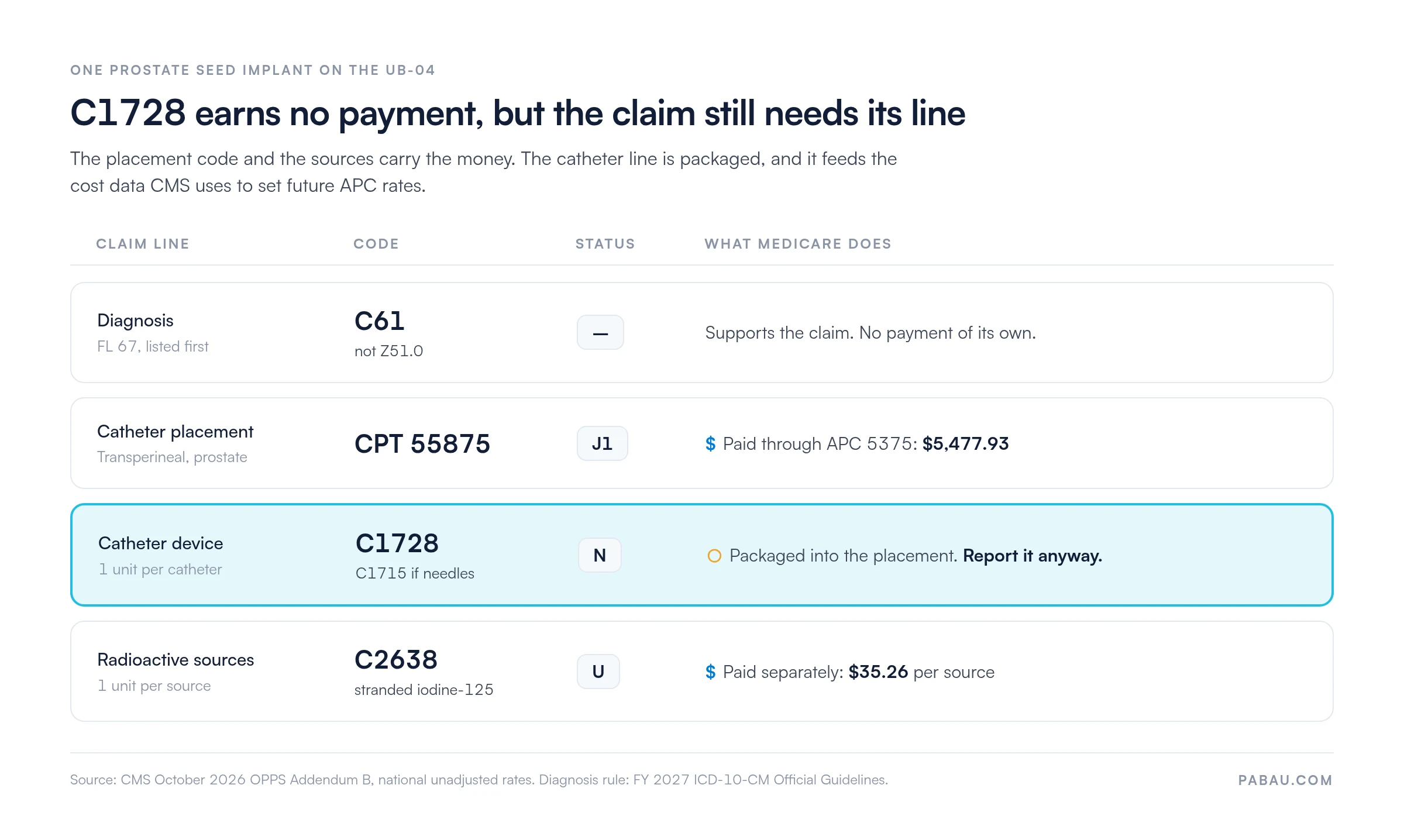
The billing field reference below maps each element to its UB-04 locator.
Map every brachytherapy catheter in your supply catalog to C1728 and every needle to C1715, then audit the mapping each quarter. Most device-line errors on these cases start in the chargemaster, not with the coder.
Every C1728 line needs a record that shows catheters were used, how many, and why. Strong medical billing compliance builds that record during the case rather than after a denial arrives.
CMS lets hospitals bill a small number of sources that were ordered but not implanted. The record must show they were acquired for that patient, never used for anyone else, and disposed of properly.
Most C1728 errors come from mixing up the device, the source, and the service. The table below compares the codes most often confused with it.
Needle-only cases are the classic trap. When the operative note describes needles and no catheters, the device line takes C1715 instead.
Some older references tie C1728 to neurostimulators, which is wrong. A neurostimulator lead is C1778, and a neurostimulator test kit lead is C1897.
Verify neighboring descriptors in the current CMS HCPCS file before you code. Never choose a code from memory or from last year’s claim.
C1728 rarely causes a denial on its own, because it carries no separate payment. The costly errors sit around it, in the placement and source lines. Good denial management workflows trace each one to a root cause before anyone resubmits.
When a denial arrives, read the electronic remittance advice first. The Claim Adjustment Reason Code (CARC) and Remittance Advice Remark Code (RARC) together identify the exact reason.
Before a brachytherapy claim goes out, check four things. Is the patient registered as an outpatient? Does the operative note say catheters or needles? Are the placement code, C1728, and every source line on the claim? Is the malignancy listed first?
The diagnosis on a C1728 claim is the cancer being treated. The FY 2027 ICD-10-CM Official Guidelines say an encounter for implanting radioactive elements lists the malignancy first. They add that Z51.0 should not be assigned.
External beam radiation works the other way, with Z51.0 as the first-listed code. A biller who carries that habit over to brachytherapy puts the wrong code first.
On a prostate seed implant, the first-listed code is usually C61. Use the most specific code the documentation supports. Where the code set offers a more precise site or laterality, the unspecified code is the wrong choice.
Brachytherapy claims go wrong at the point of capture. Seed counts sit on one worksheet, catheter labels sit in a folder, and the coder sees neither.
Pabau keeps consent forms, treatment notes, photos, and custom device fields on one patient record. Staff record catheter and source details while the case is still open.
Our claims and billing tools sit on that same record. When an auditor asks how many catheters and seeds you used, the answer is already in the file.

Pabau brings consent forms, treatment notes, and custom device fields onto one patient record. Your team documents catheters and sources once, so coders and auditors find what they need without chasing paper.

C1728 will not change your OPPS payment for a brachytherapy placement, because CMS packages the catheter into the procedure. Its value lies in the cost data and the evidence trail. No device edit flags a missing C1728, so the habit has to live in your chargemaster.
Read the operative note for catheters or needles, bill every source with the right units, and put the malignancy first. Book a demo to see how Pabau keeps device details, notes, and consent on one patient record.

Need to understand how clean claims reduce your denial rate? Clean claim submission guide covers the elements every facility claim must include before submission to avoid preventable rejections.
Confused about how denial codes map to corrective actions? Denial codes in medical billing provides a full reference to CARC and RARC codes with corrective action guidance.
Want to see how HCPCS billing fits into the broader revenue cycle? What is medical billing? explains the end-to-end process from charge capture to payment posting.
HCPCS Code C1728 covers a catheter used to deliver brachytherapy seeds or sources to a treatment site. Hospitals report it on the outpatient UB-04 claim beside the CPT code for the catheter placement.
No. Its pass-through status expired on December 31, 2002. The October 2026 OPPS Addendum B lists C1728 with status indicator N, so its cost is packaged into the placement procedure.
C1728 pairs with CPT codes that place needles or catheters for interstitial radioelement application. Common examples are 55875 for the prostate, 55920 for other pelvic sites, 20555 for soft tissue, and 41019 for the head and neck.
C1728 reports a brachytherapy catheter, while C1715 reports a brachytherapy needle. The operative note decides which one applies, because the placement CPT codes allow either device.
No. Seeds and other radioactive sources are billed on their own lines under source codes, such as C2638 for stranded iodine-125. CMS pays them per source, so the units must match the number used.
No. The ICD-10-CM guidelines say an encounter for implanting radioactive elements lists the malignancy first, and Z51.0 should not be assigned. Z51.0 belongs on encounters chiefly for external beam radiation therapy.



