CCSD code K4902: IVUS-guided coronary angioplasty billing guide
CCSD code K4902 covers IVUS-guided coronary angioplasty CCSD code K4902 covers p...

Last Updated: Oct 26, 2026
C1716 is the HCPCS Level II code for brachytherapy source, non-stranded, gold-198, per source. Hospital outpatient departments report one unit for each gold-198 source implanted, separately from the implant procedure.
The isotope sets C1716 apart from C1717, which covers high dose rate iridium-192 sources. Neither code is for stranded sources. A stranded source with no isotope-specific code goes to C2698, and the unit count on the claim must match the operative report.
Let Pabau's smart automation suggest the right codes, reduce claim denials, and keep your practice compliant—effortlessly.
Automate repetitive tasks and focus on what matters most—your patients.
Reduce coding errors and ensure compliance with the latest regulations.
Clean claims, fewer denials, and faster reimbursements.
Powerful insights and reporting to help your practice thrive.
HIPAA compliant SOC 2 certified GDPR-compliant Trusted by 4,000+ clinics worldwide

HCPCS Code C1716 reports one non-stranded gold-198 brachytherapy source, billed per source implanted.
The isotope separates C1716 from C1717, which covers high dose rate iridium-192 sources. Both codes are non-stranded.
Stranded sources never go on C1716. They take an isotope-specific stranded code, or C2698 when no specific code exists.
Hospital outpatient departments report C1716 on the UB-04, with units equal to the gold-198 sources in the operative report.
Brachytherapy sources are paid separately under OPPS, so confirm the status indicator and rate in the current Addendum B.
HCPCS Code C1716 is a Level II C-code from the Centers for Medicare and Medicaid Services (CMS) for one non-stranded gold-198 brachytherapy source. Hospital outpatient departments report it under the Outpatient Prospective Payment System (OPPS), one unit per source implanted.
Brachytherapy places radioactive sources directly in or next to a tumor. Gold-198 has a half-life of about 2.7 days, so it delivers its dose quickly and is used for permanent interstitial implants. The sources are placed individually, which is why the descriptor reads “non-stranded”.
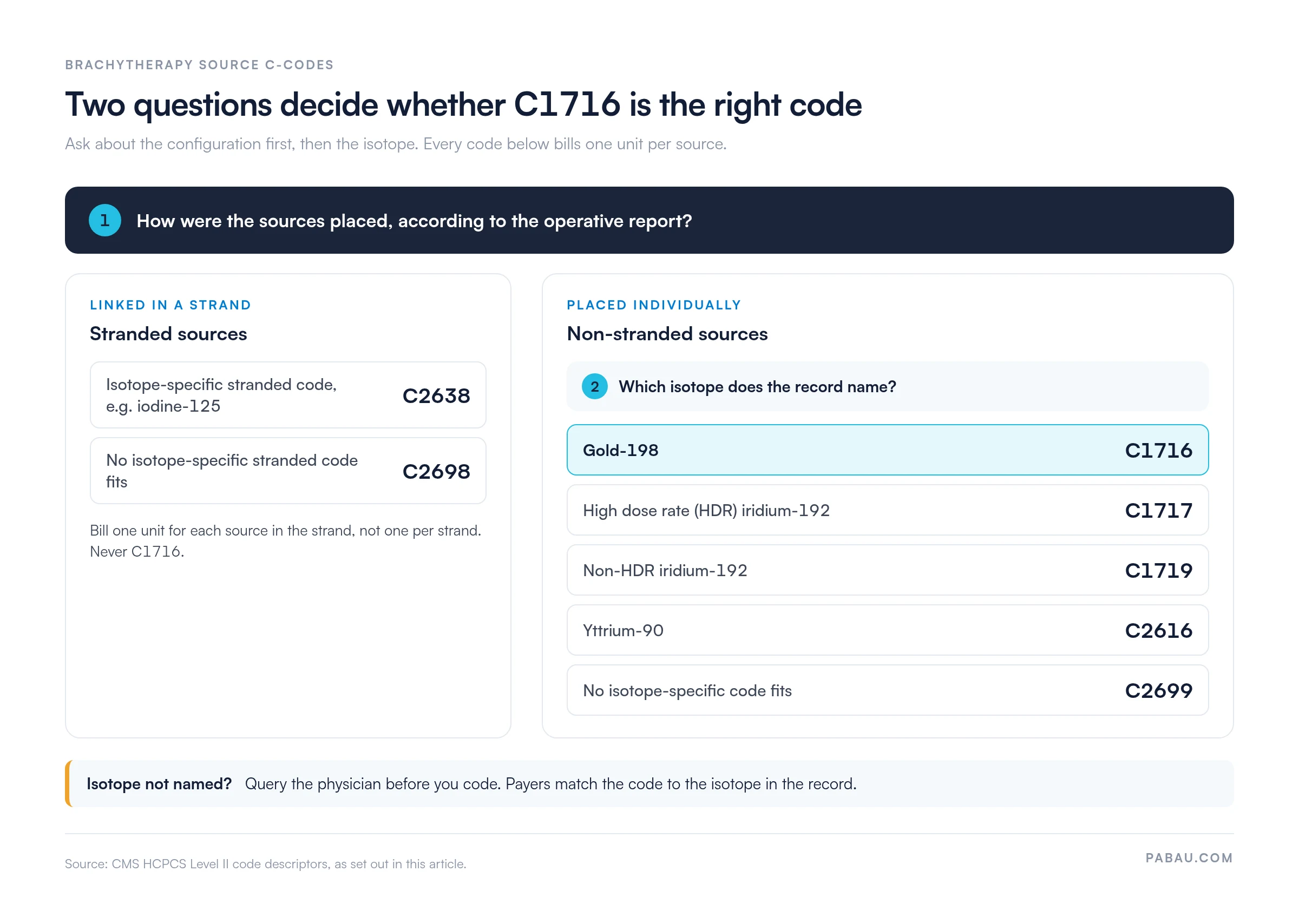
The coding decision for C1716 turns on two facts in the operative report: the isotope and the source configuration. Gold-198 points to C1716. A different isotope, or sources linked in a strand, points to a different code entirely.
The table below sets out the official CMS descriptor and the core billing attributes for HCPCS Code C1716. Confirm the code’s status each year in the CMS HCPCS quarterly update and the OPPS addenda.
HCPCS Code C1716 covers the gold-198 sources themselves, implanted individually during a hospital outpatient procedure. Each source counts as one unit. The code does not cover the implant procedure, imaging guidance, or treatment planning.
Included under C1716:
Not covered by C1716:
The isotope separates C1716 from C1717. C1716 reports gold-198, while C1717 reports a high dose rate (HDR) iridium-192 source. Both descriptors say “non-stranded”, so the strand question never decides between these two codes.
When the operative report says only “brachytherapy seeds”, without naming the isotope, query the physician before you code. Payers match the code to the isotope in the record, so a guess can turn into a denial or a recoupment.
C1716 sits in a family of per-source C-codes split by isotope and by configuration, all listed in our HCPCS procedure codes library. The codes below are the ones most often confused with it.
C2616 is also non-stranded and covers yttrium-90, so it never applies to a stranded source either. For stranded sources, CMS asks hospitals to bill one unit for each source in the strand, not one unit per strand. The diagram below puts both coding questions in the order a coder should ask them.
The procedure goes on its own line with a CPT code. For a permanent interstitial implant, that is usually 77778 for complex interstitial source application. HDR treatment delivered with C1717 uses the remote afterloading codes 77770–77772 instead.
HCPCS Code C1716 is billed on a UB-04 (CMS-1450) facility claim from a hospital outpatient department. Four requirements must be met before the claim leaves the facility. For the basics behind any facility claim, see our guide to medical billing fundamentals.
A clean claim submission for C1716 needs all four elements right before it reaches the clearinghouse. Missing any one of them creates a preventable denial.
Brachytherapy sources are paid separately under OPPS rather than packaged into the procedure’s payment. CMS pays them under the standard OPPS methodology, using source-specific costs. The hospital is paid per source, on top of the implant procedure.
That differs from transitional pass-through devices, which have their own status indicator and payment path. Check C1716’s own row in the current Addendum B to confirm its status indicator.
Practical check: Search the current year’s CMS OPPS Addendum B for C1716, then read the status indicator, the APC, and the payment rate. Rates change with each annual OPPS final rule, so never carry last year’s figure forward.
Every C1716 claim rests on a record that names the isotope and counts the sources. Payers review the operative report at post-payment audit, and a mismatch between the bill and the record usually ends in a recoupment demand. Medical billing compliance standards expect that record to be complete before the claim goes out.
The minimum documentation checklist for HCPCS Code C1716:
Before submitting a C1716 claim, check the isotope and source count in the operative report against the packing slip or source inventory log. If the slip shows a different isotope or a stranded product, resolve it before the claim goes out. Once a payer requests records, the same fix turns into an appeal.
C1716 claims face a predictable set of denial triggers, and most of them can be prevented with a pre-submission check. Pabau, the practice management and billing platform we build, keeps the procedure record next to the claim so coders can check both. Strong denial management workflows matter for any facility that bills oncology devices regularly.
The table below maps each common denial to its root cause and the fix.
Medicare covers brachytherapy for medically necessary oncology indications, and pays for C1716 sources separately under OPPS. No national coverage determination (NCD) broadly restricts brachytherapy. Instead, Medicare contractors such as Noridian Healthcare Solutions issue local coverage determinations (LCDs) that set covered diagnoses and documentation expectations.
Medicaid coverage for HCPCS Code C1716 varies by state. Some programs follow OPPS policy, while others use their own fee schedules or require prior authorization for implants. Always complete insurance eligibility verification and check prior authorization rules before the procedure date.
Commercial payers follow their own coverage policies, which may differ from Medicare’s. Key points for commercial claims:
Billing teams often rebuild a C1716 claim by hand. They read the isotope off the operative note, count sources against the packing slip, and type the units into the claim line.
Pabau keeps the treatment record, inventory log, and claims management software in one system. The source count recorded at the procedure carries through to the claim your team builds. Your team then sees a quantity mismatch before submission, while it is still a quick correction.
The result is fewer resubmissions for wrong units or wrong codes, and a record that already answers the auditor’s questions.

Pabau’s claims management software supports per-unit quantity tracking and outpatient facility billing, so your team catches C1716 errors before they reach the payer.

The safest C1716 claim is built from the operative report outward. When the report names gold-198, describes sources placed one by one, and gives a count, the code and the units follow on their own.
When any of those three is missing, query the physician before the claim is built. A short query costs minutes. A recoupment after audit costs the payment itself.
Make that check a fixed step before every brachytherapy claim leaves the facility. To see how Pabau puts the source count next to the claim line, book a demo.

Want to understand how HCPCS fits into the broader billing picture? What is revenue cycle management covers the end-to-end workflow from claim creation to payment posting.
Need guidance on handling denied outpatient device claims? Denial codes in medical billing explains the most common CARC codes and how to build an effective appeal.
Looking for a clean-claim checklist for facility billing? Superbill guide covers what belongs on a complete outpatient claim before it reaches the clearinghouse.
Coding an iridium-192 implant that is not high dose rate? HCPCS Code C1719 covers the non-HDR iridium-192 source that sits next to C1716 in the same code family.
HCPCS Code C1716 covers one non-stranded gold-198 brachytherapy source, billed per source implanted in a hospital outpatient department under Medicare OPPS. It does not cover iridium-192 sources, stranded sources, or the implant procedure itself.
The difference is the isotope. C1716 reports a non-stranded gold-198 source, while C1717 reports a non-stranded high dose rate iridium-192 source. Both are billed per source, so confirm the isotope in the operative report before coding.
Stranded sources never go on C1716 or C1717. Use the isotope-specific stranded code, such as C2638 for stranded iodine-125. When no specific code fits, use C2698, and bill one unit for each source in the strand.
Not as a rule. CMS pays brachytherapy sources separately under the standard OPPS methodology, not through transitional pass-through. Confirm the current status indicator and rate for C1716 in the CMS OPPS Addendum B before billing.
Most C1716 denials come from the wrong isotope code, a stranded source billed as C1716, or a CMS-1500 claim instead of a UB-04. Quantity mismatches, a wrong revenue code, and weak medical necessity records cause the rest.
No. C1716 is a C-code for hospital outpatient billing under OPPS, reported on the UB-04 claim form. A physician office bills on the CMS-1500, where the payer rejects C1716 because the claim type does not match the code.
Revenue code 0333 (radiation therapy) is often paired with brachytherapy lines on the UB-04, but the required revenue code varies by Medicare Administrative Contractor. Check your MAC’s billing instructions before submitting, because a mismatched revenue code is a routine denial trigger.