

HCPCS Code L0472: Hyperextension TLSO billing guide
HCPCS code L0472: Official descriptor and device definition HCPCS code L0472 des...

Last Updated: Nov 5, 2026
B4155 is the HCPCS Level II code for enteral formula made of nutritionally incomplete or modular nutrients, given through an enteral feeding tube. It covers specific nutrients such as glucose polymers, glutamine or arginine, and medium-chain triglycerides, alone or combined. One unit equals 100 calories.
Unlike B4150 and B4153, which describe nutritionally complete formulas, a B4155 product cannot be the sole source of nutrition. It is usually billed on its own line beside a base formula. Medicare treats it as a special formula, so the record must justify why the patient needs it.
Let Pabau's smart automation suggest the right codes, reduce claim denials, and keep your practice compliant—effortlessly.
Automate repetitive tasks and focus on what matters most—your patients.
Reduce coding errors and ensure compliance with the latest regulations.
Clean claims, fewer denials, and faster reimbursements.
Powerful insights and reporting to help your practice thrive.
HIPAA compliant SOC 2 certified GDPR-compliant Trusted by 4,000+ clinics worldwide

HCPCS Code B4155 covers nutritionally incomplete or modular enteral nutrients given through a feeding tube, billed at 100 calories per unit.
Typical B4155 products are single-nutrient modules, such as glucose polymers, protein or amino acid powders, and medium-chain triglyceride oil.
A B4155 module is usually billed on its own claim line alongside a nutritionally complete base formula such as B4150 or B4152.
Medicare treats B4155 as a special formula, so the record must explain why a standard formula alone cannot meet the patient’s needs.
Claim lines need a KX, GA, GY or GZ modifier under the Enteral Nutrition LCD, and orally taken products are noncovered.
HCPCS Code B4155 is the code for enteral formula made of nutritionally incomplete or modular nutrients, administered through an enteral feeding tube. One unit equals 100 calories. The code sits in the B-section of the HCPCS Level II code set, maintained by the Centers for Medicare and Medicaid Services (CMS).
The official long descriptor lists what a B4155 product supplies. It covers specific nutrients, carbohydrates such as glucose polymers, and proteins or amino acids such as glutamine and arginine. Fat such as medium-chain triglycerides (MCT), or a combination, also qualifies. None of these makes a complete diet on its own.
Medicare pays for B4155 through DMEPOS suppliers enrolled with the program. A physician practice that furnishes enteral products directly must hold its own DMEPOS supplier enrollment to bill the code.
B4155 describes a building block added to a feed. The code fits when a product adds one nutrient, or a small set of them, to a diet that comes mainly from another formula.
B41xx coding turns on one question: is the product a complete formula or a module? Every code in the table except B4155 describes a nutritionally complete formula, so B4155 is the one code built for additions.
The practical rule is to code from the product, not from the order wording. Check the manufacturer’s product sheet, then confirm the product’s code on the PDAC Product Classification List before you bill. The AAPC HCPCS Level II code lookup helps you compare neighboring descriptors quickly. Each neighboring B-code also has its own page in our HCPCS code guides.
A modular nutrient rarely travels alone. The usual pattern is a complete formula, such as B4150 or B4152, on one claim line. The module goes on a second line, each with its own calories and units.
A patient on 1,500 kcal of B4150 a day with 300 kcal of added MCT oil generates two lines. That means 15 units of B4150 a day and 3 units of B4155 a day.
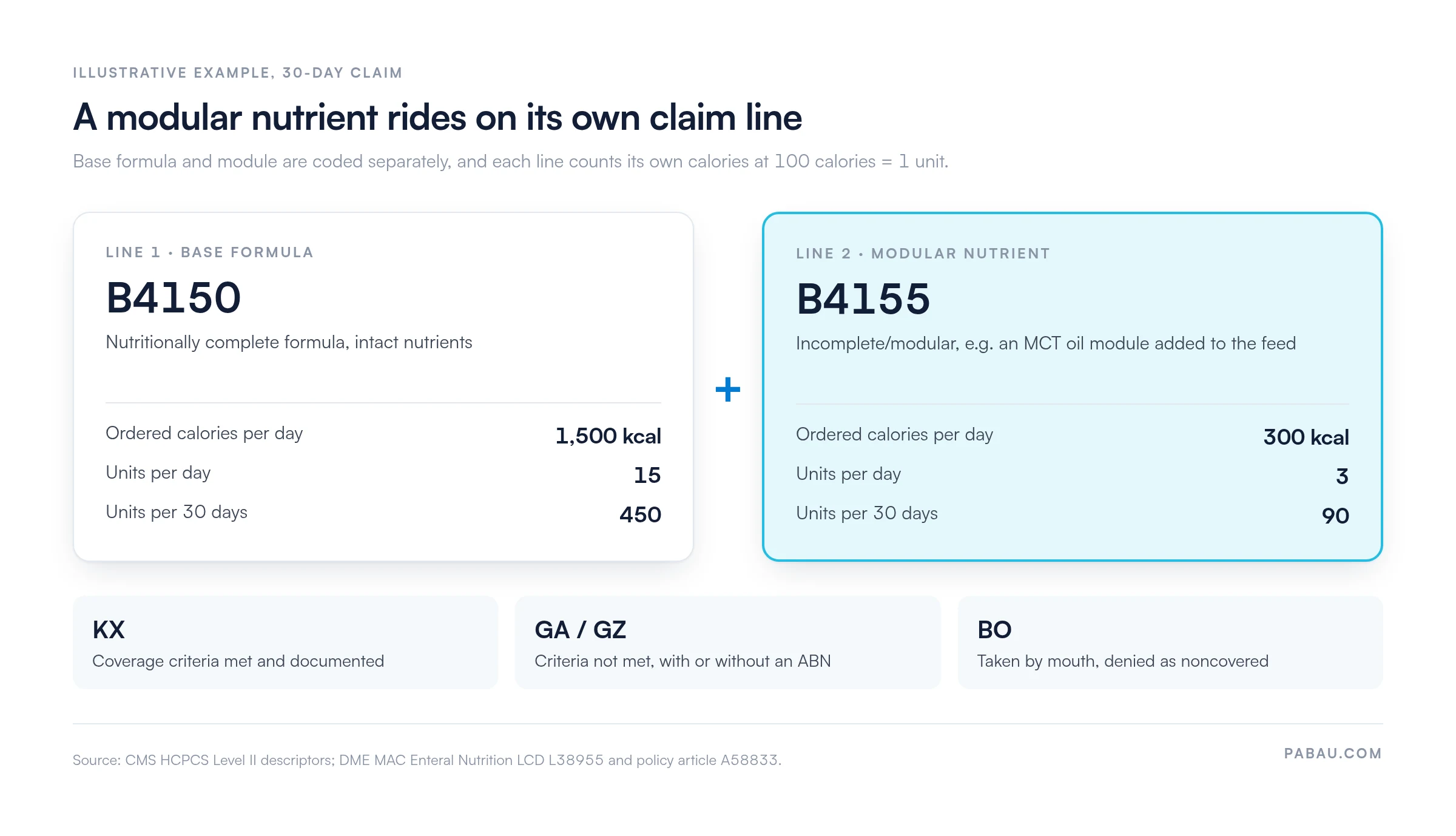
Each line needs its own medical necessity support. Justifying the base formula does not justify the module, because Medicare reviews B4155 as a special formula in its own right.
The billing unit for HCPCS Code B4155 is 100 calories of the modular product. Divide the ordered daily calories from the module by 100, then multiply by the days in the billing period.
Bill only the units the treating practitioner ordered. Under policy article A58833, units beyond the order must not be billed with the KX modifier. Suppliers also may not dispense more than a one-month quantity at a time.
Since July 2, 2023, enteral claim lines without a KX, GA, GY or GZ modifier are rejected as missing information. The KO, KP and KQ modifiers are drug unit-dose modifiers and do not belong on enteral formula claims.
Medicare covers enteral nutrition under the Enteral Nutrition LCD (L38955), published by the DME MACs with policy article A58833. The LCD replaced the retired L33783 policy and took its current KX-based form on July 2, 2023.
Coverage starts with the patient. The LCD requires feeding through an enteral access device and one of two permanent conditions:
The condition must pass the test of permanence, meaning it is expected to be of long and indefinite duration. Adequate nutrition must also not be possible through dietary adjustment or oral supplements.
B4155 then has to clear a second bar. The LCD lists it among the special nutrient formulas, together with B4149, B4153, B4154, B4157, B4161 and B4162. The medical record must explain why a standard formula cannot meet the patient’s needs, and a diagnosis alone is not enough.
These diagnoses support the need for tube feeding. The record still has to explain why the patient needs the added nutrient on top of the base formula.
Missing or thin documentation is the most common reason B4155 claims fail on review. Assemble the file before the first claim goes out.
Certificates of medical necessity and DME information forms no longer travel with enteral claims. CMS eliminated them for dates of service on or after January 1, 2023, including the enteral nutrition form CMS-10126. Suppliers still keep the supporting information on file and produce it on request.
Retain the full file for at least seven years. Post-payment audits and Targeted Probe and Educate reviews ask for the complete record. A superbill that carries the order, diagnosis and modifier data together reduces transcription errors at submission.
Check the PDAC Product Classification List each time a new module enters the formulary. A product that is not listed under B4155 cannot be billed with that code, however well the record supports the module.
B4155 claims follow predictable denial patterns. The table pairs each reason with its root cause and the step that prevents it.
For a broader framework on reducing claim failure rates, the guide to denial management in healthcare covers tracking, categorizing and appealing denials across claim types.
A clean B4155 claim follows a defined sequence. The steps most often skipped are the product classification check and the modifier choice.
Submitting a clean claim the first time shortens payment timelines. Medicare generally pays clean claims within 30 days, while claims returned for missing information restart the clock.
The Medicare DMEPOS fee schedule sets the allowed amount for HCPCS Code B4155 per 100-calorie unit. Enteral nutrition sits in its parenteral and enteral nutrition (PEN) category, and CMS updates the files at least once a year.
This guide does not state a dollar amount, because the fee schedule changes with each update. Commercial and Medicaid plans set their own rates, so confirm them in each payer contract.
Medicare’s DMEPOS Required Prior Authorization List covers only specific items, and CMS changes it from time to time. Check the current list for B4155 before each new patient start rather than assuming either way.
Commercial plans and Medicaid managed care organizations often require prior authorization for enteral products. Call the payer before the first delivery to confirm the requirement, and note the call in the patient file. For the wider picture, the guide to medical billing covers how prior authorization fits the full revenue cycle.
Enteral suppliers and the practices that order for them often keep the order, dietitian notes and refill calls in separate places. When a reviewer asks for the file, someone has to rebuild it from email and paper.
Pabau, the practice management platform we build, keeps those documents in one patient record. Digital forms capture the dietitian assessment and refill requests, and treatment notes hold the clinical reasoning for the module.
For US claims, Pabau’s claims management software sends the claim data your team has entered to Claim.MD and tracks each claim’s status. Your billers still choose the codes, units and modifiers, but they work from one complete record.

Pabau keeps orders, dietitian notes and refill records in one patient file, then sends your claims through Claim.MD and tracks their status.

Treat B4155 as an add-on that needs its own case. Before you bill a module, confirm the product is listed under B4155 and that the record explains why the base formula is not enough.
Getting this right protects the base formula claim as well. A supplier who documents the module separately can defend both lines on review, instead of losing the module and inviting scrutiny of the whole order.
Book a demo to see how Pabau keeps enteral nutrition orders, notes and claims in one place for your billing team.

New to the medical billing cycle? What is medical billing explains the end-to-end revenue cycle from patient encounter to payment posting.
Getting denials you can’t explain? Denial management in healthcare covers how to categorize, track, and systematically reduce claim denial rates.
Need a clean-claim primer before your next submission? Clean claim submission walks through every element a payer checks before auto-adjudicating a claim.
Comparing B4155 with other special formulas? HCPCS code B4153 covers complete formulas with hydrolyzed proteins, another special formula under the LCD.
Supplying a blenderized product instead? HCPCS code B4149 explains the code for manufactured blenderized natural-food formulas.
HCPCS Code B4155 covers nutritionally incomplete or modular enteral nutrients given through a feeding tube, billed at 100 calories per unit. Typical products are glucose polymers, protein or amino acid modules, and MCT oil added to a base formula.
Units equal the daily calories from the module divided by 100, multiplied by the days in the billing period. A 300 kcal daily module is 3 units a day, or 90 units over 30 days. Never bill more units than the order supports.
B4150 is a nutritionally complete formula with intact nutrients that can serve as the sole source of nutrition. B4155 is a nutritionally incomplete or modular product that adds specific nutrients. A patient can have both on the same claim, one line each.
No. CMS eliminated certificates of medical necessity and DME information forms, including CMS-10126, for dates of service on or after January 1, 2023. Suppliers still need a standard written order before billing and must keep the supporting records on file.
The most common reason is a record that does not justify the module as a special formula. A missing KX, GA, GY or GZ modifier and oral administration follow close behind. Wrong unit counts, a product not listed under B4155, and lapsed DMEPOS enrollment also cause denials.
Enrolled DMEPOS suppliers bill B4155 to the DME MAC for the patient’s area. A physician practice that furnishes enteral products must hold its own DMEPOS supplier enrollment and meet the Medicare supplier standards.
It depends on the payer. Check the current Medicare DMEPOS Required Prior Authorization List before each new start, since CMS updates it. Many commercial plans and Medicaid managed care organizations require prior authorization for enteral products.



