HCPCS code J3471: Hyaluronidase ovine injection billing guide
HCPCS code J3471: Descriptor, code type, and quick-reference data HCPCS code J34...

Last Updated: Oct 14, 2026
B4102 is the HCPCS Level II code for enteral formula, for adults, used to replace fluids and electrolytes (e.g., clear liquids), 500 ml = 1 unit.
Medicare treats B4102 as non-covered with no benefit, because electrolyte fluids do not maintain weight and strength. Suppliers add the GY modifier on Medicare claims, and the patient or another payer covers the cost.
Let Pabau's smart automation suggest the right codes, reduce claim denials, and keep your practice compliant—effortlessly.
Automate repetitive tasks and focus on what matters most—your patients.
Reduce coding errors and ensure compliance with the latest regulations.
Clean claims, fewer denials, and faster reimbursements.
Powerful insights and reporting to help your practice thrive.
HIPAA compliant SOC 2 certified GDPR-compliant Trusted by 4,000+ clinics worldwide

HCPCS code B4102 describes adult enteral formula used to replace fluids and electrolytes, such as clear liquids, billed at 500 ml per unit.
Medicare treats B4102 as non-covered with no benefit, so no certificate of medical necessity or prior authorization makes it payable.
Medicare claims for B4102 carry the GY modifier, which produces a clean denial so the patient or a secondary payer can be billed.
B4103 is the pediatric version of the same fluid replacement code, while B4149 and B4150 are calorie-based formulas Medicare can cover.
Medicaid and commercial plans set their own B4102 rules, so confirm coverage and the patient’s cost before dispensing.
HCPCS code B4102 is the Level II code for adult fluid and electrolyte replacement formula.
It belongs to the B-series enteral and parenteral therapy group of HCPCS Level II codes, which the Centers for Medicare and Medicaid Services (CMS) maintains. The official descriptor reads: Enteral formula, for adults, used to replace fluids and electrolytes (e.g., clear liquids), 500 ml = 1 unit.
Three details in that descriptor decide when B4102 applies:
The B41xx codes split along two lines: what the product does and how it is counted. B4102 and B4103 measure fluid replacement by volume. The nutrition formula codes count 100-calorie units instead. Picking the wrong line changes both the unit math and whether Medicare pays at all.
Common mistake: Suppliers bill a clear-liquid electrolyte product as B4150 or B4149 to get it paid. Those codes describe complete nutrition counted in calories, and an electrolyte fluid meets neither descriptor. The code must match the product dispensed, so fluid replacement stays on B4102 for adults or B4103 for children.
Medicare does not cover HCPCS code B4102. The DME MAC Enteral Nutrition Policy Article A58833 covers electrolyte-containing fluids (B4102 and B4103) directly. It says they “are not indicated for the maintenance of weight and strength and are therefore non-covered, no benefit.”
“No benefit” has three practical consequences for suppliers and billing teams:
Because the denial rests on the benefit category, an Advance Beneficiary Notice of Noncoverage (ABN) is not required before dispensing. Many suppliers still give the patient a voluntary written notice of the expected cost. That way, the bill does not arrive as a surprise.
Add the GY modifier to every B4102 line you send to Medicare. The policy article requires GY when a no-benefit denial is expected, and most secondary payers need that denial before they process the claim.
No ICD-10-CM code makes B4102 payable under Medicare, because the denial rests on the benefit category rather than on medical necessity. The diagnosis still belongs on the claim. Medicaid and commercial plans that cover fluid replacement often use it to justify the order.
Check the covering plan’s own policy before relying on a diagnosis. A code one Medicaid program accepts may be missing from another program’s list, and commercial plans publish separate criteria.
Traditional Medicare has no prior authorization for B4102, because no approval can make a no-benefit item payable. Medicare Advantage, Medicaid, and commercial plans set their own rules, and some do require approval.
Keep this documentation on file before you dispense B4102:
Billing B4102 correctly comes down to volume-based units, the right modifier, and a clear payer order. Each of the three depends on which code line the product sits on, as the diagram below shows.
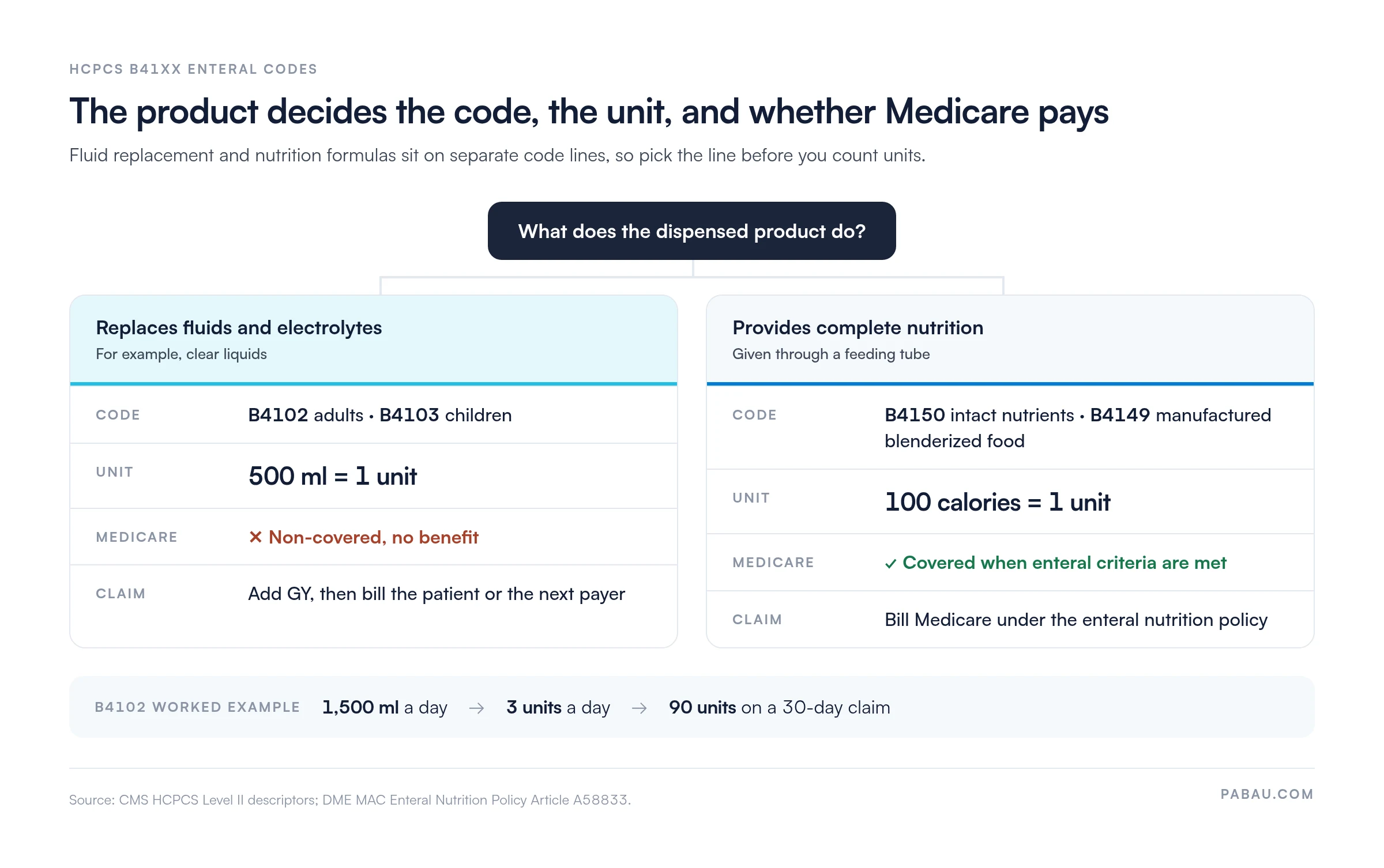
One unit of B4102 equals 500 ml of formula. A patient ordered 1,500 ml per day uses 3 units daily, so a 30-day claim carries 90 units. When the ordered volume is not a multiple of 500 ml, follow the payer’s rounding instructions and keep the ordered volume in the record.
On Medicare claims, add the GY modifier to show the item has no Medicare benefit. Medicaid and commercial plans may expect different modifiers, so check each plan’s billing manual before you submit.
B4102 claims go on the CMS-1500 form or its 837P electronic equivalent. For Medicare, send the claim to the DME MAC for the beneficiary’s state of residence. Then forward the Medicare denial to any secondary payer. Superbill documentation should record the ordered volume, the units billed, and the payer order.
A Medicare denial on B4102 is expected, so the goal is a clean denial and a correct bill to the next payer. Reviewing your denial management workflows helps you separate expected no-benefit denials from errors you can fix.
Medicare pays nothing for B4102, because the code has no Medicare benefit. The cost falls to the patient, a Medicaid program, or a commercial plan, depending on the patient’s coverage.
Where a state Medicaid program covers B4102, its rate appears in that state’s DME fee schedule. Commercial rates are set in the supplier’s contract with each plan. The right medical billing software with payer-specific rules helps teams quote patients an accurate price before dispensing.
Build a short payer matrix for B4102 and B4103 that lists which contracted plans cover them, the rate, and any authorization rule. Review it each January, when the annual HCPCS changes and new fee schedules take effect.
Non-covered enteral items tend to be handled by memory. One person adds the GY modifier, another chases the secondary payer, and the patient hears about the cost after delivery.
Pabau, the practice management and billing platform we build, keeps those steps in one place. Its claims software for billers tracks each claim line, its payer, and its remittance. A Medicare denial on B4102 can then move straight to the next payer, so your team spends less time chasing it.

Pabau’s claims management tools track each claim line, its payer, and its remittance, so expected Medicare denials move quickly to the patient or secondary payer.

Treat B4102 as a patient-responsibility item from the first order. Medicare will not pay for adult fluid and electrolyte replacement, and no amount of documentation changes that.
Revenue on this code depends on the setup around it. Confirm the payer before dispensing, tell the patient the cost in writing, and code adults and children correctly. Then send Medicare a GY-modified claim, so the next payer can act on the denial.
Book a demo to see how Pabau helps billing teams manage non-covered enteral claims from order to payment.

Need to understand how denials flow back into your billing cycle? Denial management in healthcare walks through the end-to-end process for tracking, appealing, and preventing claim rejections.
Looking for guidance on what makes a claim clean? Clean claim requirements covers the fields, modifiers, and documentation that make a claim passable on first submission.
Want to understand how electronic remittance works after B4102 claims adjudicate? Electronic remittance advice (ERA) explains 835 transaction formats and how to read denial reason codes.
Billing other DME items to Medicare? Medicare billing walks through how Medicare claims are submitted, processed, and paid.
HCPCS code B4102 covers enteral formula for adults used to replace fluids and electrolytes, such as clear liquids, billed at 500 ml per unit. Nutritionally complete formulas fall under calorie-based codes such as B4150 or B4149 instead.
No. The DME MAC Enteral Nutrition Policy Article A58833 lists B4102 as non-covered, no benefit, because electrolyte fluids do not maintain weight and strength. No certificate of medical necessity, order, or diagnosis makes it payable.
B4102 is the adult fluid and electrolyte replacement formula code, and B4103 is the pediatric version. Both are billed at 500 ml per unit, and Medicare treats both as non-covered, no benefit.
Traditional Medicare has no prior authorization for B4102, because the code has no Medicare benefit. Medicaid, Medicare Advantage, and commercial plans set their own rules, so check each plan before dispensing.
Use the GY modifier on Medicare claims. It tells the DME MAC the item has no Medicare benefit. The clean denial that follows lets you bill the patient or a secondary payer.
Medicare denies B4102 by design, because the code has no Medicare benefit. If another payer denied it, check for the wrong age code, miscalculated 500 ml units, or a secondary claim sent without the Medicare denial.
B4102 is an adult fluid and electrolyte replacement billed per 500 ml, and Medicare does not cover it. B4150 is a nutritionally complete tube-feeding formula billed per 100 calories, which Medicare can cover when enteral criteria are met.