CCSD Code H0480: Abdominal revision of restorative proctocolectomy
What is CCSD Code H0480? CCSD Code H0480 is the procedure code for abdominal rev...

Last Updated: Oct 15, 2026
A4709 is the HCPCS Level II code for acid concentrate, solution, for hemodialysis, per gallon. Acid concentrate is one of the two concentrates a hemodialysis machine mixes with treated water to make dialysate.
Medicare does not pay A4709 separately. CMS lists it on the ESRD PPS consolidated billing list, so the dialysis facility's bundled payment covers it, including for home hemodialysis.
Let Pabau's smart automation suggest the right codes, reduce claim denials, and keep your practice compliant—effortlessly.
Automate repetitive tasks and focus on what matters most—your patients.
Reduce coding errors and ensure compliance with the latest regulations.
Clean claims, fewer denials, and faster reimbursements.
Powerful insights and reporting to help your practice thrive.
HIPAA compliant SOC 2 certified GDPR-compliant Trusted by 4,000+ clinics worldwide

HCPCS code A4709 describes acid concentrate solution for hemodialysis, and each billed unit equals one gallon.
Medicare bundles A4709 into the ESRD PPS payment, so the dialysis facility is paid for it in-center and at home.
A DME supplier that ships acid concentrate to a Medicare home patient is paid by the ESRD facility, not by Medicare.
Medicaid and commercial payers set their own rules, so check the state program or the contract before billing A4709 separately.
Insurer-specific price lists in Pabau’s practice software keep A4709 off Medicare claims and on the contracts that pay for it.
HCPCS code A4709 is the Healthcare Common Procedure Coding System Level II code for acid concentrate, solution, for hemodialysis, per gallon. The Centers for Medicare and Medicaid Services (CMS) maintains the code set.
A4709 sits in the A-code section for medical and surgical supplies. It falls inside the A4706-A4714 run of dialysis concentrate and water codes. Each unit equals one gallon of acid concentrate solution. Five gallons supplied means five units, however many treatments those gallons cover.
A4709 covers acid concentrate supplied as a solution for hemodialysis, counted in gallons. However, it does not cover the other concentrates or the water used to make dialysate.
Hemodialysis removes waste and excess fluid by passing blood along a membrane, with dialysate flowing on the other side. The machine makes that dialysate by mixing acid concentrate, bicarbonate concentrate and treated water in a set ratio.
Acid concentrate supplies most of the electrolytes, such as sodium, potassium, calcium and magnesium, often with dextrose. It also contains a small amount of acid, usually acetic or citric acid. This acid keeps the mixed dialysate at the right pH.
The dialysis prescription sets the potassium and calcium levels, so a program may stock several formulations. Even so, each formulation supplied as a solution still reports under A4709, counted in gallons.
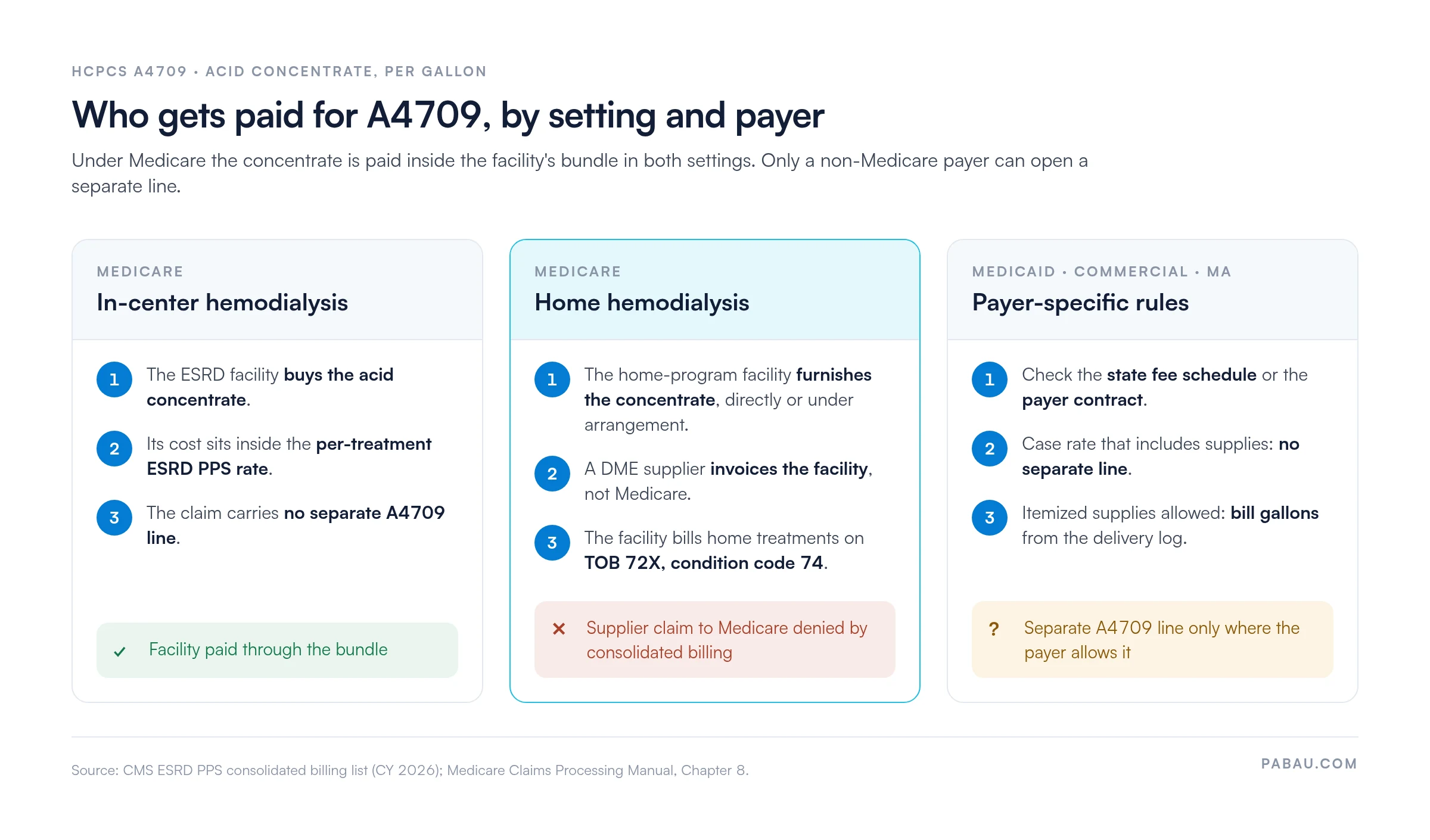
No. Medicare does not pay A4709 separately to anyone. Since January 1, 2011, the ESRD PPS has paid the ESRD facility one bundled rate per dialysis treatment. That rate covers dialysis supplies.
The bundle applies at home as well as in-center. The Medicare Claims Processing Manual, Chapter 8 says the payment covers supplies used in the ESRD facility or at a patient’s home. As a result, other suppliers must look to the ESRD facility for payment.
CMS publishes the ESRD PPS consolidated billing list so contractors can edit claims. On the CY 2026 list, A4709 appears among the DME ESRD supplies not payable to DME suppliers. As a result, consolidated billing edits deny a supplier claim for a Medicare ESRD patient.
Check the current consolidated billing list before you load any dialysis supply code into a Medicare fee table. CMS can update the list quarterly, in January, April, July and October.
Before 2011, home dialysis patients could choose Method II, which let a DME supplier bill Medicare directly for home supplies. The ESRD PPS ended that route, so home supplies now flow through the facility that runs the patient’s home program. The diagram below traces who gets paid in each setting.
The patient still owes any unmet Part B deductible and the 20% coinsurance on the facility’s dialysis payment.
A4709 has no Medicare DMEPOS fee schedule amount to look up. CMS treats it as not separately priced by Part B, because its payment sits inside the ESRD PPS bundle.
The facility’s payment is the ESRD PPS per-treatment rate, which CMS updates each calendar year through its ESRD PPS rulemaking. In other words, A4709 does not raise that rate. Money for the concentrate moves in two other places:
Medicaid handling varies by state. Some programs follow Medicare and pay dialysis supplies through a facility rate. Others list supply codes on a fee schedule. Check the state Medicaid fee schedule and provider manual before you bill A4709 to Medicaid.
Commercial and Medicare Advantage plans set their own terms. A contract may pay a per-treatment case rate that includes supplies, or it may allow itemized supply lines. Confirm the contract’s dialysis terms in writing before you bill A4709 as its own line.
Because Medicare pays the facility, the records sit with the ESRD facility’s home program and its supplier. Good medical billing compliance practice keeps four records aligned:
Where a non-Medicare payer allows separate billing, the units on the claim must match the gallons in the delivery log. Otherwise, a mismatch between the two is an easy audit finding.
No modifier makes A4709 separately payable by Medicare for an ESRD patient. Modifiers report circumstances, but they cannot override a consolidated billing edit.
Medicaid and commercial payers may set their own modifier rules for supplies. In that case, follow the payer’s billing manual where it allows A4709 as a separate line.
A4709 sits in a short run of dialysis concentrate and water codes. Each one describes a different product or unit, so the code should match what was supplied.
All five codes appear on the CY 2026 consolidated billing list as supplies not payable to DME suppliers. For this reason, Medicare bundles each of them into the facility payment.
Most A4709 denials come from billing an item that Medicare has already paid inside the bundle. Clearing these patterns out of fee tables cuts the work that lands in your denial management workflows.
Review the common denial codes to see how payers label these rejections. A clean claim check before submission also catches most of them.
Bundled supply codes cause repeat denials when a billing team keeps them in a fee table. The team then submits them by habit. Each failed claim takes time to investigate, and the same error returns next cycle.
Pabau, the practice software we build, gives your team claims software for billing teams. It covers electronic claim submission, eligibility checks, claim status tracking and ERA posting. Insurer-specific price lists let your team leave A4709 off the Medicare list. Your team can then keep it where a contract pays for it.
The result is fewer rejected claims and a clear record of which payers pay for which dialysis supplies.

Pabau’s insurer-specific price lists keep bundled codes such as A4709 off Medicare claims. Your team bills each supply only where the payer pays for it.

Under Medicare, A4709 is a cost inside the ESRD facility’s bundled payment, not a line on a supplier claim. That holds for home hemodialysis as much as for in-center care.
Your next step is to audit fee tables, supply contracts and billing defaults for leftover Medicare A4709 billing. Route supplier invoices to the facility, and keep separate billing for Medicaid or commercial contracts that clearly allow it. Book a demo to see how Pabau’s insurer-specific price lists keep A4709 on the right claims.

Coding other supplies for a home hemodialysis program? HCPCS code A4680 explains how the activated carbon filter used in dialysis water treatment is paid under the same ESRD bundle.
Billing a dialysis supply with no named code? HCPCS code A4913 covers miscellaneous dialysis supplies and why Medicare pays them inside the facility rate.
Want to see how electronic claims flow through a clearinghouse? 837 file submission guide walks through the electronic claim format used for professional and institutional claims.
Looking to tighten your revenue cycle from order through payment? Revenue cycle management fundamentals covers the end-to-end billing process for practices managing complex payer mixes.
HCPCS code A4709 covers acid concentrate, solution, for hemodialysis, billed per gallon. It does not cover bicarbonate concentrate (A4706 solution, A4707 powder), acetate concentrate (A4708) or treated water for peritoneal dialysis (A4714).
No. A4709 is on the CMS list of ESRD supplies not payable to DME suppliers. The ESRD facility pays the supplier under their arrangement, and Medicare pays the facility through the ESRD PPS.
There is no separate Medicare rate. A4709 is not separately priced by Part B and has no DMEPOS fee schedule amount. Its cost is included in the ESRD facility’s per-treatment ESRD PPS payment.
No. Since January 1, 2011, the ESRD PPS has covered home dialysis supplies as well as in-center supplies. The facility that runs the home program furnishes the concentrate and bills the home treatments on its own claim.
No modifier makes A4709 separately payable by Medicare for an ESRD patient. The AY modifier is for items not related to ESRD treatment, and acid concentrate always is. Medicaid and commercial payers that allow separate billing may set their own modifier rules.
It depends on the payer. State Medicaid programs and commercial contracts set their own dialysis payment rules. Some bundle supplies into a facility rate, and others allow itemized lines. Check the state fee schedule or the contract before billing.
Most denials come from billing Medicare for a bundled supply. Other causes are counting treatments instead of gallons and using a sibling code such as A4708 or A4706. Billing a commercial plan that pays dialysis as a case rate also fails.