HCPCS code V2630: Anterior chamber intraocular lens
HCPCS code V2630: official descriptor and code definition HCPCS code V2630 is th...

Last Updated: Oct 15, 2026
A4913 is the HCPCS Level II code for miscellaneous dialysis supplies, not otherwise specified. It describes a supply used in hemodialysis or peritoneal dialysis that no named code in the A4651-A4932 range covers.
Medicare does not pay A4913 separately. CMS gives it pricing indicator 00 and lists it on the ESRD PPS consolidated billing list. The supply is paid inside the dialysis facility's bundled rate in every setting, including home dialysis.
Let Pabau's smart automation suggest the right codes, reduce claim denials, and keep your practice compliant—effortlessly.
Automate repetitive tasks and focus on what matters most—your patients.
Reduce coding errors and ensure compliance with the latest regulations.
Clean claims, fewer denials, and faster reimbursements.
Powerful insights and reporting to help your practice thrive.
HIPAA compliant SOC 2 certified GDPR-compliant Trusted by 4,000+ clinics worldwide

A4913 is the HCPCS Level II code for dialysis supplies that no named code in the A4651-A4932 range describes.
Medicare Part B does not pay A4913 separately. CMS gives it pricing indicator 00 and lists it on the ESRD PPS consolidated billing list.
The ESRD facility’s bundled payment covers the supply in every setting, in-center and home, so a DME supplier cannot bill it to Medicare.
Use a specific code whenever one exists, and link N18.6 on the facility claim to support the ESRD diagnosis.
Pabau, the practice management platform we build, keeps the ESRD diagnosis, the supply codes and each claim’s status on one patient record.
HCPCS code A4913 is defined by the Centers for Medicare and Medicaid Services (CMS) as miscellaneous dialysis supplies, not otherwise specified. It belongs to HCPCS Level II, the CMS set of HCPCS codes for supplies, equipment and services that CPT codes do not describe.
A4913 sits in the dialysis supply range, A4651-A4932. Most codes in that range name a specific item, such as blood tubing, dialysate or gloves. A4913 is reserved for a dialysis supply that is medically necessary but matches none of those named codes.
Under Medicare, A4913 is not separately payable. It is included in the ESRD Prospective Payment System (PPS) bundle, which pays the dialysis facility one rate per treatment.
Key facts about the code:
Because A4913 is a NOS code, correct use starts with checking that no more specific HCPCS code exists for the item. If a named code fits the item, A4913 is the wrong code for it.
A4913 is a residual category. It describes items used in hemodialysis or peritoneal dialysis that are medically necessary but do not map to a named A-code. A minor consumable or ancillary component with no standalone code is the typical example.
The exclusion list matters more than the inclusion list. Any item that already has a named HCPCS code must be reported under that code, not A4913. These common dialysis supplies have their own codes:
Every code in this table is on the same CMS ESRD PPS consolidated billing list as A4913. Choosing the specific code improves reporting accuracy and audit defense. It does not unlock a separate Medicare payment.
Our guides to A4750 and A4911 show how two of those named codes are documented and billed.
Medicare covers the supplies A4913 describes, but it pays for them only inside the ESRD PPS bundle. CMS assigns A4913 pricing indicator 00, which means Part B does not price it separately. Its coverage code is D, which means special coverage instructions apply.
The code appears on neither the Physician Fee Schedule nor the DMEPOS fee schedule. For Medicare purposes, three conditions still shape how the supply is documented:
With no separate Medicare payment, there is no fee to look up and no separate Part B claim to authorize for A4913.
The ESRD PPS is the billing framework for A4913. CMS bundles dialysis-related drugs, labs, supplies and services into a single per-treatment payment to the ESRD facility. A4913 supplies are part of that bundle in every setting.
Strong medical billing compliance in this area turns on who furnished the supply. Under Medicare, that is the ESRD facility, whether the patient dialyzes in-center or at home.
When dialysis takes place at a Medicare-certified ESRD facility, the per-treatment payment covers the supplies used. No separate payment exists for A4913 in this setting. A separate claim for the supply is denied as bundled.
Home dialysis supplies are bundled too. Method II, which let a supplier bill a DME MAC directly for home dialysis supplies, ended on January 1, 2011. Since then, the ESRD facility furnishes or arranges home supplies and receives the bundled payment for them.
A supplier that ships home dialysis supplies is paid by the facility under its arrangement with that facility, not by Medicare. For each home patient, the facility should keep:
Check who furnished the supply before anyone submits A4913 to Medicare. If the patient receives dialysis in-center or at home, the ESRD facility’s bundled payment already covers it. A separate supplier claim will deny.
A4913 has no Medicare fee schedule rate. The code is absent from the Physician Fee Schedule and the DMEPOS fee schedule. As a result, it has no locality-adjusted rate, no national limitation amount and no invoice-based price.
The supply is paid through the ESRD facility’s per-treatment PPS payment. That payment does not change with the number of A4913 items a patient uses.
CMS updates the consolidated billing list each year. Check the current list on the CMS ESRD PPS consolidated billing page before you set up billing rules for dialysis supplies.
Correct use of HCPCS code A4913 starts in the chart, with a documentation sequence that has to be in place before anyone picks the code. Practices that use claims management software can build these checks into a pre-submission workflow.
Every A4913 line rests on two separate decisions, made in this order, and the diagram below maps both.
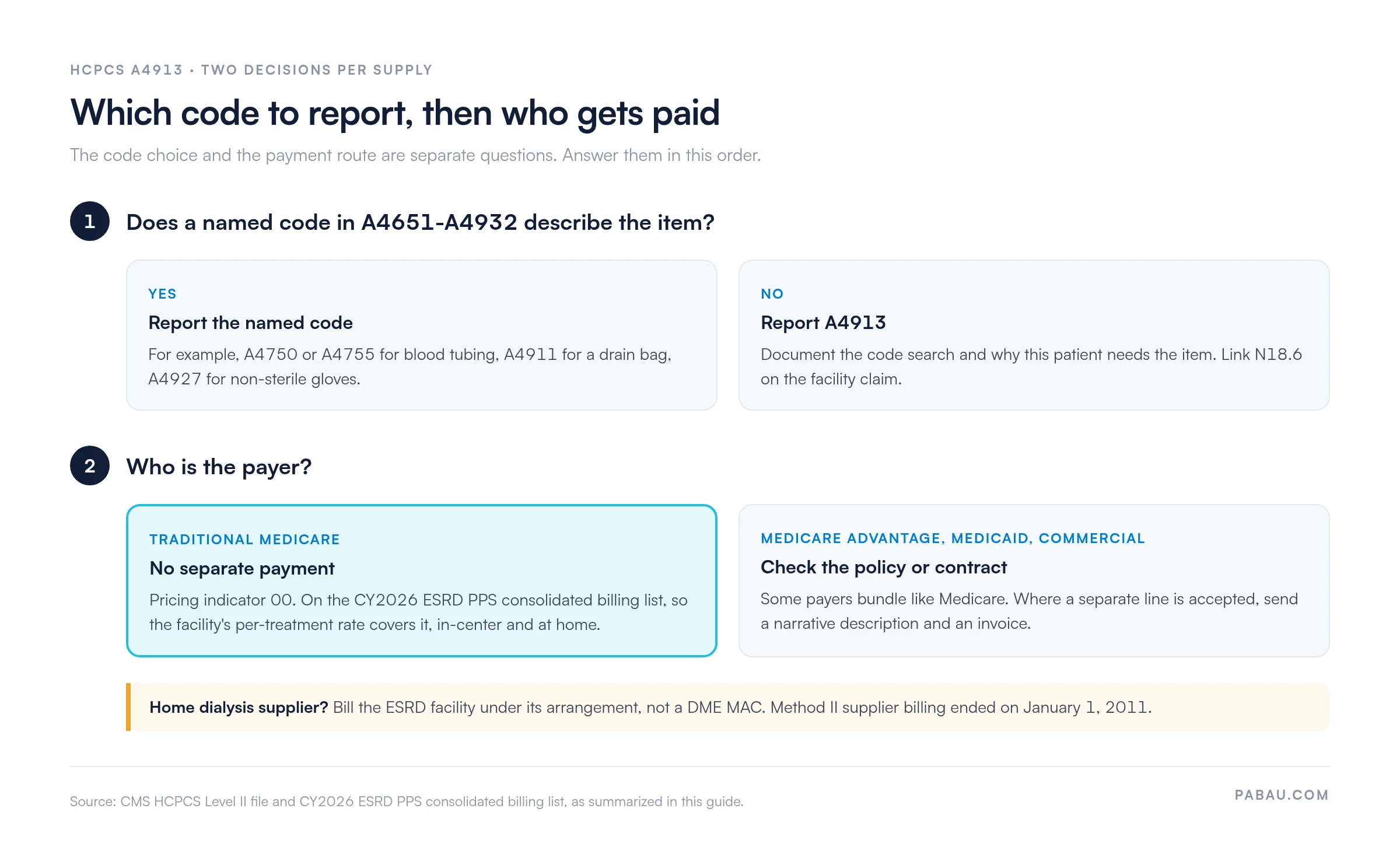
A clean claim for a dialysis patient needs the first four steps in place before it is filed. The last two protect the facility when a payer or auditor asks how the supply was handled.
The bundling rule above governs traditional Medicare claims. Medicare Advantage plans, state Medicaid programs and commercial payers set their own payment policies for dialysis supplies.
Some follow Medicare’s bundled approach. Others negotiate dialysis rates in the facility contract. Check the payer’s dialysis policy or contract before you report A4913 as a separate line.
When a payer does accept a NOC code for payment, it usually wants a narrative description of the item and an invoice. Keep both ready before the claim goes out.
Most A4913 denials trace back to one misunderstanding: Treating the code as separately payable under Medicare. Effective denial management in healthcare starts with catching that error before the claim is filed.
Read the denial reason code before anyone writes off an A4913 line. CARC 97 means the benefit is included in the payment for another service that has already been adjudicated. On a dialysis patient, that usually confirms the supply sits in the ESRD PPS bundle and needs no appeal.
Dialysis billing teams often track diagnoses, supply codes and claim outcomes in separate places. That makes it easy to send a bundled supply out as a separate claim, then lose time on the denial.
Pabau brings that work onto one patient record. The diagnosis, the codes on each claim and the claim’s status sit side by side, so nobody has to cross-check three files.
With one record per patient, your team can see the ESRD diagnosis and the codes on a claim before it is filed. Denials that do arrive are easier to trace back to their cause.

Pabau puts the ESRD diagnosis, supply codes and claim status on one patient record. Your billing team checks each dialysis claim in one place instead of several spreadsheets.

Under Medicare, A4913 records what the patient used and earns no payment of its own. The supply is paid inside the ESRD facility’s per-treatment rate, whether the patient dialyzes in-center or at home.
Your work is to pick the most specific code, link the ESRD diagnosis and document why the patient needs the item. Do that, and the facility claim is clean and audit-ready. Billing the supply separately only creates a denial to work.
Book a demo to see how Pabau helps your dialysis billing team stop a bundled supply before it leaves as a separate claim.

Need a foundation in medical billing workflows? What is medical billing covers the end-to-end revenue cycle process from patient encounter to payment posting.
Struggling with claim rejections across your coding team? Denial codes in medical billing explains the most common CARC and RARC codes and how to resolve each one.
Want to reduce HCPCS supply claim errors before they leave your practice? Medical billing compliance outlines documentation and submission standards that support cleaner claims across all payer types.
Billing peritoneal dialysis solution? HCPCS code A4726 covers dialysate by fluid volume and how Medicare treats it.
Coding a tourniquet used at the dialysis chair? HCPCS code A4929 explains its billing and coverage rules.
HCPCS code A4913 covers miscellaneous dialysis supplies that have no more specific HCPCS Level II code. It applies to consumable or ancillary items used in hemodialysis or peritoneal dialysis. If a named code in the A4651-A4932 range fits the item, A4913 must not be used.
Medicare covers the supplies A4913 describes, but it does not pay the code separately. CMS assigns pricing indicator 00 and lists A4913 on the ESRD PPS consolidated billing list. The supply is paid inside the ESRD facility’s per-treatment payment, for in-center and home dialysis alike.
A4913 has no separate Medicare reimbursement rate. It is absent from the Physician Fee Schedule and the DMEPOS fee schedule, so it has no locality-adjusted rate, national limitation amount or invoice price. Payment comes through the ESRD PPS bundle paid to the dialysis facility.
The most common reason is billing A4913 as a separate line when the ESRD PPS bundle already covers it. Other causes include a DME supplier billing a DME MAC, a more specific code being available, or a missing ESRD diagnosis on the facility claim.
No, not to Medicare. Method II home dialysis billing to DME MACs ended on January 1, 2011. The ESRD facility now furnishes or arranges home supplies, receives the bundled payment and pays the supplier under its arrangement.
The primary ICD-10-CM code for patients receiving A4913 supplies is N18.6 (end-stage renal disease). Where the ESRD has a documented underlying cause, your MAC may require that etiology code as well. Confirm diagnosis requirements with the applicable MAC billing guidance.