HCPCS Code L0472: Hyperextension TLSO billing guide
HCPCS code L0472: Official descriptor and device definition HCPCS code L0472 des...

Last Updated: Nov 5, 2026
A4690 is the HCPCS Level II code for dialyzer (artificial kidneys), all types, all sizes, for hemodialysis, each.
Medicare bundles A4690 into the ESRD facility's per-treatment payment under ESRD PPS consolidated billing. CMS lists it as a dialysis supply not payable to DME suppliers, so no supplier or practitioner bills it separately.
Let Pabau's smart automation suggest the right codes, reduce claim denials, and keep your practice compliant—effortlessly.
Automate repetitive tasks and focus on what matters most—your patients.
Reduce coding errors and ensure compliance with the latest regulations.
Clean claims, fewer denials, and faster reimbursements.
Powerful insights and reporting to help your practice thrive.
HIPAA compliant SOC 2 certified GDPR-compliant Trusted by 4,000+ clinics worldwide

HCPCS code A4690 describes a dialyzer (artificial kidney) of any type or size used for hemodialysis, reported per dialyzer.
Medicare bundles A4690 into the ESRD facility’s per-treatment payment under ESRD PPS consolidated billing, so it has no separate Part B price.
CMS lists A4690 as a dialysis supply not payable to DME suppliers, so a supplier claim for it denies.
Home hemodialysis dialyzers come through the patient’s ESRD facility, because the Method II supplier route ended in 2011.
HCPCS code A4690 is the Level II code for a dialyzer (artificial kidneys), all types, all sizes, for hemodialysis, each. The dialyzer is the filter that clears waste and excess fluid from the patient’s blood during a hemodialysis treatment.
The code sits in the A4000-A4999 medical and surgical supply range, among the dialysis supplies. For Medicare billing, its most important feature is where CMS places it. The CY 2026 ESRD PPS consolidated billing list names A4690 under DME ESRD supply HCPCS not payable to DME suppliers.
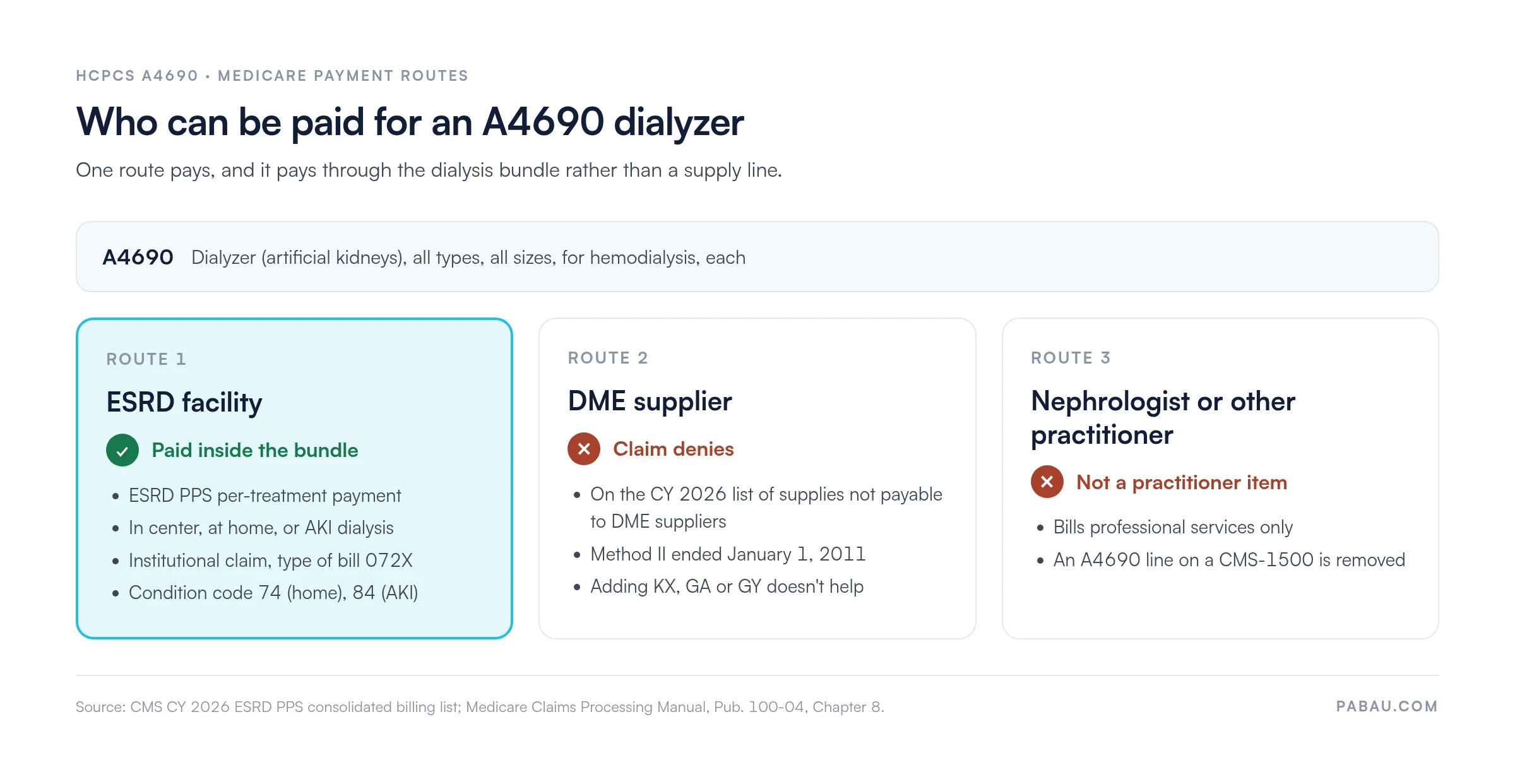
Only the ESRD facility that furnishes the patient’s dialysis is paid for the dialyzer, and it is paid through the bundle. Under the ESRD prospective payment system (PPS), one per-treatment base rate covers the dialysis and the supplies used to deliver it.
The rules sit in the Medicare Claims Processing Manual, Pub. 100-04, Chapter 8. The facility submits an institutional claim for each month’s treatments. The dialyzer cost is already inside the payment for each treatment line.
The same facility bundle applies when an ESRD facility furnishes dialysis to a patient with acute kidney injury (AKI). The dialyzer is part of that AKI per-treatment payment as well. When a physician evaluates the patient during a hemodialysis session, that professional service can be reported with CPT 90935.
Set side by side, the three possible billers show why only one route ends in payment.
A patient on home hemodialysis still receives dialyzers through the ESRD facility that supervises the home program. The facility includes them in its home dialysis payment and reports the home treatments on its own claim.
Before 2011, a home patient could choose Method II, and a supplier billed the DME MAC for home dialysis supplies directly. Method II ended on January 1, 2011, when the ESRD PPS took effect. Since then, no supplier route remains for a home patient’s dialyzers.
A home supply company can still ship dialyzers to the patient’s door. It does so under an arrangement with the facility, which pays the vendor. The vendor never sends a claim for A4690 to Medicare.
A DME supplier claim for A4690 denies because CMS runs consolidated billing edits against every code on the not-payable list. The DME MAC rejects the line, and the facility’s bundle has already paid for the dialyzer.
Modifiers do not change this outcome. Adding KX, GA, GY, NU, RR or UE to an A4690 line does not make it payable to a supplier. No coverage criteria exist for a supplier to meet.
Several neighboring dialysis supply codes share the same status, and a coder scanning the A46xx-A47xx range can pick the wrong one. The descriptors below come from the CMS HCPCS Level II code set. CMS lists each one as not payable to DME suppliers on the CY 2026 consolidated billing list.
Because every code in the table is bundled too, an error here rarely costs payment on the facility claim. It does distort supply cost reports and inventory, which the facility uses to manage its bundle.
Dialyzer documentation supports the facility’s treatment record and its conditions for coverage. These records belong in the patient’s chart for each treatment:
Keeping these records complete is part of medical billing compliance for a dialysis program. An auditor checks dialyzer use against the treatment record, because no separate dialyzer claim line exists.
Billing for the dialyzer means billing the dialysis treatment correctly, because the bundle carries the dialyzer’s cost. These steps follow the medical billing process for an ESRD facility claim.
Before a new home patient starts, confirm in writing that the ESRD facility will supply dialyzers. A supplier who ships them and bills Medicare directly will see the claim deny, and the patient may receive a confusing notice.
A4690 denials almost always trace back to the wrong entity billing the code. Recognizing the pattern makes denial management in healthcare faster, because the fix is to stop sending the claim. An appeal won’t change the outcome.
Tracking which denial codes appear on dialysis-related claims shows whether a supplier or practitioner is still billing bundled items.
If a DME supplier claim for A4690 has already been paid, treat it as an overpayment. The consolidated billing edits exist because the ESRD facility’s bundle already covered that dialyzer.
Dialysis programs keep their treatment records, orders and supply data spread across several systems. That spread makes it slow to show an auditor which facility furnished each dialyzer. Pabau, the practice management platform we build, keeps those records on one patient file.
Pabau’s claims management software pulls data already on the patient record into a claim. It submits and tracks that claim through Claim.MD for US practices. It does not choose codes or decide what is billable, so your coders still apply the consolidated billing rules.

Pabau keeps orders, treatment notes and claim status on one patient record. See how it helps your team submit and track claims with less rework.

A4690 is a code most billers should never send to Medicare on its own. The dialyzer belongs to the ESRD facility’s per-treatment bundle, whether the patient dialyzes in center or at home. A supplier or practitioner claim for it will deny.
The work that pays off happens upstream, in clear supply arrangements, complete treatment records and clean claims for the dialysis itself. To see how Pabau keeps those records together, book a demo.

Need a full overview of the medical billing process? What is medical billing walks through the revenue cycle, from charge capture to payment posting.
Dealing with denied claims? Denial management in healthcare covers systematic ways to reduce denial rates across claim types.
Want to keep your billing audit-ready? Medical billing compliance explains the rules and records that protect a practice in an audit.
Billing the physician’s side of dialysis? CPT code 90935 covers the hemodialysis procedure with a single physician evaluation.
HCPCS code A4690 covers one dialyzer (artificial kidney) of any type or size used for hemodialysis. The dialyzer is the filter that removes waste and excess fluid from the blood during treatment.
You do not bill A4690 to Medicare as a separate item. The ESRD facility that furnishes the dialysis bills the treatments on an institutional claim, and the per-treatment ESRD PPS payment already includes the dialyzer.
Keep the dialysis prescription naming the dialyzer, the treatment flowsheet for each session, and any reuse log. Home programs also keep training, supply delivery and treatment records. They belong in the facility’s treatment record, since no separate supply claim exists.
A4690 claims from DME suppliers deny because CMS lists the code as not payable to DME suppliers under ESRD PPS consolidated billing. The ESRD facility’s per-treatment payment already covers the dialyzer, so the fix is to stop billing it.
Medicare covers dialyzers, but only as part of the ESRD facility’s bundled payment for dialysis. It does not pay A4690 as a separate Part B supply, and it does not pay a DME supplier for it.
A4690 has no separate Medicare reimbursement rate. CMS assigns it pricing indicator 00, and its cost is included in the ESRD facility’s per-treatment payment under the ESRD PPS.