CCSD code H0900: Excision of left hemicolon billing guide
What is CCSD code H0900? CCSD code H0900 is the UK private healthcare code for e...

Last Updated: Oct 27, 2026
G0257 is the HCPCS Level II code for unscheduled or emergency dialysis treatment for an ESRD patient. It applies in a hospital outpatient department that is not certified as an ESRD facility.
The session must be unscheduled or emergent, and the hospital must not be a Medicare-certified ESRD facility. CMS pays it only in three situations, such as dialysis after a vascular access procedure. The hospital bills it on type of bill 13X, or 85X at a critical access hospital. Confirm the session was not pre-arranged maintenance dialysis before you report it.
Let Pabau's smart automation suggest the right codes, reduce claim denials, and keep your practice compliant—effortlessly.
Automate repetitive tasks and focus on what matters most—your patients.
Reduce coding errors and ensure compliance with the latest regulations.
Clean claims, fewer denials, and faster reimbursements.
Powerful insights and reporting to help your practice thrive.
HIPAA compliant SOC 2 certified GDPR-compliant Trusted by 4,000+ clinics worldwide

HCPCS code G0257 covers unscheduled or emergency dialysis for an ESRD patient in a hospital outpatient department that is not certified as an ESRD facility.
Both conditions must be met, and CMS limits payment to three situations, such as dialysis after a vascular access procedure or an unrelated emergency.
G0257 goes on the UB-04 with type of bill 13X, or 85X at a critical access hospital. A place of service code does not apply.
G0257 is paid under the OPPS rather than the ESRD PPS, and rates change every January, so check the current OPPS Addendum B.
Pabau, the practice management platform we build, validates CMS-1500 claims, tracks their status and flags rejected ones for the physician side of dialysis billing.
HCPCS code G0257 is defined by the Centers for Medicare & Medicaid Services (CMS). It reads “Unscheduled or emergency dialysis treatment for an ESRD patient in a hospital outpatient department that is not certified as an ESRD facility.” Each part of that descriptor is a billing condition. Understanding medical billing workflows for ESRD starts with what CMS means by each one.
The code belongs to HCPCS Level II, the CMS-managed code set for services that CPT does not capture. According to the CMS HCPCS overview, Level II codes like G0257 are updated every year. Confirm the code is still active for the claim’s date of service.
G0257 bundles the facility side of a single dialysis session. The table below sets out what falls inside and outside the code.
The official descriptor says “dialysis treatment” and does not limit the code to hemodialysis. CMS sets its limits by setting and circumstance instead. Before you report a peritoneal or other non-hemodialysis treatment under G0257, confirm your MAC’s instructions.
The CMS Claims Processing Manual (Pub. 100-04, chapter 4, section 200.2) lists three circumstances in which G0257 is payable. In each one, the ESRD patient could not get their regularly scheduled dialysis at a certified facility.
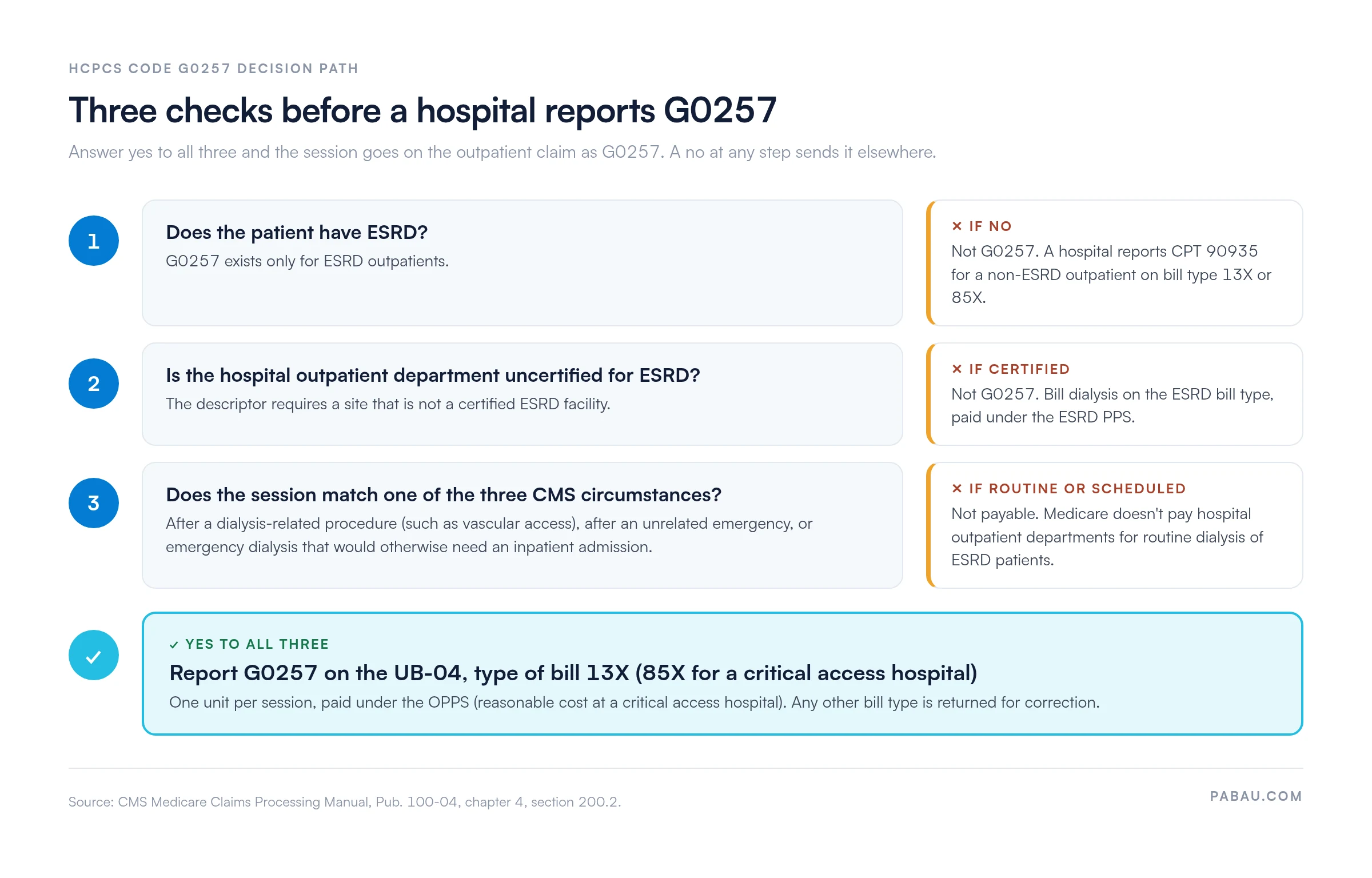
In practice, a coder works through three checks in a fixed order before reporting the code, as the decision path below shows.
Three scenarios that do not qualify:
CPT 90935 describes a hemodialysis procedure with a single physician evaluation. Physicians report it on the CMS-1500 for their professional service. A hospital may report it only for an outpatient without ESRD, or for an inpatient with Part B coverage but no Part A.
That is why the two codes rarely compete on a hospital claim. When the outpatient has ESRD and the department is not certified, the facility code is G0257.
For an ESRD patient, the hospital’s facility claim and the physician’s professional claim stay separate. The hospital reports G0257 on the UB-04. The physician’s own work goes on the CMS-1500, so G0257 never covers it.
Monthly ESRD-related physician services are billed with CPT 90951-90970. These codes replaced the monthly capitation payment codes G0308-G0327, which CMS deleted on December 31, 2008.
The nephrologist managing the patient’s dialysis bills them on the CMS-1500. The code depends on the patient’s age, the number of face-to-face visits that month and whether dialysis is done at home. CPT 90960, for example, covers a patient aged 20 or older with four or more visits in the month.
Certified ESRD facilities do not bill these codes. Medicare pays them for maintenance dialysis under the ESRD PPS. G0257, by contrast, is a single-session facility code for a hospital that holds no ESRD certification.
So both claims can stand in the same month. The nephrologist reports the monthly service, and the non-certified hospital reports G0257 for its emergency session. Neither one bills the other’s code.
Check your facility’s Medicare certification status before any ESRD dialysis claim. A certified ESRD facility never reports G0257, because its dialysis goes on the ESRD bill type under the ESRD PPS. A non-certified hospital should confirm the session matches one of the three CMS circumstances before using G0257.
CMS and Medicare Administrative Contractors (MACs) expect a specific documentation set behind a G0257 claim. Each element below supports one of the code’s conditions, so a missing one leaves the claim open to denial on review.
A correct G0257 claim matches the claim form, bill type and codes to the hospital outpatient setting. Work through these steps in order before you submit.
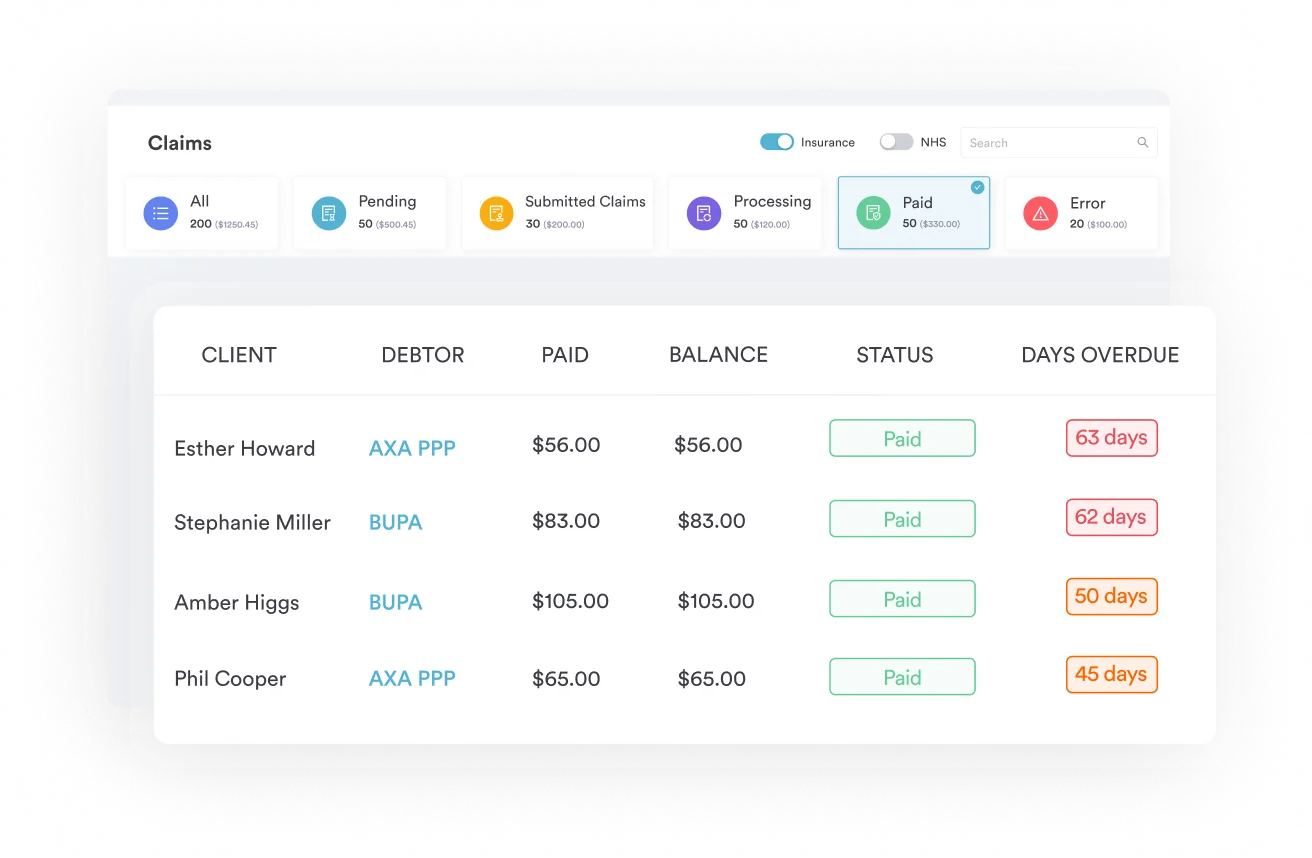
The habits behind a clean claim submission apply to G0257 as much as to any other hospital outpatient code.
G0257 falls outside the ESRD prospective payment system (PPS) bundle, which covers services at certified dialysis facilities. Instead, it is paid under the Outpatient Prospective Payment System (OPPS), or at reasonable cost to a critical access hospital. That distinction shapes the payment a billing team should expect.
G0257 claims fail on the same few conditions the code depends on. Denial management in healthcare starts with knowing which of those conditions the payer has flagged.
For appeals, the standard Medicare pathway applies. File a redetermination with the MAC within 120 days of receiving the remittance, then request reconsideration by a Qualified Independent Contractor (QIC) if needed. The remittance also carries a reason code for each denial, and our denial codes guide maps the common ones to corrective actions.
G0257 is a Medicare-specific HCPCS code. Its use, payment and documentation rules are defined within the Medicare framework. Private payers and commercial insurers do not use the HCPCS G-code series in the same way, and their coverage decisions vary widely.
For HCPCS Level II lookups, the AAPC HCPCS code search and PGM Billing HCPCS lookup give free access to the current CMS HCPCS dataset. Always cross-reference them against the official CMS source for the claim year.
If you bill ESRD encounters across several MAC jurisdictions, keep a jurisdiction-specific billing checklist for G0257. Revenue code requirements, documentation standards and local coverage articles can differ between Noridian, Palmetto GBA and Novitas. One universal approach to G0257 claims misses the MAC-specific rules that cause preventable denials.
An emergency dialysis session produces two claims. The hospital bills G0257 on the UB-04, while the nephrology practice bills its own professional services on the CMS-1500. For the practice, that means monthly ESRD service codes, visit counts and payer rules that change every January.
Pabau handles the practice’s side. It submits CMS-1500 claims through Claim.MD and checks insurance eligibility before the visit. Its claims management with validation scrubs each claim for missing or invalid details before it leaves.
If a claim comes back rejected, Pabau flags it as Needs action and links straight to the field that needs correcting. Billing staff work from one list of claims that need fixing, so rejected claims get corrected before they age. Insurance claiming is included in the subscription, with no per-claim fee.

Pabau validates CMS-1500 claims before submission, tracks the status of each one and flags rejected claims as Needs action. Your nephrology billing team fixes errors quickly instead of chasing payers.

Before reporting G0257, settle three questions in order. Does the patient have ESRD, is the hospital outpatient department uncertified, and does the session match one of the three CMS circumstances?
A yes to all three puts G0257 on a 13X or 85X claim. A no anywhere sends the session to a different code, a different bill type or no outpatient payment at all.
The physician order is worth the extra minutes at the bedside. When it names the clinical reason for the urgency, it is the record that holds the claim up on review.
Nephrology practices billing the professional side of these visits can cut rework with claim validation and status tracking. Book a demo to see how Pabau keeps your dialysis-related claims moving.

Need to understand how clearinghouses handle ESRD facility claims? Medical claims clearinghouse guide explains how electronic claim routing works for hospital outpatient submissions.
Want a denial code reference for ESRD billing rejections? Denial codes in medical billing maps common CARC codes to corrective actions you can apply to G0257 denials.
Billing the physician side of a dialysis visit? Superbill guide covers the details a superbill needs before it becomes a CMS-1500 claim.
Looking up another Level II code? HCPCS code library collects Pabau’s HCPCS billing guides in one place.
HCPCS code G0257 is a Medicare billing code for unscheduled or emergency dialysis given to an ESRD patient. It applies in a hospital outpatient department that is not certified as an ESRD facility. It captures the facility costs of a single acute dialysis session in that setting.
The official descriptor says “dialysis treatment” and names no modality. CMS limits the code by setting and circumstance instead. Check your MAC’s instructions before reporting a peritoneal or other non-hemodialysis treatment under G0257.
Use G0257 when an ESRD patient gets unscheduled or emergency dialysis in a hospital outpatient department that is not ESRD-certified. A hospital reports CPT 90935 only for an outpatient without ESRD, or for a Part B-only inpatient. Physicians bill their own professional services on the CMS-1500.
No. A Medicare-certified ESRD facility must not bill G0257. The non-certified status is written into the code’s descriptor and is a hard eligibility condition. Certified facilities bill dialysis on the ESRD bill type, paid under the ESRD PPS.
Frequent causes are an ESRD-certified billing facility, a scheduled session billed as unscheduled, and a missing or mis-sequenced N18.6. A physician order that does not document the urgency is another. A claim on a bill type other than 13X or 85X is returned for correction rather than paid.
Yes, because different entities bill them. The nephrologist reports monthly ESRD-related services with CPT 90951-90970 on the CMS-1500. A non-certified hospital bills G0257 for its own emergency session. The old monthly capitation codes, G0308-G0327, were deleted on December 31, 2008.
No. Medicare does not pay a hospital outpatient department for routine, scheduled dialysis of an ESRD patient, even at a non-certified hospital. G0257 covers only the unscheduled situations CMS lists in Pub. 100-04, chapter 4, section 200.2.