HCPCS Code A4562: Reusable non-rubber pessary
HCPCS Code A4562: official descriptor and classification HCPCS Code A4562 is one...

Last Updated: Oct 16, 2026
A4615 is the HCPCS Level II code for a nasal cannula, official descriptor "Cannula, nasal". It is the two-pronged device that delivers home oxygen through the nostrils.
Medicare does not pay A4615 as a separate line. Under the oxygen LCD (L33797) and its policy article, the cannula is part of the monthly oxygen equipment rental. The supplier keeps furnishing cannulas through the five-year useful lifetime. Most denials come from billing it separately, missing LCD documentation, or confusing it with A4616 per-foot tubing.
Let Pabau's smart automation suggest the right codes, reduce claim denials, and keep your practice compliant—effortlessly.
Automate repetitive tasks and focus on what matters most—your patients.
Reduce coding errors and ensure compliance with the latest regulations.
Clean claims, fewer denials, and faster reimbursements.
Powerful insights and reporting to help your practice thrive.
HIPAA compliant SOC 2 certified GDPR-compliant Trusted by 4,000+ clinics worldwide

HCPCS code A4615 is the code for a nasal cannula, the two-pronged device that delivers oxygen through the nostrils. Its official descriptor is “Cannula, nasal”.
Medicare includes A4615 in the monthly rental for oxygen equipment under LCD L33797, so a supplier does not bill it as a separate line.
Oxygen tubing has its own code, A4616, billed per foot. Mixing up the two codes is a common coding error.
CMS retired the oxygen CMN (CMS-484) for dates of service from January 1, 2023. Documentation now rests on the order, the qualifying test, medical records and proof of delivery.
Pabau, the billing and practice management platform we build, helps DMEPOS suppliers keep oxygen documentation together and review it before a claim goes out.
HCPCS code A4615 covers a nasal cannula, the lightweight two-pronged device that sits in the nostrils and delivers oxygen from a home oxygen system. Its official descriptor is “Cannula, nasal”. One unit on the claim equals one cannula.
A4615 sits in the A4611-A4629 range of respiratory supplies, part of the HCPCS Level II codes for medical supplies. Its neighbors are A4616 for oxygen tubing and A4617 for a mouthpiece.
For Medicare, the cannula is an oxygen accessory rather than a standalone supply. The Oxygen and Oxygen Equipment LCD (L33797) and its policy article A52514 list cannulas among the accessories included in the allowance for rented oxygen equipment.
The table below summarizes the core billing facts for A4615, drawn from the CMS HCPCS Level II code set. Check the current CMS annual release before you submit claims.
A4615 and A4616 are often confused because both items sit on the same oxygen setup. A4615 is the nasal cannula, the part that touches the patient. A4616 is the oxygen tubing that connects the cannula to the oxygen source, billed per foot.
Code the item that was dispensed. A cannula is A4615, and extension tubing is A4616, reported in feet. On a Medicare oxygen rental neither code is paid as a separate line. The choice matters most for Medicaid, commercial payers and inventory records.
Oxygen accessories span several HCPCS codes. The table below shows the codes most often billed alongside or instead of A4615, and when each one applies.
Medicare does not pay A4615 as its own line when the cannula supports rented oxygen equipment. The Oxygen LCD (L33797) and policy article A52514 include cannulas in the monthly rental allowance for that equipment. The supplier furnishes the cannula as part of the rental and bills only the equipment code, such as E1390 for a stationary concentrator.
That duty continues past the 36-month rental cap. The supplier who billed month 36 must keep furnishing accessories through the five-year reasonable useful lifetime, with no separate payment. On beneficiary-owned equipment, Medicare treats accessories as statutorily non-covered.
The oxygen rental that covers the cannula still has to meet the LCD. These are the core requirements.
CMS retired the oxygen Certificate of Medical Necessity (CMS-484) for dates of service on or after January 1, 2023. CGS, a DME MAC, confirms that claims arriving with a CMN or DIF attached are now rejected. The medical record carries that evidence instead, and keeping it in order is part of DMEPOS billing compliance.
Suppliers must keep the following records on file and produce them when the DME MAC or an auditor asks. A missing record can turn a paid oxygen rental, including its cannulas, into an overpayment on review.
Modifier use for A4615 follows your DME MAC’s oxygen LCD and policy article, not a fixed list. Because Medicare includes the cannula in the rental payment, oxygen modifiers usually belong on the equipment line rather than on A4615.
The N1, N2 and N3 group modifiers are one example. Since April 1, 2023, the policy article requires one of them on initial oxygen equipment claims. When Medicaid or a commercial plan pays A4615 separately, follow that payer’s own modifier rules.
Medicare Part B does not pay A4615 separately for rented oxygen, so there is no standalone Medicare allowable to bill the cannula against. Payment reaches the supplier through the monthly rental for the oxygen equipment code. Knowing the medical billing fundamentals behind fee schedules helps billing teams model that bundled revenue correctly.
The rental allowances themselves sit in the CMS DMEPOS fee schedule, which CMS updates each year by locality. Other payers handle the cannula in their own way, and the diagram below shows where a separate A4615 line can and cannot go.
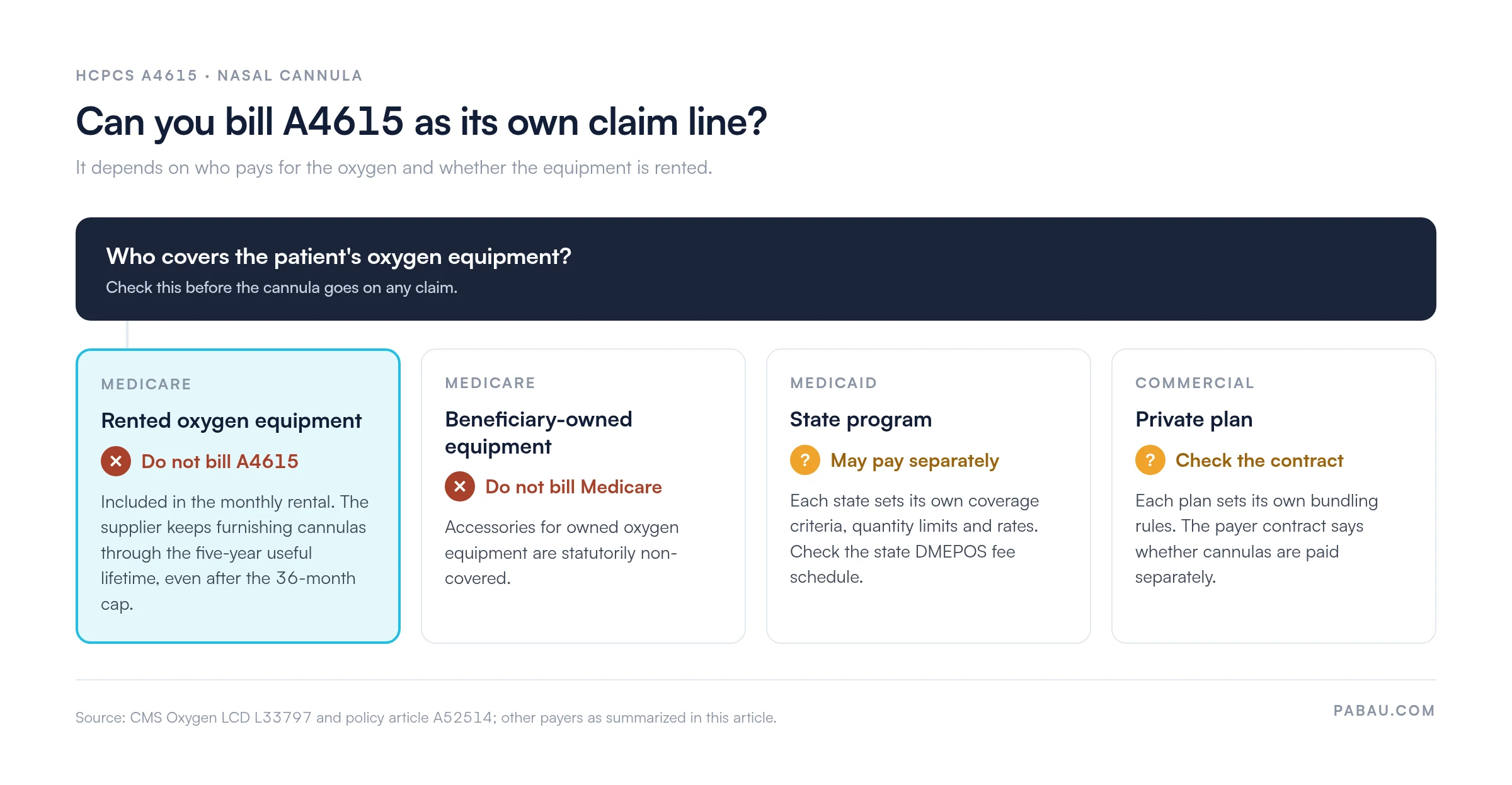
Before you bill A4615, check who covers the patient’s oxygen equipment and whether it is rented. If Medicare pays a monthly rental, the cannula is included in that payment, and a separate A4615 line will be denied.
Most A4615 denials come from treating the cannula as a separately payable item. The denial management strategies that work here focus on bundling rules, LCD documentation and code selection.
Medicare offers a five-level appeals process, but an appeal helps only when the denial came from a documentation or coding error. A bundling denial on a rented oxygen system reflects payment policy, so appealing it rarely changes the outcome.
A habit of clean claim submission keeps those lines off the claim to begin with. When an appeal is justified, the steps below apply.
Strong appeals cite the exact LCD criterion met and attach the qualifying test results and the treating practitioner’s records. Generic appeal letters without specific LCD references rarely succeed.
Many oxygen suppliers still track orders, test results and delivery records across spreadsheets, email and paper files. A bundled cannula line or a missing delivery record then surfaces only when the denial arrives.
Pabau keeps the order, the test results and the delivery record with each patient. Billing teams can review the documentation before a claim goes out and follow each claim through to payment. The result is fewer avoidable denials and less rework for your billing team.

Pabau’s claims management workflows help DMEPOS suppliers and medical billers keep orders, test results and delivery records together, so oxygen claims go out clean.

Treat A4615 as a Medicaid and commercial code first. On a Medicare oxygen rental, the cannula is already paid inside the monthly equipment payment, so a separate line only earns a denial.
Your billing effort pays off in the documentation instead. A complete order, qualifying test and delivery record protect the whole rental, cannulas included, when an auditor asks. Coding the cannula, tubing or mouthpiece by the item dispensed keeps Medicaid claims and inventory counts accurate.
Pabau’s claims management workflows give DMEPOS billing teams a structured way to keep oxygen documentation together and reduce the rework that denied claims create. Book a demo to see how Pabau keeps oxygen documentation ready before each claim goes out.

Need a deeper overview of how DMEPOS billing fits into the wider revenue cycle? What is revenue cycle management covers the end-to-end process from eligibility verification through payment posting.
Want to understand how clearinghouses process DMEPOS claims electronically? Medical claims clearinghouse guide explains how claims move from the supplier’s billing system to the MAC.
Looking for practical steps to reduce claim rejection rates across your practice? Superbill documentation guide walks through the documentation elements that support clean claim submission.
Dispensing a mouthpiece instead of a nasal cannula? HCPCS code A4617 covers the descriptor and Medicare rules for oxygen mouthpieces.
Supplying a home fill system for portable cylinders? HCPCS code K0738 explains how that oxygen equipment rental is billed.
HCPCS code A4615 covers a nasal cannula, and its official descriptor is “Cannula, nasal”. It is the two-pronged device that delivers oxygen through the nostrils. Oxygen tubing is a separate code, A4616, billed per foot.
For rented home oxygen equipment, A4615 is not billed as a separate line. Medicare’s Oxygen LCD (L33797) and policy article A52514 include cannulas in the monthly rental for the oxygen equipment. The supplier furnishes the cannula and bills the equipment code.
A4615 is a nasal cannula, billed per item. A4616 is oxygen tubing, billed per foot. Code the item that was dispensed. For Medicare oxygen rentals, both items are included in the equipment payment.
Medicare includes A4615 in the monthly allowance for rented oxygen equipment, so it is not reimbursed separately. The supplier must keep furnishing cannulas through the five-year useful lifetime, even after the 36-month rental cap. Medicaid and commercial payers set their own bundling rules.
Medicare oxygen claims rest on a standard written order, qualifying blood gas results (PaO2 or SpO2) that meet the LCD criteria, and supporting medical records. Suppliers also need proof of delivery and active DMEPOS enrollment and accreditation. CMS retired the oxygen CMN (CMS-484) for dates of service from January 1, 2023.
Modifiers for A4615 follow your DME MAC’s oxygen LCD and policy article. On a Medicare rental, the cannula is included in the equipment payment, so oxygen modifiers usually go on the equipment line. When Medicaid or a commercial plan pays A4615 separately, check that payer’s modifier rules.