CPT Code 52352: Ureteroscopic stone removal billing guide
CPT Code 52352: Official descriptor and procedure overview CPT Code 52352 descri...

Last Updated: Oct 30, 2026
A4554 is the HCPCS Level II code for disposable underpads, all sizes. It covers single-use pads placed under a patient with urinary or fecal incontinence to protect a bed or chair.
Original Medicare does not cover A4554, so payment comes from state Medicaid programs, some Medicare Advantage plans, commercial insurers or the patient. A Medicare claim, sent only when a secondary payer needs a denial, carries the GY modifier.
Let Pabau's smart automation suggest the right codes, reduce claim denials, and keep your practice compliant—effortlessly.
Automate repetitive tasks and focus on what matters most—your patients.
Reduce coding errors and ensure compliance with the latest regulations.
Clean claims, fewer denials, and faster reimbursements.
Powerful insights and reporting to help your practice thrive.
HIPAA compliant SOC 2 certified GDPR-compliant Trusted by 4,000+ clinics worldwide

HCPCS code A4554 covers disposable underpads, all sizes, while reusable underpads are billed under the separate code A4553.
Original Medicare does not cover A4554, and the CMS HCPCS file lists it with coverage code M and no Part B price.
Medicare claims for A4554 carry the GY modifier, plus GX when a voluntary notice was issued, and the KX modifier does not apply.
State Medicaid programs, some Medicare Advantage plans and commercial insurers pay for underpads, each with its own quantity and prior authorization rules.
Pabau, the practice management platform we build, lets billing teams submit claims and track each payer’s claim status in one place.
HCPCS code A4554 is defined by the Centers for Medicare and Medicaid Services (CMS) as “Disposable underpads, all sizes.” It sits in the medical and surgical supplies range of the HCPCS Level II A-series. Original Medicare does not cover it, so Medicaid programs, private plans and patients pay for these pads.
The descriptor reads “all sizes,” so the claim does not report pad dimensions. Some state Medicaid programs split underpads by size instead, using T4541 for large and T4542 for small disposable underpads. Check which code your state expects before the first claim.
A4554 covers disposable, single-use absorbent pads placed under a patient to protect bedding or seating. They are often called bed pads, incontinence pads or Chux, after a common brand. The code does not cover wearable items, reusable pads or other incontinence accessories.
The most common coding confusion involves A4553, the reusable underpad code. The table below shows when each neighboring code applies.
Never swap A4554 and A4553. Billing a reusable pad under the disposable code is miscoding and can lead to a recoupment demand on audit. The test is simple: if the pad goes in the wash after use, it belongs under A4553.
Original Medicare does not cover HCPCS code A4554. The CMS HCPCS quarterly file lists it with coverage code M, non-covered by Medicare, and pricing indicator 00. Part B therefore sets no payment amount for it.
The reason is the benefit category. Medicare pays for urological supplies under the prosthetic device benefit, and underpads are neither prosthetic devices nor needed to make one work. Noridian’s Non-Covered Urological Supplies article lists disposable underpads (A4554) among the items it denies on that basis.
Because no Medicare benefit covers the item, no Medicare coverage criteria, quantity limits or fee schedule amounts apply to A4554. Check the current quarterly file before billing, since CMS can change a coverage code between releases.
A beneficiary with only Original Medicare pays for disposable underpads out of pocket. Medicare does not require an Advance Beneficiary Notice (ABN) for an item outside every benefit category. Suppliers may still give one voluntarily, so the patient knows the cost before delivery.
Patients who also have Medicaid, a Medicare Advantage plan or commercial coverage may still have the pads paid for. The next section covers those routes.
Medicaid is the main payer for A4554, and coverage varies by state. Some programs cover disposable underpads with few restrictions. Others cap monthly quantities, require prior authorization or limit coverage to specific diagnoses.
Medicare Advantage plans must cover what Original Medicare covers, and some add supplemental benefits on top. A plan’s over-the-counter allowance or supplemental benefit may include incontinence supplies, so check its Evidence of Coverage before delivery.
Commercial policies differ widely. Call the plan or check its provider portal to confirm coverage, quantity rules and any preferred supplier. Where no plan pays, the patient pays the supplier directly.
There is no Medicare fee schedule amount for A4554, so no national rate exists to look up. Each Medicaid program publishes its own DME fee schedule. Medicare Advantage and commercial rates come from your contract with each plan.
To compare neighboring supply codes, browse our HCPCS guides for billers. The AAPC HCPCS code lookup and the NLM HCPCS Level II API both search the full code set.
Verify benefits with every new payer before the first delivery. A short verification call takes far less time than appealing the denial it prevents.
Documentation rules for A4554 come from the paying program, not from Medicare. Most Medicaid programs and plans expect four elements in the patient file before the first claim.
Good documentation practice also means keeping the superbill documentation with the order date, the ordering provider’s NPI and the delivery confirmation. A missing element gives an auditor grounds to recoup payment.
The following ICD-10-CM codes commonly establish medical necessity for underpads with Medicaid and commercial payers. Check the paying program’s covered-diagnosis list before billing, because it may add or exclude codes.
R32 is the broadest code, but many payers expect the specific type when the chart documents one. Coding R32 for a documented stress, urge or mixed incontinence can draw extra documentation requests.
Billing A4554 starts with one question: which payer will cover the underpads? The rest of the workflow follows from that answer, and the chart below maps each payer route.
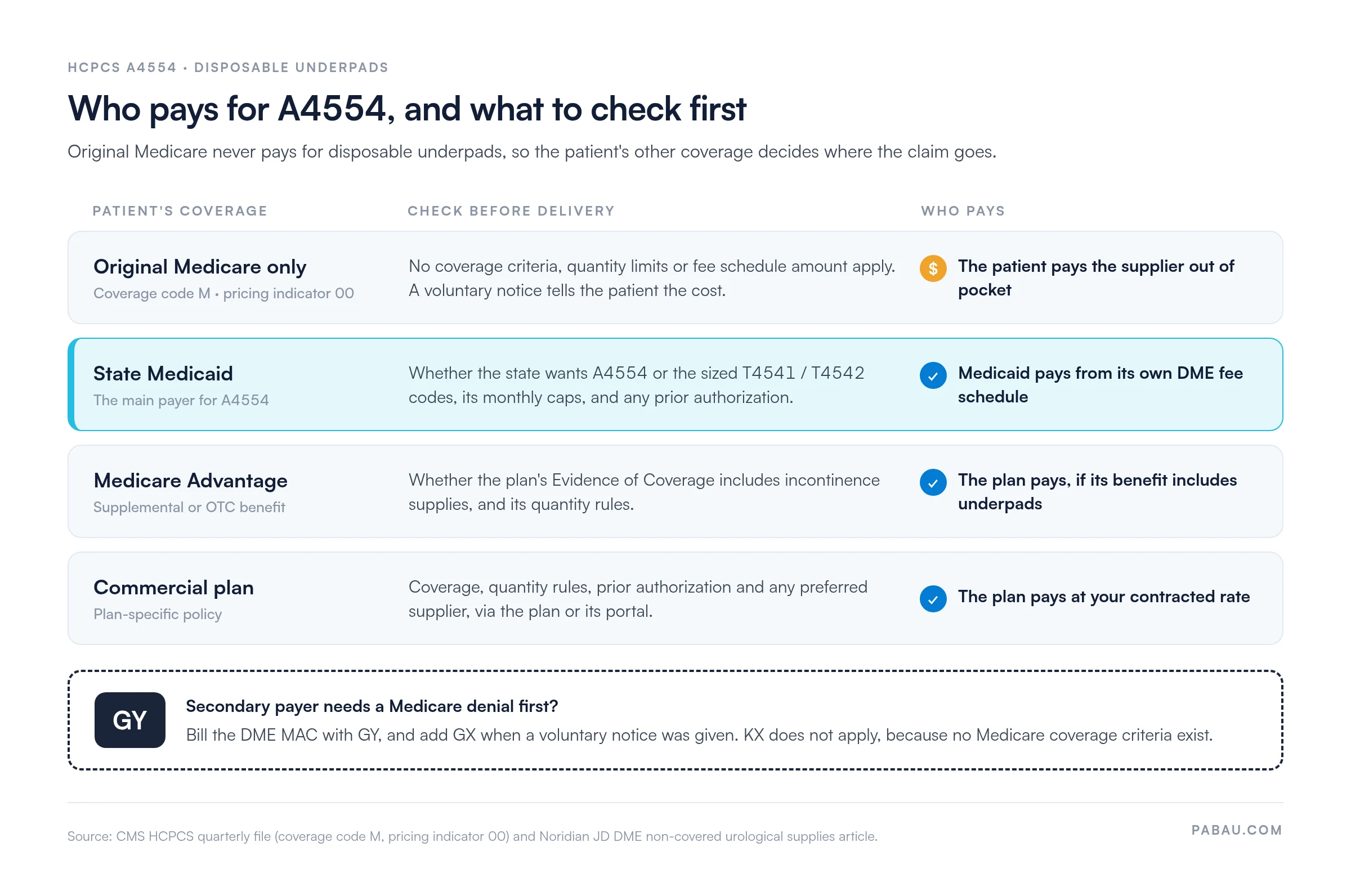
Modifier choice for A4554 depends on the payer. On a Medicare claim the item is never covered, so the modifiers signal expected non-coverage rather than met criteria.
GY tells the DME MAC up front that you expect a denial. The claim then processes quickly and gives a secondary payer the denial it needs.
Medicare sets no quantity limit for A4554, because it does not cover the item. Limits come from each Medicaid program and plan, and no single figure applies across payers.
State Medicaid programs commonly require prior authorization, and the requirements differ widely. Verify the requirement with the state program before the first delivery.
Before requesting a quantity above the payer’s monthly limit, get a signed, dated letter of medical necessity from the prescriber. It should quantify the patient’s incontinence episodes and explain why the standard quantity falls short. File it with the authorization request before delivery, not after a denial arrives.
A4554 denials follow a few recognizable patterns. Most trace back to billing the wrong payer or the wrong code.
Strong denial management strategies for A4554 start before the claim goes out. A pre-submission check of payer, code, modifier, quantity and authorization prevents most of these denials.
Repeated A4554 denials from one payer usually point to a policy detail rather than a coding error. Review that payer’s medical billing compliance requirements, then audit a sample of recent claims against them to find the element being missed.
Run a quarterly audit of your A4554 claims by payer, and compare denial rates across Medicaid, Medicare Advantage and commercial plans. A spike for one payer often points to a policy change, such as a new code or quantity rule. You can then fix it once for every affected claim.
Underpad billing often spreads one patient’s supplies across Medicaid, a private plan and self-pay. The claim history then sits in several portals, and billing teams lose sight of which claims are still waiting.
Pabau includes claims management that lets your team submit claims and track claim status in one place. Claims draw on details already in the patient record, so your team works from one source instead of retyping them.
The outcome is fewer claims lost between payers and a faster answer when a patient asks about a bill.

Pabau’s claims management lets your billing team submit claims and track claim status in one place, so A4554 claims don’t stall between payers.

HCPCS code A4554 gets paid only when it reaches the right payer. Treat Original Medicare as a denial route with GY, and treat Medicaid or the patient’s plan as the source of payment.
The work that protects revenue happens before delivery. Confirm the payer, the code the state expects and any prior authorization, and keep the disposable and reusable codes apart. Proof of delivery then holds up on audit.
Book a demo to see how Pabau helps your billing team submit underpad claims and track their status across payers.

Need a framework for managing denied supply claims? Denial management in healthcare covers the end-to-end process for resolving and preventing claim rejections.
Want to understand how clean claims reduce A4554 rework? What makes a clean claim explains the elements that get claims paid on the first submission.
Looking to strengthen your compliance documentation practices? Medical billing compliance covers the documentation and audit readiness requirements that protect against recoupment.
Billing briefs or pull-ups instead of pads? HCPCS code A4520 covers the incontinence garment code and how to bill it.
Supplying an incontinence item with no specific code? HCPCS code A4335 explains the miscellaneous incontinence supply code.
HCPCS code A4554 covers disposable underpads, all sizes, used for patients with urinary or fecal incontinence. It applies to single-use pads placed under a patient to protect a bed or chair. Reusable underpads are billed under A4553, and wearable briefs fall under A4520 or the sized T-series brief codes.
No, Original Medicare does not cover A4554. CMS lists it with coverage code M, and Noridian’s DME MAC guidance denies disposable underpads because they are not prosthetic devices. Patients pay out of pocket unless Medicaid, a Medicare Advantage plan or a commercial policy covers them.
A4554 covers disposable underpads, all sizes, and A4553 covers non-disposable underpads, all sizes. The products do the same job but are billed under separate codes. Billing a washable pad as A4554 is miscoding and can trigger recoupment on audit.
Medicaid coverage for A4554 varies by state. Some programs cover disposable underpads with few restrictions, while others require prior authorization, cap monthly quantities or bill underpads under T4541 and T4542. Check the state DME policy and any authorization rules before the first claim.
Use the GY modifier, which marks an item outside every Medicare benefit category. Add GX when you gave the patient a voluntary notice of non-coverage. The KX modifier does not apply, since no Medicare coverage criteria exist for A4554.