CCSD code G5100: Bypass of duodenum billing guide
CCSD code G5100 bills a bypass that leaves the duodenum in place CCSD code G5100...

Last Updated: Oct 16, 2026
A4305 is the HCPCS Level II code for a disposable drug delivery system, flow rate of 50 ml or greater per hour. It covers single-use devices such as elastomeric infusion pumps.
Medicare doesn't cover A4305, because CMS Policy Article A52507 says disposable drug delivery systems don't meet the Medicare definition of durable medical equipment. Medicare claims carry the GY modifier, while commercial and Medicaid coverage varies by payer. The labeled flow rate on the device decides A4305 versus A4306.
Let Pabau's smart automation suggest the right codes, reduce claim denials, and keep your practice compliant—effortlessly.
Automate repetitive tasks and focus on what matters most—your patients.
Reduce coding errors and ensure compliance with the latest regulations.
Clean claims, fewer denials, and faster reimbursements.
Powerful insights and reporting to help your practice thrive.
HIPAA compliant SOC 2 certified GDPR-compliant Trusted by 4,000+ clinics worldwide

HCPCS code A4305 covers disposable drug delivery systems, such as elastomeric pumps, with a labeled flow rate of 50 mL/hr or greater.
Medicare doesn’t cover A4305, because CMS Policy Article A52507 says disposable drug delivery systems don’t meet the Medicare definition of durable medical equipment.
Medicare claims for A4305 carry the GY modifier, plus GX when you issued a voluntary ABN, and the KX modifier doesn’t apply.
Commercial plans, Medicare Advantage plans, and state Medicaid programs set their own A4305 rules, so verify coverage and authorization payer by payer.
The device label showing the flow rate is the document that separates A4305 from A4306 on audit.
HCPCS code A4305 is the Level II code for a disposable drug delivery system with a flow rate of 50 ml or greater per hour. The code sits in the A-code range of the HCPCS Level II code set. CMS maintains that set for supplies, devices, and services that CPT, the American Medical Association’s code set, doesn’t capture.
A4305 applies to single-use infusion devices. Elastomeric and spring-loaded pumps with a labeled flow rate at or above 50 mL/hr are the device types billed under this code. Electronic pumps, implantable pumps, and reusable devices have codes of their own. Our HCPCS guides for billers cover many of them, from implantable pumps to pump batteries.
Medicare’s position on the device shapes every A4305 claim. CMS Policy Article A52507 states that disposable drug delivery systems, including elastomeric infusion pumps (A4305, A4306, A9274), are non-covered devices. They don’t meet the Medicare definition of durable medical equipment (DME), and the drugs and supplies used with them are non-covered too.
A4305 covers flow rates at or above 50 mL/hr. A4306 covers flow rates below 50 mL/hr. That single threshold is the only difference between the two codes, so the labeled rate decides which one you bill.
Coders run into trouble because the flow rate lives on the device label, not in the physician order. A prescribing physician typically specifies the drug, concentration, and infusion duration.
The flow rate in mL/hr comes from those parameters or from the label itself. If that label isn’t in the medical record, the claim is unsupported on audit, whichever code was billed.
When the practice keeps the manufacturer’s lot label or product specification sheet, flow-rate verification becomes a one-line check. Without it, the coder is estimating, and estimates are audit risk. Always retain the device label as part of the dispensing record.
Check the device manufacturer’s product label before selecting A4305 or A4306. The labeled flow rate determines the correct code. A physician order stating infusion duration alone isn’t enough, because duration doesn’t specify mL/hr. Confirm the rate is documented in the dispensing record before billing.
Medicare denies A4305 on benefit-category grounds rather than on medical necessity. The external infusion pump policy covers durable pumps, such as E0781, when a patient meets the coverage criteria. A disposable elastomeric pump fails at an earlier step, because it isn’t durable equipment at all. No diagnosis, order, or chart note changes that outcome.
That has four practical consequences for billers.
For a non-covered item, the Medicare claim has a different purpose. You submit it to get a clean denial, which a secondary payer often needs before it will pay.
Prior authorization doesn’t arise for A4305 under Traditional Medicare, because there’s no coverage to authorize. The work shifts to the other payers on the account. Insurance eligibility verification should identify each one before the device is dispensed.
Coverage outside Traditional Medicare is set payer by payer.
When a payer requires authorization and it wasn’t obtained, an appeal rarely succeeds on the merits. Build the check into the dispensing workflow so it happens before the device leaves the practice.
A4305 documentation has two jobs. It proves the device matches the flow-rate code, and it shows the patient knew who would pay. Standard medical billing compliance practice calls for these records before you bill.
Keep these records for as long as your longest payer contract or state rule requires. Many practices treat seven years as the floor.
A4305 is billed per device. Each disposable delivery system dispensed counts as one unit, and every unit needs its own entry in the dispensing record. Billing more units than the log shows is a common audit trigger for supply codes.
Clean claim submission for A4305 comes down to two checks, shown below. The labeled flow rate picks the code, and the payer and paperwork pick the modifier.
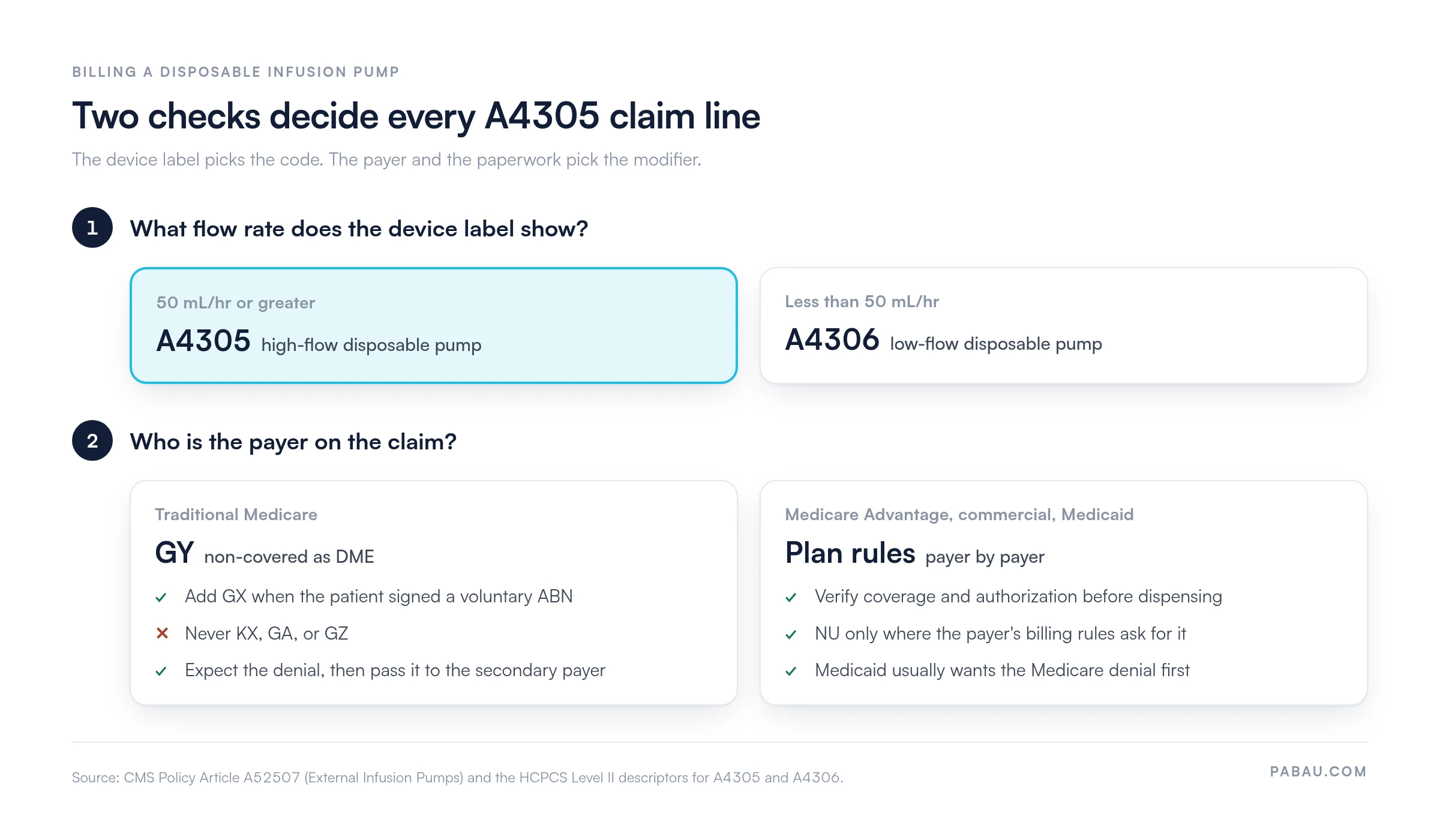
A KX modifier on an A4305 line is the error to fix first. It attests that coverage criteria were met, and no such criteria exist for a non-covered device. Pabau’s claims software for billing teams keeps each claim’s code, modifiers, and status in one record. Your team can confirm a Medicare line carries GY before it leaves the practice.
On a CMS-1500 paper claim, A4305 and its modifiers go in item 24D. On an electronic 837P, the code sits in loop 2400, segment SV1, with the modifiers appended. Place of service for home use is typically 12 (home). The superbill should capture the lot number, quantity, date dispensed, and modifiers applied.
Medicare doesn’t pay for A4305 in 2026, because the device is non-covered as DME. The CMS DMEPOS fee schedule is the reference for covered supplies. For A4305, set the expected Medicare payment at zero so your aging reports don’t carry a balance that won’t arrive.
Reimbursement comes from one of four sources.
Third-party fee aggregators often lag behind payer updates. Take rates from the payer contract or the state’s published schedule, and refresh them in your billing system every January.
Effective denial management workflows for A4305 separate expected denials from avoidable ones. A Medicare denial on a GY line is the expected result. The rows below are the avoidable kind.
A4305 rarely appears alone in an infusion episode. The drug carries its own J-code or NDC, and a durable pump used instead carries an E-code. Catheter supplies for that durable pump are billed weekly under A4221.
Know the adjacent codes to avoid miscoding or billing two devices for one infusion. The AAPC HCPCS code lookup is a useful reference for confirming descriptor language.
When a patient switches between a durable pump and a disposable one mid-course, bill each device under its own code and modifier. E0781 lines follow the A52507 coverage criteria and carry KX, GA, or GZ. A4305 lines carry GY.
Three records have to line up to bill A4305 cleanly. They are the dispensing log, the signed ABN, and the claim. When they sit in separate systems, a KX slips onto a Medicare line or a secondary claim goes out without the Medicare denial.
Pabau keeps those records on one patient file. Digital forms collect the voluntary ABN with an e-signature before the device is dispensed. Inventory tracking logs each pump against the treatment note, and the claim sits alongside both.
Your billing team checks the code, the flow-rate label, and the modifiers in one place before submission. The Medicare denial, the patient notice, and the device record then agree. The handoff to the patient or a secondary payer goes through without rework.

Pabau keeps the signed ABN, the dispensing record, and the claim on one patient file. Your team can confirm the A4305 code and modifiers before submission.

Treat A4305 as a self-pay or other-payer item from the moment it’s ordered. A52507 settles Medicare’s answer, so the only Medicare task is a GY claim that denies cleanly.
The decisions that protect your revenue happen before dispensing. Confirm the flow rate from the label, get a voluntary ABN signed if you use one, and check the commercial or Medicaid plan. A few minutes at intake costs far less than chasing a balance no payer will settle.
Book a demo to see how Pabau keeps the ABN, the dispensing record, and the claim together for every non-covered device you bill.

Need to understand denial codes on rejected A4305 claims? Denial codes in medical billing explains common CARC and RARC codes and how to action them.
Need to match a Medicare denial to the right claim line? Electronic remittance advice covers how ERA files map denial reasons back to specific claim lines.
Billing a durable pump instead of a disposable one? HCPCS code K0455 covers the infusion pump used for uninterrupted parenteral medication.
Coding an implanted pump rather than a disposable one? HCPCS code C1772 explains how the programmable implantable infusion pump is billed.
HCPCS code A4305 covers a disposable drug delivery system with a flow rate of 50 mL/hr or greater. It applies to single-use elastomeric and spring-loaded devices. Electronic, implantable, and reusable pumps have their own codes.
No. CMS Policy Article A52507 classes disposable drug delivery systems, including A4305, as non-covered because they don’t meet the Medicare definition of durable medical equipment. The drugs and supplies used with them are non-covered too.
Use the GY modifier, which marks an item that isn’t a Medicare benefit. Add GX if you issued a voluntary ABN. Don’t append KX, GA, or GZ, because those apply to covered items and medical necessity denials.
A4305 applies to disposable drug delivery systems with a flow rate of 50 mL/hr or greater. A4306 applies to the same device type but with a flow rate below 50 mL/hr. The only distinction is the flow-rate threshold, which must be confirmed from the device label before billing either code.
Not under Traditional Medicare, because the item isn’t covered. Medicare Advantage plans, commercial insurers, and state Medicaid programs set their own rules. Check each plan’s authorization requirements before dispensing.
Yes. For a Medicare patient the device is the patient’s responsibility unless another payer covers it. No ABN is required for a statutorily non-covered item, but a voluntary ABN tells the patient the cost in advance.
A4305 is billed per device dispensed, not per day. The number of billable units equals the number of disposable delivery systems dispensed, each with its own line in the dispensing record. Billed quantity must match the dispensing log exactly, because quantity mismatches are a common audit trigger.
Medicare doesn’t pay for A4305 in 2026, so there’s no Medicare allowable to collect. Reimbursement comes from commercial contracts, state Medicaid schedules, or the patient. Take rates from the payer contract or the state’s published schedule.