



CCSD code G5100: Bypass of duodenum billing guide
CCSD code G5100 bills a bypass that leaves the duodenum in place CCSD code G5100...

Last Updated: Oct 16, 2026

CPT code 99233 covers one day of subsequent hospital inpatient or observation care at the high complexity level. The alternative pathway is 50 minutes or more of total physician time.
Time and medical decision making are alternative pathways, so the note has to spell out whichever one the claim rests on.
The pre-2023 code set listed 35 minutes as the typical time for 99233. That retired figure is still the most common reason teams bill the wrong level.
Thin MDM documentation is the leading denial reason, so two of the three MDM elements must read at high complexity in the record.
Practice management software like Pabau submits CMS-1500 claims, runs real-time eligibility checks, and confirms the fields an insurer requires are filled before the claim leaves.
CPT code 99233 is the highest level of subsequent hospital inpatient or observation care in the CPT set. You report it for a follow-up day that needs high complexity medical decision making, or at least 50 minutes of your total time.
This guide covers the documentation, the decision making rules, the 2026 RVUs, and the checks that keep a 99233 claim clean on the first pass.
CPT code 99233 reports one day of subsequent hospital inpatient or observation care at the high complexity level. It applies from the second day of the stay onward, once an initial hospital care code such as 99221 to 99223 has been billed. The American Medical Association maintains it as part of the CPT set.
Each day the attending physician rounds on that patient earns its own code from the 99231 to 99233 range. The level comes from the medical decision making documented that day, or from the physician’s total time. Yesterday’s note carries no weight for today’s level.
Every 99233 claim rests on one of two pathways: high complexity MDM, or a stated total time of 50 minutes or more. Reviewers will not infer either one from how sick the patient reads on the chart. Each encounter also has to stand on its own, so a previous day’s note cannot support today’s level.
The 2021 AMA E/M framework reached subsequent hospital care on January 1, 2023. It retired the old counting of history elements and exam systems. In its place you document a medically appropriate history and exam, plus the basis for the level you billed.
High complexity MDM is the pathway most 99233 claims rest on, and it is where most of them fail. The AMA framework scores three elements separately. To reach 99233, at least two of the three have to sit at the high complexity level.
Here is how that reads in a note. A patient in septic shock stays on norepinephrine overnight. The physician reviews the transferring hospital’s records, reads the chest CT personally, and calls nephrology about a rising creatinine. Two elements clear high complexity: the problem threatens life, and the vasopressor titration is high risk.
One high complexity element on its own does not get you there. So when you review a progress note, look for explicit language in at least two of the three columns above before you assign this level.
Since 2023 you can bill CPT 99233 on total time alone. Total time means every minute the billing physician personally spends on that patient’s care that day, face-to-face or not.
Watch the numbers here, because two sets are in circulation. The pre-2023 code set listed 15, 25 and 35 minutes as typical times for 99231 to 99233. Current thresholds run 25, 35 and 50 minutes. Plenty of cheat sheets and note templates still carry the retired figures, which is how a 35-minute day ends up billed as 99233.
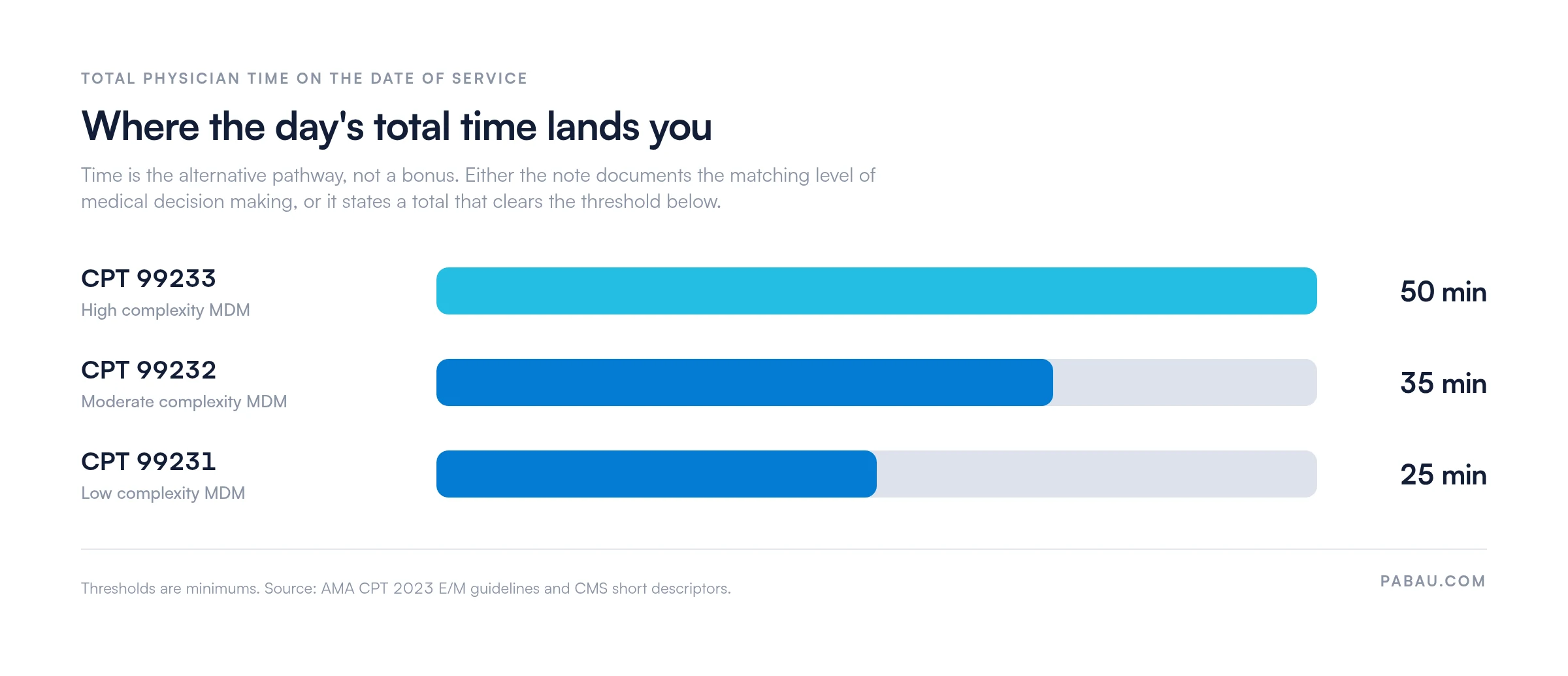
Time billing helps most when the day is long but not clinically dramatic. Think of a stable patient whose family needs an hour of counseling, or a discharge that takes three consultants to line up.
When you bill 99233 on time, record the window as well as the total. A note reading ‘total physician time 9:05 AM to 10:00 AM, 55 minutes’ beats a bare total. Then list what filled those minutes: record review, examination, the call to cardiology, documentation.
Medicare pays 99233 from the Physician Fee Schedule, so the amount depends on where you practice. Geographic adjustment runs through the Geographic Practice Cost Index, known as GPCI, which scales each RVU component to local costs. The CMS fee schedule lookup tool holds the current national and locality rates.
The formula is the same for every code. Take the total RVU, apply the GPCI adjustment, then multiply by that year’s conversion factor. Subsequent hospital care almost always happens in a facility, so hospitalists should look at the facility rate.
Relative value units, known as RVUs, are how CMS measures the resources a service consumes. For 99233 in 2026 the work RVU is 2.40 and the total RVU is 3.20. CMS publishes the current figures in its relative value files, which are updated every year.
One myth is worth clearing up. Practice expense RVUs for 99233 are 0.62 in both the facility and the non-facility column, so this code carries no facility penalty. The setting changes your place of service code, not the payment weight.
Compare G0237, where the facility rate for a hospital outpatient department sits below the non-facility rate. The non-facility figure is higher because it carries the provider’s own overhead.
The three subsequent care codes share one setting and split on two axes: MDM level and total time. Pick too high and you carry compliance risk. Go too low and you hand back revenue you already earned.
Here is a decision rule that holds up on the ward. Ask whether the patient is deteriorating, whether you started a high-risk therapy, or whether the day ran close to an hour.
If any of those is true, 99233 fits. When the day’s work does not reach that bar, 99232 is usually the right call. Let the documented level decide, not how busy the round felt.
Before 2023, subsequent inpatient care ran on 99231 to 99233 and subsequent observation care on 99224 to 99226. Billers had to track the patient’s formal status, and a status change mid-stay often broke the claim.
That split is gone. CPT 99231, 99232 and 99233 now cover subsequent care in both settings. You still have to confirm the initial encounter was billed correctly before you bill day two. Status also still drives your place of service code, even though it no longer drives the E/M code.
A 99233 charge passes five checkpoints between the progress note and the remittance. Knowing where it can stall tells you what to fix first.
Payment is not the end of it either. A post-payment review can pull the chart months later, which is why the note matters more than the claim form.
CPT 99233 appears on the CMS Recovery Audit Contractor list as approved topic 0037. That topic targets per-diem duplicates, meaning the same subsequent or initial hospital care code billed twice on one date for the same patient and physician. A code on that list draws post-payment review, so the documentation has to hold.
Most rejections come back with a claim adjustment reason code attached. Reading those denial codes first tells you whether to correct and resubmit or write an appeal.
Run a monthly code distribution report showing the split of 99231, 99232 and 99233 claims per physician. Flag any provider who bills 99233 on more than 40 to 50% of their subsequent care days. A clinical documentation review is cheaper than a payer audit.
The diagnosis codes on a 99233 claim have to describe a patient sick enough to justify high complexity care. Payers read the principal and secondary ICD-10 codes against the E/M level. A mild diagnosis sitting next to a 99233 charge is one of the clearest denial triggers there is.
Code to the highest specificity the record supports. Sepsis, unspecified organism works while cultures are pending. Once the organism is named, update the code. Auditors read that kind of precision as a sign the rest of the documentation is sound.
Hospitalists round on 15 to 20 patients in a session. Capturing two high complexity MDM elements per chart, or a defensible time total, is a lot of typing between beds. The result is undercoding on the busy days and level creep on the quiet ones.
Practice management software like Pabau will not read a clinical note for you, and no billing tool honestly can. What it does is take the mechanical work off the billing team. Pabau’s claims management software submits CMS-1500 claims through the Claim.MD clearinghouse, which reaches thousands of US payers.
Before a claim leaves, Pabau confirms the fields the insurer requires are filled, including membership and authorization numbers. Real-time eligibility runs on the 270 and 271 transactions, so you know the coverage holds before the encounter.
Claim status and ERA or 835 remittance files come back into the same record, which makes denial patterns easier to read than a monthly spreadsheet.

Pabau submits CMS-1500 claims through the Claim.MD clearinghouse, checks the fields each insurer requires, and posts ERA remittances straight back to the patient record. See how it fits an inpatient billing workflow.

The safest way to bill 99233 is to make the note do the work. When the note puts two MDM elements at high complexity, or states a total of 50 minutes or more, the code defends itself. Without that, no amount of clean claim formatting will save it.
The trade-off worth remembering runs both ways. Teams that fear an audit drift down into 99232 and lose revenue they earned. Those who never look at their own code mix drift up and invite one. A monthly glance at the distribution per physician keeps you honest in both directions.
If the mechanical side of the claim is what slows your team down, that part can be handed over. Book a demo to see how Pabau submits CMS-1500 claims, verifies coverage in real time, and posts remittances back for inpatient billing teams.

Need to see what a clearinghouse submission looks like end to end? How a medical claims clearinghouse works follows the claim from provider to payer.
Want to know how the 837 electronic file is built? The 837 claim file format explained breaks down the transaction set for professional and institutional claims.
Researching a denial code after a 99233 rejection? Denial codes in medical billing maps the common CARC codes to their causes and appeal routes.
Losing money to rework on rejected claims? Denial management in healthcare sets out how to triage, appeal and prevent repeat denials.
Aiming to get paid on the first submission? What makes a clean claim lists the fields and checks that keep a claim out of the rework pile.
Only one physician of a given specialty in a group can report subsequent care per day. A physician from a different specialty may bill their own subsequent care code for the same date. Each has to document a separate, medically necessary problem.
Yes, where the state scope of practice and the payer’s enrollment rules allow it. The nurse practitioner or physician assistant bills under their own NPI, and the note must show who did the work. Split or shared billing rules apply when a physician also contributes to the same encounter.
Use place of service 21 for a formal inpatient admission. Use 22 for a patient held in observation on the hospital campus. The E/M code is the same either way, but the wrong place of service can still trigger a rejection.
No. Discharge day management codes 99238 and 99239 replace subsequent care on the date the physician finalizes the discharge. Billing both for the same patient and date will not clear the payer’s edits.
No. Medicare gives E/M visit codes an XXX global indicator, so the global surgery concept does not apply. Each day of subsequent care is billed on its own.



