



CCSD code G5100: Bypass of duodenum billing guide
CCSD code G5100 bills a bypass that leaves the duodenum in place CCSD code G5100...

Last Updated: Oct 16, 2026

CPT code 99392 is the periodic preventive medicine visit for an established patient aged 1 to 4.
Medicare does not cover this code, because routine physical checkups are excluded by statute.
The note has to show an age-appropriate history, a comprehensive exam, anticipatory guidance by topic, risk counseling, and any orders.
When a sick visit happens on the same day, modifier 25 goes on the E/M code and never on 99392.
Pabau’s claims management software checks that a claim’s required fields are complete before submission, then tracks eligibility, status, and ERA remittances.
CPT code 99392 is the periodic preventive medicine visit for an established patient aged 1 to 4. Pediatric and family practices bill it for the routine well-child check on a child they have seen before.
Medicare pays nothing toward 99392, because routine physical checkups are excluded from coverage by statute, so commercial plans and state Medicaid programs set the rate.
Below, we work through the official wording, the documentation, and the diagnosis pairings. Then come the rates, the modifiers, and the denials that keep coming back.
Three tests decide whether 99392 is the right code. The patient has to count as established. That means a provider of the same specialty in the same group saw the child within three years.
The child’s age on the date of service has to fall between 1 and 4. And the encounter has to be a periodic preventive check rather than a visit built around a complaint.
The American Medical Association describes the service as a “periodic comprehensive preventive medicine reevaluation and management” of an established patient aged 1 to 4 years.
The descriptor then names what the encounter has to contain:
Every component in the descriptor has to occur during the encounter, and the chart has to demonstrate each one. Payers deny 99392 when the note cannot show the full set.
Here is what each component looks like in a room with a toddler in it.
Medicaid’s EPSDT benefit requires a blood lead test at ages 1 and 2, which bills as 83655 on the same encounter.
Anticipatory guidance deserves its own attention. Per AAPC coding resources, a note that records guidance as a checkbox or a single word leaves post-payment audits an easy target. Name the topics you covered.
An auditor reads the chart, not the visit. If a required element is not on the page, the claim is exposed even when the provider did the work.
Run the list below as a closing check before the encounter is signed off:
Template-driven notes carry most of this load. A well-child template that prompts for growth measurements, immunization status, and named guidance topics closes with far fewer holes than a blank text box.
It also makes the chart faster to defend a year later, when nobody remembers the appointment.
A 99392 claim with no abnormal findings goes out with Z00.129. When the exam turns something up, the primary diagnosis becomes Z00.121 and the finding is coded behind it.
Both sit in the Z00 category, which covers encounters for general examination with no complaint or reported diagnosis.
The abnormal-findings version is where claims go wrong. Z00.121 on its own says an abnormality was found without naming it, so the finding needs its own secondary diagnosis code.
That pairing feeds payer reporting and downstream risk adjustment, so it is worth getting right the first time. Check both codes against the current ICD-10-CM code index, since the tabular list updates every October 1.
Medicare does not cover CPT 99392. Routine physical checkups are excluded from Medicare by statute, under Section 1862(a)(7) of the Social Security Act.
No locality adjustment changes that, because there is no allowed amount to adjust. Commercial plans and state Medicaid programs carry the code instead, and they sit at very different rates.
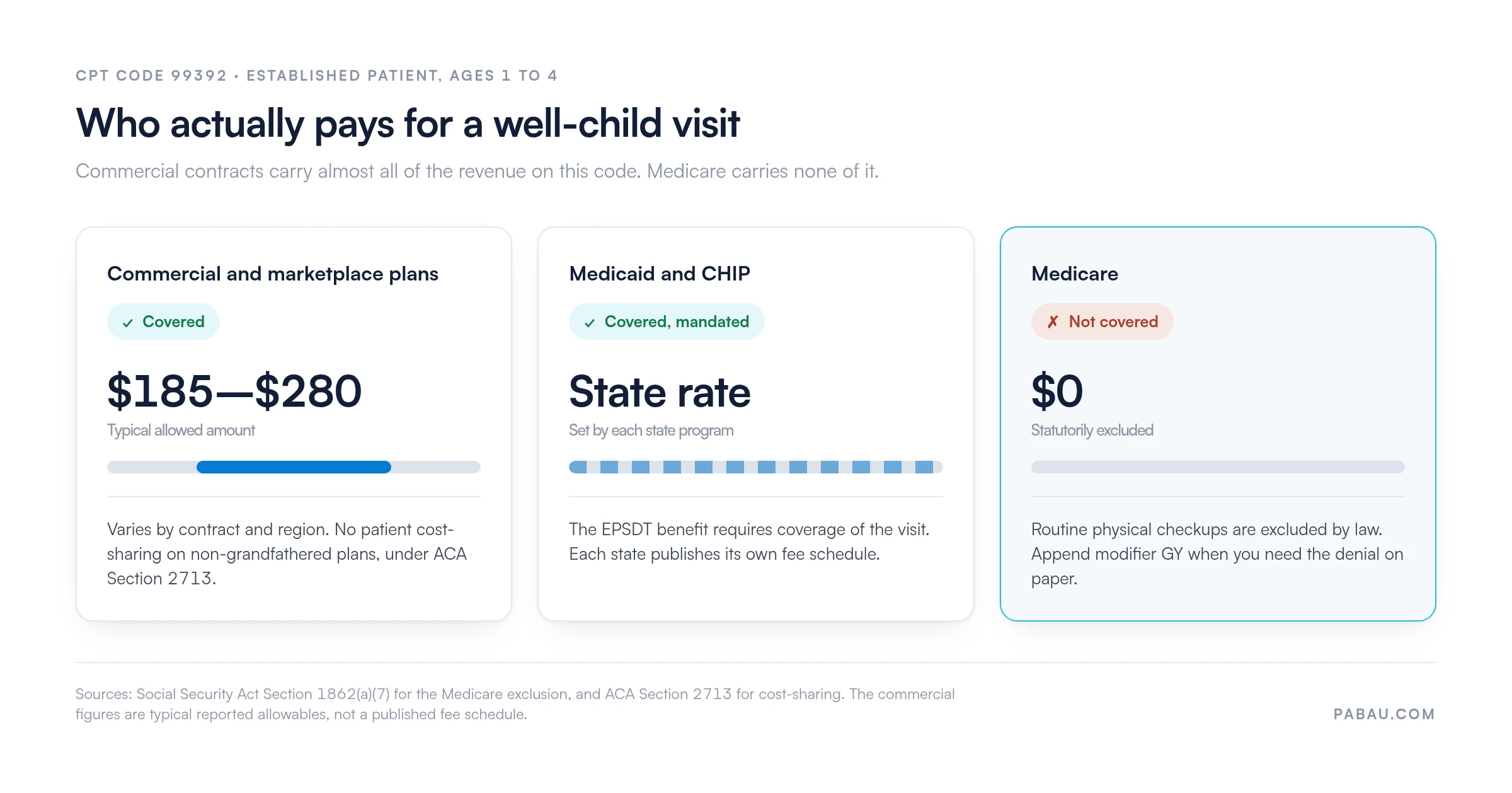
The figures below are 2026 estimates. Confirm your own numbers against the payer contract. The CMS Physician Fee Schedule lookup tool is where you show a payer exactly where this code stands with Medicare.
Section 2713 of the Affordable Care Act also matters here. Preventive services with a USPSTF grade A or B recommendation must be covered without cost-sharing on non-grandfathered plans, and well-child visits sit inside that mandate.
It changes what the family owes, not what the plan allows, so your fee schedule does not move. Grandfathered plans can still apply a copay, which is why an eligibility check before the appointment earns its 30 seconds.
When a secondary payer needs a Medicare denial on file, append GY to 99392 and let the claim deny. The remittance then becomes the paperwork the secondary asks for. Billing it without GY produces the same denial, just slower and without the clean trail.
Modifier 25 belongs on the E/M code. Getting that backwards is one of the more common reasons the problem-oriented half of a visit goes unpaid.
Two modifiers matter on a routine 99392 claim, and a third only shows up when Medicare is involved.
Here is how modifier 25 works in practice. A provider runs a full well-child exam and, in the same appointment, treats an acute ear infection.
The claim carries 99392 for the preventive visit and 99213-25 for the ear infection. Each service needs its own documentation, with the E/M note standing on its own medical decision-making or time.
A well-child visit rarely bills as a single line. Screening tools, vaccines, and caregiver assessments are separately reportable when they are performed and documented.
Bundling policies differ by payer, so confirm each combination before you make it routine.
The 99381-99397 series splits cleanly. Codes 99381 to 99387 cover new patients, and 99391 to 99397 cover established ones. Within each group, one code owns one age band, and 99392 owns 1 to 4 in the established column.
The new-versus-established test follows the standard CPT rule. A patient nobody of the same specialty in the group has seen in three years is new. So a child transferring in from another practice is new, while a child back for their annual check is established.
Coding that returning child as 99382 is a familiar audit trigger. A scheduler can usually prevent it before a coder ever sees the chart.
CPT code 99392 covers the preventive exam, and an office E/M code from 99211 to 99215 covers a problem-oriented visit. Swapping one for the other misrepresents what happened in the room.
A preventive visit is booked for health maintenance, while a problem-oriented visit answers a symptom, a condition, or a chronic care need.
Both can happen in one appointment. If a provider completes the full well-child exam and also evaluates an ear infection that needs its own decision-making, both services are billable.
Three scenarios cover almost every case:
Separate documentation templates make this much easier to hold onto. One note for the preventive visit and one for the problem keeps both services defensible. A single merged note usually supports only one of them.
Denials on this code are repetitive, which is good news, because repetitive problems are fixable at the template level.
The table below collects the six that recur most in pediatric preventive billing, each with the correction that stops it.
Pull your last 30 CPT 99392 claims and check two things: where modifier 25 landed, and which diagnosis went out as primary. Those two account for a disproportionate share of preventive denials. A 30-claim sample is usually enough to expose a template problem before it repeats across hundreds of future claims.
You can head off most of these denials in the minute before a claim leaves the practice. Six checks, in this order, cover it:
Then check the payer before you send. Commercial and Medicaid claims go out normally, while a Medicare claim needs GY if you want the denial in writing.
From there the claim moves through your clearinghouse to the payer. It comes back as an 835 remittance, which posts against the invoice and shows whether the check matches the contract.
Preventive billing errors repeat because they live in the workflow rather than in one coder’s memory. The same wrong patient type comes back next month, and so does the same thin guidance note.
Practice management software like Pabau keeps the clinical record and the claim in one system. That way the claim starts from what the provider already charted.
Pabau’s medical claims management tools pre-fill the claim from that record. The CPT code attached to the service lands on the charge line, and the ICD-10 slots are seeded from the patient’s recorded problem list.
Full ICD-10-CM and CPT lookup libraries sit behind a search icon, so a coder can confirm Z00.129 without leaving the claim.
Before the send button unlocks, Pabau checks that the claim’s required fields are complete. A missing membership or authorization number surfaces in the practice rather than on a remittance three weeks later.
Submission then runs through Claim.MD, the US clearinghouse Pabau connects to, which reaches thousands of payers. Real-time eligibility checks, claim status tracking, and 835 remittance posting come back the other way.
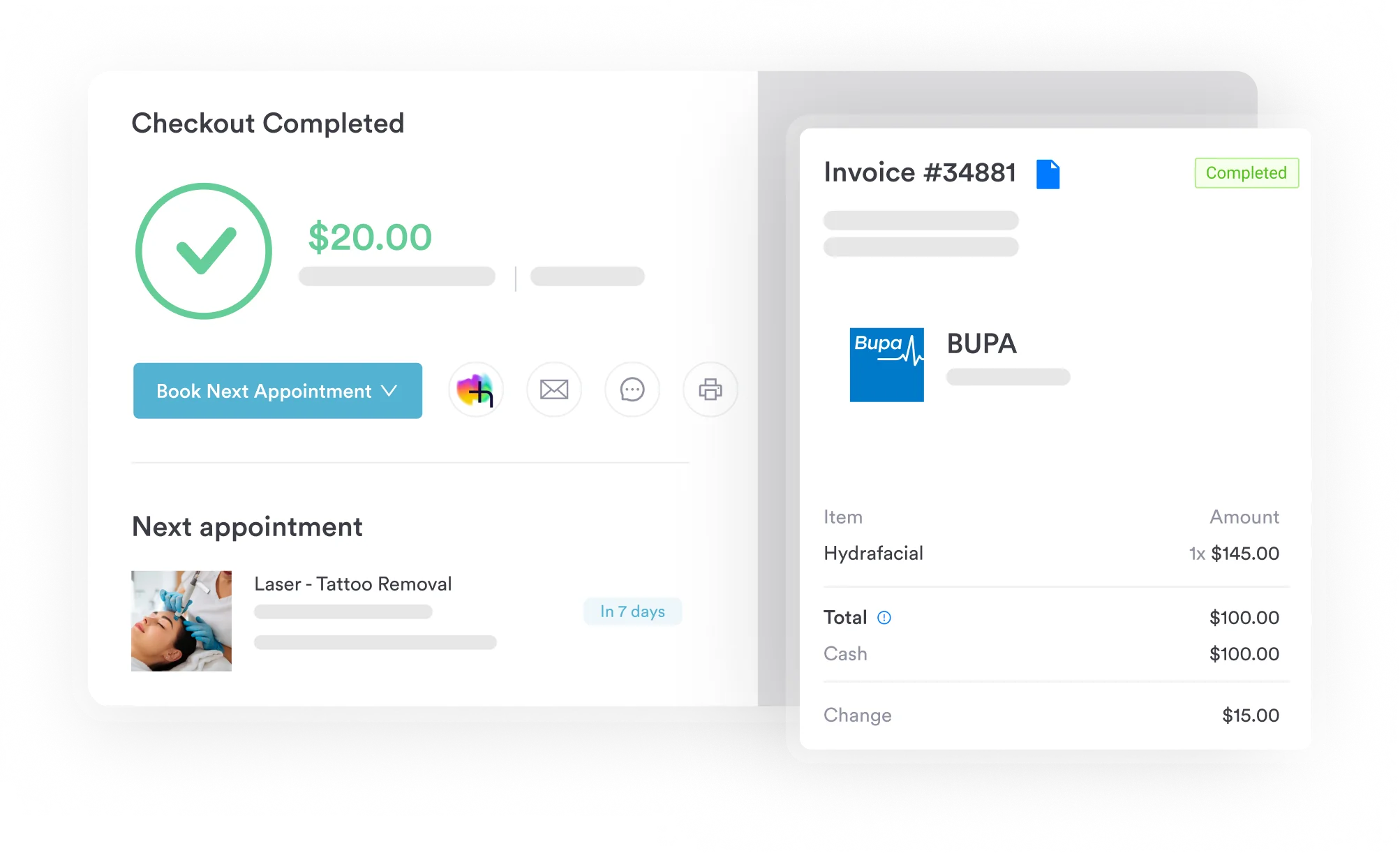
Automated remittance posting is where most of the time comes back. Denial follow-up stops being a month-end reconstruction job. The outstanding claims already sit in one list with their status attached.

Pabau builds each claim from the patient record and checks that its required fields are complete. Pabau then tracks eligibility, claim status, and ERA remittances in one place. Pediatric and primary care teams spend less of the month chasing denials.

CPT code 99392 rewards consistency more than coding skill. Patient type, the age on the date of service, and modifier placement are the three checks that decide whether the claim pays. Build them into the note template and the pre-submission review, and the code mostly stops generating work.
The trade-off worth remembering is where the revenue comes from. Medicare pays nothing here, so commercial contracts and your state Medicaid rate are what make a well-child schedule viable. Track the allowed amounts plan by plan, rather than the national average you would reach for on a Medicare code.
If you would rather have those checks running inside the workflow than on a sticky note, look at how the software handles it. Book a demo to see a preventive claim built, validated, and tracked in one place.

Need to understand how claims clearinghouses process your 99392 submissions? Medical claims clearinghouse guide covers how payers receive and adjudicate electronic claims.
Want to reduce denial rates across your preventive care billing? Denial codes in medical billing explains the most common CARC reasons and how to respond to each one.
Looking to verify insurance eligibility before well-child visits? Insurance eligibility verification outlines how real-time checks reduce patient billing disputes.
Billing a developmental screen alongside the well-child visit? CPT code 96110 covers the scoring and documentation a standardized screening tool needs.
Want fewer claims coming back at all? Clean claim sets out what a payer needs on a first submission to adjudicate it without a rework cycle.
No. Routine physical checkups are statutorily excluded from Medicare under Section 1862(a)(7) of the Social Security Act, so the allowed amount is zero. Medicare’s own wellness benefits use different codes: G0402 for the initial preventive physical exam, then G0438 and G0439 for annual wellness visits.
Once per scheduled well-child visit, following the periodicity schedule the payer recognizes. Bright Futures and the AAP place visits at 12, 15, 18, 24, and 30 months, then annually at ages 3 and 4. A second preventive claim inside the same interval usually denies as a duplicate.
No. Preventive medicine codes are not selected by time, unlike office E/M codes such as 99213. Age, patient type, and the elements performed decide the code, so a 20-minute well-child visit and a 40-minute one both bill as 99392.
Yes, where state scope of practice allows that provider to perform a comprehensive preventive exam. The claim goes out under the rendering provider’s NPI once they are credentialed with the plan. Some payers reimburse mid-level providers at a reduced percentage, so check the contract first.
The visit still bills as 99392 when the required elements were performed and documented. Record the discussion and the refusal in the note, and leave the administration codes off the claim. Add Z28.82 for immunization not carried out because of caregiver refusal.



