HCPCS Code G0163: Skilled nursing observation and assessment
What is HCPCS Code G0163? HCPCS Code G0163 is a deleted Level II code for skille...

Last Updated: Oct 15, 2026
99382 is the CPT code for preventive medicine evaluation and management, new patient; 1 through 4 years.
Pediatric practices bill it for well-child visits. The visit covers age-appropriate history, physical examination, counseling, anticipatory guidance, and risk factor reduction, plus any lab or diagnostic orders. Billing 99392 by mistake, or submitting without complete documentation, is the most common reason these claims are denied.
Let Pabau's smart automation suggest the right codes, reduce claim denials, and keep your practice compliant—effortlessly.
Automate repetitive tasks and focus on what matters most—your patients.
Reduce coding errors and ensure compliance with the latest regulations.
Clean claims, fewer denials, and faster reimbursements.
Powerful insights and reporting to help your practice thrive.
HIPAA compliant SOC 2 certified GDPR-compliant Trusted by 4,000+ clinics worldwide

CPT Code 99382 covers initial comprehensive preventive visits for new patients aged 1 through 4 years only.
The established-patient equivalent is CPT 99392, and using the wrong one triggers an automatic denial.
Documentation must name the age-appropriate history, physical exam, anticipatory guidance topics, and any lab orders.
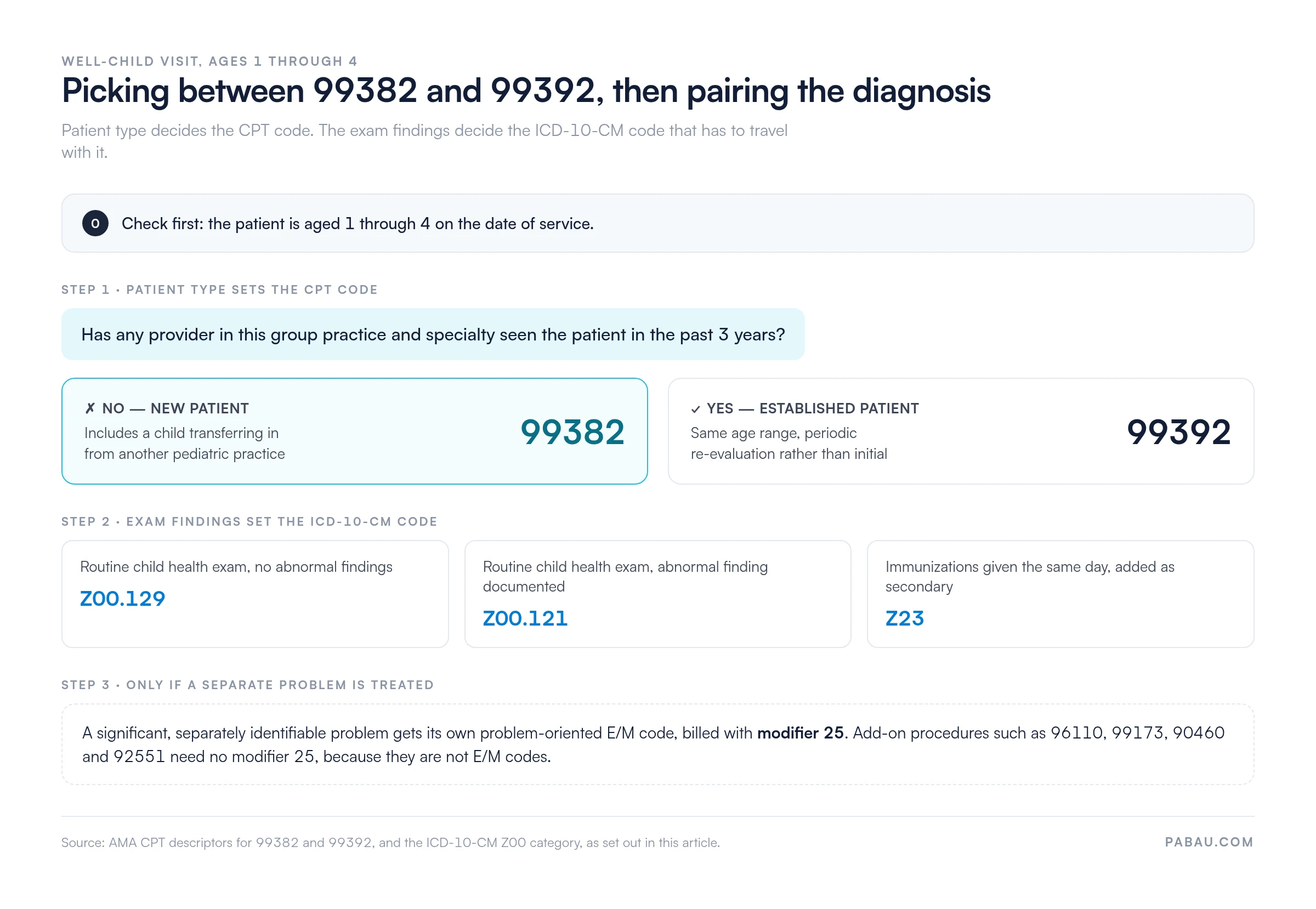
Z00.129 and Z00.121 are the ICD-10-CM codes that pair with the visit, and Z23 is added for same-day immunizations.
Pabau’s claims management software validates the required claim fields before submission, so fewer 99382 claims come back for rework.
CPT Code 99382 is the initial comprehensive preventive medicine evaluation and management (E/M) code for new patients aged 1 through 4 years. The descriptor comes from the American Medical Association (AMA), which owns and publishes the CPT code set. The code belongs to the preventive medicine new patient series 99381-99387, and selection within that series turns on the patient’s age at the visit.
It covers well-child visits through toddlerhood and early childhood. The American Academy of Pediatrics (AAP) Bright Futures schedule places several visits in that window. New patient status means no provider has treated the child in the past three years. That test covers the billing provider and anyone of the same specialty in the same group practice.
A 99382 visit must include all the following clinical elements to meet the AMA’s descriptor. Missing any one of them exposes the claim to medical necessity denials or documentation audits.
Anticipatory guidance documentation is the element auditors look for most closely. A note that says “counseling discussed” without specifying the topics covered is insufficient. List each guidance topic by name.
CPT 99382 applies exclusively to new patients. 99392 is the established patient equivalent for the same age range. Picking the wrong one is the most common billing error in this code family. It produces an automatic denial, because the payer verifies patient type against its own claim history for that practice.
A patient counts as new when no provider in the same group practice and specialty has seen them for three years. A child transferring in from another pediatric practice qualifies as new. Years of care elsewhere make no difference, because the three-year clock runs against this practice only.
The chart below walks the same decision in order, from the age check to the diagnosis code on the claim.
CPT Code 99382 sits within two parallel series of preventive codes. Knowing the full series helps when a child’s birthday falls near the visit date. It helps again when several providers in one group see children of different ages. The wider CPT code library carries the reference pages for the rest of the lifespan.
Every 99382 claim requires a supporting ICD-10-CM diagnosis code. The correct codes come from the Z00 encounter for examination chapter. Using a symptom or illness code instead, unless a separate billable problem is addressed, causes payer edits that bundle or deny the claim.
Verify all ICD-10-CM codes against the current fiscal year guidelines. The CDC/NCHS ICD-10-CM web tool provides the official annual code lookup. Codes update each October 1, and billing a retired or modified Z-code causes payer rejections that are preventable with an updated reference.
Medicare rarely covers pediatric well-child visits, because Medicare serves adults 65 and older. Medicaid and commercial payers therefore set the reimbursement picture for CPT Code 99382. Rates change annually, so verify each one against the current CMS Physician Fee Schedule lookup and your own payer contracts.
Medicaid reimbursement for 99382 is administered at the state level and varies widely. Before billing a new Medicaid plan, pull the state-specific EPSDT fee schedule and confirm the exact rate for the current plan year. Some state Medicaid plans also require prior authorization for well-child visits beyond a set annual frequency.
Incomplete documentation is the second most common reason 99382 claims are denied on audit. The note must reflect every component of the AMA descriptor, not just the physical exam findings. Practices that rely on templated notes should confirm each section is individually completed rather than cloned from a prior visit.
Every note should be dated, signed, and stored where an auditor can retrieve it on request. Practices still working on paper tend to fail here first. A note written on a chart and typed up later often loses the counseling detail that justified the code.
Records from this age band are often shared with specialists or with a preschool. The note therefore needs consent language and a record of how the data was handled. Structured digital forms that populate straight into the clinical note cut the odds of an omission.
Modifier 25 is appended to a separate, significant E/M service performed on the same date as a 99382 well-child visit. The modifier signals to the payer that the additional E/M was for a distinctly different reason from the preventive visit and is separately billable.
Take a 2-year-old who arrives for a scheduled well-child visit. During the exam the clinician finds acute otitis media, then evaluates, diagnoses, and treats it.
The preventive visit is billed as 99382. The problem-oriented E/M is billed alongside it with Modifier 25 appended, at whichever level from 99211-99215 the work supports. Both services are documented separately in the medical record.
Cross-check each payer’s policy once a year. Modifier bundling edits move with fee schedule updates, so a rule that held last January may not hold this one.
Most 99382 denials are preventable with front-end edits before submission. Understanding the denial pattern for each payer in your mix allows billers to build targeted pre-submission checks.
A pediatric practice should review a denial trend report every month. When 99382 spikes on one rejection reason, trace it back before you appeal. The cause is usually one provider’s documentation habit or a payer policy change, and fixing that clears the rest.
Several services performed during a 99382 well-child visit can be billed on the same date without Modifier 25. They are procedure codes rather than evaluation codes, so the same-day E/M bundling rule does not reach them. Payer-specific bundling edits still do, so check them before you bill a screening separately.
Developmental screening with CPT 96110 is commonly bundled by Medicaid plans when billed on the same day as a well-child visit. Check your state Medicaid fee schedule and payer-specific bundle edits before billing 96110 separately with 99382. Some state plans reimburse only one code in this combination.
Two manual habits drive most 99382 denials. Billers look the code up in a reference table after the encounter, and the note skips some of the anticipatory guidance topics. Practice management software like Pabau moves both jobs to the point of service, where they are cheaper to get right.
Pabau handles the submission side through cleaner claims management. The claim is pre-filled from what already sits on the patient record, and the required fields are validated before it leaves. Membership numbers and authorization codes are checked there, which is where a preventable rejection usually starts. Code selection stays with the biller.
Claim.MD is the US clearinghouse behind that submission, and it runs eligibility checks against thousands of payers before the claim goes out. Coverage limits and plan-specific bundling rules surface while the visit is still fresh.
Pabau’s reporting shows which denial reasons recur by provider and by payer across a practice’s 99382 claims. Read next to the documentation record, that tells an administrator whether the problem starts in the note or at submission. It is a shorter route to the cause than reading remittances one by one.

Pabau pulls what is already on the patient record into a pre-filled claim, checks the required fields, and submits it through your clearinghouse. Your billers spend less of the week reworking well-child claims.

CPT Code 99382 has a narrow and predictable denial profile. Wrong patient type, thin documentation, and the wrong Z code account for most rejections. All three are decided before the claim is submitted, which is the useful part. A structured well-child note and a pre-submission check on patient type will carry a pediatric practice most of the way.
Pabau keeps the note, the claim and the eligibility check in one system, so the biller is not chasing three screens per visit. Book a demo to see how that works across a week of well-child appointments.

Need to understand how medical billing connects to practice revenue? Revenue cycle management fundamentals explains the end-to-end process from patient encounter to payment posting.
Submitting clean claims the first time? Clean claim submission guidelines outlines the elements payers require for first-pass acceptance.
Working the rejections that still come back? Denial management in healthcare sets out how to triage, appeal, and stop repeat denials.
Billing the same visit for a child the practice already knows? CPT Code 99392 covers the established patient equivalent for ages 1 through 4.
New to the billing cycle itself? What is medical billing walks through each step from the encounter to the posted payment.
CPT Code 99382 is the initial comprehensive preventive medicine evaluation and management code for new patients aged 1 through 4 years. It covers age-appropriate history, physical examination, counseling, anticipatory guidance, risk factor reduction, and the ordering of laboratory or diagnostic procedures.
CPT 99382 is for new patients aged 1-4. CPT 99392 covers the same age range for established patients. A patient is established if the same provider or group has treated them within the past three years. Using 99382 for an established patient produces an automatic denial.
Yes, when a significant, separately identifiable problem is addressed during the same encounter. Append Modifier 25 to the problem-oriented E/M code and document each service separately in the medical record. Payer rules vary, so verify modifier acceptance before assuming coverage.
Z00.129 (routine child health exam without abnormal findings) and Z00.121 (routine child health exam with abnormal findings) are the primary ICD-10-CM codes paired with 99382. Use Z00.121 when a finding is identified and documented; use Z00.129 for a normal exam.
Yes. Medicaid covers well-child visits for patients aged 1-4 under the federal EPSDT mandate in all 50 states. Reimbursement rates and prior authorization requirements vary by state plan, so check your specific state Medicaid fee schedule for the current year’s rate.
Five reasons cover most of them. The top one is billing 99382 for an established patient who should be 99392. Next come an age outside 1-4 years on the date of service, and documentation that misses the anticipatory guidance topics. The last two are an illness code used in place of Z00.129 or Z00.121, and same-day E/M bundling without Modifier 25.