

CPT Code 52352: Ureteroscopic stone removal billing guide
CPT Code 52352: Official descriptor and procedure overview CPT Code 52352 descri...

Last Updated: Oct 30, 2026
99367 is the CPT code for a physician's participation in a medical team conference of 30 minutes or more, held without the patient or family.
A hospitalist reviewing a stroke patient's discharge plan with the therapy team reports this code. So does a psychiatrist joining a care conference about a complex case. Social workers, therapists, and nurses at the same meeting report 99368 instead. Medicare bundles 99367 and never pays it separately, so payment depends on Medicaid and commercial payer policy.
Let Pabau's smart automation suggest the right codes, reduce claim denials, and keep your practice compliant—effortlessly.
Automate repetitive tasks and focus on what matters most—your patients.
Reduce coding errors and ensure compliance with the latest regulations.
Clean claims, fewer denials, and faster reimbursements.
Powerful insights and reporting to help your practice thrive.
HIPAA compliant SOC 2 certified GDPR-compliant Trusted by 4,000+ clinics worldwide

CPT code 99367 reports a physician’s participation in a medical team conference of 30 minutes or more, held without the patient or family.
Nonphysician qualified health care professionals report the same conference with 99368, and with 99366 when the patient or family attends.
A physician at a conference with the patient or family present reports an E/M code, not 99366.
Documentation must show the date, start and stop times, every participant’s credentials, the conditions discussed, and the care plan decisions.
Medicare never pays 99367 separately because CMS gives it status indicator B, so payment depends on Medicaid and commercial payer policy.
CPT code 99367 reports a physician’s participation in a medical team conference of 30 minutes or more, held without the patient or family. The American Medical Association’s Current Procedural Terminology gives its official descriptor as:
Medical team conference with interdisciplinary team of health care professionals, patient and/or family not present, 30 minutes or more; participation by physician.
The code sits in the case management services range, 99366-99368, which captures care planning done in team conferences rather than in a face-to-face visit.
The three codes share one service definition. They differ on two points: whether the patient or family is present, and whether the participant is a physician. The rest of the evaluation and management range sits in our procedure codes library.
99367 is the physician code for a conference without the patient. A social worker or therapist at the same meeting reports 99368, or 99366 if the patient or family joins. Sending 99367 under a nonphysician’s NPI is a provider-type mismatch and a predictable denial.
Only physicians can bill CPT code 99367. The descriptor ends with “participation by physician”, so the code belongs to MDs and DOs of any specialty who take part in the conference.
Typical billers, consistent with AAPC coding guidance, include:
Who cannot bill 99367: Licensed clinical social workers, occupational therapists, speech-language pathologists, registered nurses, physical therapists, psychologists, and dietitians. They report the same conference without the patient with 99368. Nurse practitioners and physician assistants fall under the nonphysician wording of 99368 unless a payer’s policy says otherwise.
CPT adds participation rules that apply to every code in the family:
Practices treating complex mental health and rehabilitation patients often hold these conferences for shared patients. Each eligible participant bills under their own NPI for their own time, rather than splitting one claim across the team.
CPT code 99367 covers an interdisciplinary team conference focused on one patient’s care plan, held without the patient or family. The conference addresses medical, functional, psychosocial, or care coordination needs. The physician must contribute to the discussion, and attendance alone does not qualify.
The physician must take part in at least 30 minutes of the conference. Reported time starts when the team begins reviewing the patient and ends when that review concludes. Record keeping and report writing do not count toward the 30 minutes.
Team conference services under 30 minutes are not reported separately. If the review of the patient runs 28 minutes, 99367 cannot be billed, and no shorter code exists in this family.
Documentation for CPT code 99367 must be thorough enough to withstand a payer audit. Missing participant credentials and absent start and stop times are the weak points auditors look for first. Consistent medical billing compliance practices reduce that exposure.
The medical record must capture all of the following elements:
Payers flag records that list total time without start and stop times, omit credentials, or describe the conference in boilerplate. Give each element above its own field in the conference note, rather than burying it in a narrative paragraph.
The 99366-99368 family covers one service, and the right code depends on two facts. Was the patient or family present? And is the participant a physician? Getting either one wrong is a leading cause of denials for these codes.
When several providers attend the same conference, each reports the code that fits their own provider type and participation time. A physician and a social worker at a 35-minute conference without the patient bill 99367 and 99368, under separate NPIs. Neither bills for the other’s time.
The chart below adds the two checks every participant must clear before any of these codes applies.
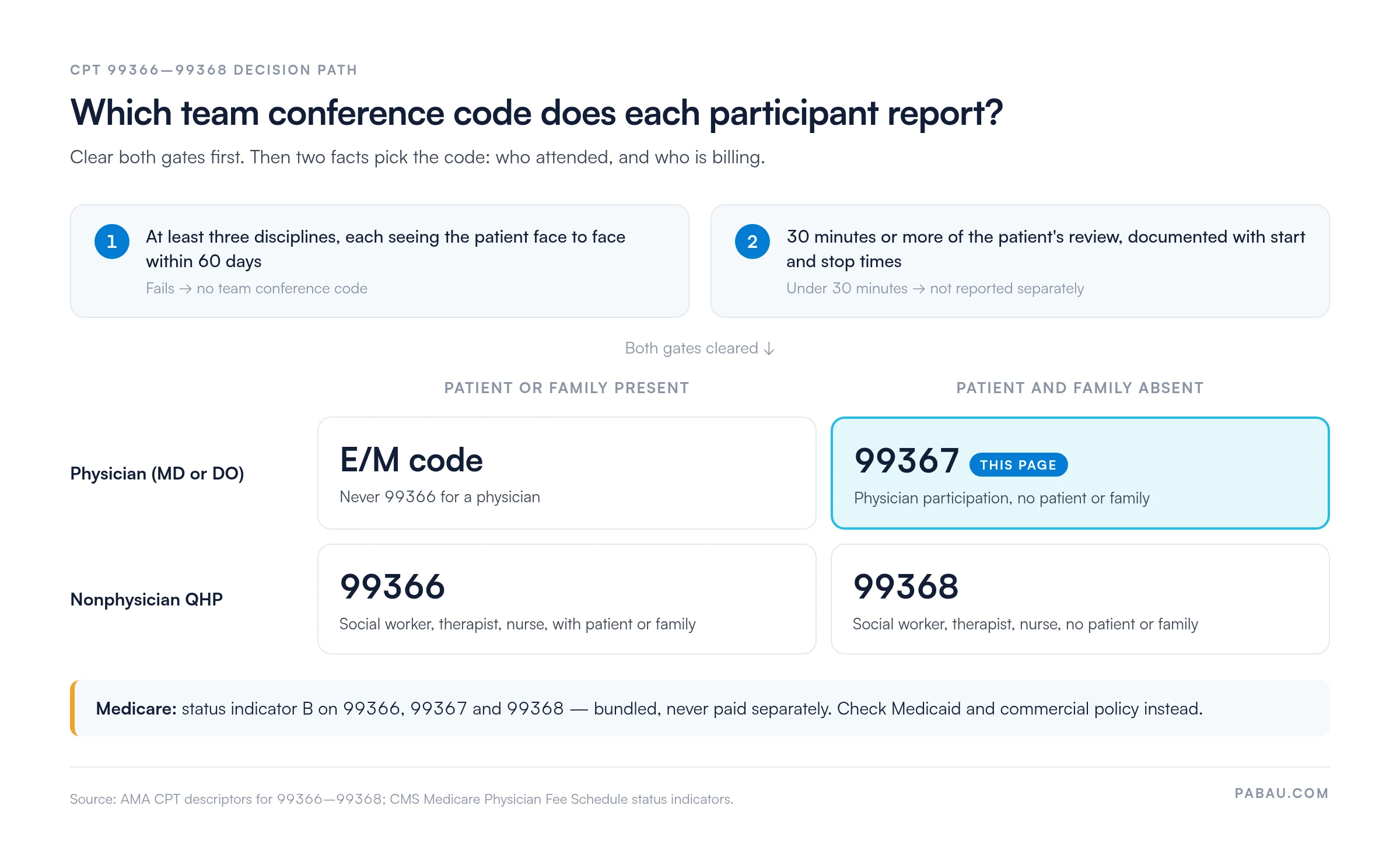
No. Medicare never pays CPT code 99367 as a separate service. CMS assigns 99366, 99367, and 99368 status indicator B on the Medicare Physician Fee Schedule, meaning payment is always bundled into another service.
Key points for Medicare and other payers:
For Medicare patients, physicians can sometimes capture care coordination time through other codes, such as chronic care management under 99490 or 99491. Those codes have their own consent, time, and documentation requirements, so check them before switching.
Reimbursement for CPT code 99367 depends entirely on the payer, because Medicare never pays it separately. The CMS Physician Fee Schedule lookup tool shows the code’s status indicator for the current year.
Recheck these policies at the start of each calendar year. A payer that changes its reimbursement policy can start or stop paying 99367 without much notice.
Build a payer matrix for 99366-99368. Mark Medicare and plans that follow its status indicators as non-payable, then list which Medicaid and commercial plans pay each code. Set claim rules from that matrix so staff stop sending 99367 to payers that never reimburse it.
The CMS National Correct Coding Initiative (NCCI) sets bundling rules for 99367. Chapter 11 of the NCCI Policy Manual covers codes in the 90000-99999 range. It lists which codes cannot be billed together on the same date without a modifier showing a separate, distinct service.
Core restrictions affecting 99367 claims:
Claims management software can flag likely NCCI conflicts before submission, which cuts manual rework. Check the current quarterly tables, because NCCI edit pairs update four times a year.
Submitting 99367 claims correctly means checking payer policy, documenting the conference, selecting the right code, and routing the claim correctly. Pabau, the practice software we build, submits US claims electronically through the Claim.MD clearinghouse. It checks the patient’s eligibility in real time before the claim reaches the payer.
Most 99367 denials trace back to a short list of errors. Effective denial management workflows start by knowing which ones generate the most volume.
CPT code 99367 must be submitted with an ICD-10-CM diagnosis code for the condition that requires coordinated interdisciplinary care. That code justifies the medical necessity of the conference.
A vague or nonspecific code can trigger a denial even when the conference was clinically appropriate. Build your medical billing workflow so the diagnosis comes from the current record, not a prior visit.
Common ICD-10 pairings for 99367 include conditions that routinely need interdisciplinary care:
The diagnosis on the 99367 claim should reflect the primary condition discussed in the conference, not necessarily the patient’s longest-standing diagnosis. Some commercial and Medicaid payers publish approved diagnosis lists for team conference codes, so check them.
Build a diagnosis reference list for the conferences your physicians attend most. For a hospitalist group, that list might hold 10-15 codes covering stroke sequelae, dementia, and complex chronic conditions. Pre-mapping common diagnoses cuts lookup time and prevents the nonspecific-code denials auditors flag most often.
Team conference notes often live in shared documents or meeting minutes, away from the patient record. Coders then chase start times, attendee names, and credentials before they can pick between 99367 and 99368.
In Pabau, the conference note can be a custom digital form attached to the patient’s record. Fields for start and end time, attendees and credentials, patient presence, and care plan decisions are completed during the meeting. Claims then go out through the Claim.MD integration, after a real-time eligibility check.
The result is a note that supports the claim on its own. Your team can see which code applies and which payer will pay it before the claim leaves the practice.

Pabau keeps conference notes, attendee credentials, and claim submission in one platform. Each 99367 claim is then backed by a complete record before it reaches the payer.

CPT code 99367 belongs to physicians, and only for conferences the patient and family do not attend. Treat provider type and patient presence as the first two checks on every team conference claim.
Medicare will not pay the code separately, so your revenue from it depends on Medicaid and commercial policy. Build those rules into your note templates and payer setup once, and the code stops generating avoidable denials.
Book a demo to see how Pabau handles care coordination documentation and billing for multidisciplinary practices.

Want to understand how claims reach payers? Medical claims clearinghouse guide explains the electronic pathway from claim submission to remittance advice.
Need to reduce claim rejections systematically? Revenue cycle management overview covers the end-to-end workflow from eligibility through payment posting.
Dealing with denied claims? Denial codes in medical billing breaks down CARC and RARC codes used in ERA responses.
CPT code 99367 covers a physician’s participation in a medical team conference of 30 minutes or more, held without the patient or family present. At least three professionals from different disciplines review the patient’s care plan, conditions, and treatment decisions.
Only physicians can bill CPT 99367, such as attending physicians, hospitalists, psychiatrists, and physiatrists. Social workers, occupational therapists, speech-language pathologists, nurses, and other nonphysician professionals report the same conference with CPT 99368.
The minimum is 30 minutes of conference time spent reviewing the patient. Preparation, record keeping, and report writing do not count. Record the start and end times of the review, because total minutes alone are weak documentation.
No. Medicare never pays CPT 99367 separately. CMS assigns 99366, 99367, and 99368 status indicator B, meaning payment is always bundled into another service. That applies in every MAC jurisdiction, and no LCD changes it.
CPT 99366 is for a conference with the patient or family present, reported only by nonphysician qualified health care professionals. CPT 99367 is for a conference without the patient or family, reported only by physicians. A physician at a conference with the patient present reports an E/M code instead.
Both codes cover a team conference of 30 minutes or more without the patient or family. CPT 99367 is for physician participation. CPT 99368 is for nonphysician qualified health care professionals, such as social workers, therapists, and nurses.
NCCI edits can bundle 99367 with an E/M service billed by the same physician on the same date, so document each service separately. Report one code per conference per provider, chosen by patient presence and provider type. NCCI tables update quarterly, so verify current edit pairs.



