

CCSD code G5100: Bypass of duodenum billing guide
CCSD code G5100 bills a bypass that leaves the duodenum in place CCSD code G5100...

Last Updated: Oct 16, 2026
99343 was the CPT code for a new patient home visit requiring a detailed history, a detailed examination and moderate-complexity medical decision making. Counseling and/or coordination of care with other providers or agencies was provided to fit the patient's and family's needs. Presenting problems were usually of moderate to high severity, and physicians typically spent 45 minutes face-to-face.
The AMA deleted 99343 from the CPT code set effective January 1, 2023, while the other home visit codes stayed active. A comparable visit now bills as 99344 when moderate medical decision making drives code selection. Billed by time, the same 45 minutes only reaches 99342.
Let Pabau's smart automation suggest the right codes, reduce claim denials, and keep your practice compliant—effortlessly.
Automate repetitive tasks and focus on what matters most—your patients.
Reduce coding errors and ensure compliance with the latest regulations.
Clean claims, fewer denials, and faster reimbursements.
Powerful insights and reporting to help your practice thrive.
HIPAA compliant SOC 2 certified GDPR-compliant Trusted by 4,000+ clinics worldwide

CPT Code 99343 was deleted on January 1, 2023, so a claim that carries it for a later date of service is denied as invalid.
Before deletion, 99343 covered a new patient home visit with moderate-complexity medical decision making, typically 45 minutes face-to-face.
Only 99343 was deleted. Codes 99341, 99342, 99344, 99345 and 99347-99350 stayed active with new descriptors.
A former 99343 visit bills as 99344 when moderate MDM is documented, but billed by time, 45 minutes only reaches 99342.
Pabau’s claims management software, part of the practice platform we build, holds a claim until membership numbers and authorization codes are complete.
CPT Code 99343 is a deleted code for a new patient home visit at moderate complexity, typically 45 minutes face-to-face.
The American Medical Association’s CPT code set removed it effective January 1, 2023, when it overhauled the home and domiciliary E/M codes. A comparable visit now bills as 99344 when moderate MDM drives code selection.
Only 99343 was deleted from the new patient home series. Codes 99341, 99342, 99344 and 99345, plus established patient codes 99347-99350, were revised with new descriptors and remain active. The separate domiciliary and rest home codes, 99324-99337, were deleted at the same time and folded into the home codes.
The official pre-deletion descriptor defined 99343 as a home visit for the evaluation and management of a new patient, with four parts:
Before 2023, time could set the level only when counseling or care coordination took up more than half of the face-to-face visit. In that case, 45 minutes supported 99343.
Before January 2023, new patient home visits used five codes, set by MDM complexity and typical time. CPT Code 99343 sat in the middle of the range. It ranked above 99342 (low complexity, 30 minutes) and below 99344 (moderate MDM with a comprehensive history and exam, 60 minutes).
Under AMA rules, a “new patient” has had no professional services from the physician, or another same-specialty physician in the group, within three years. That definition still applies under the 2023 framework.
No single code replaced CPT Code 99343. The 2023 AMA E/M overhaul deleted it and revised the remaining home visit codes. They now use MDM- or time-based selection, the same logic as office E/M codes. New patients now bill 99341, 99342, 99344 or 99345, and established patients bill 99347-99350.
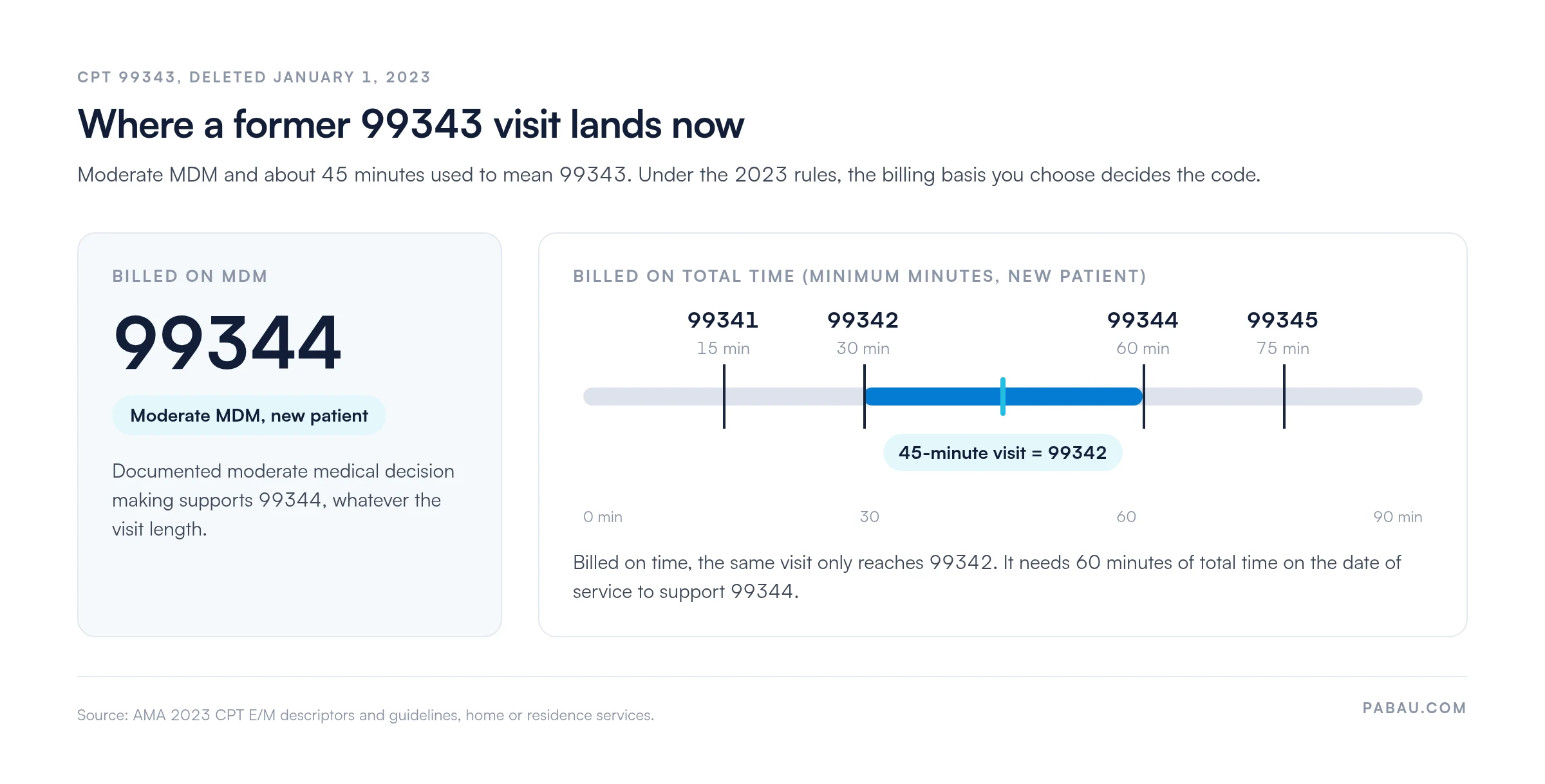
The old five tiers don’t map 1:1 onto the four new ones, so a crosswalk only points toward a code. The documentation decides it. A visit that met the old 99343 criteria (moderate MDM, about 45 minutes) lands on different codes depending on the billing basis:
The 2023 framework counts total time on the date of service, including prep and documentation, rather than face-to-face time alone. Its thresholds also sit higher than the old typical times.
A 45-minute visit billed by time reaches only 99342, because 99344 needs 60 minutes. If the note supports moderate MDM, billing on MDM earns the same visit 99344.
Billing a home visit after 2023 takes five steps. The place of service (POS) code matters as much as the CPT code, because it tells the payer which setting the home codes cover. A POS that doesn’t fit the code is one of the most preventable home visit denials.
Check where the patient lives before you pick a code set. A skilled nursing facility resident (POS 31) is billed with nursing facility codes 99304-99310. A home visit code reported with POS 31 is likely to deny.
Home visit E/M claims have long drawn Office of Inspector General (OIG) audit attention. The OIG has repeatedly flagged home visit upcoding as a high-risk billing area, so the note has to support the level billed.
When billing by MDM, the record must support two of the three MDM elements at the claimed level. Those elements are the problems addressed, the data reviewed, and the risk of patient management.
For moderate MDM, one chronic illness with exacerbation meets the problem element. So do two stable chronic illnesses, or an undiagnosed new problem with uncertain prognosis.
When billing by time, the record must state the total time spent on the date of service. That includes pre-visit review, the visit itself, and post-visit documentation and coordination. The note must give the total in minutes, and a generic statement like “extensive time spent” does not satisfy the requirement.
For Medicare claims, the note must confirm where the visit took place and show that the service was medically necessary. Home visit E/M codes are separate from the home health benefit, so the patient doesn’t need to be certified as homebound.
Since 2019, Medicare no longer requires the note to justify why the visit happened at home instead of the office. Practices that still add that justification spend time on a requirement that no longer exists.
CPT Code 99343 has no active Medicare rate, because it was deleted on January 1, 2023. The CMS Physician Fee Schedule lookup tool shows no reimbursement data for it in any year after 2022. For current rates, use the active home visit codes.
The rates below are 2024 Medicare Physician Fee Schedule (MPFS) non-facility rates, which apply to POS 12 and POS 13. MPFS rates change every year with the conversion factor, so check the current year in the FastRVU 2026 RVU lookup.
*Approximate 2024 national non-facility rates. Geographic adjustment factors apply, so rates vary by Medicare Administrative Contractor (MAC) jurisdiction. Verify exact rates in the CMS Physician Fee Schedule for your locality.
Physicians can bill home visit E/M codes, and so can nurse practitioners, physician assistants, and clinical nurse specialists. These non-physician practitioners (NPPs) follow rules that differ by payer and billing method.
Under Medicare, NPPs with state licensure and a Medicare enrollment number can bill home visit codes independently at 85% of the fee schedule. Incident-to billing pays 100%, but it is generally not available for home visits. It requires direct physician supervision, which the home setting rarely allows.
Commercial payer rules vary. Some managed care organizations pay NPPs at 100%, while others cap at 85% or require prior authorization for home visits. Running insurance eligibility verification before the visit confirms coverage and any authorization requirement.
When a home visit billed by time runs well past the top code, a prolonged services add-on can be reported with 99345 or 99350. Medicare and commercial payers use different add-on codes, and a mismatch causes a denial.
Both add-ons apply only when time selected the code. The note must record total time in minutes and show that the add-on threshold was met. For G0318, Medicare also counts time spent in the three days before and the seven days after the visit.
For commercial payers, verify that the specific plan recognizes 99417. Some managed care contracts exclude prolonged service add-ons for home visit codes.
Most home visit E/M denials trace back to a short list of coding and documentation errors. Knowing the pattern lets you fix the upstream error before the claim leaves the practice.
Practices with a steady volume of home visit claims benefit from structured denial management workflows. Tracking denials by code and payer shows whether the root cause is documentation, POS coding, or code selection.
Our guide to medical billing denial codes explains the CARC and RARC codes that come back on each remittance.
Run a quarterly check for home visit claims dated on or after January 1, 2023 that still carry 99343. Rebill each one as 99342, 99344, or 99345, based on the documented MDM or total time. Medicare generally allows 12 months from the date of service to file a corrected claim.
Medicare sets the baseline for home visit E/M policy, but commercial payers and Medicaid programs apply their own coverage rules. Checking payer-specific requirements before billing prevents a whole class of home visit denials.
Meeting clean claim submission standards on every electronic submission makes it less likely that a payer-specific edit denies a home visit code.
Home visit denials usually start before the claim leaves the practice. A retired code typed from memory, a missing authorization number, or a POS that doesn’t match the setting is enough. Catching those by hand means a biller rereads every claim before it goes out.
Pabau, the practice management platform we build, includes claims management software that pre-fills each claim from the patient record and treatment details. Background checks hold the claim until membership numbers and authorization codes are complete, so it never goes out without them.
For US practices, Pabau submits through its Claim.MD integration, which reaches thousands of payers. Your team can run real-time eligibility checks before the visit and post ERA remittances when payment lands.
Each claim is tracked from pending to paid on one dashboard. Billers then spend their review time on the CPT code and POS instead of chasing missing numbers.

Pabau checks membership numbers and authorization codes before submission, runs real-time eligibility checks, and sends claims through Claim.MD. Your team sees every home visit claim’s status on one dashboard.

CPT Code 99343 is gone for good, and a claim that uses it after 2022 has no route to payment except a corrected resubmission. The decision that matters now is which basis you bill a former 99343 visit on. If the note supports moderate MDM, bill 99344 on MDM. Billed by time, 45 minutes only earns 99342.
The 2023 rules reward documentation over habit. A clear MDM note, a total time recorded in minutes, and the right POS protect the level you bill.
Pabau holds each claim until membership numbers and authorization codes are complete. It also checks eligibility in real time through Claim.MD and tracks every home visit claim to payment. Book a demo to see how it fits your home visit billing workflow.

Submitting 837P claims electronically for Medicare? How Claim.MD works as a medical claims clearinghouse explains real-time eligibility, ERA processing, and payer enrollment.
Seeing a new patient for a short, simple home visit? CPT code 99341 covers the straightforward-MDM new patient home visit.
Want to benchmark your billing against industry standards? Best medical billing software for US practices compares the tools practices use to manage E/M coding and claim submission.
CPT Code 99343 is a deleted code for a new patient home visit with moderate-complexity medical decision making, typically 45 minutes face-to-face. The AMA removed it effective January 1, 2023, when it revised the other home visit E/M codes. Claims that use 99343 for a later date of service are denied.
No single code replaced 99343. A comparable new patient home visit now bills as 99344 when moderate MDM is documented. Billed by total time, 30 minutes reaches 99342 and 60 minutes reaches 99344. Apply the 2023 MDM or time criteria directly rather than relying on an old-to-new crosswalk.
There is no Medicare reimbursement rate for CPT Code 99343, because the code was deleted on January 1, 2023. For a comparable service, the 2024 MPFS non-facility rate for 99344 (moderate MDM, new patient) is approximately $175. For 99345 (high MDM, new patient), it is approximately $231. Verify current-year rates in the CMS Physician Fee Schedule, because rates change annually with the conversion factor.
Before 2023, 99342 covered low-complexity new patient home visits (30 minutes), and 99343 covered moderate complexity (45 minutes). 99344 covered moderate MDM with a comprehensive history and exam (60 minutes), and 99345 covered high complexity (75 minutes). On January 1, 2023, only 99343 was deleted. The other three stayed active with new descriptors based on MDM or total time.
Yes. Nurse practitioners with a Medicare enrollment number and state licensure can bill home visit E/M codes independently at 85% of the fee schedule. Incident-to billing at 100% is generally not available, because the home setting rarely allows direct physician supervision. Commercial payer rules vary, and some pay NPPs at 100% while others require prior authorization.
The most common cause is a deleted code, such as 99343 billed after January 1, 2023. A wrong place of service code, like POS 31 on a home code, comes next. Thin MDM documentation and missing total time follow close behind. Correct the specific error and resubmit within the payer’s timely filing window. Medicare generally allows 12 months from the date of service.



