CPT code 21011: Excision of soft tissue tumor of the face
CPT code 21011: Official descriptor and procedure overview CPT code 21011, as pu...

Last Updated: Oct 8, 2026
CPT code 99292 is the add-on code for critical care evaluation and management of a critically ill or critically injured patient. It covers each additional 30-minute block beyond the first 74 minutes of critical care provided on a given date.
99292 cannot be reported alone. It must always be listed with its parent code, CPT code 99291, which covers the initial 30 to 74 minutes.
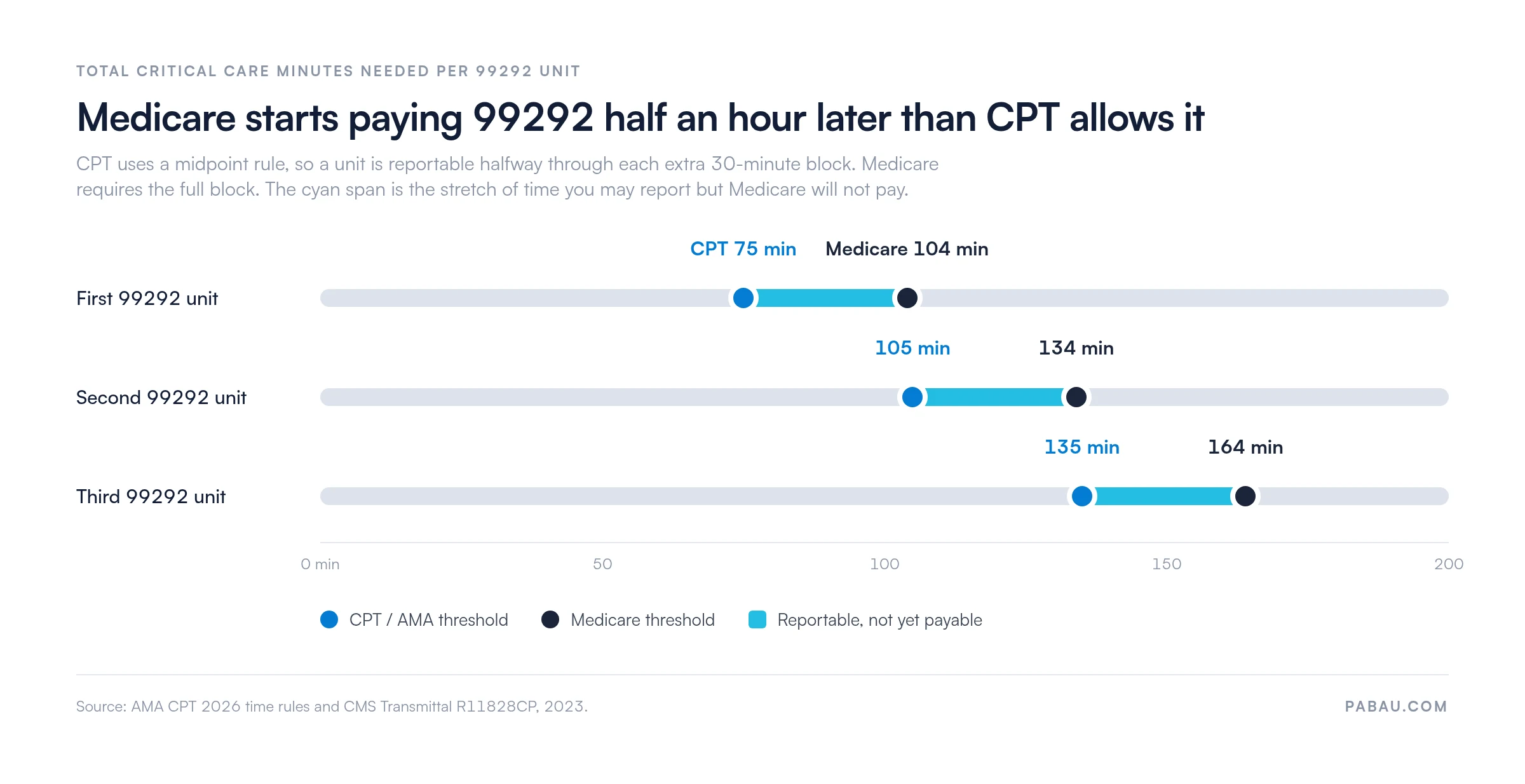
CPT and Medicare do not start counting the add-on at the same minute. CPT allows the first unit of 99292 once total critical care time reaches 75 minutes. Medicare will not pay that unit until 104 minutes. This guide covers both thresholds, the documentation each one requires, bundled services, and 2026 reimbursement.

CPT code 99292 is an add-on code that must always be billed alongside CPT 99291.
99292 covers each additional 30-minute block of critical care beyond the first 74 minutes on a given date.
CPT allows the first unit at 75 total minutes, but Medicare pays it only from 104 minutes.
Time spent on separately billable procedures is excluded from the critical care time total.
Pabau’s claims management software helps practices track time-based billing and reduce 99291 and 99292 claim errors.
The American Medical Association (AMA) sets the descriptor for CPT code 99292. It reads: “Critical care, evaluation and management of the critically ill or critically injured patient; each additional 30 minutes.” The manual then instructs coders to list it separately, in addition to the code for the primary service.
That parenthetical instruction carries weight. It classifies 99292 as a plus-code, marked in the CPT manual with a “+” symbol. Reporting it without 99291 on the same claim triggers an automatic denial.
The code was established alongside 99291 to handle cases where physician critical care time runs well past the first hour. A single date of service can therefore carry one unit of 99291 and several units of 99292, depending on total documented time.
99291 covers the first block of critical care. 99292 covers every subsequent block. The two codes interlock through a time framework that rewards accurate documentation and punishes estimates.
Under CPT rules, 104 minutes of critical care produces one unit of 99291 and one unit of 99292. A total of 135 minutes produces one unit of 99291 and three units of 99292. The AMA’s rounding convention, covered in the next section, sets the exact minute each additional unit is earned.
Time-based billing for critical care follows a strict threshold model. The minutes you count must be the physician’s own direct, face-to-face or unit/floor critical care time. Administrative tasks, separately billable procedures, and time logged by other team members all fall outside the count.
The CPT midpoint rule: 99292 does not become reportable the moment the clock passes 74 minutes. CPT applies a block-midpoint convention, so the first unit is earned once total critical care time reaches 75 minutes.
The second unit follows at 105 minutes, the third at 135. Billing a unit at 80 minutes of total time is upcoding, and auditors flag it routinely.
The Medicare 104-minute rule: Medicare does not use the midpoint convention at all. CMS corrected its own guidance in Transmittal R11828CP in February 2023, after the 2022 fee schedule mistakenly printed 75 minutes.
The corrected rule requires a complete additional 30-minute block, so 104 total minutes before Medicare pays the first 99292 unit. Each further unit needs another full 30 minutes, at 134 and 164 minutes.
A claim submitted at 85 minutes is valid under CPT and denied under Medicare. Practices billing a mixed payer panel need both thresholds in the same workflow, because the coder cannot apply one rule to every claim.
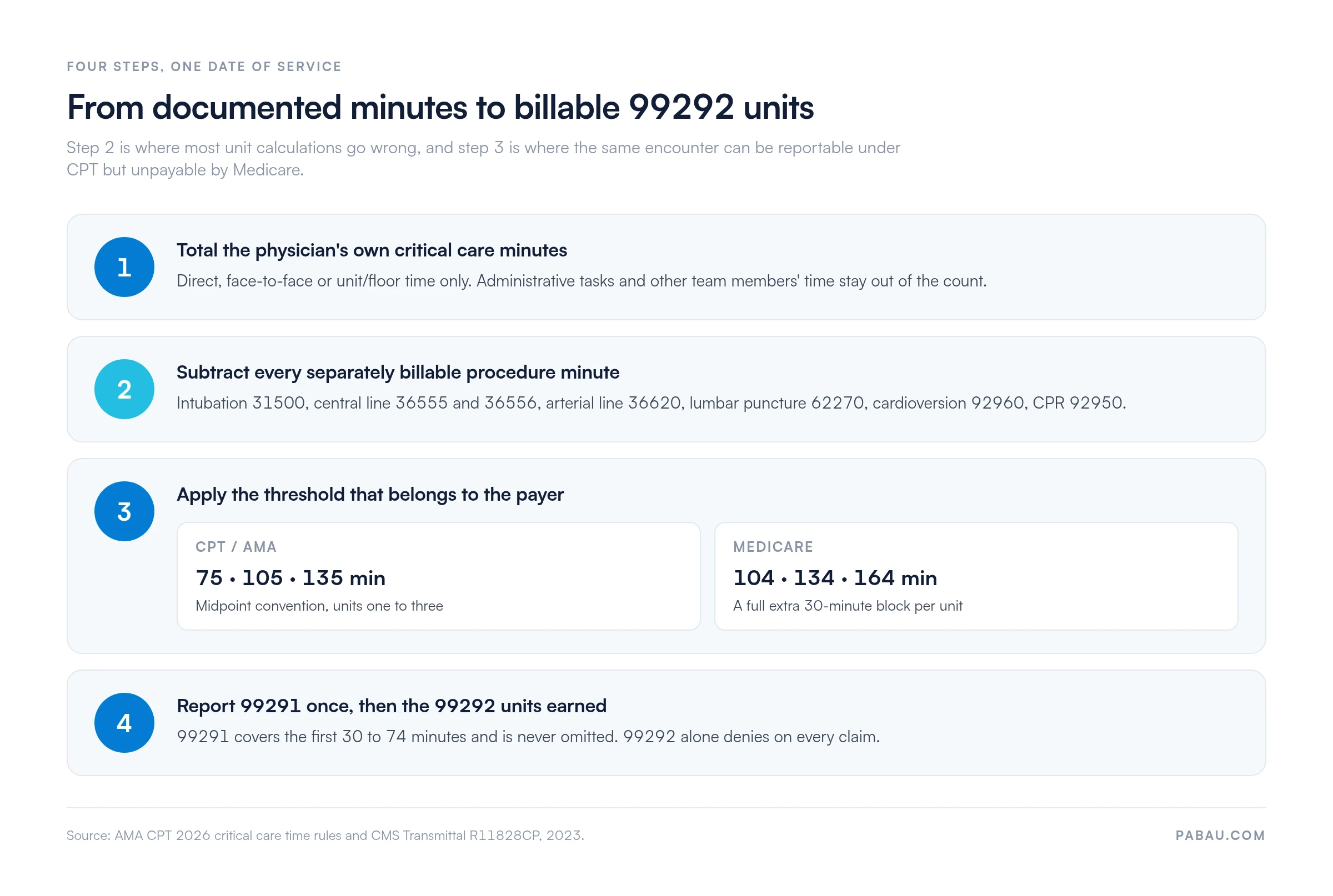
Time spent on separately billable procedures must come out of the critical care total before either threshold is applied. This subtraction is one of the most common sources of calculation error in practices billing 99291 and CPT code 99292 together.
Document critical care time as a total running count in minutes in your notes, not as start-and-stop clock times. Auditors reviewing 99292 claims want a stated total, such as ’95 minutes of critical care provided’. They also want confirmation that separately billable procedure time was excluded.
Critical care is the direct delivery of medical care for a critically ill or critically injured patient. The patient’s condition must acutely impair one or more vital organ systems.
The AMA definition also requires a high probability of imminent or life-threatening deterioration. CPT and CMS share this clinical standard, then diverge on administrative rules around time, location, and concurrent care.
Billers working Medicare claims have to satisfy both rule sets at once. CPT governs the code structure, CMS governs coverage and payment.
CPT codes 99291 and 99292 bundle a defined list of services. Those services cannot be billed separately on a date when critical care codes are reported. Knowing which side of the line each activity falls on is what keeps a claim clear of National Correct Coding Initiative (NCCI) edit denials.
The left column stays bundled however much physician time those activities consume. The right column can be billed separately, but the minutes spent on them are subtracted from the critical care total before you calculate units.
Check the current NCCI edit file for each code pairing, since CMS updates bundling rules quarterly. That subtraction is the second step of a four-step route from documented minutes to billable units.
CPT code 99292 may be reported in any location where critical care is delivered, because the AMA does not restrict it by setting. CMS applies additional place-of-service (POS) requirements for Medicare billing. Verify current MAC guidance for your jurisdiction before assuming a non-hospital setting qualifies.
Mismatched POS codes are among the top technical reasons critical care claims are denied without clinical review. Check the POS field against where the patient was treated before submitting.
Critical care documentation has to establish three facts. The patient met the clinical threshold for critical illness. The physician provided direct care during the time claimed. The time total is accurate once separately billable procedures have been removed. An audited 99292 claim missing any one of them results in recoupment.
Structured clinical notes are what make these five elements reliable. Ask for the time total and the organ-system justification as named fields, and the physician answers both before signing. The coder then inherits a complete record rather than free text to interpret.
Medicare reimbursement for CPT code 99292 is published annually in the CMS Physician Fee Schedule (PFS). Rates vary by geographic payment locality, and by whether the service was provided in a facility such as an ICU or in a non-facility setting.
The CMS Physician Fee Schedule lookup tool carries the current verified rates. Pull figures from CMS rather than a prior-year table, because conversion factor adjustments move rates every year.
For 2026, the work RVU (wRVU) value for 99292 is 2.25. Total RVU values, which add practice expense and malpractice, vary by setting. Use FastRVU’s 2026 RVU lookup tool to convert that into a location-adjusted estimate using your MAC jurisdiction’s geographic practice cost index (GPCI).
Submitting 99292 claims through a clearinghouse that validates against current payer fee schedules catches rate mismatches before remittance.
Practice management software like Pabau handles electronic claims through its Claim.MD integration, which reaches thousands of US payers. Real-time eligibility checks run alongside 99291 and 99292 submission.
Medicare Advantage and Medicaid rates are plan-specific and sit outside the CMS PFS. Check the individual plan’s fee schedule or contract terms before assuming parity with traditional Medicare. Rates for critical care add-on codes vary enough between plans that each contract is worth checking on its own.
Three billing scenarios produce most of the confusion around CPT code 99292, and most of the audit exposure when they are handled badly.
Two physicians from the same specialty group generally cannot each bill 99291 on the same date for the same patient under Medicare. CMS treats critical care as a shared time pool within a specialty. Their combined time counts, but one physician bills the primary code and any 99292 units.
Physicians from different specialties may each bill critical care for the same patient on the same day. Each has to meet the clinical and documentation criteria independently for their own portion of care.
CMS split/shared visit rules were updated in 2023 and refined for 2024. In a facility setting, critical care may be shared between a physician and a qualified non-physician practitioner (NPP). The provider who performs the substantive portion bills the service under their own NPI. CMS defines that portion as more than half of the total time.
Time spent by each provider is documented separately. The physician must be present for some portion of the visit, and must review and sign the note.
In teaching hospitals, the teaching physician must be present for the entire critical care service to bill under their own NPI. Other E/M services accept a note co-signature. Critical care requires direct physician involvement throughout, documented in the teaching physician’s own note rather than only in the resident’s record.
Most 99292 denials trace back to one of five recurring errors. Catching them before submission costs far less than answering a recoupment demand afterward.
A pre-submission review step that checks POS code, time calculation, and bundled service exclusions prevents most of these before the claim reaches the clearinghouse. Sorting rejections by reason code afterward shows whether the errors cluster around documentation or arithmetic. Our guide to denial codes maps what payers return on critical care claims.
Run a quarterly billing pattern review for 99292 units per encounter. An average that consistently exceeds two units per encounter is a potential outlier flag against peer benchmarks. Pull a sample of those claims for documentation review before a MAC medical review does it for you.
CPT code 99292 sits within a broader critical care and high-acuity E/M code family. Coders working in ICU, ED, or neonatal settings need the adjacent codes at hand, because age alone decides which pair applies.
Use the AAPC Codify CPT lookup to verify the current descriptors. Cross-reference the neonatal and pediatric codes against your patient population before the year’s first claim goes out.
Accurate 99292 billing depends on two steps landing correctly. The physician records total critical care time with enough clinical specificity, and the biller calculates units against that documented time under the right payer’s threshold. Errors multiply when those two steps happen in systems that do not talk to each other.
Pabau links clinical documentation to claim generation in a single workflow. Structured note templates for critical care visits prompt physicians to record the time total, the clinical justification, and any separately billable procedure time. Those are the exact fields an auditor asks for.
That structured data then feeds straight into the billing workflow, so nobody re-types a time total from one screen into another. Our software for billing teams keeps the CPT and Medicare thresholds beside the encounter, and routes 99291 and 99292 pairs through clearinghouse validation before submission.


Pabau’s claims management software helps practices track time-based billing, flag incomplete documentation, and submit clean claims for 99291 and 99292. See how it works in your workflow.

CPT code 99292 is simple in concept and demanding in execution. The single decision that matters most is which threshold applies to the payer in front of you: 75 minutes under CPT, 104 under Medicare. Get that right and the rest of the code’s rules are ordinary coding hygiene.
The trade-off worth remembering is that neither threshold can be checked after the fact. Once the note is signed without a stated time total, no reviewer can reconstruct the minutes. The unit is lost whichever rule you were working under, so build the check into the note rather than into the appeal.
For teams billing critical care every week, the practical move is to put both thresholds into the documentation workflow itself. Book a demo to see how Pabau captures critical care time totals and validates 99291 and 99292 pairs before the claim goes out.

Need to understand how medical claims move from documentation to payment? Medical billing workflows explained covers the end-to-end billing cycle for US healthcare practices.
Dealing with critical care claim denials? Denial management strategies outlines how to categorize, appeal, and prevent common claim rejection patterns.
Want to understand how ERA responses map to your 99292 payments? Electronic remittance advice breaks down how to read and act on payer EOBs and 835 transaction files.
Want fewer 99292 claims coming back at all? Clean claim submission sets out the checks that get a claim paid on the first pass.
Preparing for a payer audit of your critical care claims? Medical billing compliance explains the controls auditors expect a practice to have in place.
CPT code 99292 is the add-on code for each additional 30-minute block of physician critical care. It applies beyond the first 74 minutes provided on a given date. It must always be billed alongside CPT 99291, which covers the initial 30 to 74 minutes of critical care. It cannot be reported as a standalone code.
99291 is the primary code covering the first 30 to 74 minutes of critical care, reportable once per date of service. 99292 is the add-on code for each additional 30-minute block beyond 74 minutes. It can be reported multiple times on the same date, depending on total documented critical care time.
There is no hard cap on 99292 units per date, but the payer decides when each one is earned. Under CPT, 135 to 163 minutes of total critical care time supports one unit of 99291 and three units of 99292. Medicare requires a full additional 30 minutes per unit, so the same encounter supports only two. Units beyond what the documented time supports will be denied on audit.
Medicare pays the first unit of 99292 only from 104 total minutes of critical care. CMS set that threshold in Transmittal R11828CP in February 2023, correcting a 2022 fee schedule statement that said 75 minutes. CPT still allows the first unit at 75 minutes, so the same encounter can be reportable under CPT and unpayable under Medicare.
Bundled services include cardiac output measurements, chest X-ray interpretation, co-oximetry, gastric intubation, pulse oximetry, transcutaneous pacing (92953), and ventilator management interpretation. Separately billable procedures such as endotracheal intubation (31500), central line insertion, and cardioversion (92960) can be billed independently. The time spent on them must be excluded from the critical care time total.
Under Medicare, two physicians from the same specialty generally cannot each bill 99291 for the same patient on the same date. Their time may be combined and reported by one physician. Physicians from different specialties can each bill critical care independently on the same date, provided each meets the clinical and documentation requirements separately.
The 2026 Medicare reimbursement rate for CPT 99292 varies by geographic payment locality, and by whether care was provided in a facility or non-facility setting. The work RVU value for 99292 is 2.25. Use the CMS Physician Fee Schedule lookup tool or FastRVU to calculate the current adjusted rate for your MAC jurisdiction.