



CCSD code G5100: Bypass of duodenum billing guide
CCSD code G5100 bills a bypass that leaves the duodenum in place CCSD code G5100...

Last Updated: Oct 16, 2026

CPT code 99254 reports a moderate-level inpatient or observation consultation. Since January 1, 2023, medical decision making or total time selects the level, not history and examination.
CPT deleted code 99251 effective January 1, 2023. The active consultation range is 99252 through 99255, and 99252 is now the lowest level.
Bill 99254 on moderate MDM, or on 60 minutes or more of total time on the date of the encounter. The next level up starts at 80 minutes.
Medicare has not paid consultation codes since January 1, 2010 (Transmittal 1875, Change Request 6740). Bill 99221-99223 or 99231-99233 for Medicare patients instead.
The consultation still needs a documented request from another provider and a written report back to that provider. Missing either one disqualifies the claim as a consultation.
Practice management software like Pabau stores the consultation record your coders work from and submits the claim through the Claim.MD clearinghouse.
CPT code 99254 is the moderate-level code for an inpatient or observation consultation. A consulting specialist reports it after another provider asks for an opinion on an admitted patient. Moderate medical decision making selects the level, or 60 minutes of total time on the date of the encounter.
That basis changed on January 1, 2023, when CPT stopped grading history and examination to set consultation levels. This guide covers the current descriptor, the MDM and time thresholds, documentation, modifiers, and payer rules. It also covers the errors that still trace back to the retired framework.
CPT code 99254 reports an inpatient or observation consultation for a new or established patient at a moderate level of medical decision making. The American Medical Association (AMA) publishes and maintains the CPT code set. Its current descriptor pairs a medically appropriate history and examination with moderate MDM. Total time of 60 minutes on the date of the encounter is the alternative basis for the same code.
Four things have to line up before 99254 is the right choice.
The code sits in the 99252-99255 inpatient or observation consultation series. CPT deleted 99251 effective January 1, 2023, so 99252 is the floor of the range. The same revision folded observation care into these codes, which means a consultation on a patient in observation status is reported here.
Report one consultation per consultant per admission. Later visits by that same consultant during the stay use the subsequent inpatient or observation care codes, 99231 through 99233.
Through the end of 2022, the level of an inpatient consultation came from three key components: history, examination, and MDM. All three had to be met, so the weakest one governed the code. From January 1, 2023, only MDM or total time selects the level, exactly as office visits changed in 2021.
The practical effect cuts both ways. A note with a brief history and a focused examination can now support 99254 when the MDM is genuinely moderate. A comprehensive head-to-toe write-up earns nothing on its own, because the level no longer rewards volume.
Inadequate documentation is still the top reason 99254 claims get denied. Three things have to be provable from the record. Another provider asked for the consultation, the consultant rendered an opinion, and that opinion went back to the requester in writing.
Those are the three key criteria that apply to every consultation code. On top of them, the note has to carry the MDM or the total time that supports the level you bill. A clean claim starts with that record, not with the claim form.
A physician or other qualified health care professional has to ask for the opinion. Either that provider or the consultant can record the request, but it has to appear in the patient’s chart with the reason attached. A visit the patient or the family asks for is not a consultation, and neither is routine co-management of a shared patient.
The consultant’s findings and recommendations go back to the requesting provider in writing. A shared electronic record satisfies this when the consultation note is visible to the requester. A separate letter is not required, but an answer to the specific question that was asked is.
Pick one basis for the level and document it cleanly. A note that hedges between MDM and time tends to support neither on review. These elements form the clinical and legal record of the consultation, not just the billing file.
Moderate MDM means two of the three MDM elements reach the moderate column. Those elements are the number and complexity of problems addressed, and the amount and complexity of data reviewed. The third is the risk of complications from the management options considered.
For 99254, the note has to do more than name a diagnosis. Show the condition that is worsening, the data you reviewed or interpreted yourself, and the risk in the plan you settled on. Acknowledging the ordering provider’s reading of a test is not independent interpretation.
Total time of 60 minutes or more on the date of the encounter supports 99254 on its own. The MDM level does not have to agree. The next level starts at 80 minutes, so 60 to 79 minutes lands on 99254. Below 60 minutes, time supports 99253 or 99252 instead. The bands below plot each threshold against the next one up.
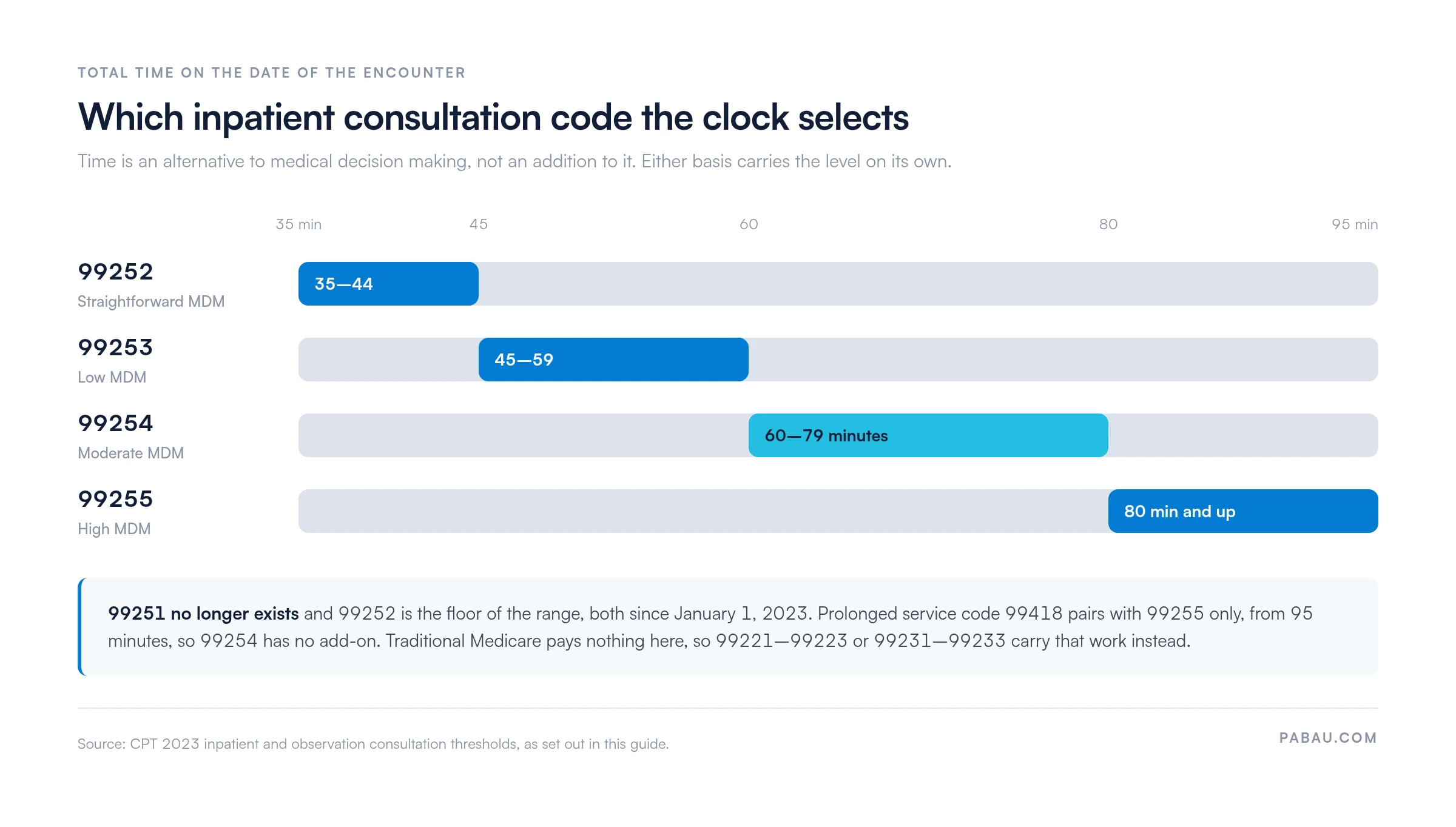
Total time counts only the consultant’s own work on that single calendar date. Record review, the face-to-face encounter, ordering tests, writing the note, and talking to the requesting provider all count toward it. Work you billed separately does not count, and neither does clinical staff time.
Prolonged service code 99418 pairs with 99255 only, from 95 minutes. There is no prolonged services add-on available for 99254.
Any physician or qualified non-physician practitioner acting as a specialist consultant on an inpatient or observation encounter may bill 99254, subject to payer rules. The consultant cannot be the attending or admitting provider for that same stay.
Verify eligibility with each payer before you submit. Some commercial plans add credentialing or specialty conditions for consultation codes that go beyond the AMA guidelines.
Start with the fact that decides most claims: Medicare does not pay CPT 99254. CMS removed the consultation codes from Medicare payment effective January 1, 2010, in Transmittal 1875 (Change Request 6740). Submitting 99254 to traditional Medicare produces a denial every time.
The code still appears in the CMS relative value file with a status indicator of I, meaning it is not valid for Medicare purposes. Some groups still use its published RVUs for internal productivity credit. The CMS Physician Fee Schedule lookup returns no payment amount for it, so that tool is not a pricing source for this code.
For Medicare patients, bill the hospital E/M code that matches the work instead. Initial inpatient or observation care runs 99221 through 99223, and subsequent care runs 99231 through 99233. The 2009 transmittal also pointed to observation codes 99217 through 99220. CPT deleted those in 2023, so observation work now maps into the same 99221 series.
Commercial rates for 99254 come from your own contract rather than a national schedule. Ask each payer for its consultation fee schedule, and confirm whether it prices the code at all before you rely on the revenue. Submitting the encounter as an 837 electronic claim file speeds up adjudication and removes the keying errors that delay payment.
Most commercial insurers never followed Medicare’s 2010 decision. Many Blue Cross Blue Shield plans, along with Aetna, Cigna, and United Healthcare, still recognize 99252-99255 for inpatient and observation consultations. Policies vary by regional plan and by employer group contract.
When a payer does reimburse 99254, the electronic remittance advice confirms the payment or explains the adjustment codes applied to the claim.
Check the payer’s consultation policy before the patient is discharged. Verifying coverage takes minutes, while appealing a denied consultation claim after discharge can take months. Flag each payer’s consultation status in your practice management system so billers see it at claim entry.
Modifiers change how a service is billed without changing the code. Four come up regularly on inpatient and observation consultations.
Teaching settings add modifier GC when a teaching physician is present for the key portions of a resident’s consultation. That requirement comes from CMS, so it reaches the payers that follow CMS teaching physician policy. Confirm each payer’s modifier list before you rely on it, because consultation edits are one of the places policies diverge most.
The diagnosis on the claim states why the consultation was requested. It does not set the level, because MDM or time does that. These examples show the kind of question that lands in front of a consultant at the moderate level.
Code the diagnosis to the detail the record supports. An unspecified code holds up while the consultant is still working the problem, and a more specific code is expected once the workup answers it.
The OIG has treated consultation coding as a standing audit target. These are the errors that generate denials and recoupment requests most often, and the first two both come from the 2023 change.
A pre-submission documentation audit catches most of these before the claim leaves the practice. A worked denial queue catches the rest, provided someone opens it inside the appeal window.
Four codes remain in the series, separated by MDM level and by total time. The two columns are alternatives rather than a pair you satisfy together. Each level has its own entry in our CPT code guides, including the high-complexity level above this one.
99253 and 99254 are the pair coders confuse most. The line between them is MDM, not the depth of the write-up. One stable chronic illness with limited data supports 99253. A condition that is progressing, with data you interpreted yourself and a plan carrying moderate risk, supports 99254.
Consultation billing breaks down in three places. Documentation goes in incomplete, claims leave with elements missing, and denials sit unworked until the appeal window closes.
Practice management software like Pabau keeps the consultation note, the codes your coders assign, and the claim on one record. Its built-in claims management assembles the claim from what the team already entered, so nobody re-keys the encounter at submission time.
The Claim.MD clearinghouse integration then submits and tracks that claim, and runs payer edits before it goes out. It also brings back the CARC reason codes when a payer rejects the claim. Pabau does not select the code or write the MDM narrative for you. It holds the record your coders work from, and it shows which consultation claims came back unpaid. The pattern surfaces while the appeal windows are still open.
Pabau also supports superbill documentation and 837 claim submission, with ERA reconciliation through the same Claim.MD connection. Every Pabau subscription includes the full billing feature set, so there is no billing module to add on top.
Audit your 99254 claims monthly. Pull ten notes at random. Check each one for the documented request, the report back to the requester, and either a moderate MDM narrative or a stated total time. Practices that audit against that short list catch level errors before a payer does.

Pabau keeps the consultation record, the codes your team assigns, and the claim in one place, then submits and tracks it through the Claim.MD clearinghouse.

CPT 99254 is the moderate level of the inpatient and observation consultation range. Since January 1, 2023 it is selected on medical decision making, or on 60 minutes of total time on the date of the encounter. History and examination still belong in the note, but they no longer decide the level, and 99251 no longer exists. Traditional Medicare still pays nothing for any code in the series.
The claims that survive review share one trait. The request, the report, and the chosen basis for the level are all findable in the record. To see how Pabau holds those pieces together from the consultation note through to the remittance, book a demo.

Need to understand how clearinghouses validate claims before submission? Medical claims clearinghouse guide explains the role of clearinghouses in the electronic claim workflow.
Confused about explanation of benefits and denial reason codes? Denial codes in medical billing breaks down the most common CARC codes and how to respond to them.
Want to understand how insurance verification affects claim approval rates? Insurance eligibility verification outlines how real-time verification reduces front-end billing errors.
Working the high-complexity level of the same range? CPT code 99255 sets out the high MDM criteria and the 80-minute time threshold.
Following the patient past the consultation? CPT code 99233 covers the subsequent hospital care visits a consultant reports after day one.
CPT code 99254 reports an inpatient or observation consultation at a moderate level of medical decision making. A consulting specialist bills it after another provider formally requests an opinion on a hospitalized patient. Since January 1, 2023, the level comes from MDM or from 60 minutes of total time on the date of the encounter.
No. CMS stopped recognizing consultation codes for Medicare payment effective January 1, 2010, in Transmittal 1875 (Change Request 6740). Submitting 99254 to traditional Medicare results in a denial. Bill the hospital care code that matches the work instead, from 99221 through 99223 or from 99231 through 99233.
Yes. Total time of 60 minutes or more on the date of the encounter supports 99254 on its own. Count only your own work on that calendar date, including record review, the visit, orders, documentation, and communication with the requesting provider. At 80 minutes the encounter moves up to 99255.
Ask each contracted payer for its consultation fee schedule, because commercial rates come from your contract. The CMS Physician Fee Schedule lookup returns no payment amount, since the code carries status indicator I and is not valid for Medicare purposes. The CMS relative value file still lists RVUs, which some groups use for internal productivity credit.



