



HCPCS code E0198: Water pressure pad billing guide
HCPCS code E0198 is a water pad for a standard mattress HCPCS code E0198 is the ...

Last Updated: Oct 13, 2026

CPT Code 99221 covers initial hospital inpatient or observation care for new or established patients, requiring straightforward or low medical decision making.
Time-based billing applies at 40 minutes total time on the date of service, including pre- and post-encounter work.
The 2023 AMA revision merged former observation-specific codes (99217-99220) into the 99221-99223 series, deleting the old standalone observation codes.
Practice management software like Pabau helps hospital billing teams flag missing or incomplete documentation before submission and reduce E&M claim denials.
CPT Code 99221 is the entry-level code in the initial hospital inpatient or observation care series, billed for a patient’s first day of a hospital stay when medical decision making is straightforward or low, or when total time reaches 40 minutes. Selecting the correct level requires understanding both the MDM thresholds and the 2023 AMA restructuring that folded observation care into this same code set.
This guide covers the official description, documentation requirements, 2026 Medicare fee schedule and RVUs, ICD-10 crosswalk codes, and the billing errors that most often trigger audits.
Hospitalists, internists, and hospital billing staff who work across both inpatient and observation settings will find this reference particularly useful. The sections below follow the order coders typically need: code description first, then level selection, documentation, reimbursement, and common errors.
Official long description (AMA CPT 2023 and forward): “Initial hospital inpatient or observation care, per day, for the evaluation and management of a patient, which requires a medically appropriate history and/or examination and straightforward or low medical decision making.”
Short description: Initial hospital inpatient or observation care, per day, low complexity.
As maintained by the AMA CPT code set, CPT Code 99221 applies to both new and established patients on the first day of a hospital inpatient or observation stay. It is an evaluation and management (E&M) code within the hospital-based E&M series, and applies to the physician or qualified healthcare professional who performs the initial assessment.
A key distinction from outpatient E&M codes: CPT 99221 does not require a “comprehensive” history and examination in the traditional sense. The AMA’s 2023 revision removed the history/exam complexity requirements and anchored level selection to MDM or total time instead.
Billing teams who haven’t updated their internal guidance since before 2023 are often using outdated documentation checklists, which leads to unnecessary rework. For best practices on documentation workflows.
Selecting the wrong level within the initial hospital care series is the most common upcoding risk flagged by Recovery Audit Contractors (RACs). Each code has a defined MDM floor and a minimum time threshold for time-based billing.
MDM level is determined by three elements: the number and complexity of problems addressed, the amount and complexity of data reviewed, and the risk of complications. For CPT Code 99221, at least two of the three MDM elements must meet the straightforward or low threshold. A single self-limited problem with minimal data review and low treatment risk typically qualifies.
Hospitalists frequently encounter patients who present at low acuity but deteriorate during the stay; the initial day’s code should reflect what was known and decided on day one, not the eventual complexity of the admission.
The Centers for Medicare & Medicaid Services (CMS) and the AMA both require documentation that supports the selected MDM level or clearly establishes total time. Since the 2023 revision, the “comprehensive history and physical” standard no longer drives level selection. What must be documented instead:
Palmetto GBA, a Medicare Administrative Contractor (MAC), specifically flags incomplete problem complexity documentation as a top audit finding for the 99221-99223 series. Auditors look for the physician’s explicit statement of problem complexity rather than implied complexity derived from the diagnosis alone.
Practices using claims management software can configure pre-submission documentation checks to catch these issues before the claim goes out.
When time is the basis for level selection, total time includes all physician work on the date of service: pre-encounter review of records, the face-to-face encounter itself, and post-encounter work such as documentation, care coordination, and ordering. This definition was established by the AMA in the 2021 E&M revision and carried forward into the 2023 hospital care restructuring.
The 40-minute threshold for CPT Code 99221 is a minimum, not a midpoint. If a hospitalist spends 38 documented minutes on a patient’s initial assessment, the encounter does not qualify for time-based 99221 billing; it would need to be supported by MDM instead. For practices integrating time tracking into their digital clinical documentation, auto-capturing encounter timestamps removes the manual step of adding time notations to notes.

Document total time in the note as a specific number of minutes (e.g., “Total time on 07/10/2026: 43 minutes”) rather than a time range. Auditors cannot verify a range, and MAC reviewers consistently flag range documentation as insufficient for time-based billing.
Medicare reimburses CPT Code 99221 based on its Relative Value Units (RVUs) multiplied by the Medicare Conversion Factor and adjusted for geographic location via the Geographic Practice Cost Index (GPCI). The CMS PFS look-up tool provides the authoritative payment amount for any locality and year. National averages vary by facility vs. non-facility setting.
Based on the 2026 Medicare Physician Fee Schedule (MPFS), the national average facility payment for CPT 99221 is approximately $90-$95 (2.75 total RVUs multiplied by the 2026 conversion factor of roughly $33.40-$33.57). CPT 99221 is inherently a facility-only (hospital) service, so a separate non-facility rate doesn’t meaningfully apply.
Confirm the exact locality-adjusted figure using the CMS PFS look-up tool, as GPCI adjustments can shift final payment significantly in high-cost areas like San Francisco or New York City compared to rural localities. For ongoing fee schedule tracking across your full code mix.
RVUs are the building blocks of Medicare payment. The FastRVU RVU lookup tool provides current wRVU, practice expense, and malpractice values for any CPT code. The table below shows the standard RVU components for 99221-99223 for comparative reference; always confirm against the current CMS data file for your billing year.
Note: RVU values are subject to annual CMS updates. Confirm against the CMS MPFS data file for the applicable payment year. Facility rates apply when the physician bills from a hospital setting; the practice expense component differs in non-facility (office) settings.
Effective January 1, 2023, the AMA deleted the standalone observation care codes 99217-99220 and merged observation status billing into the inpatient codes 99221-99223. This was one of the most significant structural changes to hospital E&M coding in two decades. The practical result: physicians no longer bill a separate code based on whether a patient is technically “inpatient” or “observation” on the first day. CPT Code 99221 now covers both.
Key changes coders need to know:
Practices that updated their EHR billing templates before January 2023 but have not audited them since should verify that the old observation codes have been fully retired from the charge capture system. Submitting 99218-99220 on a 2023 or later claim generates an automatic denial. For teams managing HIPAA compliance checklist together, this type of annual code audit is a recommended practice.

Pabau’s claims management tools help billing teams validate documentation before submission, track denial patterns by code, and automate follow-up on outstanding claims. See how it works for hospital-based practices.

CPT Code 99221 must be paired with an ICD-10-CM diagnosis code that justifies the level of care and the hospital admission. No ICD-10 pairing is universally required; payers may have specific medical necessity policies, and coverage varies by MAC jurisdiction. The table below lists common diagnosis codes billed alongside 99221, sourced from AAPC coding guidance and MAC billing data.
For crosswalk reference between CPT and ICD-10-CM codes, the AAPC Codify CPT lookup provides linked ICD-10 pairings commonly used with specific procedure codes. Always verify that the diagnosis coded supports the medical necessity of the admission and the complexity level billed. Payer-specific Local Coverage Determinations (LCDs) can add restrictions beyond what the AMA or CMS nationally publish.
Skin substitute supply code Q4182 has no national coverage determination of its own. Medicare coverage for it rests on the applicable MAC Local Coverage Determination for skin substitute grafts.
Reviewing how your team handles EHR integration with your billing platform can help align clinical documentation with code selection at the point of charge capture.
The initial hospital care codes (99221-99223) cover only the first day of the admission. From day two onward, subsequent hospital care codes apply. Understanding both series prevents coding the wrong family of codes on day two, which is a frequent audit finding for hospitalist groups. The CPT coding reference library on Pabau covers additional E&M code families for outpatient and specialty settings.
CPT 99291 (critical care, first 30-74 minutes) is mutually exclusive with the 99221-99223 series for the same encounter. When a patient’s condition meets the critical care threshold, the physician must bill 99291 rather than an E&M initial hospital care code. Billing both for the same date and same physician is a claim edit failure. Practices reviewing their patient scheduling workflows often identify opportunities to standardize this distinction across hospitalist groups. Checking insurance eligibility before the visit catches terminated coverage while the appointment can still be rescheduled. The 1500 claim form and its electronic equivalent ask for the same data in a different layout.
The Office of Inspector General (OIG) and RACs have consistently flagged the 99221-99223 series for upcoding. The most common errors coders and physicians need to catch before submission:
For a free CPT code reference and crosswalk tool, PGM Billing’s CPT lookup uses CMS-sourced data and can help verify code descriptors before submission.
Billing teams that integrate a billing automation workflow with pre-submission edit checks reduce denial rates by catching these issues at the charge entry stage rather than after the claim is rejected. Teams working toward full billing workflow integration can also review time-saving practice features that apply directly to hospital billing operations.
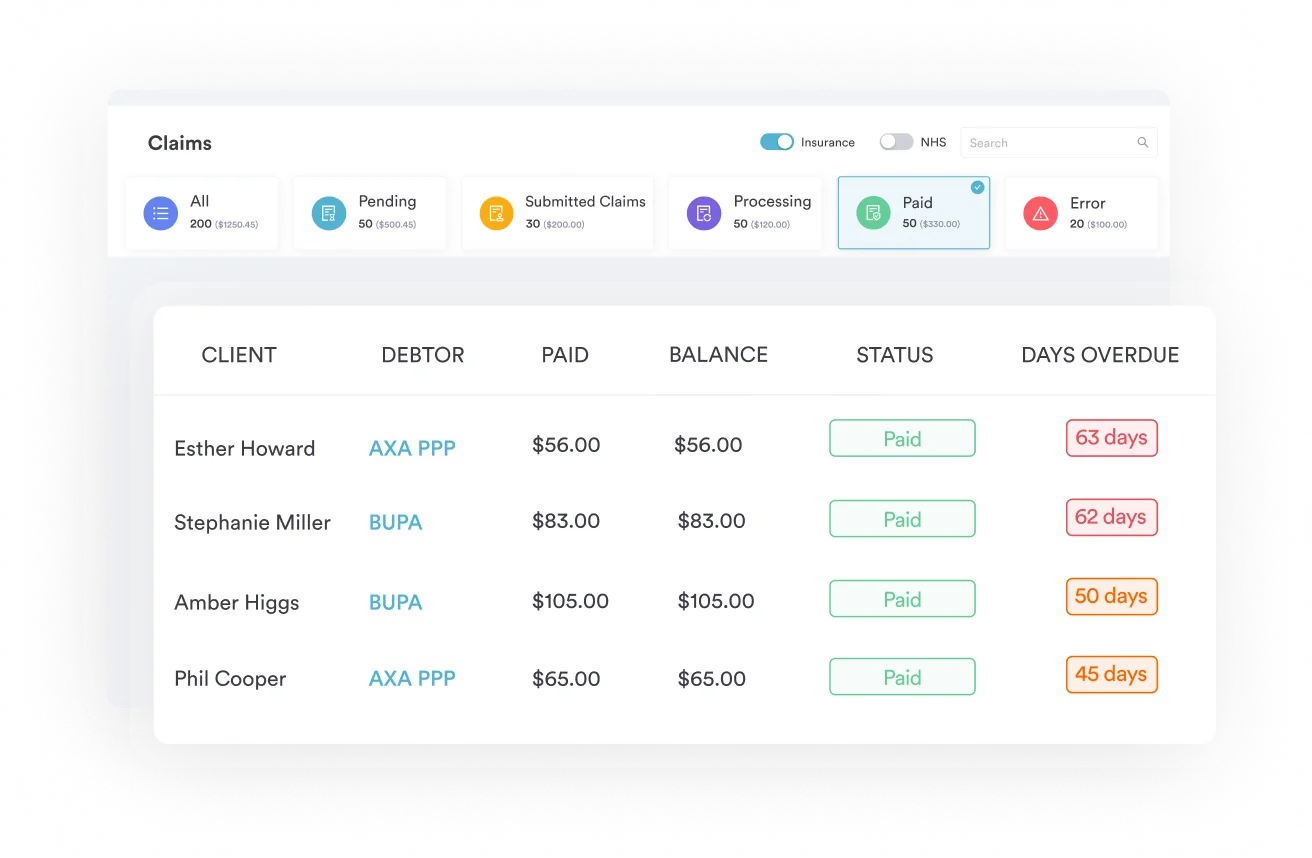
Hospital billing teams still relying on manual charge capture and end-of-day reconciliation carry more audit risk than practices that have moved to integrated workflows. The documentation issues that trigger RAC audits for CPT Code 99221 are largely preventable with the right tools in place. Multi-specialty groups, from general practice to psychiatry, need the same documentation discipline when hospital-based physicians handle initial encounters.
Pabau’s claims management software helps billing teams in three ways specific to E&M hospital coding: pre-submission documentation validation that checks whether the note supports the billed MDM level, denial tracking by code to identify patterns in 99221-99223 rejections, and automated follow-up workflows for outstanding claims.
For practices managing a high volume of initial hospital encounters, a system that flags documentation mismatches before the claim goes out is considerably cheaper than working denials after the fact.
The revenue cycle management fundamentals that reduce billing overhead apply directly to hospital-based groups managing multiple coders and hospitalists across shifts. Teams interested in streamlining documentation workflows can also explore patient care management systems that connect clinical notes with billing codes at the point of entry.
CPT Code 99221 covers the first day of hospital inpatient or observation care at the straightforward or low MDM level, or when total time meets the 40-minute threshold. The 2023 AMA revision merged observation and inpatient billing into a single code set, eliminating the old 99217-99220 codes that still appear in some practices’ charge templates.
Documentation accuracy drives everything: the note must explicitly support the MDM level or record specific total minutes. For hospital billing teams, reducing denials and tracking the 99221-99223 code series efficiently starts with getting these fundamentals right on day one.

Billing for diabetic footwear too? Diabetic depth-inlay shoe billing covers the PDAC approval requirement and the yearly limit of one pair plus three inserts.
Coding collagen wound fillers next? Collagen wound filler billing explains why billing by grams applied instead of calculated units causes most denials.
Need the code for wound dressings too? Hydrocolloid dressing billing guide covers the size limit and per-dressing billing rules for pressure injury and ulcer claims.
CPT Code 99221 is the initial hospital inpatient or observation care code for the evaluation and management of a new or established patient on the first day of a hospital stay, requiring straightforward or low medical decision making or 40 minutes of total time on the date of service. It applies to both inpatient and observation settings following the 2023 AMA revision that merged these two previously separate code sets.
The 2026 Medicare national average facility payment for CPT 99221 is approximately $90-$95 (2.75 total RVUs multiplied by the 2026 conversion factor of about $33.40-$33.57). Because 99221 is inherently a facility-only (hospital) service, a separate non-facility rate doesn’t meaningfully apply. Confirm the exact locality-adjusted figure using the CMS Physician Fee Schedule look-up tool at cms.gov, as GPCI adjustments vary payment by MAC jurisdiction and year.
All three codes cover the first day of hospital inpatient or observation care, but differ by complexity level: 99221 requires straightforward or low medical decision making (or 40 minutes total time), 99222 requires moderate MDM (or 55 minutes), and 99223 requires high MDM (or 75 minutes). Select the code whose MDM threshold matches the documented complexity of the encounter, or use total time if that is the basis for billing.
Yes. Since January 1, 2023, CPT 99221 covers both hospital inpatient and observation care on the first day of a stay. The prior standalone observation codes 99218-99220 were deleted in the 2023 AMA CPT restructuring. Submitting those old observation codes on any date of service after December 31, 2022 results in automatic denial.
CPT 99221 carries approximately 1.92 work RVUs (wRVU), 0.71 practice expense RVUs (facility), and 0.12 malpractice RVUs, for a total of approximately 2.75 total RVUs in a facility setting. Confirm against the current CMS MPFS data file for your billing year, as RVU values are updated annually.
CPT 99221 follows the AMA E&M guidelines revised in 2023, which eliminated the requirement for a comprehensive history and physical examination and replaced it with MDM-based or time-based level selection. CMS adopted these guidelines for Medicare, and most commercial payers have followed. The AMA CPT 2023 manual and the CMS Internet-Only Manual (IOM) Publication 100-04 are the primary authoritative references for billing and documentation requirements.



