HCPCS Code G0163: Skilled nursing observation and assessment
What is HCPCS Code G0163? HCPCS Code G0163 is a deleted Level II code for skille...

Last Updated: Oct 15, 2026
99252 is the CPT code for an inpatient or observation consultation, new or established patient, with straightforward medical decision making.
It sits in the 99252-99255 range, which covers specialist consultations in hospital inpatient or observation settings at another provider's written request. Medicare stopped paying consultation codes in 2010, while many commercial payers still accept them. Payment therefore turns on the payer. It also turns on documenting all three Rs, meaning the request, the rendered service and the report back.
Let Pabau's smart automation suggest the right codes, reduce claim denials, and keep your practice compliant—effortlessly.
Automate repetitive tasks and focus on what matters most—your patients.
Reduce coding errors and ensure compliance with the latest regulations.
Clean claims, fewer denials, and faster reimbursements.
Powerful insights and reporting to help your practice thrive.
HIPAA compliant SOC 2 certified GDPR-compliant Trusted by 4,000+ clinics worldwide

CPT code 99252 applies to initial inpatient or observation consultations, not follow-up visits or outpatient encounters.
Straightforward medical decision making supports 99252. Low complexity moves the encounter up to 99253.
Medicare does not reimburse 99252, so bill 99221 to 99223 instead. Many commercial payers still accept the consultation family.
All three Rs must be documented, meaning the written request, the rendered service, and the report back to the requesting provider.
Pabau’s claims management software flags a missing consultation request before the claim reaches the clearinghouse.
CPT code 99252 is an evaluation and management code for an initial inpatient or observation consultation. It applies when the consulting specialist’s medical decision making is straightforward. The American Medical Association maintains the CPT code set and publishes the official descriptor. The code sits inside the 99252-99255 inpatient and observation consultation family.
CPT deleted the level 1 code, 99251, on January 1, 2023, so 99252 is now the lowest level in the family.
The table below shows each code in that family with its MDM complexity level and setting, so coders can confirm the right level before submitting.
A consultation code applies only to the initial encounter. Once a specialist takes over ongoing management of the patient, later visits bill under the inpatient follow-up codes 99231-99233. A second consultation code is not available for the same admission.
Valid documentation for CPT code 99252 requires all three Rs. Missing any one of them is grounds for claim denial or post-payment audit recoupment.
Each R blocks a specific denial reason, and each one is captured at a different moment in the encounter.
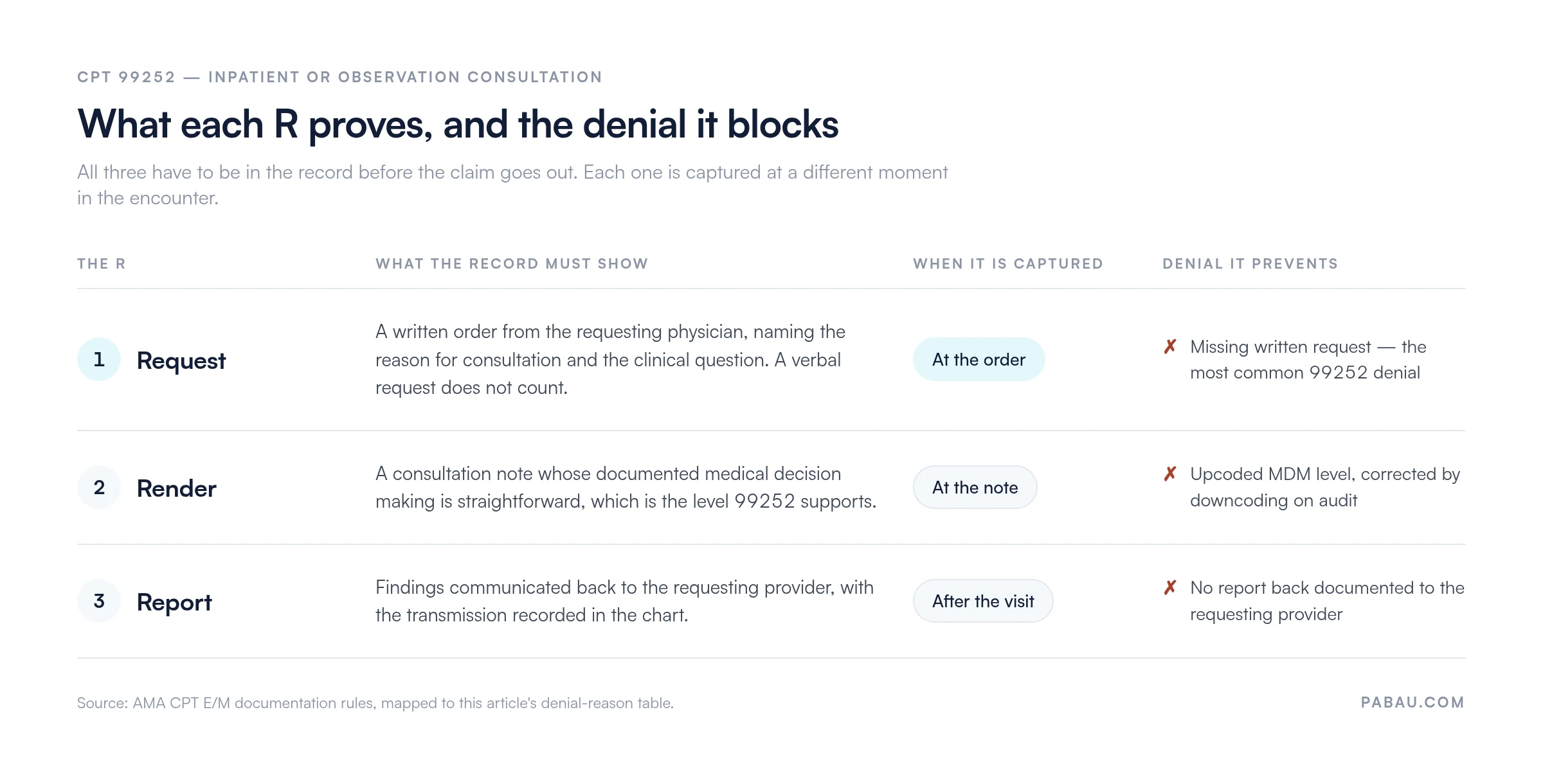
Consultation requests are often given verbally on inpatient floors, and the written order never reaches the chart. Build the workflow so that the written request is filed before the consult note is signed. An auditor reading the record months later can only judge what was captured at the time.
CPT 99252 requires straightforward MDM under the AMA’s current E/M guidelines. MDM is scored on three elements. Those elements are the problems addressed, the data reviewed, and the risk to the patient.
For 99252 to be supported, the consultation note has to document straightforward decision making:
Time-based billing is an alternative when the consulting physician records total time spent on the date of the encounter. For CPT 99252, the AMA threshold is 35 minutes. Confirm the figure against the current year’s CPT codebook, because the consultation range is revised separately from the office visit codes.
The most common confusion around CPT code 99252 is when to bill it instead of initial hospital care. Those codes are 99221, 99222 and 99223. A consultation needs a request from another provider and a report back to them. An initial hospital care code covers the admitting physician’s first encounter with an admitted patient, and needs no referral.
For Medicare patients, the consulting specialist bills 99221, 99222 or 99223 by MDM level, rather than CPT 99252. This is payer policy, not a documentation question. Complete three-R documentation will still not make Medicare pay a consultation code.
No. Medicare eliminated the consultation code family (99241-99255) effective January 1, 2010, under CMS Transmittal 1875 and MLN Matters SE1010. Billing CPT 99252 to Medicare produces an automatic claim denial. The rejection happens at system level, so correcting the note and resubmitting the same code changes nothing.
For Medicare inpatient consultations, the correct substitution codes are:
A payer-aware coding workflow is what makes the substitution reliable. When a specialist sees a Medicare patient in the inpatient setting, the billing team swaps in the matching 9922x code. The MDM documented in the note decides which one.
Build a payer-flag step into your inpatient consultation billing workflow. Before a claim is coded, verify the patient’s primary payer. Medicare patients get 99221-99223. Commercial patients get 99252-99255 where the payer accepts them. Flag Medicaid patients separately, because state policies vary. This one step prevents the most common consultation-code denials.
Medicare does not pay CPT 99252, so the 2026 Physician Fee Schedule carries no national average rate for it. Commercial payers that do reimburse the code negotiate rates individually, under their contract with the provider group.
The CMS Physician Fee Schedule search tool is where you check RVU values and estimate fee schedule equivalency from Medicare conversion factors. Some MAC localities still publish RVU data for consultation codes, even though Medicare does not pay them.
On commercial claims, the 99252 allowed amount usually falls between $90 and $160 at the national average. The figure moves with the payer contract, the MAC locality, the specialty and the geographic adjustment factor.
Verify your contracted rate in the payer portal or in your remittance data before you rely on any published benchmark.
Medicare’s consultation ban gets most of the attention in coding references. Commercial payer policy decides more of the revenue on this code, and it shifts by carrier and by plan.
Confirm the payer’s current policy before billing any consultation code. Carriers revise these policies, so last year’s acceptance is no evidence of this year’s. Capturing the payer type at scheduling is what makes the right coding pathway obvious later.
Practices with a high volume of Medicare Advantage patients should take extra care here. Those plans are administered by commercial carriers but regulated under Medicare rules, and plan designs vary widely on consultation code acceptance. Check the plan-level policy, not the brand on the card.
CPT code 99252 denials cluster around a predictable set of documentation and payer-selection errors. Knowing them in advance is the fastest way to cut rework volume.
Track rejections at the code level rather than the claim level. Where most 99252 rejections carry the same CARC reason, the cause is usually one workflow step rather than a one-off documentation error. Our reference on denial codes explains what each reason code is telling the billing team.
Most consultation code denials are preventable at the point of charting. The clinical team documents the encounter, and the billing team finds the missing element days later, once the payer has already rejected it. Practice management software like Pabau closes that distance.
Pabau’s claims software for practices surfaces documentation and payer-policy problems before a claim is submitted. Electronic claims run through our Claim.MD integration, which reaches thousands of US payers. Real-time eligibility checks then flag whether a patient’s primary payer accepts consultation codes at all.
For a specialist who covers Medicare and commercial patients on the same ward, that one check prevents the largest category of 99252 denials.
Denial patterns are tracked at the code level as well. When 99252 claims are rejected above the practice’s average for one payer, the reporting surfaces that trend early. The billing team can then check whether a payer policy changed or a documentation step slipped.
Run a monthly report on consultation code denial rates by payer. If 99252 denials spike for one carrier, pull the CARC reason codes from the ERA data and compare them against your payer policy log. A sudden rise in CO-4 denials usually signals a policy change rather than a documentation error. Verify the policy before you correct and resubmit.

Pabau’s claims tools flag a missing consultation request, verify payer-specific code acceptance, and track denial patterns at the code level before claims reach the clearinghouse.

Treat 99252 as a payer question first and a coding question second. The MDM bar is the lowest in the family, so the encounter almost never fails on complexity. It fails because the payer stopped buying consultations, or because the written request never reached the chart.
Practices that keep this code clean do two things. They verify the payer at scheduling, and they file the consultation request before the note is signed. Both cost seconds per consult, and both remove rework on a denial that cannot be appealed. Book a demo to see how consultation claims get validated before they leave the practice.

Need to understand the full medical billing process? What is medical billing walks through each stage from patient encounter to payment posting.
Want to track denial patterns across CPT codes? Denial management in healthcare covers how to build a systematic denial tracking and appeals workflow.
Looking for guidance on clearinghouse claim submission? Claim.MD clearinghouse overview explains how electronic claims reach payers and where validation happens.
Want fewer claims sent back for correction? What is a clean claim sets out the checks that let a claim pass on first submission.
Checking coverage before the visit? Insurance eligibility verification shows how to capture payer details at scheduling rather than after a denial.
CPT code 99252 covers an initial inpatient or observation consultation performed at the written request of another provider. The documented medical decision making must be straightforward. The code does not cover follow-up visits, outpatient consultations, or encounters with no documented consultation request.
No. Medicare eliminated all consultation codes (99241-99255) effective January 1, 2010. Submitting CPT 99252 to Medicare results in an automatic system-level denial. Consulting specialists must bill 99221, 99222, or 99223 for Medicare inpatient encounters based on the MDM level documented.
They are request, render and report. The record needs a written request from the referring provider. The consulting specialist then renders the service and documents MDM at the level billed. A written report goes back to the requesting provider. All three must be present for the claim to survive an audit.
Use 99252 when the documented MDM is straightforward. Use 99253 when MDM reaches low complexity, such as two or more self-limited problems or one stable chronic illness. Use 99254 when MDM is moderate. Code selection follows the MDM documented in the consult note, not the complexity the specialist perceived.
Yes. The 99252-99255 range covers inpatient and observation consultations alike. A specialist consultation performed while the patient is in observation status qualifies. The documentation and three-R requirements are the same in both settings.
Five reasons cover most denials. The claim went to Medicare, which does not accept consultation codes. The written consultation request is missing from the record. No report back to the requesting provider is documented. The MDM billed is higher than the note supports. Or a follow-up visit was billed as an initial consultation instead of 99231-99233.