

HCPCS Code G0163: Skilled nursing observation and assessment
What is HCPCS Code G0163? HCPCS Code G0163 is a deleted Level II code for skille...

Last Updated: Oct 15, 2026
99218 is the CPT code for initial observation care at the lowest complexity level. Its descriptor required a detailed or comprehensive history, a detailed or comprehensive examination, and medical decision making that is straightforward or of low complexity.
The American Medical Association (AMA) deleted CPT code 99218 effective January 1, 2023. The 2023 revision merged the observation and inpatient initial care codes, so revised 99221-99223 now cover both settings. Payers reject 99218 on claims for any date of service from that day on.
Let Pabau's smart automation suggest the right codes, reduce claim denials, and keep your practice compliant—effortlessly.
Automate repetitive tasks and focus on what matters most—your patients.
Reduce coding errors and ensure compliance with the latest regulations.
Clean claims, fewer denials, and faster reimbursements.
Powerful insights and reporting to help your practice thrive.
HIPAA compliant SOC 2 certified GDPR-compliant Trusted by 4,000+ clinics worldwide

CPT code 99218 covered initial hospital observation care at the lowest complexity level, with straightforward or low medical decision making (MDM).
The AMA deleted 99218 on January 1, 2023, along with 99219 and 99220.
The revised CPT codes 99221-99223 now cover initial care for both inpatient and observation patients in one code family.
A claim carrying 99218 for a date of service on or after January 1, 2023 is rejected as an invalid code. Today the level rests on MDM or total time.
Billing software such as Pabau runs validation checks before a claim is sent, giving your team a chance to fix coding errors first.
CPT code 99218 is the former initial hospital observation care code for low-complexity presentations. The AMA CPT codebook required a detailed or comprehensive history, a detailed or comprehensive exam, and straightforward or low medical decision making (MDM). It belonged to the 99218-99220 family, which split initial observation care into three complexity tiers. The 2023 restructuring deleted all three, and the revised 99221 now covers this service.
Under CMS policy, patients placed on observation status are outpatients, however many nights they spend in a hospital bed. That status shapes both billing and cost-sharing. Medicare Part B pays the physician fee for observation services, and patients may face higher out-of-pocket costs than under an inpatient admission.
No. CPT code 99218 is no longer a valid billing code. The AMA deleted 99218, 99219, and 99220 on January 1, 2023. The change was part of a broader restructuring of hospital evaluation and management (E/M) codes. It merged the observation and inpatient initial care codes into one family. As in the 2021 office visit framework, MDM or time now sets the level.
The replacement codes are the revised 99221, 99222, and 99223. Under the 2023 framework, these three codes cover initial inpatient care and initial observation care alike. Code selection changed as well. The level now rests on MDM complexity or total physician time on the date of service, whatever the patient’s status.
Each replacement code carries its own documentation rules, and our CPT code guides walk through them code by code.
When CPT code 99218 was active, the AMA required three documented elements. They were a detailed or comprehensive history, a detailed or comprehensive exam, and straightforward or low-complexity MDM. All three had to appear in the record on the date of the initial observation placement. The two higher tiers, 99219 and 99220, required a comprehensive history and a comprehensive exam.
A detailed history needed a chief complaint, an extended history of present illness (HPI), and an extended review of systems (ROS). It also needed a pertinent past, family, and social history (PFSH). A comprehensive history raised the ROS to 10 or more systems and recorded all three PFSH areas.
A detailed exam covered the affected area and related organ systems in depth. A comprehensive exam typically documented eight or more organ systems. MDM at the straightforward or low level meant minimal diagnostic workup and low risk of complications from treatment.
Missing any one of the three elements was enough for a Medicare administrative contractor (MAC) to deny the claim. Auditors expected a history and physical (H&P) in the observation record that met at least the detailed level. A brief progress note did not qualify.
MDM complexity set each tier apart, but the history and exam requirements differed too. 99218 accepted a detailed or comprehensive history and exam. 99219 and 99220 both required the comprehensive level for each.
Before 2023, the patient’s status set the code family. Observation status called for 99218-99220, and a formal inpatient admission called for 99221-99223. A physician could treat two patients with the same diagnosis on the same floor. One under observation was billed 99218, and the other, formally admitted, was billed 99221.
Status was decided by the admitting or ordering physician, and the billing team had no say in it. Under CMS policy, the physician’s order and the hospital’s admission review set whether a patient was observation or inpatient. A coder could not reclassify status to improve payment.
Handoffs made this harder. Emergency physicians often wrote the observation order before a hospitalist took over. The billed code could then end up out of step with the status in the hospital’s admission, discharge, and transfer (ADT) system.
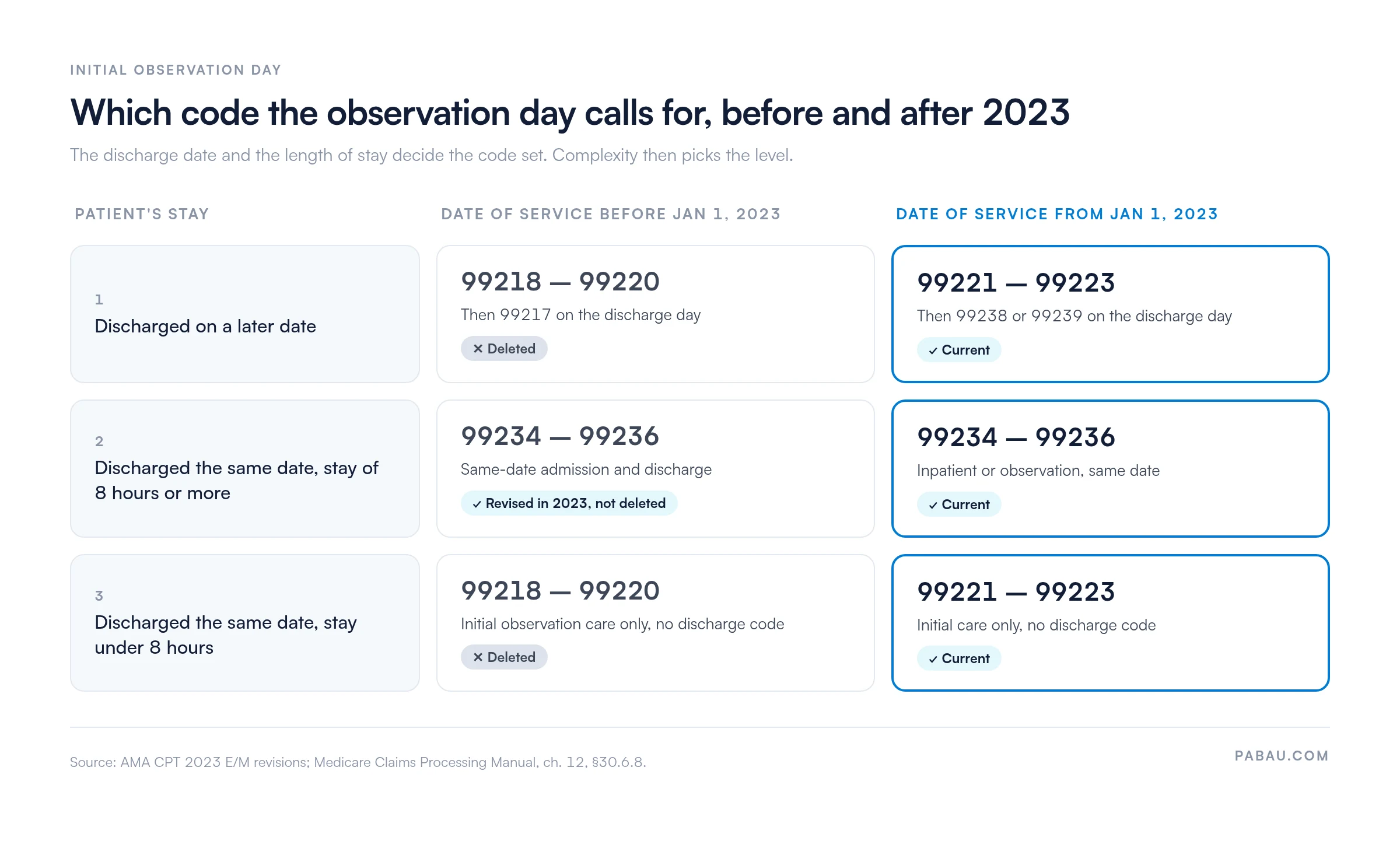
When a patient was placed in observation and discharged on the same date, the length of stay decided the code. Under the Medicare Claims Processing Manual, chapter 12, §30.6.8, CPT codes 99234-99236 applied to stays of 8 hours or more. Like the initial codes, they were tiered by complexity, with 99234 at low, 99235 at moderate, and 99236 at high.
For a same-date stay under 8 hours, the physician billed initial observation care only, such as 99218, with no discharge code. The 99234-99236 codes were revised in 2023, not deleted. They remain valid as hospital inpatient or observation care with admission and discharge on the same date, and 99234 is the low level.
The grid below shows which code set an initial observation day called for, before and after the 2023 change.
Medicare reimbursed CPT code 99218 under the Part B Physician Fee Schedule using facility and non-facility relative value unit (RVU) rates. Facility rates applied when the service was rendered in a hospital-based observation unit. Non-facility rates were higher and applied in rare circumstances where observation occurred in a non-facility setting.
Historical reimbursement rates for 99218 varied by year and geographic adjustment factor. The FastRVU lookup tool reflects current RVU values under the revised 2023 framework. Because the code was deleted, its historical rates are no longer available there.
Before the deletion, MACs published fee schedules and medical necessity criteria for 99218. Examples include CGS Administrators (Jurisdiction 15) and Novitas Solutions (Jurisdictions H and L). Those policies no longer apply to active claims.
Practices submitting claims for services rendered before January 1, 2023 may still need to reference historical 99218 payment data for appeals or audit responses. Those rates are accessible through CMS’s archived Physician Fee Schedule data files, which keep prior-year fee schedules by locality. For initial observation care dated on or after January 1, 2023, bill the revised 99221-99223.
When 99218 was active, payers enforced medical necessity criteria that went beyond the AMA’s documentation requirements. Medicare required observation status to be clinically justified. The patient’s condition had to warrant monitoring without clearly meeting inpatient admission criteria under the two-midnight rule.
Commercial payers had their own policies. Some commercial and Medicaid plans required prior notification of observation placement. Missing that step did not automatically deny the claim, but it put the burden of proof on the provider in a later audit. Compliance also meant a written observation order in the record, signed by the ordering physician before billing.
Denials for CPT code 99218 followed predictable patterns, and they still matter today. Practices answering audits or appeals for pre-2023 services meet the same criteria. The same errors now surface on claims using the replacement codes 99221-99223.
Effective denial management in healthcare for observation claims starts at the point of documentation, not at the clearinghouse. Practices that audit claims before submission catch status mismatches and thin documentation before they turn into denial letters. Clean claim submission for observation services starts with three checks. The code must be active on the date of service, and it must match the setting. The documentation must also support the complexity level billed.
Run a quarterly audit of all observation claims billed in the previous 90 days. Pull any claim where the billed code doesn’t appear on the current AMA active code list and cross-check against replacement codes. For pre-2023 claim appeals, request the MAC’s historical LCD or fee schedule for the date of service to document the correct reimbursement basis.
On calendar days following the initial observation placement, subsequent observation care codes applied rather than repeat billing of 99218. CPT 99224 covered subsequent observation care at low complexity, 99225 at moderate complexity, and 99226 at high complexity. Each required documentation of an interval history, examination, and MDM appropriate to the complexity level billed.
CPT 99217 was the observation discharge day management code used when discharge occurred on a calendar day different from the initial observation date. The three subsequent codes and the discharge code were also deleted effective January 1, 2023. Subsequent care moved to the revised inpatient or observation codes 99231-99233. Discharge moved to the combined hospital inpatient or observation discharge codes, 99238 for 30 minutes or less and 99239 for more than 30 minutes.
Observation billing errors persist because the 2023 code restructuring wasn’t universally understood across billing teams at the time it took effect. Many practices had charge capture workflows mapped to 99218-99220 that weren’t updated before the deletion date. Claims sent with those old mappings fail at the payer with an invalid-code rejection. A practice that doesn’t review denial reports regularly may miss the pattern for months.
Practice management platforms reduce this risk by checking claims before they leave the practice. Pabau’s claims management software runs validation checks before a claim is sent. Your team can correct errors at that point, before the claim reaches a payer.
Professional claims go out on the CMS-1500 through Claim.MD, a medical claims clearinghouse that connects to thousands of US payers. Hospitalist and emergency medicine groups with heavy observation volume catch problems before submission, instead of chasing denial letters afterward.

Observation billing also means tracking the whole episode, with initial, subsequent, and discharge codes billed as one chain. A discharge code with no matching initial claim gets flagged in payer audits as incomplete episode billing. Linking each encounter to its codes by date of service keeps that chain intact.
For practices running revenue cycle management across observation and inpatient encounters, one billing platform for both cuts the manual checks on coding staff. Check the AAPC’s CPT code database to verify the active status of any observation or inpatient code before including it in a charge master update.

Pabau’s claims management software runs validation checks before a claim is sent and routes professional claims through Claim.MD to thousands of US payers. See how it works for your practice.

Treat 99218 as a historical code. It belongs on appeals and audit responses for dates of service before January 1, 2023, and never on a newer claim. For those older claims, the record needs a detailed or comprehensive history and exam, plus straightforward or low MDM.
For current claims, the bigger risk is an out-of-date charge map. Map initial observation care to 99221-99223 and same-date stays of 8 hours or more to 99234-99236. Then let a check before submission catch what slips through.
Book a demo to see how Pabau checks each observation claim before it goes out, so coding errors get fixed before a payer sees them.

Need to understand how clearinghouse claim routing works? Claim.MD clearinghouse overview explains how electronic claims reach payers through Pabau’s integrated clearinghouse.
Looking for the full medical billing process from encounter to payment? What is medical billing covers the end-to-end billing workflow including claim submission and denial follow-up.
Want a structured approach to reducing claim denials? Denial management in healthcare outlines the systematic steps practices use to prevent, track, and appeal denied claims.
Billing a discharge on a later date? CPT code 99217 explains the deleted observation discharge code and what replaced it.
Need the high-complexity tier of the replacement family? CPT code 99223 covers the documentation and MDM it requires.
CPT code 99218 is the former initial hospital observation care code for low-complexity presentations. It required a detailed or comprehensive history, a detailed or comprehensive exam, and straightforward or low medical decision making. The AMA deleted it effective January 1, 2023, and it is no longer valid for billing.
No. CPT code 99218 was deleted effective January 1, 2023. Claims submitted with this code for dates of service on or after that date will be automatically rejected by payers as an invalid code.
The revised CPT code 99221 replaced 99218 for low-complexity initial observation or inpatient care. The full set is 99221 (low), 99222 (moderate), and 99223 (high). Code selection now rests on MDM complexity or total physician time, not admission status.
Before 2023, 99218 applied to patients on observation status, who are outpatients, and 99221 applied to formally admitted inpatients. Documentation differed after the change. 99218 required a detailed or comprehensive history and exam. The revised 99221 needs only a medically appropriate history and exam, and MDM or time sets its level.
Common denial reasons included incomplete H&P documentation, MDM the record didn’t support, and a mismatch between the hospital’s ADT status and the physician’s claim. Others were billing 99218 with 99217 on a same-day discharge, and submitting the code for dates of service after January 1, 2023.




