



HCPCS code E0198: Water pressure pad billing guide
HCPCS code E0198 is a water pad for a standard mattress HCPCS code E0198 is the ...

Last Updated: Oct 13, 2026
CPT code 99217 is a now-deleted procedure code for observation care discharge day management. It covered patients leaving outpatient hospital observation status on a date after their initial observation admission. Effective January 1, 2023, the American Medical Association deleted it and directed physicians to report observation discharge with 99238 or 99239 instead. Those two codes are chosen by total time on the discharge date, and they now cover discharge from inpatient and observation status alike.
Practices still submitting 99217 will have those claims rejected automatically. Below you will find the code’s history, the replacement codes, and the documentation each one needs. Medicare reimbursement and the errors that cost observation claims most often follow after that.

CPT code 99217 covered observation care discharge day management when a patient’s discharge occurred on a date after their initial observation admission date.
The AMA deleted CPT 99217 effective January 1, 2023. Observation discharge on a later date is now reported with 99238 or 99239.
Code 99238 covers 30 minutes or less of discharge day time, and 99239 covers more than 30 minutes. Both are selected by time, not by medical decision making.
Codes 99231-99233 apply only to subsequent days of care between admission and discharge. Using one of them for the discharge day is a coding error.
Same-day observation admit and discharge has always used codes 99234-99236, and those codes remain valid post-2023.
Submitting CPT code 99217 on or after January 1, 2023 results in automatic claim denial. Verify your billing system has removed this code from active code sets.
CPT code 99217 is the former AMA procedure code for observation care discharge day management. It applied only when discharge from outpatient hospital observation status fell on a calendar date different from the initial observation admission date.
The NIH Value Set Authority Center preserves the last active definition from CPT version 2021.
The key restriction that defined 99217 was the “different date” requirement. If a patient was admitted to observation on a Monday and discharged on Tuesday, 99217 covered the Tuesday discharge encounter. If they were admitted and discharged on the same day, 99217 never applied. That scenario always required codes 99234-99236.
The AMA deleted the standalone observation care codes 99217-99220 and 99224-99226 effective January 1, 2023, as part of a broader restructuring of hospital-based E&M coding. CMS adopted the change for Medicare in the CY2023 Physician Fee Schedule final rule. The stated aim was to remove a payment distinction between observation care and inpatient care that had no clinical basis. It had confused payers, physicians, and patients for years.
Under the old framework, a physician managing a patient in observation status used a separate code set. The same physician treating a similar patient under formal inpatient admission billed from a different one. The clinical work was often identical; the billing path was not. CMS resolved this by folding observation services into the existing inpatient E&M hierarchy.
Practices that had 99217 hardcoded in their billing templates, charge capture sheets, or EHR order sets needed to update those systems before the changeover. Many found out only when the first denial batches landed in early 2023.
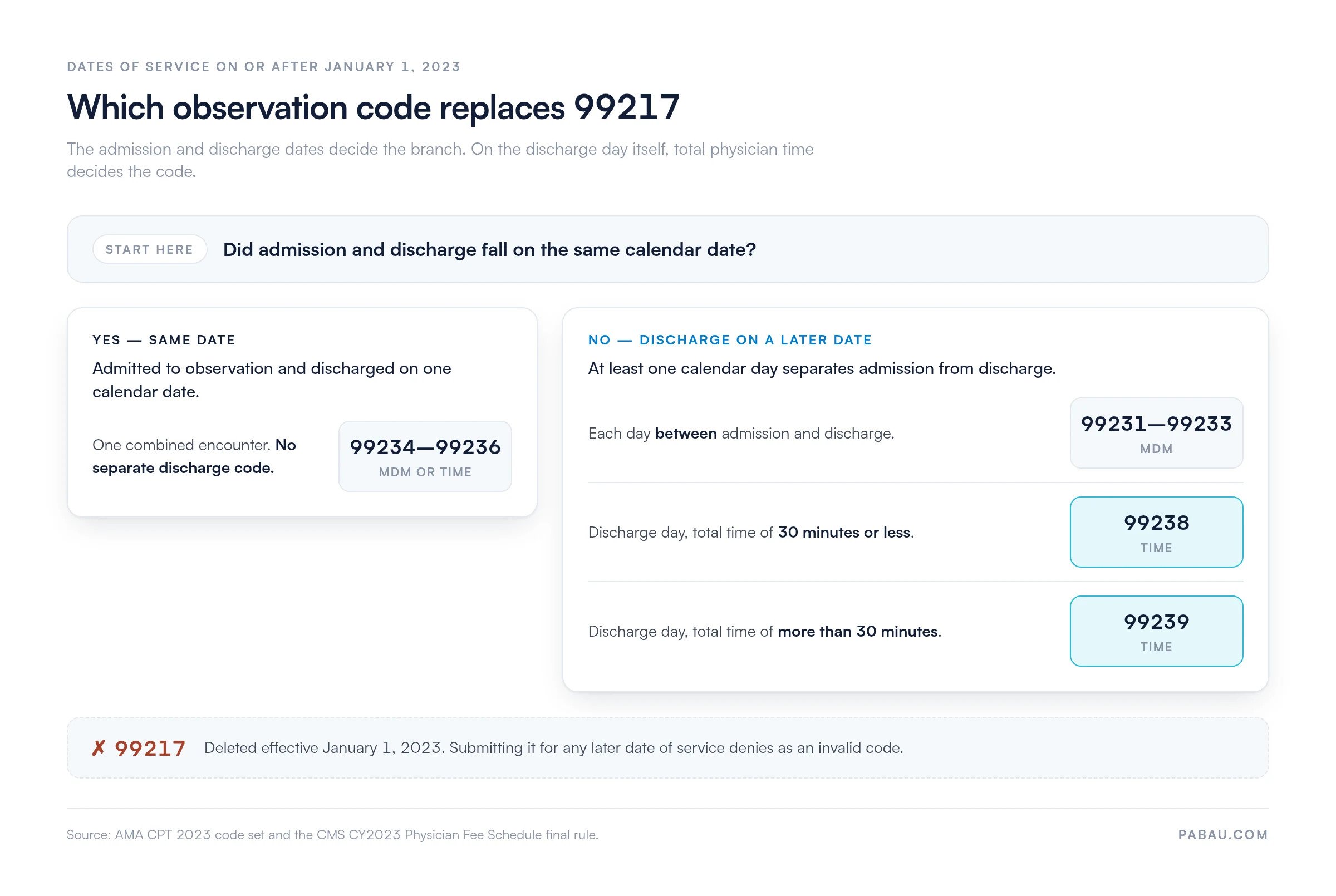
Observation discharge on a date after admission is now reported with CPT 99238 or 99239. The 2023 CPT revision retitled both as hospital inpatient or observation discharge services, so they cover either status. Report 99238 when total physician time on the discharge date is 30 minutes or less, and 99239 when it runs longer than 30 minutes. The rest of the observation stay maps onto the inpatient/observation E&M codes that previously applied only to formally admitted patients.
The discharge encounter is now timed rather than scored. When a patient leaves observation on a later date, record the total time spent on discharge day work. Pick 99238 or 99239 from that figure. Codes 99231-99233 belong to the days in between, never to the discharge day itself. The diagram below walks the same decision in the order a coder actually meets it.
Billing observation discharge correctly after January 2023 means reporting the discharge day with 99238 or 99239 and backing that choice with a documented time. The steps below apply to the physician billing the discharge visit on a date after the initial observation admission. Work through them in order, because each one supplies data the payer needs for a clean claim on first submission.
Documentation is what makes an observation discharge claim survive review. Audits targeting E&M upcoding have increased, and thin records are the main reason observation claims are recouped after payment. Confirm the charge matches what the note supports before the claim goes out.
The following elements must appear in the medical record for the discharge encounter to be billable under 99238 or 99239:
Time is what separates the two discharge codes, so a note that records none of it caps the claim at 99238 by default. Subsequent days of observation care work the other way around. Those visits are coded 99231 to 99233 on medical decision making, with time available as an alternative selection method under the post-2022 E&M guidelines.
Flag every observation case in your billing system with the admission date before the claim is generated. A discharge date that matches the admission date should automatically route to the 99234-99236 code set, not to 99238 or 99239. Building this logic into your charge capture workflow eliminates one of the most common observation billing errors before it reaches the clearinghouse.
Medicare reimbursement for observation discharge encounters is now paid through the unified inpatient/observation E&M fee schedule rather than through a separate observation payment pathway. Rates vary by year and locality. Use the CMS Physician Fee Schedule lookup tool to find the current-year non-facility rate for your MAC region.
Medicare rates are updated annually and vary by locality. Check each code against the current-year CMS Physician Fee Schedule before you rely on a figure.
Rates change every January. A fee schedule loaded once and never refreshed quietly underpays observation discharge claims for the rest of the year. Reload it whenever CMS publishes a new one, and check the posted allowable against your contracted rate at the same time.
Observation billing does not exist in isolation. A physician managing a hospital observation case meets a whole family of codes before, during, and after the discharge encounter. The table below covers the full observation and inpatient/observation E&M code set, including the deleted codes you will still meet when reviewing pre-2023 claims.
Observation discharge billing generates a disproportionate share of E&M claim errors, and most of them are predictable. Catching one at charge entry costs a few seconds. Appealing the same error after the payer rules on it costs a staff member an afternoon. The denial codes on the remittance usually point straight at which of the five below caused it.
Observation billing errors are usually systemic rather than individual. A deleted code like 99217 can sit in a charge capture template for years, and every physician working from that template inherits it. Software that ties coding logic to the clinical workflow catches the stale code before it becomes a denial pattern.
Pabau, our practice management software, connects documentation, coding, and claim submission in one workflow. Its claims management software scrubs each claim on generation and flags invalid codes before they leave the practice. Billing staff read remittance advice in the same place, so denial patterns across observation encounters surface without an export.
Every claim also carries an audit trail of who coded it and when. A Medicare Administrative Contractor asking for the documentation behind a 99239 gets one record. The note, the recorded time, and the claim sit together instead of in three systems.
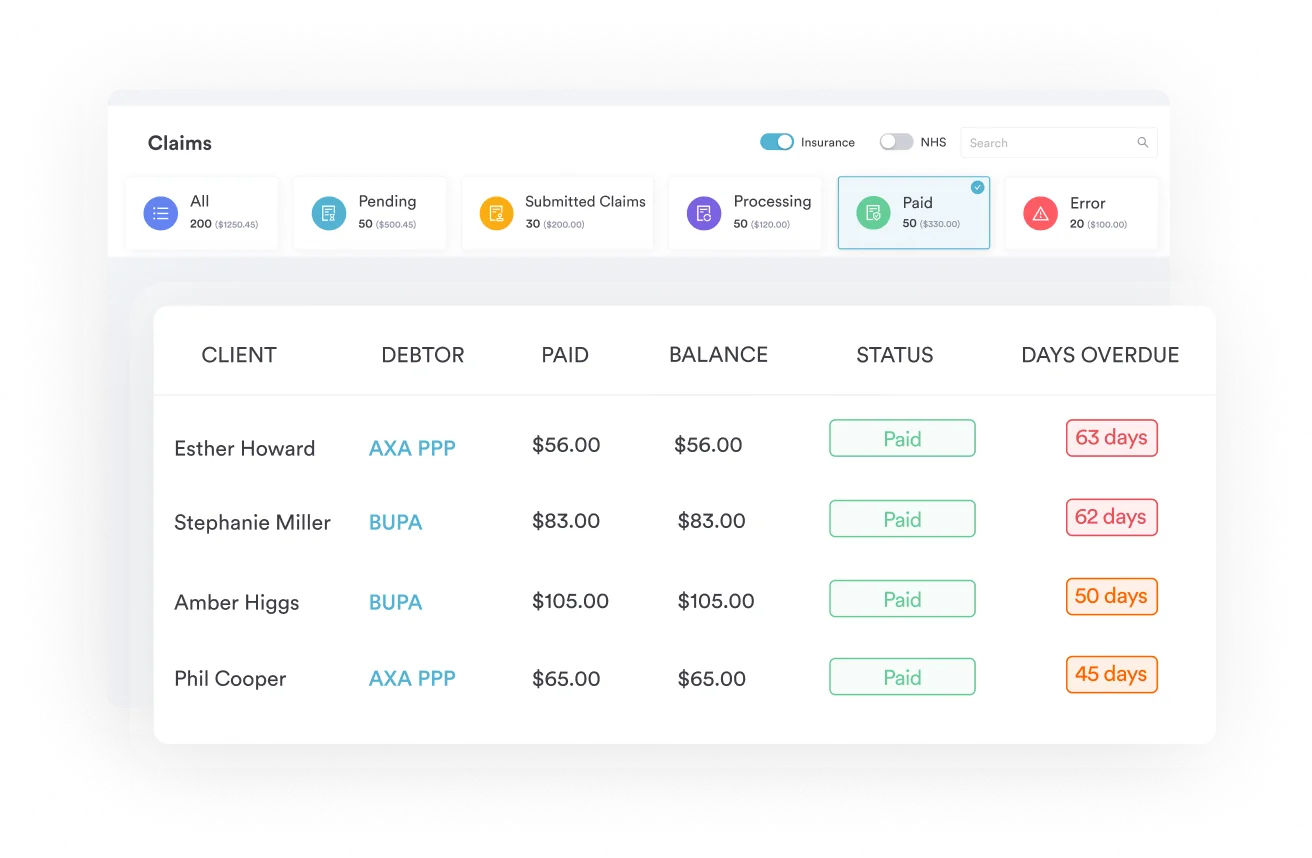
A scrubbing layer with current CPT validity checks would have flagged any 99217 submission from January 2023 onward. That happens at claim generation, before the payer ever issues a denial. Pabau reaches payers through the Claim.MD clearinghouse, which connects to thousands of commercial payers. It also supports real-time eligibility verification alongside CMS-1500 and 837P claim submission.

Pabau’s integrated claims management connects documentation, coding, and clearinghouse submission in one workflow. Automated claim scrubbing catches invalid and deleted codes before they reach the payer.

Three years on, 99217 is no longer really a coding question. Any claim still carrying it points at a template, a charge master, or an order set that nobody has audited since 2022. Payer systems enforce the deletion automatically, so the code will never quietly slip through.
So the useful next move is an inventory rather than a memo. Pull every active code set and confirm the deleted observation codes are gone from all of them. Then make sure a recorded time sits behind every 99238 and 99239 claim, because that is the first thing an auditor asks for.
Automated scrubbing and clearinghouse submission catch these errors while the claim is still yours to fix. Book a demo to see how Pabau handles observation discharge claims in your own billing workflow.

Need to understand how claims move through the billing cycle? Medical billing fundamentals covers the end-to-end process from encounter to payment posting.
Seeing observation claim denials come back from your clearinghouse? Denial management in healthcare outlines how to categorize, appeal, and prevent recurring denial patterns.
Want to verify your observation claims meet clean claim standards before submission? Submitting a clean claim covers the data elements payers require for first-pass acceptance.
CPT code 99217 is the now-deleted code for observation care discharge day management. It applied when a physician discharged a patient from outpatient hospital observation status on a date after the initial observation admission. It covered the final examination, discharge instructions, and medication reconciliation performed on the discharge day. The code was deleted effective January 1, 2023 and is no longer billable.
No. CPT code 99217 was deleted effective January 1, 2023 and is not valid for any date of service from that point forward. Claims submitted with this code for any date of service from 2023 onward are denied automatically as an invalid code.
Codes 99238 and 99239 replaced it. Report 99238 when total physician time on the discharge date is 30 minutes or less, and 99239 when it runs longer than 30 minutes. Both codes now cover discharge from inpatient and observation status. Same-day observation admit and discharge still uses 99234, 99235, or 99236.
CPT 99217 was the observation-only discharge code, and 99238 is the code that replaced it. Since January 1, 2023, CPT 99238 has been titled hospital inpatient or observation discharge day management, so one code now covers both patient statuses. It applies when total time on the discharge date is 30 minutes or less. Beyond 30 minutes, report 99239 instead.
No. Codes 99231 to 99233 cover subsequent hospital inpatient or observation care, meaning the days between admission and discharge. The discharge day itself is reported with 99238 or 99239. This set replaced the deleted subsequent observation care codes 99224-99226, not 99217.
No. CPT 99217 and 99220 could never be billed on the same date of service. CPT 99220 covered the initial observation admission encounter, and 99217 covered the discharge encounter on a subsequent day. Both are now deleted as of January 1, 2023. Billing either code for services after that date will result in denial.
Yes. Medicare covers observation discharge services when they are properly documented and billed under the current replacement codes. That means 99238 or 99239 for discharge on a later date, and 99234-99236 for same-day discharge. Patients on observation status carry different cost-sharing obligations under Medicare than admitted inpatients. Before billing, verify that the observation status notification requirement under the NOTICE Act was met.



