HCPCS Code Q4175: Billing, coverage, and documentation guide
HCPCS Code Q4175: Code Description and Product Identity HCPCS Code Q4175 is the ...

Last Updated: Nov 20, 2026
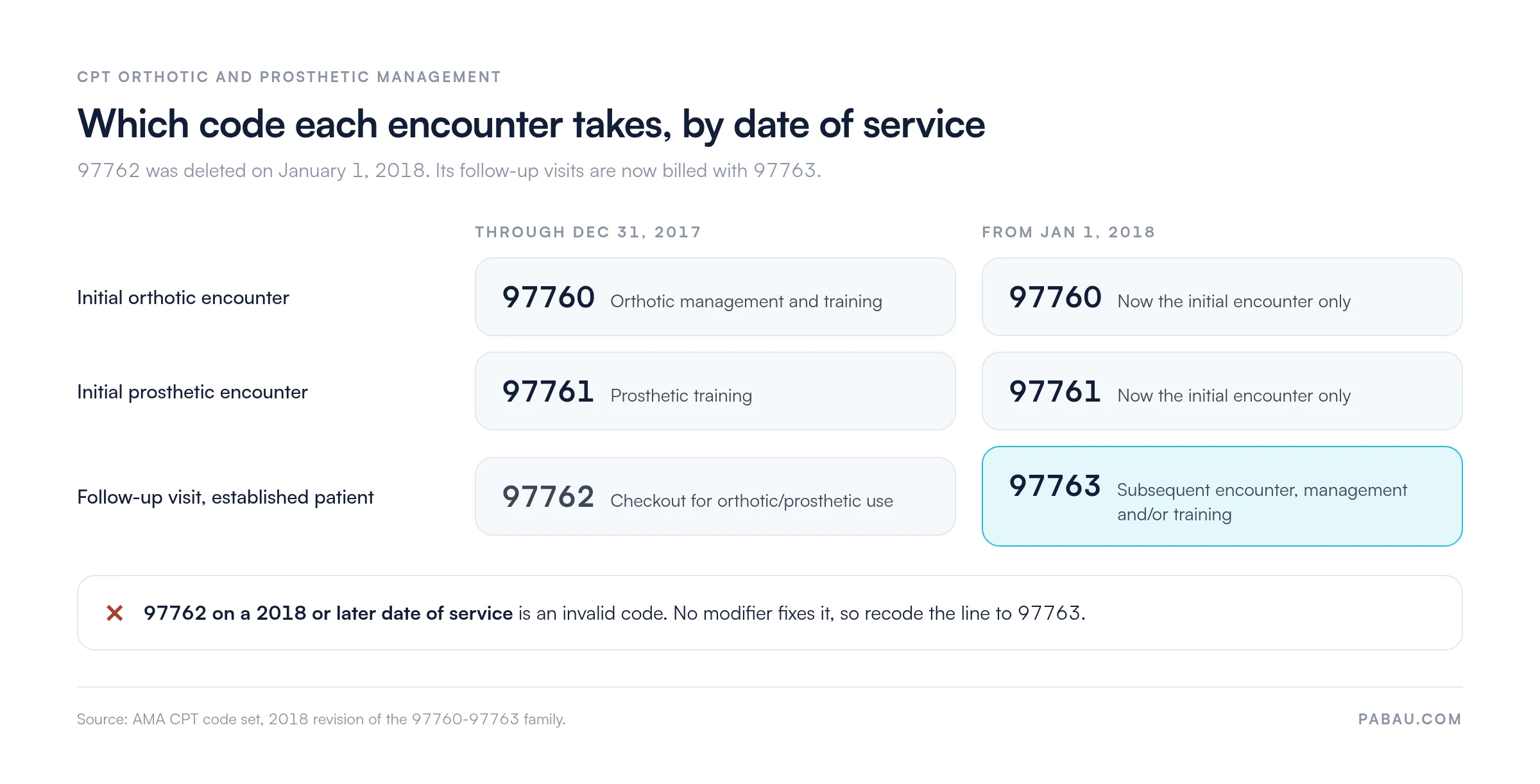
97762 is the deleted CPT code for checkout for orthotic/prosthetic use, established patient, each 15 minutes. The AMA removed it from the CPT code set effective January 1, 2018.
Claims with a 2018 or later date of service use the replacement codes instead. 97763 covers every subsequent orthotic or prosthetic management and training encounter. 97760 and 97761 cover the initial orthotic and prosthetic encounters.
Let Pabau's smart automation suggest the right codes, reduce claim denials, and keep your practice compliant—effortlessly.
Automate repetitive tasks and focus on what matters most—your patients.
Reduce coding errors and ensure compliance with the latest regulations.
Clean claims, fewer denials, and faster reimbursements.
Powerful insights and reporting to help your practice thrive.
HIPAA compliant SOC 2 certified GDPR-compliant Trusted by 4,000+ clinics worldwide

CPT Code 97762 was deleted on January 1, 2018, so claims with a later date of service must use another code.
97763 covers subsequent orthotic and prosthetic encounters, while 97760 (orthotic) and 97761 (prosthetic) cover initial ones.
A 97762 line with a 2018 or later date of service is denied as invalid, and no modifier fixes it.
Medicare treats 97763 as an always-therapy code, so each claim line needs a GN, GO, or GP modifier.
Pabau submits and tracks claims through Claim.MD, with the encounter note on the same patient record.
CPT Code 97762 was the billing code for checkout for orthotic/prosthetic use, established patient, each 15 minutes. The AMA deleted it effective January 1, 2018. Follow-up orthotic and prosthetic visits are now billed with 97763 instead.
The code was time-based and billed in 15-minute units. In practice, providers used it at follow-up visits to check how an established patient was using an orthosis or prosthesis that had already been fitted.
The descriptor described a checkout rather than training. Instead, fitting and training on a new device were reported with 97760 for orthotics or 97761 for prosthetics. An assessment of whether assistive technology suits the patient at all is a separate service, billed as 97755.
According to the American Medical Association’s CPT code set, 97762 sat in the Physical Medicine and Rehabilitation section (97010-97799), alongside 97760 and 97761.
The AMA deleted CPT 97762 effective January 1, 2018, as part of a three-part revision of the orthotic and prosthetic management codes.
Any claim with a date of service on or after January 1, 2018 that uses 97762 carries a coding error. For example, some billers first hit the issue in early 2018, when claims for December 2017 services still used the old code. Payers typically accepted 97762 for a 2017 date of service. However, for 2018 dates of service, the code is invalid.
CPT code 97763 is the active replacement for the deleted 97762. Its official descriptor reads: “Orthotic(s)/prosthetic(s) management and/or training, upper extremity(ies), lower extremity(ies), and/or trunk, subsequent orthotic(s)/prosthetic(s) encounter, each 15 minutes.”
Set against the old descriptor, 97763 differs in three ways. First, it describes management and/or training rather than a checkout. Second, it names the upper extremity, lower extremity, and trunk. Finally, it applies only to subsequent encounters, because 97760 and 97761 now carry the initial one.
The time-based billing rule is unchanged. Likewise, 97763 is billed in 15-minute units, and Medicare counts them under the 8-minute rule that governs other timed therapy codes. One unit covers 8-22 minutes, two units cover 23-37 minutes, and so on.
Four codes make up this family, and each serves a distinct billing purpose. Specifically, the table sets them side by side.
The practical rule is short. In short, bill 97760 (orthotic) or 97761 (prosthetic) for first encounters, and 97763 for subsequent ones. The deleted 97762 should not appear on any claim with a 2018 or later date of service, as the map below shows by date.
Orthotic management and training under CPT 97763 covers the clinical work around a device. That means evaluating how the patient uses it, training them on application and care, adjusting fit, and documenting functional progress. Importantly, it is distinct from the device itself, which is billed separately through HCPCS L codes.
Provider eligibility varies by payer. Physical therapists and certified orthotists and prosthetists are the primary billing providers. Physical therapists bill under their own provider number. By contrast, orthotists and prosthetists may bill as Medicare-enrolled suppliers through a different enrollment pathway. For physical therapy practices, the distinction matters, because Part B therapy billing uses a different claims structure from durable medical equipment supplier billing.
Because 97763 is a time-based code, the clinical note must support the time billed. Missing time documentation is a common reason these claims are denied or downcoded on audit. For this reason, every note needs a clear time record.
Every note supporting a 97763 claim should include the elements below. Pabau, the practice management platform we build, can hold an encounter note template that captures each one. The note is then ready for clean claim submission.
The CMS Physician Fee Schedule assigns 97763 its relative value units. Reimbursement varies by geographic location. Therefore, look up current-year values with the CMS PFS lookup tool rather than relying on prior-year figures.
The orthotic or prosthetic device itself is never billed under a CPT code. HCPCS Level II L codes cover the physical device, and they are billed separately from the management and training service. Otherwise, confusing the two creates either duplicate billing or missing revenue.
A claim for a subsequent orthotic management visit often carries both kinds of code. 97763 reports the management service, and an L code reports the device if it was provided or adjusted at that visit. Together, the two lines complement each other. The HCPCS Level II code set lists the L codes for each device type.
When billing 97763 on the same date as an L code, make sure the L code reflects the device provided or adjusted at that encounter. Otherwise, billing for a device on a date with no device work is a documentation mismatch that invites audits.
Medicare covers CPT 97763 under Part B when the service is medically necessary and provided by an enrolled Medicare provider. Coverage rules differ by billing provider type. For instance, a physician or therapist bills under the Part B therapy benefit, while an orthotics and prosthetics supplier enrolls through a separate Part B pathway.
Under the Medicare therapy benefit, 97763 is paid under the Medicare Physician Fee Schedule and counts toward the patient’s annual therapy spending. Likewise, therapists billing under a practice’s Medicare provider number follow the standard documentation rules for timed therapy codes. The AAPC’s CPT code reference includes coverage notes and the documentation MACs expect on audit.
Key Medicare-specific rules for 97763 include the following.
Before billing 97763 to Medicare, check the LCDs and billing articles your MAC publishes for orthotics. CMS publishes no single national LCD for orthotic management codes. Coverage criteria can differ between MACs, for example CGS (J15) and Noridian (JE). Search the Medicare Coverage Database at cms.gov for 97763 to find what applies in your state.
These codes generate predictable denial patterns. Moreover, knowing them speeds up corrections and builds documentation habits that prevent repeat denials. Practices with structured denial management workflows catch these earlier in the revenue cycle.
If a claim was submitted after January 1, 2018 using code 97762, the correction path depends on how the payer processed the initial submission. Check the remittance against our denial code reference to identify the specific rejection reason before acting.
An orthotic management claim passes through three hands: the clinician writing the note, the biller coding the line, and the clearinghouse sending it. However, when those steps sit in separate tools, timed minutes and device details drop out between them.
Pabau keeps them on one patient record. An encounter note template captures start and end time, the device, and the training provided. Afterward, the invoice becomes a CMS-1500 claim that Pabau submits and tracks through its Claim.MD clearinghouse integration.
Billers follow each claim from pending to submitted, paid, or error with Pabau’s claims tracking and management. As a result, a denied 97763 line returns to the same record, and the correction starts from the original note.
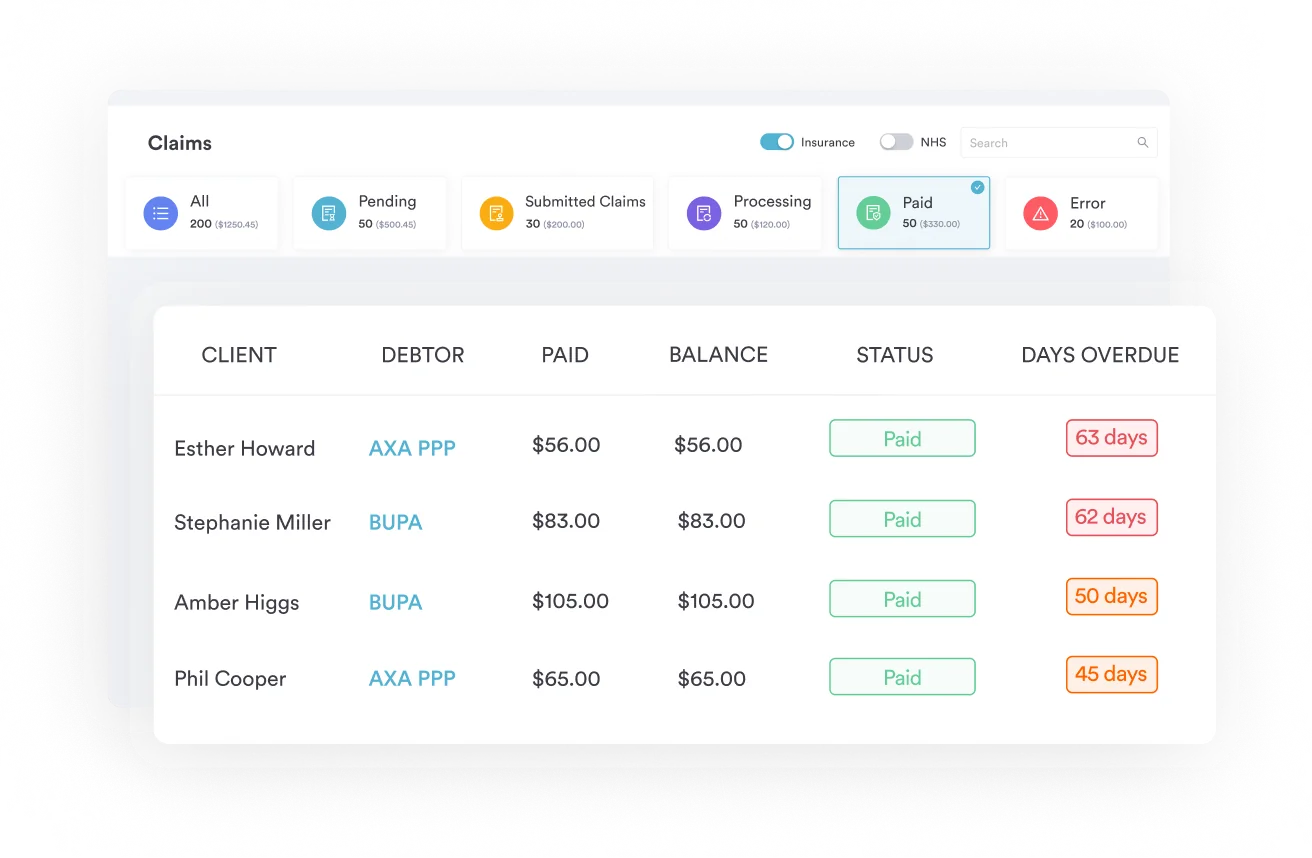

Pabau’s encounter note templates capture timed minutes and device details, and Pabau submits and tracks each claim through Claim.MD. See how it works for physical therapy and orthotics practices.

Treat any 97762 on a 2018 or later claim as a recoding job. An appeal cannot revive a deleted code. Therefore, the fastest path is to confirm the note supports 97763 and resubmit it as a corrected claim.
However, the harder work sits upstream. Timed minutes, the L code, the GN, GO, or GP modifier, and KX past the threshold all have to be right first time. For that reason, build them into the note template once, and follow-up visits stop producing the same denials.
Book a demo to see how Pabau keeps orthotic management notes and claims on one patient record.

Billing the replacement code? CPT code 97763 walks through the subsequent-encounter code in full.
Need a clearinghouse for US claims? Claim.MD clearinghouse overview explains what Claim.MD does and how claims move through it.
Want to understand the full claims submission process? Medical billing fundamentals covers the end-to-end billing workflow from encounter documentation to payment posting.
Seeing ERA denials you cannot decode? Electronic remittance advice explained breaks down how to read ERA files and act on CARC and RARC denial codes.
CPT code 97762 is a deleted code that described checkout for orthotic/prosthetic use, established patient, each 15 minutes. The AMA deleted it effective January 1, 2018, in a revision that limited 97760 and 97761 to initial encounters. The same revision created 97763 for every subsequent orthotic or prosthetic encounter.
CPT code 97763 replaced 97762 effective January 1, 2018. It covers orthotic and prosthetic management and/or training for the upper extremity, lower extremity, and trunk at subsequent encounters, billed per 15 minutes. The time-based billing rules are the same as they were for the old code.
Yes. Medicare covers CPT 97763 under Part B when the service is medically necessary and documentation supports ongoing orthotic or prosthetic management beyond the initial fitting. It is an always-therapy code, so each claim line needs a GN, GO, or GP modifier. Coverage criteria and prior authorization rules vary by Medicare Administrative Contractor (MAC), so check your MAC’s Local Coverage Determination before billing.
Documentation must include the start and end time (or total timed minutes), the device type and body region, and the assessment findings. It also needs the training provided, the patient’s response, progress toward goals, and the treating provider’s credential and signature. Missing time documentation is a leading cause of audit downcoding for this code.