CPT Code 99465: Newborn resuscitation in the delivery room
CPT Code 99465: Definition and clinical description CPT Code 99465 is the AMA pr...

Last Updated: Nov 2, 2026
97546 is the CPT code for work hardening/conditioning; each additional hour (List separately in addition to code for primary procedure). It is an add-on code, so 97545 must appear on the same claim for the initial 2 hours. 97546 then adds one unit for each additional full hour.
Most denials trace back to a missing 97545 line, thin functional-goals documentation, or a program that does not match the payer's definition. Work hardening and work conditioning are both reported with these codes, but payers define and document the two programs differently.
Let Pabau's smart automation suggest the right codes, reduce claim denials, and keep your practice compliant—effortlessly.
Automate repetitive tasks and focus on what matters most—your patients.
Reduce coding errors and ensure compliance with the latest regulations.
Clean claims, fewer denials, and faster reimbursements.
Powerful insights and reporting to help your practice thrive.
HIPAA compliant SOC 2 certified GDPR-compliant Trusted by 4,000+ clinics worldwide

CPT code 97546 is an add-on code for each additional hour of work hardening or conditioning, and it requires CPT 97545 on the same claim.
CPT 97545 covers the initial 2 hours of a session, and 97546 covers each additional full hour after that.
Under Medicare and payers that follow CMS therapy-modifier rules, each line carries GP or GO to match the discipline of the plan of care.
Pabau’s billing software checks claims for missing or invalid details before submission and flags any claim that fails so your team can fix it.
CPT code 97546 is defined by the American Medical Association (AMA). Its official descriptor is Work hardening/conditioning; each additional hour (List separately in addition to code for primary procedure). The AMA marks 97546 with a plus sign (+), which makes it a formal add-on code. It may only appear on a claim that also carries 97545.
In practice, 97545 covers the initial 2 hours of a session. Every additional full hour after that adds one 97546 unit on the same claim.
97545 covers the initial 2 hours of a work hardening or work conditioning session. 97546 covers each additional full hour within the same visit. When a session runs past 2 hours, both codes go on the same claim for the same date of service.
A common billing error is submitting 97546 without 97545 because the coder assumes 97545 was billed in a prior session. Each date of service is a separate claim. Both codes must appear on every claim where additional-hour time is reported.
Both programs are reported with the same CPT codes, 97545 and 97546, because the descriptor itself reads work hardening/conditioning. What differs is how each payer defines the two programs and the documentation it expects for each.
Payers increasingly audit work hardening claims for evidence that the program addressed specific occupational demands. Where a payer defines the two programs separately, your notes have to match the program it authorized. Notes that describe general strengthening, with no link to the patient’s job tasks, will not support a work hardening authorization.
Physical therapists and occupational therapists working in outpatient rehabilitation settings bill CPT code 97546. Physiatrists (PM&R physicians) may also supervise and bill, depending on the payer. State licensure laws vary, so confirm scope of practice in your jurisdiction before billing.
Where a payer follows CMS therapy rules, the discipline modifier on each claim line has to match the plan of care. The rules below summarize how that works.
Work hardening programs often involve both PT and OT. Each line carries only the discipline modifier of the treating therapist’s plan of care, and 97545 is billed once per session under the payer’s rules.
Documentation is where post-payment audits of work hardening claims usually focus. Each session needs to show medical necessity through functional, job-specific evidence, not just attendance records.
Every session note should include a superbill-ready record of the following elements:
Document start and stop times for every session, not just total time. Auditors look for time logs, not estimated durations. A 4-hour session billed as 97545 x1 and 97546 x2 must show exactly when the session began and ended in the treatment note.
Prior authorization is common for work hardening programs. Check authorization requirements before the program begins, because retrospective denials on a multi-week program are difficult to appeal and expensive to absorb.
Medicare coverage of 97545 and 97546 is restricted and depends on the Medicare Administrative Contractor (MAC). Verify the Local Coverage Determination (LCD) and the fee schedule status indicator before treating the service as payable. Some MACs also set frequency limits or medical necessity criteria that restrict which patients qualify.
Work hardening sessions typically run two to four hours. The unit rule is simple: bill 97545 once for the initial 2 hours, then bill 97546 once for each additional complete hour.
Under this rule, partial hours do not generate an additional 97546 unit, so a 2.5-hour session bills as 97545 x1 only. Partial-hour rules are payer-specific, though, and state workers’ comp fee schedules often set their own. Payers compare billed units against the documented start and stop times, so a mismatch between claim and note is a direct audit trigger.
Work hardening claims give a payer more grounds for denial than a single therapy visit, with multi-hour units, prior authorization and job-specific documentation. When a denial arrives, the payer’s denial codes tell you which of the causes below applied.
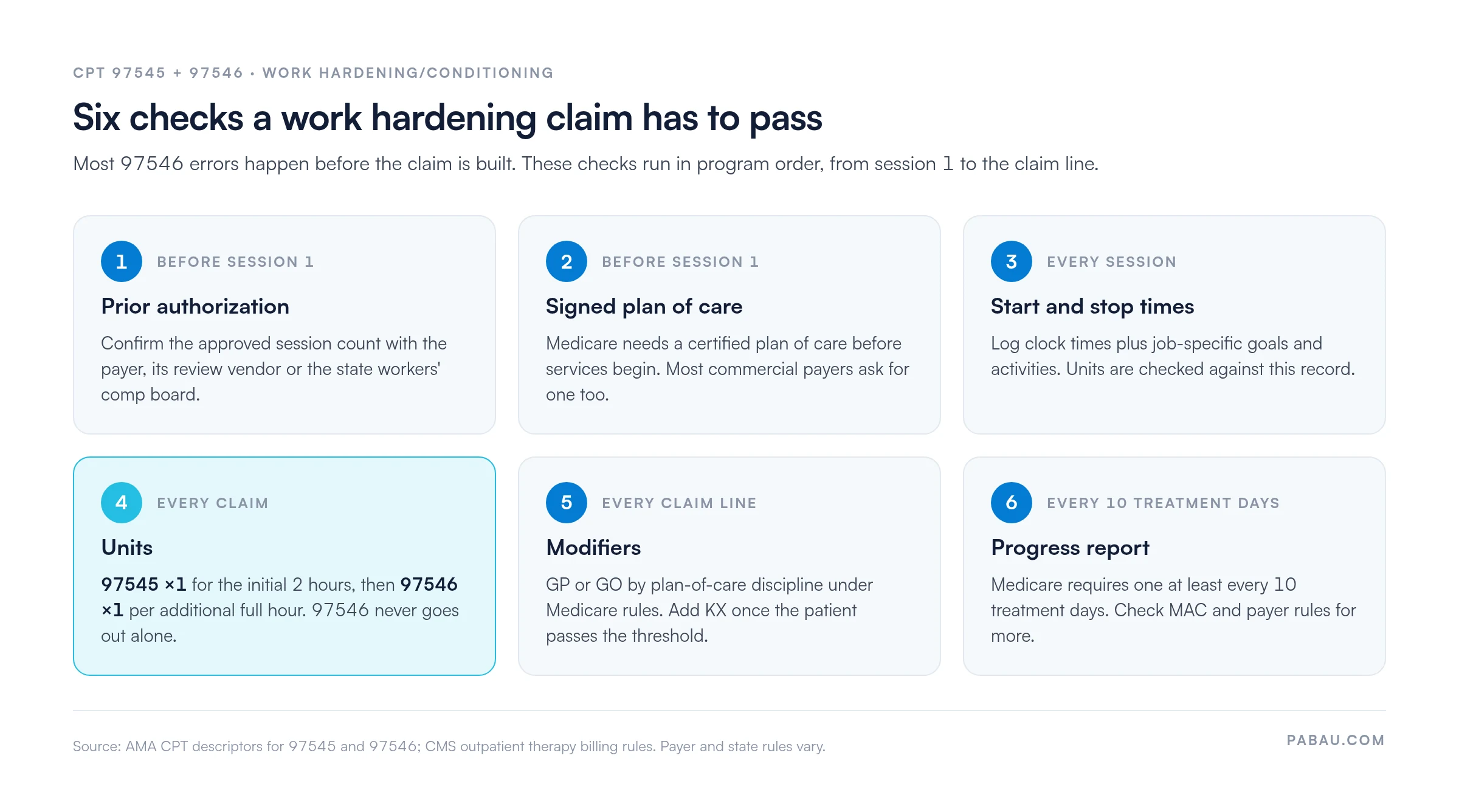
Effective denial management for work hardening programs starts before the first session. Confirm authorization, verify provider qualifications, and set up documentation templates that capture the job-specific elements payers require. The six checks below run in the order a program meets them.
Several codes in the 97000 series are often confused with or billed alongside 97546. Knowing what each one covers prevents unbundling errors and missed billing opportunities.
Functional capacity evaluations (FCE) are a common pairing. The FCE establishes baseline function before the work hardening program begins and is billed under 97750, not 97545 or 97546. Billing the FCE as part of a work hardening session inflates the unit count and creates an unbundling flag.
Before you bill 97530 or 97110 on the same date as a work hardening session, check the current NCCI procedure-to-procedure edits for that pair. The edits change quarterly, so a pairing that paid last year may not pay now.
Medicare reimbursement for CPT code 97546 is set annually under the Medicare Physician Fee Schedule (MPFS). Rates differ between facility and non-facility settings and vary by geographic locality. Check the status indicator first, since Medicare coverage of these codes is restricted.
CMS publishes the PFS relative value files each year, and the AMA publishes the CPT code set. Third-party tools such as the AAPC Codify CPT lookup can help you cross-check those figures. Rates update every January 1, so never use prior-year figures for current claims.
Most 97546 errors happen before the claim reaches the clearinghouse, during documentation and code selection. A missing 97545 line or an expired authorization usually traces back to the session record, not the claim form.
Pabau’s claims management software checks each claim for missing or invalid details before submission. Claims that fail are flagged as needing action, so your billing team can fix them before the payer sees them.
For US claims, Pabau works with the Claim.MD clearinghouse, which connects to thousands of US payers. It runs real-time eligibility checks and handles electronic remittance advice (ERA), so payments settle against the right claims. On a program running 10 to 20 sessions, catching an expired authorization at session 1 prevents a run of denials later.
That is how a practice submits a clean claim on the first attempt instead of reworking it after a denial.

Pabau’s claims management checks work hardening claims for missing or invalid details before submission and flags failed claims for fixing. See how it works for PT and OT practices.

Work hardening claims usually fail for reasons that come before submission, such as a missing parent code, an undocumented functional goal or an expired authorization. The unit logic of 97546 is simple. The friction comes from its add-on status and from payer documentation rules.
The practical move is to settle the checks once, at program intake, instead of rediscovering them with each denial. Pin down the payer’s program definition, partial-hour rule and modifier policy before session 1, and the claims that follow become routine.
Pabau checks claims for missing or invalid details before they go out, which cuts the manual review your billing team does today. Book a demo to see how it fits your PT or OT practice’s work hardening workflow.

Need the primary code’s rules? CPT code 97545 covers the initial 2 hours of work hardening/conditioning that every 97546 claim depends on.
Billing insurance for therapy services? Insurance billing for therapists walks through the claim steps therapy practices handle with commercial payers.
Want to reduce claim denials before they happen? Denial management in healthcare covers how to build a proactive denial prevention workflow across billing teams.
Looking to streamline US claim submission for rehab services? Clean claim submission explains what makes a claim clean and how to enforce those standards at the point of care.
Billing Medicare for outpatient therapy? Medicare billing covers the rules and claim steps that apply to Medicare services.
CPT code 97546 covers work hardening or conditioning for each additional hour after the initial 2 hours billed under parent code 97545. It is an add-on code, so it must appear on the same claim as 97545 and cannot be submitted alone.
97545 is the parent code covering the initial 2 hours of a work hardening or conditioning session. 97546 is an add-on code billed for each additional complete hour in the same session. When a session runs past 2 hours, both codes go on the same claim, and 97546 billed without 97545 is denied.
Medicare coverage of 97545 and 97546 is restricted and depends on the MAC. Verify the Local Coverage Determination (LCD) and the fee schedule status indicator before treating the service as payable. Where Medicare does pay, append the KX modifier once the patient passes the annual KX modifier threshold and continued treatment is medically necessary.
Functional capacity evaluations (FCE) are billed under CPT 97750 (physical performance test or measurement), not 97545 or 97546. The FCE is a separate service that establishes baseline function before or during a work hardening program. Leave it out of the session time and unit count.