HCPCS code P9058: Red blood cells, leukocytes reduced, CMV-negative, irradiated
HCPCS code P9058: Official descriptor and key attributes HCPCS code P9058 report...

Last Updated: Oct 26, 2026
97545 is the CPT code for work hardening/conditioning; initial 2 hours. It covers the first two hours of a work hardening or work conditioning program on a date of service. Add-on code 97546 covers each additional hour.
Both program types bill under the same code pair. Work conditioning is a single-discipline physical or occupational therapy program, while work hardening adds vocational and psychological services. That difference lives in team composition and documentation, not in the code. Most denials trace back to missing authorization or a record that doesn't match the program billed.
Let Pabau's smart automation suggest the right codes, reduce claim denials, and keep your practice compliant—effortlessly.
Automate repetitive tasks and focus on what matters most—your patients.
Reduce coding errors and ensure compliance with the latest regulations.
Clean claims, fewer denials, and faster reimbursements.
Powerful insights and reporting to help your practice thrive.
HIPAA compliant SOC 2 certified GDPR-compliant Trusted by 4,000+ clinics worldwide

CPT Code 97545 bills the first two hours of a work hardening or work conditioning session once per date of service. It is not a 15-minute timed unit like most PT codes.
Add-on code 97546 extends the session beyond two hours, billed once per additional hour on the same date of service.
Work hardening and work conditioning bill under the same pair, 97545/97546. Hardening adds vocational and psychological services to PT or OT, while conditioning is single-discipline.
Most workers comp carriers require prior authorization before a program begins, and missing authorization is the leading denial trigger for 97545 claims. Aetna denies both codes outright.
Pabau’s claims management software tracks per-diem billing dates, prior auth status, and documentation completeness to reduce 97545 denial rates.
CPT Code 97545 is the AMA CPT code for the first two hours of a work hardening or work conditioning program. Both programs aim to return an injured worker to a specific job through physical conditioning and functional training.
The code sits in the Physical Medicine and Rehabilitation (PM&R) section of the CPT code set, in the 97545-97546 work hardening/conditioning range.
The official AMA descriptor reads: “Work hardening/conditioning; initial 2 hours.” This billing unit structure distinguishes 97545 from nearly every other rehabilitation code.
Where codes like 97530 (therapeutic activities) bill in 15-minute timed units, 97545 is billed once per date of service for the initial two hours. Add-on code 97546 covers each additional hour.
Eligible providers who can bill CPT Code 97545 include physical therapists (PTs) and occupational therapists (OTs) supervising qualified multidisciplinary programs. For PT and OT practices, team composition decides which program you run, while the code stays the same. A work hardening program adds at least one discipline beyond the supervising PT or OT, while work conditioning is delivered by PT or OT alone.
A work hardening program billed under CPT Code 97545 encompasses four components, each documented in an individualized treatment plan. A work conditioning program focuses on the physical conditioning and functional training components.
97545 does not cover general physical therapy sessions, standalone psychological visits, or functional capacity evaluations (FCEs), which use separate codes. A common audit finding is a single-discipline program documented and authorized as work hardening. It should have been documented as work conditioning, under the same code.
Work hardening and work conditioning are distinct program types, but they bill under the same CPT code pair, 97545/97546. No separate single-discipline code exists. The difference lives in team composition and documentation, so a record that blurs the two creates denial patterns across an entire patient panel.
Because the code is the same, the distinction is made in the record. A program without a vocational rehabilitation counselor or psychologist is work conditioning, and its referral, authorization and notes should say so. Some payers make no distinction between the two at all.
Aetna Clinical Policy Bulletin 0198 excludes both work hardening and work conditioning as vocational training, not a covered benefit. When an audit finds a program labeled work hardening without multidisciplinary participation, every CPT Code 97545 claim in that period is at risk.
CPT 97545 and 97546 always work as a pair. Understanding their relationship prevents both under-billing (not capturing extended sessions) and over-billing (billing 97546 without 97545).
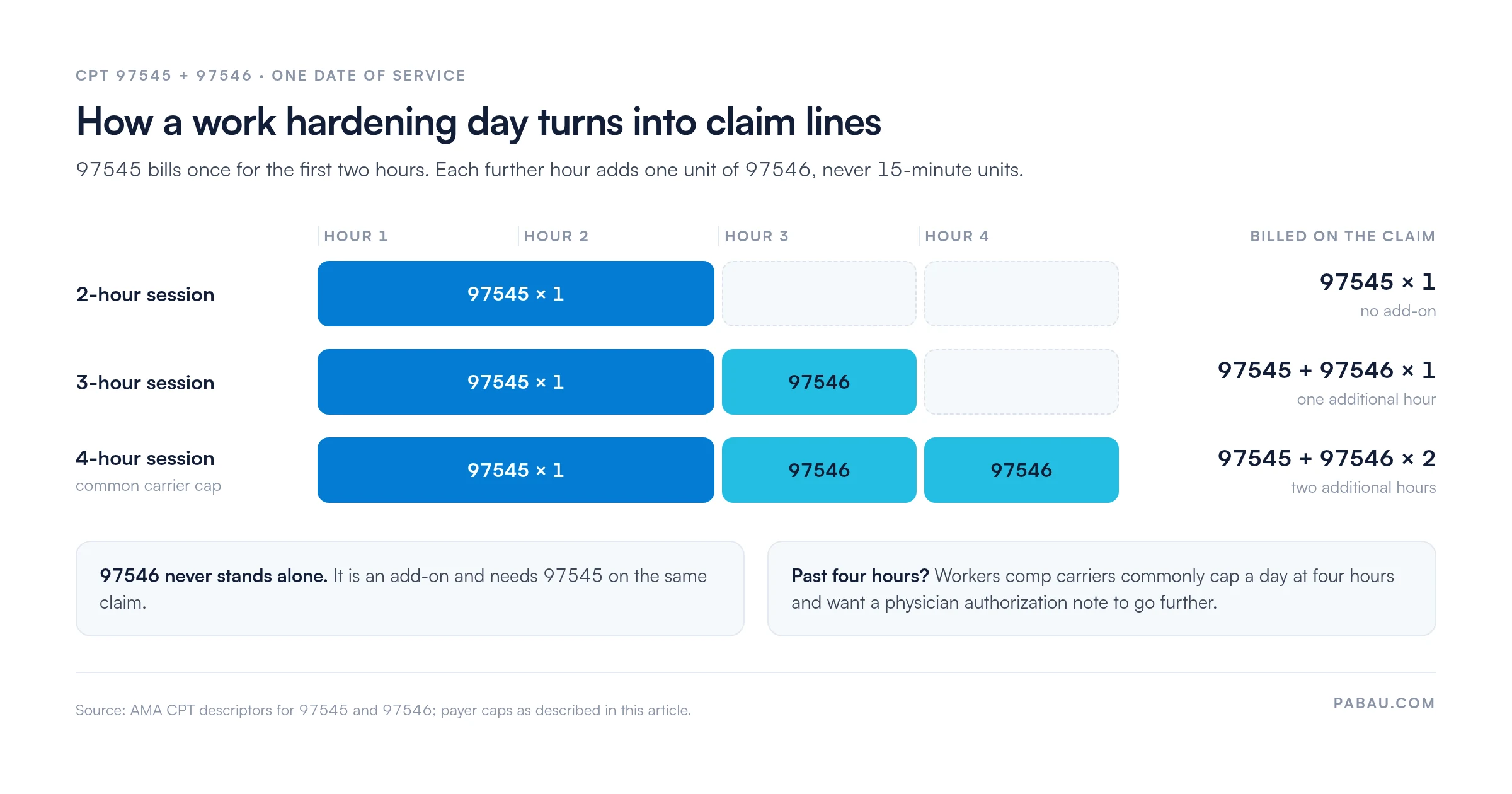
A four-hour session bills as 97545 (first two hours) plus two units of 97546 (one unit per additional hour). CPT Code 97546 cannot appear on a claim without 97545. Most payers cap the session length they will reimburse.
Workers comp carriers commonly cap at four hours per day and require a physician authorization note to go beyond that. The timeline below shows how each session length lands on the claim.
The per-diem billing mechanic means time documentation functions differently here than for timed codes. Rather than counting 8-minute minimums per unit, the therapist documents the total session duration. The note also confirms the full program was delivered during that period.
Document the session start and end time in every progress note for a 97545 claim. Per-diem codes do not require 8-minute unit counting, but payers still audit total duration. A note that states ‘session duration: 3.5 hours’ with a clear start/end timestamp answers the time question auditors raise most often on work hardening claims.
Documentation for work hardening and work conditioning claims is more extensive than for standard PT codes. Payers want evidence of medical necessity, team participation, and job-specific program design at every stage.
The audit exposure on CPT Code 97545 is high. Claims that pass at submission are often recouped on retrospective audit when the records turn out incomplete. Following medical billing compliance best practices from the outset protects against both.
Required documentation elements span four phases of the program.
Prior authorization is required by most payers before a work hardening program begins. If a payer says it does not require prior auth, confirm that directly with the carrier before the first session. Authorization denials on CPT Code 97545 are rarely overturned once the program is underway.
Checking insurance eligibility verification before program initiation also surfaces coverage limits that affect how many sessions will be approved.
Medicare coverage of CPT Code 97545 is limited. The Centers for Medicare and Medicaid Services (CMS) lists the code as restricted coverage, with no national rate (see the fee schedule section below).
Billing 97545 to Medicare without written confirmation of coverage from your Medicare Administrative Contractor (MAC) is likely to result in denial and potential compliance exposure.
Workers compensation is the dominant payer for CPT Code 97545. Work hardening programs are specifically designed around occupational injury and return-to-work goals, which aligns directly with workers comp program objectives. Most claims in this code category come from workers comp rather than commercial group health.
State-specific rules create meaningful variation. Each state workers comp system maintains its own fee schedule or pricing rules. Texas (Texas DWC), California (California DWC), and other large state systems publish annual fee schedules that apply to all work hardening claims in their jurisdiction.
Medicare publishes no national rate for 97545, so there is no Medicare figure to fall back on. Bill to the state schedule or the carrier contract.
Medicare publishes no national payment amount for CPT Code 97545 or add-on code 97546. In the CY2026 Medicare Physician Fee Schedule relative value files (RVU26A and RVU26D), CMS lists both codes with status indicator R, restricted coverage.
Every RVU for both codes is 0.00. The 2026 conversion factors are $33.5675 for qualifying APM participants and $33.4009 for other clinicians, but a zero RVU produces no rate.
Status R means special coverage instructions apply. If the service is covered, your local MAC sets the price, so ask it for coverage and pricing in writing before billing Medicare. Workers comp carriers and commercial payers set their own rates through state fee schedules or contracts.
The figure that matters is the one in your payer agreement. Pabau, the practice management platform we build, sends claims through its Claim.MD integration, with real-time eligibility checks before submission. This Claim.MD clearinghouse guide explains how that submission path works.
Several codes in the PM&R section share clinical overlap with CPT Code 97545. Add-on 97546 is covered in the billing structure table above. Selecting the wrong code or combining codes incorrectly generates both underpayment and unbundling denials.
The 97530 and 97545 combination requires particular caution. Confirm the NCCI edit relationship between these two codes in the current CMS tables before billing both on the same date of service. When the therapeutic activity is part of the work hardening program, it is included in the per-diem 97545 rate and cannot be separately billed.
The OT Potential CPT coding guide adds occupational therapy context on these codes. OT practices billing work hardening programs should record the code pairing decision in the clinical record before claim submission.
Denials on CPT Code 97545 cluster around a short list of documentation and authorization failures. Each one has a prevention step that fits into the pre-billing workflow, and the payer’s claim denial codes tell you which failure triggered it. Systematic denial management workflows that catch these triggers before submission reduce reimbursement delays significantly.
Build a pre-billing checklist for CPT Code 97545 that runs before any claim is submitted. Confirm the prior auth number, the FCE, and the team’s credentials. Then check today’s supervision statement, the functional goal progress note, and that no codes are unbundled. Five minutes at submission prevents weeks of appeals.
CPT Code 97545 claims usually fail on paperwork that slips during a multi-week program. An expired authorization or a note without a supervision statement is the typical cause.
Pabau’s claims management software supports work hardening billing by linking treatment plan documentation, daily progress note completion, and per-diem claim tracking in a single workflow. Billing staff can then confirm documentation is complete before submission rather than after a denial.
Authorization tracking matters most here, because work hardening programs run for weeks and authorization windows expire. A system that surfaces expiring authorizations before a session date prevents the most avoidable denial category in this code range.
Add clean claim scrubbing through revenue cycle management workflows, and 97545 claims reach the payer with their documentation package intact.

Pabau connects clinical documentation, prior authorization tracking, and claim submission in one platform. See how PT and OT practices use Pabau to keep work hardening claims clean from program start to discharge.

The code is the easy part of CPT 97545. Work hardening and work conditioning share 97545 and 97546, so payers judge each claim on the record behind it.
That means the referral, the authorization, the team named in each note, and the session times. Settle the program label before session one, because an authorization for the wrong program type is hard to correct mid-program.
Price it the same way. Medicare publishes no national rate, so the number that counts is your MAC’s pricing, the state workers comp schedule or your payer contract. Book a demo to see how Pabau keeps work hardening and work conditioning claims documented, authorized and ready to submit.

Looking for guidance on clean claim submission standards? Clean claim requirements for billing covers the payer-side criteria that determine whether a claim pays first pass.
Want to understand 837 file structure for PT and OT claims? 837 EDI file guide for medical claims explains how electronic claim files are structured for payer submission.
CPT Code 97545 covers the first two hours of a work hardening or work conditioning program on a date of service. Work hardening is multidisciplinary, adding vocational and psychological services to physical therapy or occupational therapy. Work conditioning is a single-discipline PT or OT program. Both bill under 97545, with add-on 97546 for each additional hour.
CPT 97545 is the base per-diem code that covers the first two hours of a work hardening session. CPT 97546 is the add-on code billed once for each additional hour beyond the initial two hours. A four-hour session would bill one unit of 97545 and two units of 97546. CPT 97546 cannot be submitted without 97545 on the same claim.
No. Work conditioning and work hardening both bill under 97545 for the initial two hours and 97546 for each additional hour. The AMA descriptor itself names both: work hardening/conditioning. CPT 97530 is therapeutic activities, a separate one-on-one service billed per 15 minutes, not a work conditioning code.
Medicare rarely covers CPT 97545. In the 2026 Medicare Physician Fee Schedule, CMS lists 97545 and 97546 with status indicator R (restricted coverage) and 0.00 RVUs. That means there is no national payment amount. If your Medicare Administrative Contractor (MAC) covers the service, it sets the price. Confirm coverage and pricing with your MAC in writing before billing.
Yes, most payers require prior authorization before beginning a work hardening program. Workers compensation carriers and most managed care plans require pre-certification. Aetna is different, because its Clinical Policy Bulletin 0198 denies 97545 and 97546 outright as vocational training. The authorization typically requires submission of the FCE results, the physician referral, and the proposed treatment plan. Starting the program without confirmed authorization is the leading denial trigger for CPT Code 97545 claims.
CPT 97545 is billed per diem, meaning once per calendar day. It is not a timed 15-minute unit code like most physical therapy codes. The code covers the first two hours of the session. CPT 97546 is the add-on billed for each additional hour beyond two hours.
CPT 97545 requires direct supervision by a qualified PT or OT during the work hardening session. AMA guidelines and most payer policies do not mandate one-on-one contact for every minute of the session. The supervising therapist must still be present in the facility and immediately available throughout. Specific supervision requirements vary by payer. Workers comp carriers sometimes impose stricter one-on-one requirements than AMA guidelines mandate. Document the supervision level explicitly in every daily progress note.
The most common denial reasons are missing prior authorization and an incomplete or absent functional capacity evaluation. Others include a single-discipline work conditioning program documented as work hardening and a supervision level missing from the progress note. Unbundling 97530 or 97112 with 97545 for services included in the per-diem rate also triggers denials. Each denial reason has a corresponding pre-submission check that prevents it.