CPT code 92521: Speech fluency evaluation billing guide
CPT code 92521: Definition and clinical scope CPT code 92521 is defined by the A...

Last Updated: Oct 5, 2026
HCPCS Code S0115 is a deleted Level II S-code that described bortezomib, 3.5 mg, billed to Medicaid and some commercial payers but never to Medicare. Indeed, it is no longer valid, and any claim that carries it today is denied as an invalid code. Instead, Velcade, the reference bortezomib product, now bills under J9041 at 35 units per 3.5 mg vial. Meanwhile, bortezomib from other manufacturers uses J9046, J9048, J9049 or J9051, matched to the NDC.
Coders still meet S0115 in legacy chargemasters, retrospective audits and old remittance reports. Specifically, this guide covers its descriptor, the unit change, the current codes, and how to correct or defend historical claims.

HCPCS Code S0115 described bortezomib, 3.5 mg, and is a deleted S-code that Medicare never paid.
S-codes are maintained by the Blue Cross Blue Shield Association, so S0115 was billed only to Medicaid and commercial payers.
J9041 is the current code for Velcade only, and its unit is 0.1 mg, so a 3.5 mg vial bills as 35 units.
Bortezomib from other manufacturers bills under J9046, J9048, J9049 or J9051, matched to the NDC. The old catch-all code, J9044, was deleted 12/31/2022.
Claims sent with S0115 after its deletion are denied as invalid, and only a new or corrected claim with the current code fixes them.
HCPCS Code S0115 was a Level II temporary S-code with the official descriptor “Bortezomib, 3.5 mg.” S-codes are maintained by the Blue Cross Blue Shield Association, not the HCPCS National Panel, and are not payable by Medicare. However, they still appear in the HCPCS Level II codes that the Centers for Medicare and Medicaid Services (CMS) publishes. As a result, traditional Medicare Fee-for-Service never processed a claim under S0115.
The code is now listed as deleted across major code references, including the AAPC HCPCS code database. Therefore, submitting it on a claim today returns an invalid-code denial regardless of payer. Instead, J9041 is the current code for Velcade.
S0115 was deleted from the HCPCS code set, and J9041 is the current Velcade code. Meanwhile, bortezomib from other manufacturers now has its own manufacturer-specific codes. Therefore, verify the precise deletion effective date against the CMS HCPCS alpha-numeric file for the applicable year, since the file is updated annually.
What deletion means operationally:
J9041 is the current HCPCS code for Velcade, with the descriptor “Injection, bortezomib (Velcade), 0.1 mg.” However, it covers the reference product only. Bortezomib from other manufacturers bills under J9046, J9048, J9049 or J9051, and the NDC on the vial decides which one applies. In addition, the old not-otherwise-specified code, J9044, was deleted 12/31/2022.
The crosswalk from S0115 carries one critical operational change: the unit of service. S0115 was billed per 3.5 mg vial, while J9041 is billed per 0.1 mg. For example, a single 3.5 mg vial of Velcade equals 35 units of J9041. As a result, billing only 1 unit for a full vial underbills by a factor of 35 and causes underpayment.
Verify J9041 reimbursement rates against the current CMS ASP drug pricing file. In addition, Medicare reimburses separately payable drugs at ASP+6%, and those rates update quarterly. The decision below shows which code a bortezomib line takes, based on the date of service and the NDC.
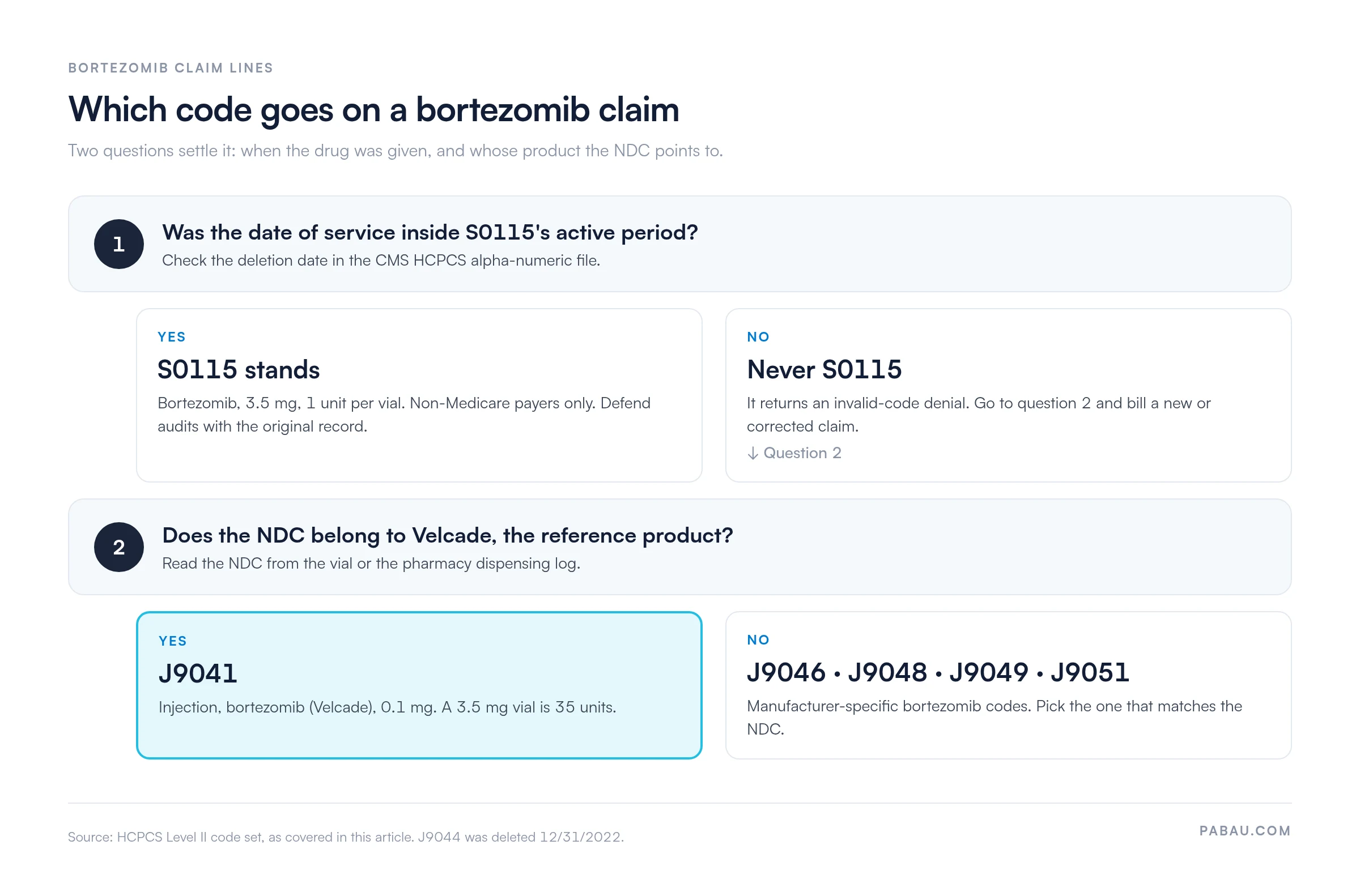
When S0115 was active, it covered the drug acquisition cost for one 3.5 mg vial of bortezomib. Notably, the code did not bundle administration, supportive care, or anti-emetic premedicants. Instead, billers paired S0115 with a separate CPT administration code for the injection itself, chosen by route and setting.
Drug-only HCPCS codes like S0115 cover the product, not the service around it. In fact, that split runs through the whole medical billing workflow for oncology drugs.
Always bill the drug HCPCS code (S0115 historically, now J9041 or the NDC-matched code) separately from the administration CPT code. Bundling both into a single line item is a common oncology drug billing error. Payer claim-editing software splits or denies those lines automatically.
Traditional Medicare Fee-for-Service never covered S0115. S-codes are maintained by the Blue Cross Blue Shield Association, not the HCPCS National Panel, and are not payable by Medicare. Therefore, submitting S0115 to Medicare would have produced a non-covered service denial regardless of the date of service.
The payers that accepted S0115 historically were mainly state Medicaid programs and commercial insurers that adopted HCPCS S-codes into their own coverage policies. However, coverage terms varied by payer and plan year.
S0115 denials fell into five patterns. Overall, recognizing them helps billers correct legacy claims and avoid repeating them with the current codes. Good denial management depends on categorizing root causes, not just resubmitting rejected claims.
Bortezomib billing intersects with several related codes. Specifically, the table below clarifies when each applies so billers can make the right selection in current practice.
Payers that accepted S0115 required specific documentation to validate the claim. Indeed, these requirements still matter when responding to retrospective audits on historical S0115 claims. The billing compliance requirements for oncology drugs were stricter than for routine services.
Audit historical S0115 claims for missing NDC numbers before a payer does it first. Missing NDCs are a frequent finding in Medicaid and commercial drug audits. If the encounter record lacks the NDC, reconstruct it from pharmacy dispensing logs and submit a corrected claim before the audit window closes.
Billers who meet S0115 in retrospective audits or legacy EHR systems need a structured approach. The code is valid for claims with a date of service inside its active period. However, it is not valid for any claim submitted after its deletion date. Apply clean claim submission standards when correcting or resubmitting any historical bortezomib claim.
The errors above usually start before a claim is built. For example, a chargemaster still mapped to S0115 is one source. Similarly, a unit count copied from the per-vial convention, or a Medicaid line with no NDC, reaches the payer just as easily.
Pabau, the practice management platform we build, keeps the treatment note, the invoice and the insurance claim on one patient record. Its claims management software submits claims electronically and tracks the status of each one. When a payer rejects a line, your billing team can correct and resubmit it from the original visit.
The result is a claim history you can defend. For example, paid, rejected and corrected bortezomib claims sit against the visit they came from when an auditor asks.
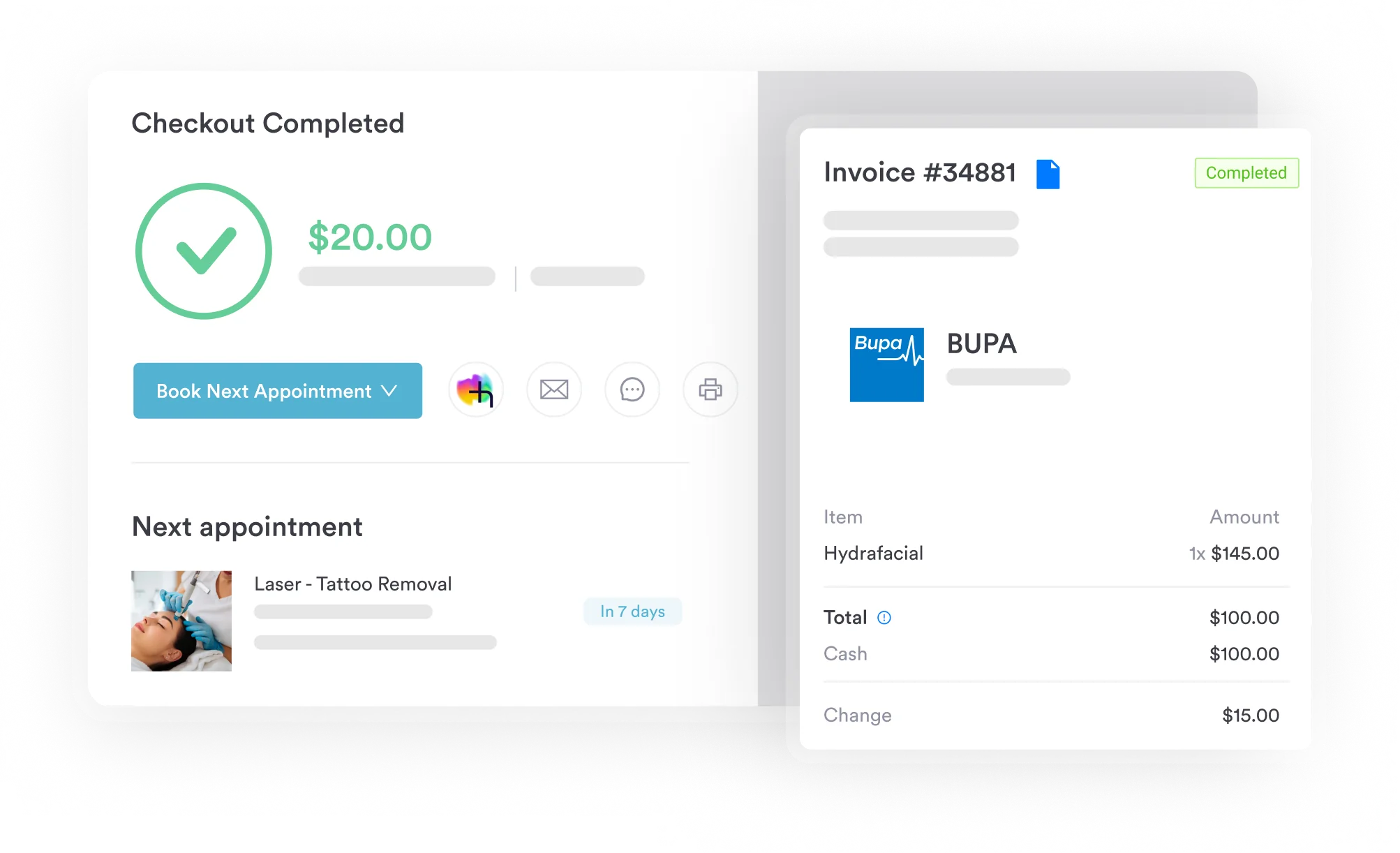

Pabau keeps the visit, the invoice and the insurance claim on one patient record, then submits the claim and tracks its status. Your billing team sees which bortezomib claims were paid and which need a correction.

Treat S0115 as a historical code with one job left: explaining old claims. Overall, on any current date of service, the NDC decides the code, and for Velcade the unit count decides the payment. Get either wrong and the claim is denied or underpaid, even when the drug and the diagnosis are right.
The fix worth doing once is in the chargemaster. Map Velcade to J9041 in 0.1 mg units, map each other bortezomib NDC to its own code, and retire S0115 for new claims. In addition, keep the original records for any S0115 claim still inside an audit window.
Book a demo to see how Pabau submits and tracks drug claims for oncology and infusion practices.

Managing claim denials from deleted or transitional codes? Denial management in healthcare covers root-cause categorization and appeal workflows for billing teams.
Billing Velcade on a current date of service? HCPCS code J9041 covers the current Velcade descriptor, units and documentation.
New to how drug codes fit into a claim? Medical billing fundamentals explains how HCPCS, CPT, and ICD-10 codes work together in the claim lifecycle.
Reading a remittance advice after an S0115 denial? Denial codes in medical billing provides a reference for interpreting remittance advice denial reasons.
HCPCS Code S0115 was a temporary Level II billing code for bortezomib, 3.5 mg, used by Medicaid and commercial payers. The code is now deleted and cannot be used on any current claim. Instead, Velcade now bills under J9041.
S0115 was deleted from the HCPCS code set, and J9041 is now the current code for Velcade. S-codes are maintained by the Blue Cross Blue Shield Association, not the HCPCS National Panel. In addition, verify the exact deletion date against the CMS HCPCS alpha-numeric file.
For dates of service during S0115’s active period, the code was correct at the time, so respond to audits with the original documentation. For a claim sent with S0115 after its deletion, file a corrected claim with the current code. For Velcade that is J9041 at 35 units per 3.5 mg vial. In addition, include the NDC wherever Medicaid or the payer’s policy requires it.
State Medicaid programs and select commercial insurers historically accepted S0115. In contrast, Medicare Fee-for-Service never accepted it. However, Medicare Advantage plan coverage varied by plan. Therefore, verify any historical payer-specific coverage against that payer’s archived policy for the applicable plan year.