CPT code 92521: Speech fluency evaluation billing guide
CPT code 92521: Definition and clinical scope CPT code 92521 is defined by the A...

Last Updated: Oct 5, 2026
S0077 is the deleted HCPCS Level II code for injection, clindamycin phosphate, 300 mg. It is valid only for dates of service through June 30, 2023.
From July 1, 2023, clindamycin phosphate injection is billed with J0736, or J0737 for the Baxter product CMS lists as not therapeutically equivalent. Both J codes carry a Medicare Part B payment limit and bill at one unit per 300 mg.
Let Pabau's smart automation suggest the right codes, reduce claim denials, and keep your practice compliant—effortlessly.
Automate repetitive tasks and focus on what matters most—your patients.
Reduce coding errors and ensure compliance with the latest regulations.
Clean claims, fewer denials, and faster reimbursements.
Powerful insights and reporting to help your practice thrive.
HIPAA compliant SOC 2 certified GDPR-compliant Trusted by 4,000+ clinics worldwide

HCPCS code S0077 was deleted on July 1, 2023, and is valid only for clindamycin doses given through June 30, 2023.
Bill clindamycin phosphate injection with J0736, or with J0737 when the product’s NDC crosswalks to Baxter’s non-equivalent product.
Medicare Part B pays both J codes at the quarterly ASP payment limit. For October to December 2026, that is $1.854 (J0736) and $2.068 (J0737) per 300 mg.
One unit equals 300 mg, so a 600 mg dose is 2 units and a 900 mg dose is 3 units.
Report the administration separately, usually 96365 for an infusion over 15 minutes or 96374 for an infusion of 15 minutes or less.
HCPCS Code S0077 is the deleted HCPCS Level II code for “Injection, clindamycin phosphate, 300 mg.” It was an S code, one of the temporary national codes created for commercial payers and Medicaid programs rather than Medicare. S0077 was deleted effective July 1, 2023.
Clindamycin phosphate injection now has permanent J codes. J0736 reports clindamycin phosphate, 300 mg. J0737 reports the Baxter clindamycin phosphate product that CMS lists as not therapeutically equivalent to J0736, also per 300 mg.
The switch changed more than the code number. Because J codes are Medicare-recognized, clindamycin injection is now billable to Medicare Part B with its own payment limit. Earlier advice to bill Medicare with an unlisted drug code no longer applies.
Confirm code status against the current CMS HCPCS Level II code files before you bill. Medicare contractors, including CGS and Noridian, announced the S0077-to-J0736/J0737 change in 2023 provider notices.
Every clindamycin phosphate injection given on or after July 1, 2023 is billed with J0736 or J0737. Claims for doses given on or before June 30, 2023 keep S0077, even when you submit them late.
The product’s National Drug Code (NDC) decides the code, not the manufacturer name. In the October 2026 CMS average sales price (ASP) NDC-HCPCS crosswalk, Baxter makes products under both codes. Three Baxter NDCs map to J0737, and several other Baxter NDCs map to J0736. The chart below walks a dose through the date check, the NDC check and the unit count.
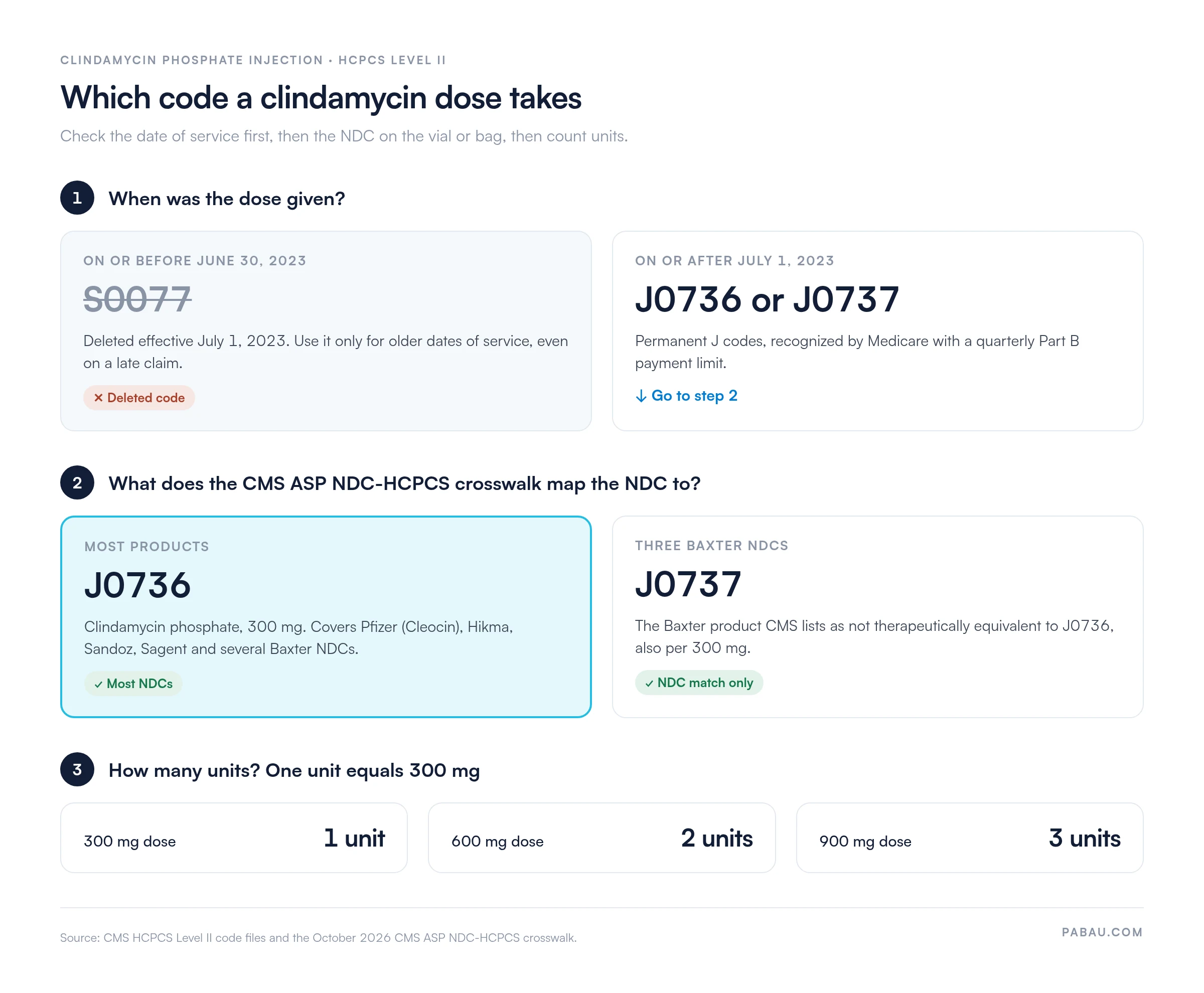
Read the NDC off the vial or bag before you code the drug line. The CMS ASP NDC-HCPCS crosswalk shows whether that product bills as J0736 or J0737, and Baxter makes products under both codes. Coding from the manufacturer name alone sends some Baxter bags to the wrong code.
S codes and J codes both sit in HCPCS Level II, but they behave differently at the payer. J codes are permanent national codes that Medicare recognizes and prices. S codes are temporary codes that Medicare does not pay.
Every payer that follows the HCPCS code set treats S0077 as invalid for dates of service from July 1, 2023. Before you run insurance eligibility verification, check which J0736 rules the plan adds, such as NDC reporting or prior authorization.
Payer drug policies change during the year. Check the plan’s fee schedule or provider manual before you submit, and note the date you checked in the billing record.
Medicare covers clindamycin injection under Part B when the drug is reasonable and necessary for the patient’s infection. In the physician office, J0736 and J0737 are paid separately at the payment limit in the quarterly CMS ASP pricing files.
CMS updates these limits every quarter from manufacturers’ average sales price data. Pull the current file before you set a charge or check a remittance, rather than reusing an older figure.
In a hospital outpatient department, the Outpatient Prospective Payment System (OPPS) often packages low-cost drugs into the administration payment. Check the J0736 status indicator in the current OPPS Addendum B before you expect a separate drug payment.
Medicare also needs the JW or JZ modifier on drugs from single-dose vials and bags. Append JZ when none of the drug was discarded. Report any discarded amount on its own line with JW.
Do not bill Medicare with J3490 or J8999 for clindamycin. J3490 is the unclassified drugs code, reserved for drugs without a specific code. J8999 covers oral chemotherapy drugs not otherwise specified.
A clean clindamycin claim matches the drug administration record field by field. A mismatch between the documented dose and the billed units is a common audit finding on drug lines. Follow these steps to keep medical billing compliance on track.
A complete superbill for a clindamycin encounter captures the J code and units, the NDC, and the administration CPT. It also needs the ICD-10-CM codes, place of service, date of service, and the ordering physician’s NPI.
J0736 reports the drug, and the administration CPT reports the service of giving it. Both belong on the same claim. The FDA label says clindamycin must be diluted before IV use and infused, not given as an undiluted bolus.
The administration code is not separately payable under every contract. Some commercial plans bundle administration into the visit or the drug payment. Check the payer’s drug billing policy before you bill 96365 or 96374 with J0736.
Prior authorization (PA) rules for J0736 vary by payer contract, care setting, and clinical indication. Original Medicare does not require PA for the drug in the physician office. Commercial and Medicaid plans set their own rules.
PA is more likely in these settings and situations:
Typical PA criteria include a confirmed diagnosis, documented allergy or intolerance to first-line agents, and the ordering physician’s notes. Collecting them up front speeds approval and lowers the risk of a retroactive denial.
Clindamycin claims deny in predictable ways, and the deleted S0077 code is now the first thing to rule out. For a wider framework, see denial management workflows.
Match each remittance to the standard standard denial codes before you appeal. The CARC and remark code pair on the electronic remittance advice tells you which argument to lead with.
Every J0736 claim needs at least one ICD-10-CM diagnosis that justifies clindamycin. The diagnosis must appear in the physician order, the clinical note, and the claim. A vague or unrelated diagnosis is a common cause of medical-necessity denials.
Code to the highest specificity the clinical documentation supports. An unspecified code, when a specific one is documented, invites a medical-necessity query or denial. Confirm current descriptors with the CDC/NCHS ICD-10-CM web tool.
The place of service (POS) code on the claim must match where the drug was given. A mismatch between POS and the clinical record is a common audit trigger. Each setting also splits facility and professional billing differently.
When clindamycin is given in a hospital outpatient department, the hospital’s facility claim captures the drug. The physician’s professional claim leaves the drug line off. Confirm the split with the facility’s billing team before you submit.
Most clindamycin denials start with data that lives in different places. The dose sits in the treatment note, the NDC sits on a stock sheet, and the claim is typed up later from memory. A code change like S0077 to J0736 then slips through on the claims that get rebuilt by hand.
Pabau, the practice management platform we build, keeps the treatment note, diagnosis, invoice and inventory in one patient record. Its built-in claims management pulls that existing record data into the claim, submits it through Claim.MD, and tracks its status.
Your coders still choose the code and units. When a payer rejects a line, the team corrects it against the same record and resubmits. Nobody chases paper medication administration records across the practice.

Pabau keeps the dose, NDC and diagnosis in one patient record, then submits and tracks the claim through Claim.MD. Your team fixes a rejected line from the record instead of rebuilding it.

S0077 now matters only as a date check on older claims. Any clindamycin dose given since July 1, 2023 goes out as J0736 or J0737, and the NDC decides which. That one change also opens Medicare Part B payment that the old S code never had.
Update your charge master, superbill templates and payer cheat sheets now, then spot-check recent drug lines for leftover S0077 entries. Book a demo to see how Pabau keeps drug documentation and claim tracking in one record.

Need to understand how HCPCS drug codes interact with your billing process? What is medical billing explains the end-to-end revenue cycle and where drug codes fit into the claim workflow.
Want a step-by-step framework for working denials? Denial management in healthcare covers how to categorize, appeal, and prevent the most common claim rejection types.
Looking to improve how you submit clean drug claims? Clean claim submission walks through the field-level requirements that eliminate the most preventable rejections before they happen.
No. S0077 was deleted effective July 1, 2023. Use it only for clindamycin given on or before June 30, 2023. For any later date of service, bill J0736 or J0737.
J0736 (injection, clindamycin phosphate, 300 mg) replaced S0077 for most products. J0737 covers the Baxter clindamycin phosphate product that CMS lists as not therapeutically equivalent to J0736. Both are billed per 300 mg.
Look up the NDC on the vial or bag in the CMS ASP NDC-HCPCS crosswalk. The NDC decides the code, not the manufacturer name. In the October 2026 crosswalk, several Baxter NDCs map to J0736 and three map to J0737.
Yes, when the drug is reasonable and necessary. J0736 is a Part B drug code with a quarterly ASP payment limit, set at $1.854 per 300 mg for October to December 2026. The patient owes 20% coinsurance after the Part B deductible.
Bill 2 units. Each unit of J0736 or J0737 equals 300 mg, so 300 mg is 1 unit and 900 mg is 3 units.
No. J3490 is the unclassified drugs code, and it is for drugs without a specific HCPCS code. Clindamycin has two. J8999 is for oral chemotherapy drugs not otherwise specified, so it never applies to clindamycin injection.
Not under Original Medicare in the physician office. Commercial and Medicaid plans may require it for home infusion or outpatient infusion visits, so check the plan’s drug policy first.