CCSD code M5630: Therapeutic injection into bladder neck
CCSD code M5630: Definition and clinical description CCSD code M5630 covers ther...

Last Updated: Nov 23, 2026
97036 is the CPT code for hydrotherapy in a Hubbard tank, billed in 15-minute units.
It's a constant-attendance modality in the 97032-97039 group, so the provider stays in direct one-on-one contact for every billed minute. Medicare counts its units under the 8-minute rule. Each note should record the minutes, body area, water temperature and the provider's direct attendance. Whirlpool is a separate, untimed supervised code, 97022, and active aquatic exercise is 97113.
Let Pabau's smart automation suggest the right codes, reduce claim denials, and keep your practice compliant—effortlessly.
Automate repetitive tasks and focus on what matters most—your patients.
Reduce coding errors and ensure compliance with the latest regulations.
Clean claims, fewer denials, and faster reimbursements.
Powerful insights and reporting to help your practice thrive.
HIPAA compliant SOC 2 certified GDPR-compliant Trusted by 4,000+ clinics worldwide

CPT code 97036 covers passive hydrotherapy in a Hubbard tank, while active exercise in water is billed as 97113.
97036 is a timed, constant-attendance code billed in 15-minute units, and Medicare counts them under the 8-minute rule.
A note missing minutes, body area, water temperature or one-on-one attendance is a common reason 97036 claims are denied.
Pabau, a practice management platform, submits claims through Claim.MD in the US, with eligibility checks and ERA remittances beside your PT notes.
CPT code 97036 is the constant-attendance code for hydrotherapy in a Hubbard tank, billed in 15-minute units.
The American Medical Association’s CPT code set describes it as “application of a modality to 1 or more areas; Hubbard tank, each 15 minutes.” It sits in the 97032-97039 constant-attendance group of the 97010-97039 modalities range.
Constant attendance means the provider stays in direct one-on-one contact with the patient for every billed minute. Minutes the patient spends in the tank while the therapist treats someone else don’t count. That rule separates 97036 from supervised modalities such as whirlpool, which are untimed and billed as a single unit.
97036 covers one technique, full-body hydrotherapy in a Hubbard tank, with the provider in constant attendance. Two other water modalities look similar but carry their own codes, so check the descriptor before you pick one.
Medical necessity has to link each session to a specific documented diagnosis. Hydrotherapy ordered for general conditioning, with no qualifying diagnosis, isn’t covered under Medicare Part B and will be denied on audit.
Choose the supporting ICD-10-CM codes before the session note is signed, so the claim and the note tell the same story.
Several water-based services look like 97036 but need different codes. Billing 97036 when another code fits is an audit trigger and an NCCI edit risk.
Whirlpool is the code most often mixed up with 97036, because both involve agitated water. The 97022 whirlpool code is untimed and billed once per session, as the comparison below shows.
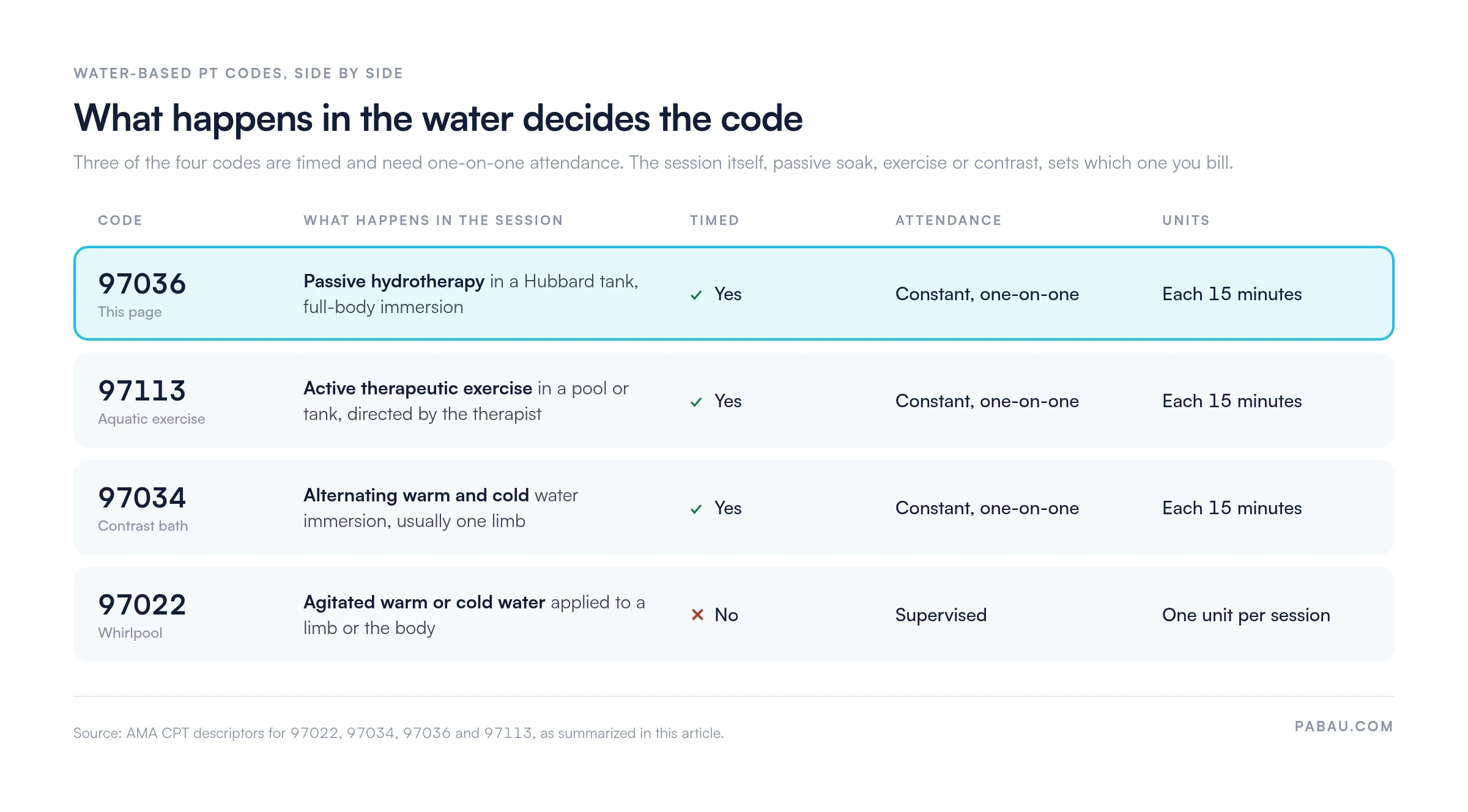
CPT 97036 covers passive hydrotherapy in a Hubbard tank, while 97113 covers active aquatic therapeutic exercise. Both are timed, constant-attendance codes billed in 15-minute units, so attendance won’t separate them. They’re the two water-based PT codes coders confuse most, and billing them interchangeably invites NCCI edit denials.
When hydrotherapy and aquatic exercise happen on the same date, document them as separate intervals with their own minutes. NCCI has long listed 97036 as a component of 97113, so verify the current edit table before billing both. Edit status can change each quarter, so relying on a prior-year table is itself a compliance risk.
Hydrotherapy is rarely the only intervention in a PT session. The codes below often appear on the same date of service as CPT code 97036. Every one is timed, so Medicare adds their minutes to the 97036 minutes when it sets the units. Check current NCCI edits in the AAPC code lookup before pairing any of them with 97036.
CPT code 97036 is a timed code. Bill it in 15-minute units, counting only the minutes the provider spent in direct one-on-one contact with the patient. The “each 15 minutes” in the official descriptor is the unit instruction.
For Medicare, apply the 8-minute rule to the session’s total timed minutes, 97036 included. A single timed service needs at least 8 minutes for one unit, and 23 minutes or more supports two. Many Medicaid and commercial payers also count 97036 in 15-minute units, so check each plan’s policy.
Say a patient spends 25 minutes in the Hubbard tank with the therapist alongside, then 15 minutes on therapeutic exercise (97110). That’s 40 timed minutes, which supports three units under the 8-minute rule.
Each code first takes one unit per full 15 minutes, so 97036 gets one unit and 97110 gets one. The third unit goes to the service with the most minutes left over. That’s 97036, with 10 remaining minutes, so the claim shows two units of 97036 and one of 97110.
Log start and stop times for every Hubbard tank session, and note that the provider stayed with the patient throughout. Minutes the patient spent in the tank while you treated someone else aren’t billable 97036 time. If the note can’t show constant attendance, the minutes won’t support a unit.
Incomplete session notes are a frequent cause of 97036 denials on audit. The medical billing record has to support every element that links the treatment to a payable claim. A single missing field gives a payer grounds to deny for medical necessity or insufficient documentation.
Most 97036 problems start well before the claim goes out. Here’s the path a clean claim takes, from the benefits check to the remittance.
Hold every 97036 claim to clean claim standards at step five, and far fewer of them reach step seven.
Medicare Part B covers CPT code 97036 when hydrotherapy is medically necessary and documented under the applicable Local Coverage Determinations (LCDs). No diagnosis earns blanket approval. The treating physical therapist must document why this patient’s presentation justifies hydrotherapy.
Medicare publishes rates each year in the Medicare Physician Fee Schedule (MPFS). Rates differ between facility and non-facility settings, because the practice expense (PE) RVU is adjusted for overhead. A PT practice billing at POS 11 (office) receives the non-facility rate.
A hospital outpatient department billing at POS 22 receives the facility rate. For current figures, search code 97036 for the right year in the CMS MPFS Look-Up Tool. The FastRVU lookup tool then adjusts the RVUs for your geographic location.
Commercial coverage varies widely. Many plans cap PT modality visits per year, and others won’t pay unless the treatment plan lists hydrotherapy. Some Medicaid managed care plans treat 97036 as a low-priority modality and require prior authorization that Medicare doesn’t. Verify the plan’s rules before you start billable hydrotherapy.
Medicare doesn’t require prior authorization for CPT code 97036 as a standard rule. Commercial payers and Medicaid managed care organizations often do, and the threshold varies by plan, state and benefit year. A few patterns are consistent enough to build a workflow around.
If you skipped prior authorization and the claim is denied, many payers accept a retro-auth request, but approval isn’t guaranteed. Retro-auth usually needs a clinical justification letter from the treating therapist and records showing the treatment was medically urgent. Build a benefits check into every new PT episode, including the 97036 prior auth status for that payer and plan.
Most CPT code 97036 denials trace back to one of five root causes. Each has a defined fix, and front-end documentation controls prevent most of them. Denial management workflows help you spot the pattern across claims before you work individual remittances.
The place of service (POS) code on the CMS-1500 affects both claim processing and the Medicare rate for CPT code 97036. The facility vs. non-facility split changes the practice expense part of the RVU calculation. A wrong POS code therefore risks both a denial and a possible overpayment.
Some PT practices sit on a hospital campus but bill on the physician fee schedule rather than the hospital outpatient prospective payment system (OPPS).
In that case, confirm whether CMS provider-based department rules call for POS 19 (off-campus outpatient hospital) or POS 22. The wrong POS there brings a reimbursement adjustment and a possible compliance finding. Build a quarterly POS audit into your medical billing compliance routine.
Two minutes with this list before submission can save weeks of appeals later.
Each of these errors is easy to fix once you know where it hides.
Most 97036 denials start in the session note, with missing minutes or no record of one-on-one attendance. When notes live on paper and billing runs in a separate tool, nobody sees the missing field until a payer rejects the claim.
Pabau keeps the session note, treatment plan and claim on one patient record. Its claims management software submits claims through Claim.MD in the US, runs eligibility checks and receives ERA remittances. Your team can confirm coverage before the first Hubbard tank session and reconcile payment when the ERA comes back.
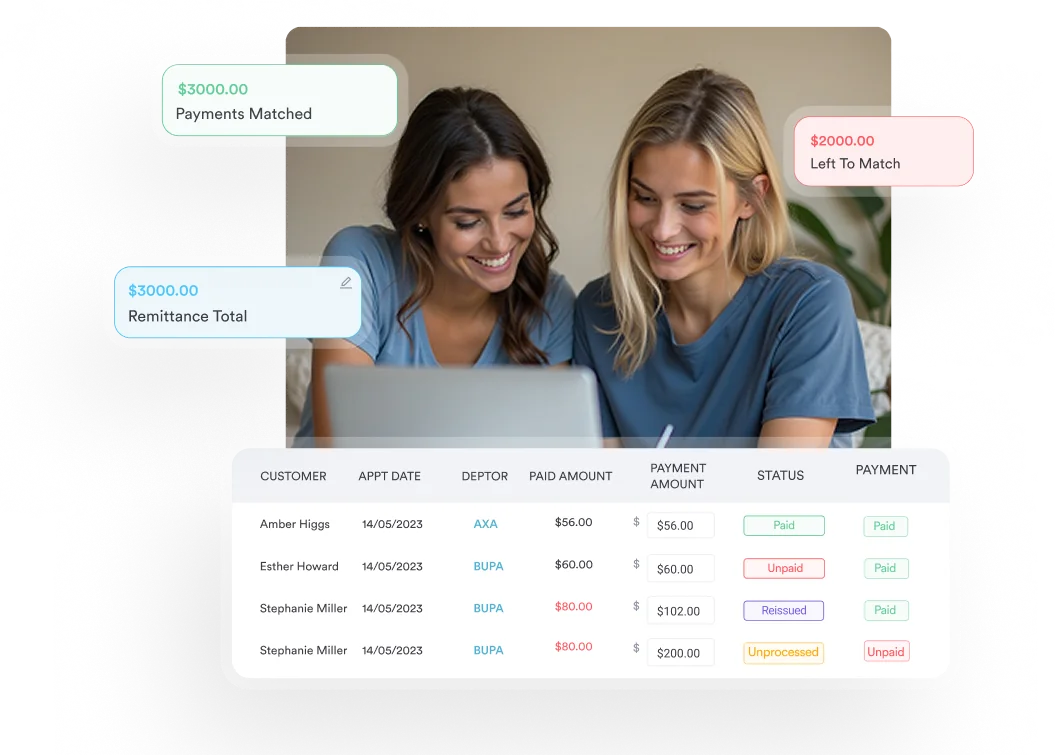

Pabau keeps PT session notes, eligibility checks and Claim.MD claim submission on one record. Your team can confirm minutes and attendance before claims go out.

Once you separate CPT code 97036 from 97113 and whirlpool, the code itself is simple. What decides payment is the note behind it. Minutes, attendance, water temperature and body area need recording at every session.
If you change one habit, let billing start from the note. A biller who counts units straight from the start and stop times has far less to appeal later. Book a demo to see how Pabau links PT notes to claims, so each 97036 unit is backed before it’s billed.

Billing aquatic exercise in the same episode? CPT code 97113 explains the timing, attendance and documentation that set it apart from 97036.
Treating one limb in a whirlpool instead? CPT code 97022 covers the untimed, supervised whirlpool code and how to document it.
Adding ultrasound to the same session? CPT code 97035 covers therapeutic ultrasound, another constant-attendance modality.
Pairing hydrotherapy with land-based exercise? CPT code 97110 walks through units and documentation for therapeutic exercise.
Want to understand how denial management works across your full claim portfolio? Denial management in healthcare explains how to identify denial patterns and build prevention workflows that reduce rework.
Physical therapists add the GP modifier. Medicare requires a therapy modifier on outpatient therapy services, and GP marks the service as delivered under a PT plan of care. Occupational therapists use GO instead.
Add KX once a Medicare patient’s yearly therapy spending passes the threshold CMS sets each year. It confirms the extra treatment is medically necessary and documented. 97036 counts toward that threshold like other PT services.
Yes, a PTA can deliver the session under PT supervision where state practice rules allow it. Medicare then needs the CQ modifier when a PTA furnishes the service in whole or in part. It pays 85% of the fee schedule amount.
It’s far less common than it once was. Many burn and wound centers moved to showering or localized cleansing, partly over infection-control concerns with shared tanks.
On its own, 30 minutes of one-on-one hydrotherapy supports two units under Medicare’s 8-minute rule. Other timed services on the same date change the math, because Medicare counts total timed minutes.