



HCPCS code E0198: Water pressure pad billing guide
HCPCS code E0198 is a water pad for a standard mattress HCPCS code E0198 is the ...

Last Updated: Oct 13, 2026

CPT code 97113 covers aquatic therapy with therapeutic exercises, billed per 15-minute unit of one-on-one care.
Only skilled treatment minutes count, so changing, pool entry, and drying off never reach the claim.
Medicare Part B covers 97113 when the note explains why water suits this patient better than land.
Same-day billing with 97110 turns on documentation of two distinct services, not on a modifier rule.
Practice management software like Pabau pre-fills claims from the visit record and flags missing required fields.
CPT code 97113 covers aquatic therapy with therapeutic exercises, billed per 15-minute unit of one-on-one care. One rule decides most claims. Only the minutes a therapist spends treating the patient in the water count toward those units.
Payers read this code closely, because a pool session looks a lot like recreational fitness on paper. A note that reads like an exercise log comes back denied. So three questions decide the claim: who may bill, what the record proves, and which minutes count.
The American Medical Association (AMA) publishes the official descriptor for 97113. It reads: Therapeutic procedure, 1 or more areas, each 15 minutes; aquatic therapy with therapeutic exercises.
The AMA maintains the CPT code set, so its wording settles any question of interpretation.
Aquatic therapy uses buoyancy, water resistance, and hydrostatic pressure to make exercise possible when land-based work would hurt too much.
Swimming lessons and recreational hydrotherapy do not qualify. The therapeutic exercise is what separates 97113 from a non-covered pool session, and the notes have to say so plainly.
Eligibility rests on two things: state licensure and payer policy. Under Medicare, these provider types may bill the code.
Speech-language pathologists sit outside this code under most payer policies, since aquatic therapy falls outside typical SLP scope.
State licensure rules vary too, so check your state board’s scope-of-practice language before you build a pool-based service line. Your Medicare Administrative Contractor (MAC) can confirm the rest.
Medicare Part B pays for 97113 as an outpatient therapy service when the care is medically necessary. The patient also has to be expected to improve within a reasonable timeframe.
Coverage sits under the Medicare Benefit Policy Manual, Chapter 15, and each MAC adds its own Local Coverage Determinations (LCDs).
Underneath all of that is one expectation. The record has to explain why this patient needs water rather than a mat and a set of bands.
Medical necessity turns on a therapeutic advantage the patient cannot get on land. These conditions usually clear that bar:
Reimbursement moves with geographic locality and place of service. The CMS Physician Fee Schedule lookup tool gives current rates by zip code and provider type.
The figures below are approximate national averages for 2026, so treat them as a starting point rather than a quote.
Rates shift with each annual fee schedule update, so check CMS before you build them into a forecast.
Medicare sets an annual threshold on outpatient therapy spending, indexed each year. Once a patient’s combined physical therapy and speech services pass it, treatment can continue if it remains medically necessary. The KX modifier is how the therapist says exactly that, and points to a record that supports it.
Using KX early is an audit trigger. Append it only after the patient has passed the threshold for the year. The documentation behind it has to show why care continues, in clinical terms rather than habit.
97113 is a time-based code billed in 15-minute increments. Under the CMS 8-minute rule, one unit needs at least eight minutes of direct skilled service. More units need proportionally more time, on the ladder below.
Here is where aquatic therapy differs from every other code on that ladder. Pool entry, changing, and drying off are part of the visit, but none of it is treatment. Only the minutes of skilled therapeutic exercise in the water go into the total. That difference usually costs a session one unit.
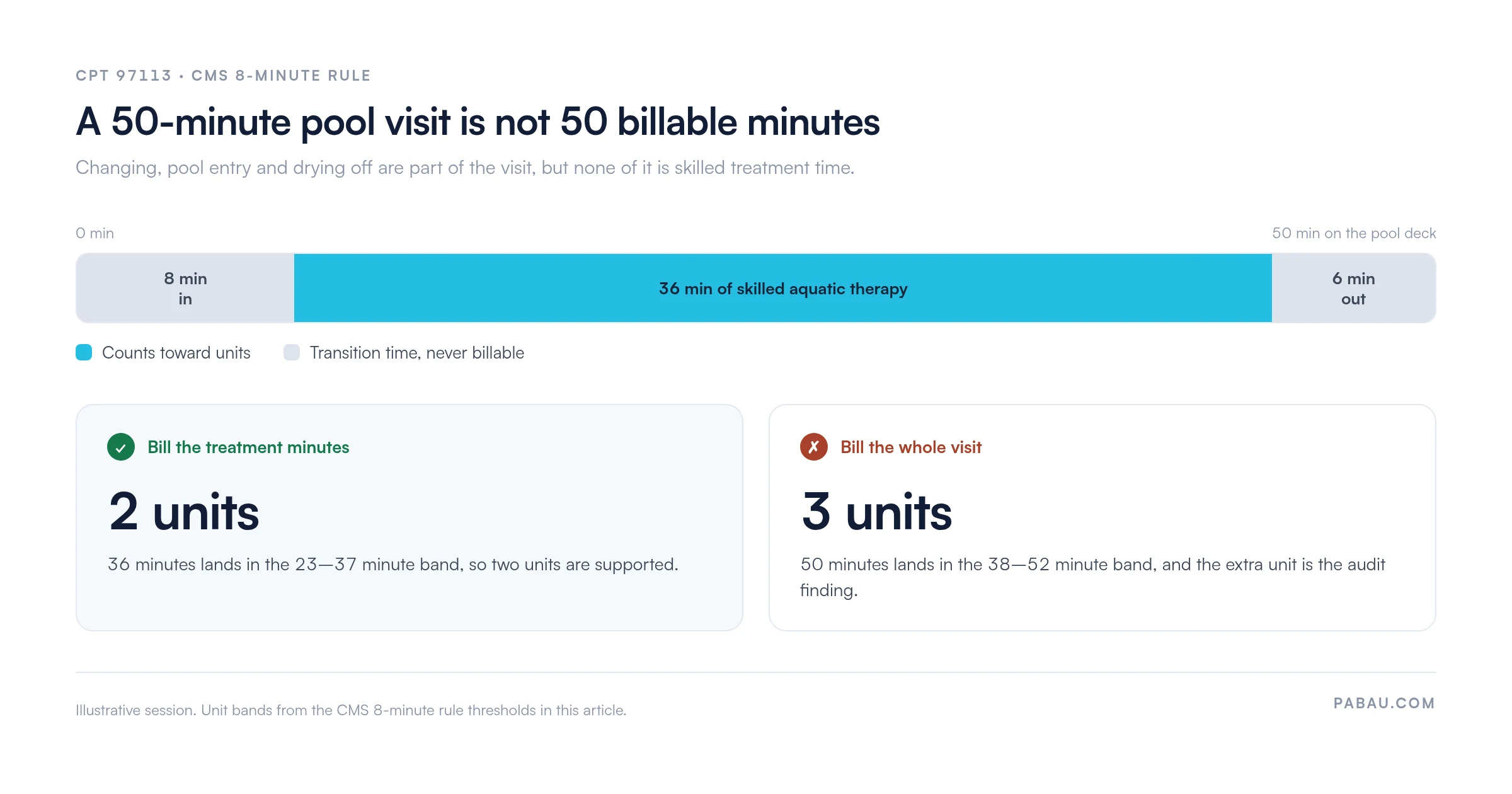
The exclusion is not specific to aquatic therapy. State Medicaid programs billing HCPCS code H0032 in 15-minute units leave administrative time out of the unit count.
Place of service matters just as much. Use 11 for a private practice pool and 22 for hospital outpatient. Code 12 belongs only to services delivered in the patient’s home. Pick the wrong one and you land on the wrong side of the facility rate.
Which modifiers you need depends on provider type, payer, and what happened in the session.
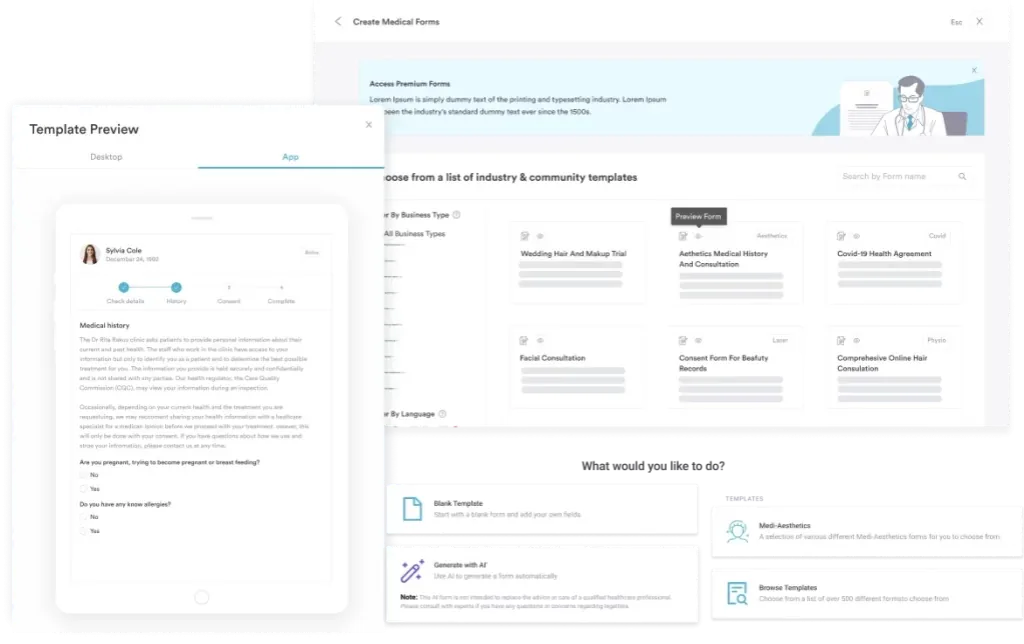
Thin documentation is the leading cause of 97113 denials and post-payment recoupments. Every billed session needs contemporaneous notes that show skilled care. A standard template keeps the required elements in front of the therapist while they write.
Required elements include:
Read a finished note back and ask one question. Does it describe a clinician making decisions, or a patient doing exercises? The first gets paid.
Name the water in every session note. Write “performed therapeutic exercises in the aquatic environment” rather than “therapeutic exercises completed.” Auditors look for that wording to confirm 97113 was the right code, not 97110.
Every 97113 claim needs a supporting ICD-10-CM diagnosis, and the diagnosis has to make the case for water. The CDC/NCHS ICD-10-CM web tool confirms the current code set.
These pairings come up most often:
One trap catches practices every year. ICD-10 code M54.5 was retired in October 2021, so a claim carrying it rejects on arrival. Use M54.50, or a more specific low back pain code where the record supports one.
Aquatic therapy denies more often than most outpatient therapy codes, for a straightforward reason. Payers are watching for pool time dressed up as treatment.
These six patterns account for most of it:
Patterns beat one-off corrections here. Track which denial codes keep coming back, then fix the note template that produced them. A claim denied for thin documentation in March gets denied again in June if only the claim was corrected.
Audit 97113 claims once a quarter, comparing units billed per session against the treatment notes. If the average runs high, transition time is probably creeping into the count. Fix the template, not just the individual claims.
Four fields decide whether a 97113 claim survives its first pass. They are the diagnosis, the units, the modifiers, and the plan of care date.
Your clearinghouse checks the format first, then the payer’s system checks policy rules. Nobody reads the clinical note unless the claim reaches review or appeal.
That order is why a two-minute check before submission beats a two-week appeal after one. Run through these five:
Each of these is a clean claim requirement. Catching one now costs far less than appealing it later. Five points, thirty seconds, one claim that pays first time.
Neighboring therapy codes describe similar work in different settings. Picking the wrong one counts as miscoding, even when the intent is honest. Here is what separates 97113 from the codes it sits beside.
Before you bill a new combination, check it against the payer’s own edits. The AAPC Codify CPT lookup confirms a descriptor quickly. Current NCCI edit tables show which pairs a payer bundles.
Aquatic therapy billing usually breaks in the handover. A therapist writes the note, and someone else builds the claim. The minutes or the diagnosis get retyped along the way. Time-based codes punish that, because one wrong unit repeats across every visit in the plan of care.
Practice management software like Pabau closes that handover. Pabau handles claims management without rekeying. The payer, the diagnosis, and the plan of care come straight from the patient record.
Built-in ICD-10 and CPT lookup libraries keep the codes themselves current. Completeness checks then flag a required field left empty before the claim goes anywhere.
From there, claims go out electronically through Claim.MD, our US clearinghouse integration. It supports CMS-1500 and 837P formats for thousands of US payers.
Remittance advice comes back into the same record, so denial reason codes sit next to the visit that caused them.
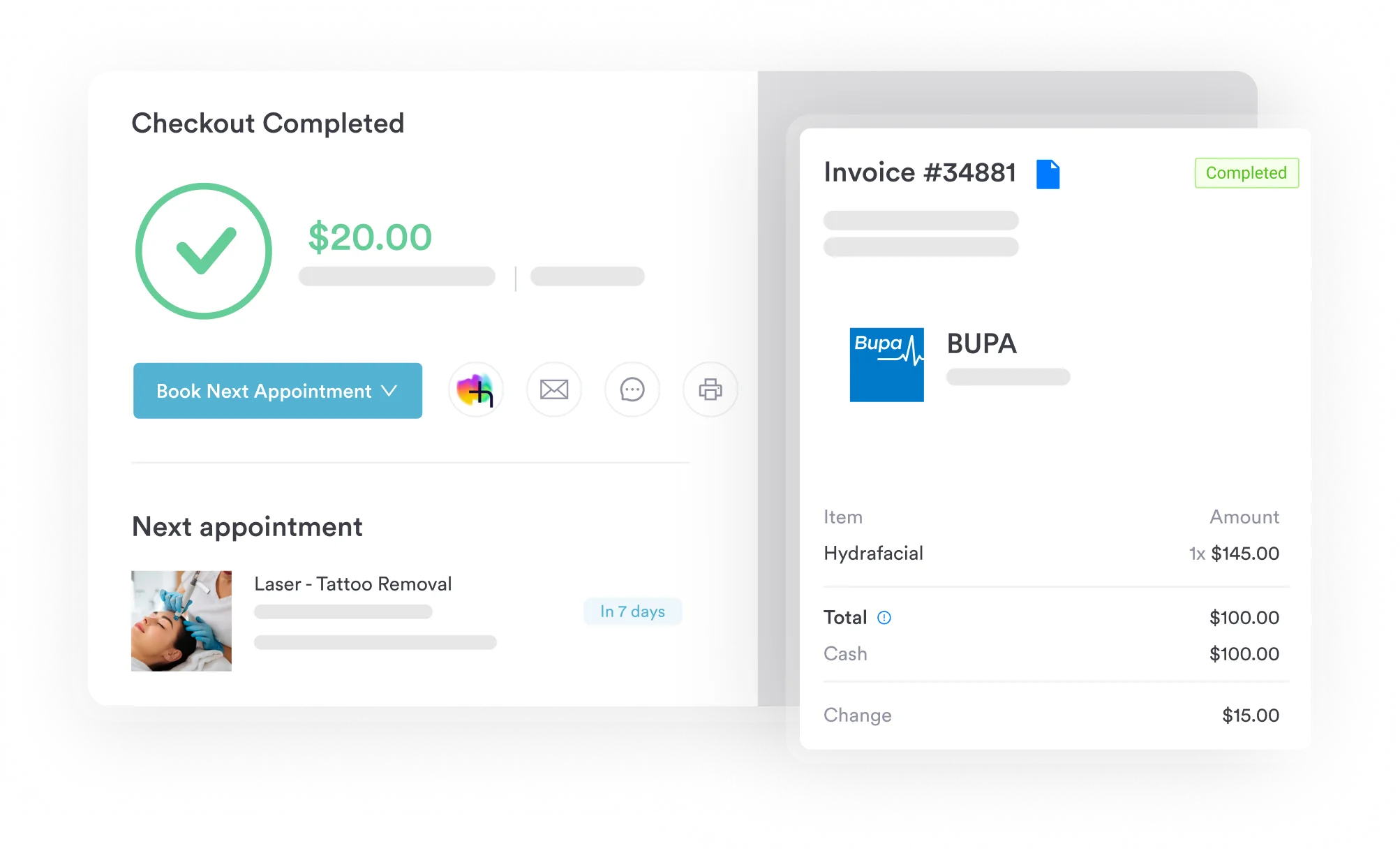
For an aquatic therapy practice, that adds up to four practical wins:

Pabau builds each claim from the visit record and keeps ICD-10 and CPT libraries current. Claims go out electronically through our Claim.MD integration. See how it works for a PT or OT practice.

Aquatic therapy is worth billing properly, and the practices that do it well treat 97113 as a documentation code first. Three pieces carry the claim: the clinical case for water, the minutes that count, and the matching provider modifier. Get those three right and the code stops being a problem.
The trade-off worth remembering is time. Every minute you spend tightening a note template buys back the hours an appeal would cost, several claims later. Start with the one thing your denials keep pointing at.
Want the note and the claim to stay in step without retyping? Book a demo and we will show you how Pabau handles therapy billing end to end.

Need to understand the broader revenue cycle for your therapy practice? Revenue cycle management fundamentals covers how claims move from scheduling through payment posting.
Billing across multiple rehabilitation code types? Superbill documentation guidance explains how to structure superbills for time-based therapy codes.
Seeing the same rejections every month? Denial management in healthcare sets out a workflow for tracking reason codes and fixing the cause.
New to the claim side of the practice? What medical billing involves walks through each step from encounter to payment.
Managing insurance credentialing for your PT practice? Getting credentialed with insurance companies walks through the payer enrollment process for therapy providers.
The descriptor does not say where the therapist stands. It does require direct one-on-one contact for every billed minute. So the therapist attends that patient alone, in the water or at the poolside. The note should say which.
Medicare does not require a referral. It does require a certified plan of care, signed by a physician or non-physician practitioner. Certification is due within 30 days of the evaluation. State direct-access rules and commercial payer policies can be stricter, so check both.
Not in most settings. Under Medicare Part B, a private practice needs the supervising therapist on the premises while the PTA treats. Other settings allow general supervision, and some state practice acts go further. The CQ modifier applies either way.
Only when a therapist’s skill is needed to deliver it safely. Medicare covers skilled maintenance therapy, but not a pool routine the patient can carry out alone. The note has to show what the therapist did that an unskilled helper could not.



