



CCSD code G5100: Bypass of duodenum billing guide
CCSD code G5100 bills a bypass that leaves the duodenum in place CCSD code G5100...

Last Updated: Oct 16, 2026

CPT code 97035 covers therapeutic ultrasound applied to one or more areas, billed in 15-minute units.
It is a constant attendance code, so the therapist stays with the patient for every minute billed.
The 8-minute rule sets the unit count. Eight to 22 minutes is one unit, and 23 to 37 minutes is two.
Start and stop times, the treated area, ultrasound settings, and a dated signature belong in every note.
Medicare trims the practice expense on the second timed therapy code each day, and wants modifier KX past the annual threshold.
CPT code 97035 bills therapeutic ultrasound in 15-minute units, and it is a constant attendance code. That means the therapist stays with the patient for every minute billed. Those minutes belong in the note as clock times, because the 8-minute rule turns them into units. Eight to 22 minutes is one unit.
So a missing stop time is the most common reason a 97035 line comes back unpaid. Below, we walk that claim from the treatment note through to the remittance, and name the denial code waiting at each step.
The American Medical Association’s CPT code set words it this way: Application of a modality to one or more areas; ultrasound, each 15 minutes. You will find it in the constant attendance section of the physical medicine and rehabilitation modalities.
Two features of that descriptor shape every claim you file. Constant attendance means the therapist stays in the room and stays engaged. Timed billing means the clock decides your unit count, not the length of the appointment slot.
The constant attendance group also holds 97033 for iontophoresis, which uses direct current rather than ultrasound to move medication through the skin. Both codes bill in 15-minute units, so your note needs start and stop times either way.
Physical therapists file most 97035 claims. Occupational therapists, chiropractors, and some physicians bill it too, as long as it falls inside their state scope and their payer contracts.
Eligibility is never universal, so confirm it with the payer and your licensing board before the first claim goes out.
Read your state practice act alongside each payer contract before you bill. Some Medicare Administrative Contractors (MACs) add their own provider criteria through Local Coverage Determinations. Those rules differ from one jurisdiction to the next.
Every 97035 claim needs a documented reason the patient needed ultrasound that day. “Patient tolerated treatment well” tells a reviewer nothing. The note has to tie the modality to a specific diagnosis and to the function you are trying to restore.
Payers accept these indications most consistently:
Your local MAC can draw the line more tightly than that. Its Local Coverage Determination for therapeutic modalities names the diagnoses it will and will not cover. Check that list before you bill an uncommon presentation.
One unit takes at least 8 minutes of that specific service. Every unit after that takes another 8 minutes on top. CMS sets the rule in Chapter 5 of the Medicare Claims Processing Manual. It applies to every timed therapy code, not just ultrasound.
That ladder is a Medicare rule. Commercial payers write their own. Some round at 8 minutes the same way, others divide total time by 15, and a few cap units per visit outright. Check the timed-code language in each contract before you assume the CMS version applies.
Mixed sessions are where the arithmetic gets interesting. When 97035 shares a visit with another timed code, the 8-minute rule looks at the total timed minutes first, then hands out units. Leftover minutes go to whichever code has the largest remainder.
Take 20 minutes of therapeutic exercise and 6 minutes of ultrasound. Six minutes on its own is not billable. Together the session runs 26 timed minutes, which supports two units. Exercise takes the first unit at 15 minutes and keeps a 5-minute remainder, so the second unit goes to 97035.
That only works if the note records each code’s minutes separately. A single “32 minutes of therapy” entry cannot be audited, and it cannot be defended either. The CPT code 97110 guide walks through the same math from the therapeutic exercise side.
Documentation failures drive most 97035 denials and nearly every audit finding. A reviewer checks three points. Was the service needed? Did a qualified provider deliver it? And did it happen the way you billed it?
These eight elements answer all three:
Skilled care justification is the element reviewers query most. Therapeutic ultrasound looks simple from the outside, so someone will ask what the therapist’s training added. Answer that in the note, in one sentence, while the session is fresh.
Knowing the descriptor is not enough to get paid. Place of service, bundling edits, and one modifier account for most of the friction between a finished note and a posted payment.
Outpatient practices normally use place of service (POS) code 11 for an office, or POS 22 for a hospital outpatient department. Skilled nursing facilities use POS 31. When the POS code disagrees with the service address or the facility type, the claim stalls in edits before a human ever reads it.
The National Correct Coding Initiative restricts certain code combinations in the same session unless an appropriate modifier applies.
CPT 97035 conflicts with some other physical medicine modalities, and CMS republishes the table every quarter. Verify any pair you plan to bill against CMS’s current NCCI procedure-to-procedure edits.
Each pair carries a modifier indicator. An indicator of 0 means no modifier will ever unbundle it. A 1 opens the door to modifier 59, or one of the X modifiers, where the record genuinely supports separate services.
The hard Medicare therapy cap ended in 2018. What replaced it is an annual KX modifier threshold, set at $2,480 for physical therapy and speech-language pathology combined in 2026.
Past that point, KX on the claim attests that the care is still medically necessary and that the record proves it.
Leave KX off after the threshold and the claim denies automatically. A separate targeted medical review threshold sits at $3,000, and that figure holds through 2028. CMS resets the KX amount every year, so confirm the current one with your MAC.
Medicare reimburses 97035 under the Physician Fee Schedule. CMS sets the rate each year through federal rulemaking, then adjusts it for where you practice using the Geographic Practice Cost Index. So there is no single national number to quote a practice owner.
As a rough reference point, the national average sits somewhere around $20 to $30 per unit. Your own figure depends on your MAC jurisdiction and locality code. Pull it from the CMS Physician Fee Schedule lookup tool rather than a round-up, and refresh it every January.
Expected payment also depends on the patient’s coverage on the day. A real-time eligibility check before the visit tells you whether the plan is active and what the patient owes. That costs far less than finding out on the remittance three weeks later.
Re-check your 97035 rate every January, once CMS publishes the annual fee schedule final rule. Practices that carry last year’s figure into this year’s forecast end up explaining a shortfall that was never a collections problem.
97035 rarely appears alone on a claim. Some pairings are routine, some need a modifier, and one of them is never paid separately no matter what it sits beside. The table covers the combinations you will meet most weeks.
The 97010 row is worth a second look. Medicare classifies hot and cold packs as status B, meaning the payment is always bundled into another service. It is never separately payable, whatever else appears on the claim, so listing it will not add a cent.
Not every superficial heat modality follows that rule. Paraffin bath carries an active status A on the fee schedule, so 97018 is separately payable when the notes support it.
The billable pairings carry their own reduction. Medicare’s Multiple Procedure Payment Reduction applies when several therapy services reach one patient on the same day. The service with the highest practice expense is paid in full, and every additional one has its practice expense component cut by 50%.
MPPR leaves the work and malpractice components alone, so the hit is smaller than a flat 50% cut. It still changes what a three-code session is worth. Model it into your expected revenue per visit rather than adding up fee schedule amounts and hoping.
Almost every 97035 denial lands in one of five buckets, and each bucket has a fix that lives upstream of the claim. The claim adjustment reason code (CARC) on the remittance tells you which one you hit. The visual below maps each one to the point in the workflow that creates it.
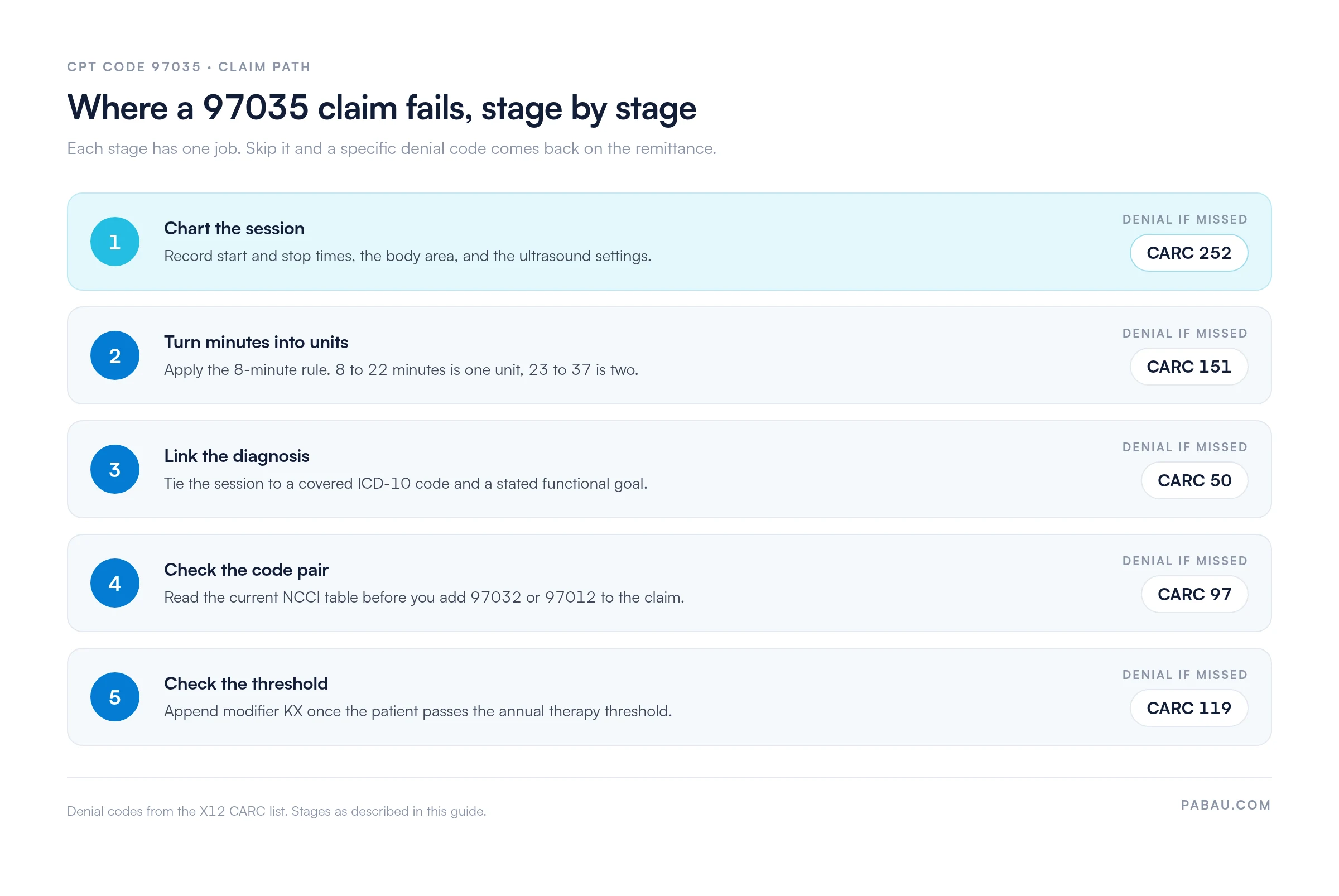
Reading denials one claim at a time hides the pattern. If 97035 keeps drawing CARC 252 from the same payer, that is a workflow problem in your practice, not bad luck. Grouping remittance data by payer and reason code is how the fix becomes obvious.
Some reason codes mean something different from what their label suggests, which sends appeals down the wrong path. Our reference on medical billing denial codes spells out what each code means in practice.
A 97035 line takes about a minute to verify and a month to appeal. Run this pass on every claim that carries the code:
Three mistakes account for most of what this catches. Units typed from the appointment length rather than the treatment time. A diagnosis pointer left on the first code in the list. And KX applied to the whole claim when only the therapy lines need it.
Audit your 97035 claims once a quarter. Pull the units billed per date of service and compare them with the clock times in the matching note. A mismatch between billed units and documented time is the first item a reviewer checks on any constant attendance code.
In most practices, the note and the claim live in different systems. A therapist writes the treatment record, a biller reads it, and the claim gets rebuilt by hand in a second screen. Every retyped field is a chance for the units to drift away from the minutes.
Practice management software like Pabau removes the retyping step. The treatment note and the claim sit in the same patient record. Any CPT code attached to the service lands straight on the charge line.
ICD-10 slots seed from the patient’s recorded problem list. Coders search built-in CPT and ICD-10 libraries instead of a separate lookup tool.
Pabau’s claims management software also checks that the required fields are complete before a claim can be sent. An incomplete claim simply cannot go out.
On the US pipeline, eligibility checks run before the visit and claims go out electronically to thousands of payers. Electronic remittance advice, or ERA, then posts back against the same record the therapist wrote in.
That last part matters for a timed code. Payment, reason code, and treatment note all sit together. Spotting the payer that keeps rejecting your 97035 units then takes minutes, not a spreadsheet export.
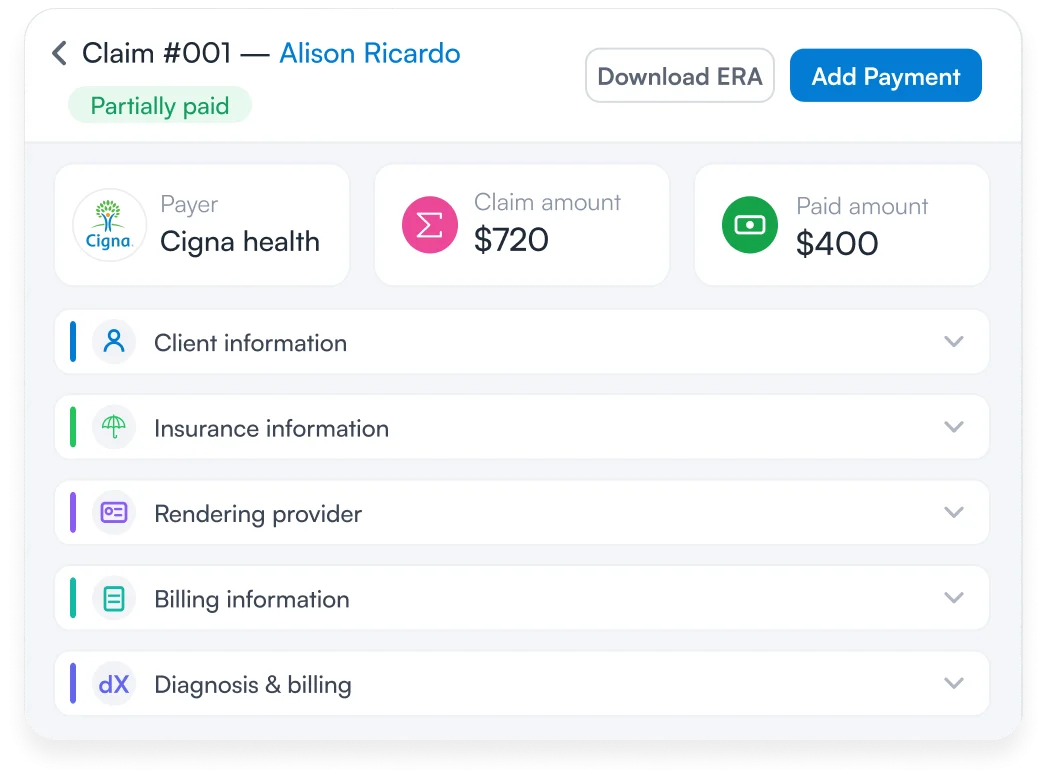

Pabau pre-fills the claim from the patient record and checks the required fields before it can be sent. Each ERA posts back against the same file, so your billers stop retyping what the therapist wrote.

The descriptor for 97035 is short and the treatment is familiar, which is exactly why the code gets billed carelessly. What decides the outcome is a set of clock times, written down while the machine is still on the patient.
So put the effort at the front. Fix the note template, agree the diagnosis pointers with your therapists, and check the NCCI table each quarter. Appeals are always more expensive than the 30 seconds it takes to record a stop time.
If your notes and your claims still live in separate systems, close that distance first. Book a demo to see how Pabau keeps therapy documentation and claim submission in one patient record.

Billing exercise in the same session? CPT code 97110 sets out the unit math when therapeutic exercise and ultrasound share a visit.
Adding manual therapy to the plan of care? CPT code 97140 covers the documentation and modifier rules that come with it.
Wondering why hot packs never seem to pay? CPT code 97010 explains the status B classification and what it means for your fee schedule.
Need to read a remittance line by line? Electronic remittance advice explained breaks down how an 835 file returns payment data to your billing system.
Denials stacking up across several payers? Denial management in healthcare shows how to work them as a group instead of one appeal at a time.
No. CPT 97035 is a treatment modality, delivered by a therapist to heat or stimulate tissue. Diagnostic musculoskeletal ultrasound is imaging, and it is billed with the 76881 and 76882 family instead. Billing an imaging code for a therapy session is a straightforward denial.
No. Medicare pays a chiropractor for manual manipulation of the spine only, using 98940 to 98942. Therapeutic ultrasound and the other physical medicine modalities are excluded from that benefit, whatever the state scope of practice allows. Commercial plans set their own rules, so check the contract.
Modifier 59, or one of the more specific X modifiers, XE, XP, XS and XU. It only works on pairs whose NCCI modifier indicator is 1. An indicator of 0 means no modifier will ever separate them, so appending 59 there simply invites an audit.
There is no universal frequency limit. Individual MACs publish expected visit ranges in their Local Coverage Determinations, and commercial payers often set their own caps per episode. Once ultrasound continues past the usual course, the note has to show measurable progress that justifies more.



