



CCSD code G5100: Bypass of duodenum billing guide
CCSD code G5100 bills a bypass that leaves the duodenum in place CCSD code G5100...

Last Updated: Oct 16, 2026

CPT code 97032 covers attended electrical stimulation, billed per 15-minute unit with a qualified therapist in constant attendance.
Billing 97032 after the therapist has left the room is upcoding, so the note has to show continuous presence.
The 2026 Medicare national baseline is about $14.70 per unit, from 0.44 total RVU multiplied by the $33.4009 conversion factor.
97032 pays more than the untimed unattended codes, 97014 and G0283, because the 15 minutes include skilled therapist time.
Pabau, practice management software for therapy practices, timestamps attendance and checks 97032 claims before they reach the payer.
CPT code 97032 is the timed code for attended electrical stimulation. One unit covers 15 minutes of treatment. A qualified therapist has to stay in the treatment room and actively monitor the patient throughout that unit.
The unattended equivalents are untimed. Commercial payers take 97014, and Medicare takes G0283. Choosing between the attended and the unattended code drives most electrical stimulation denials, and the treatment note is what settles it.
The American Medical Association (AMA) CPT code set describes 97032 as “electrical stimulation (manual), each 15 minutes; attended.” Two elements define the code. One is the 15-minute time unit, and the other is the attendance requirement. Both have to be satisfied for every unit billed.
Physical therapists, occupational therapists and, in some clinical contexts, speech-language pathologists can bill 97032 when they provide the constant attendance themselves. The supervising clinician has to be a qualified healthcare professional as the payer defines it.
A PTA or COTA may deliver the treatment under the supervising therapist’s direction, and state practice acts differ on what that supervision requires. Medicare also expects a payment modifier on those lines. Verify supervision rules against each payer contract and your state board.
CMS and most commercial payers read constant attendance strictly. The therapist stays in the treatment room, actively monitoring the patient, for the full duration of each billed unit. Stepping out to take a call, write notes at the front desk, or start another patient breaks it.
This is the most audited element of a 97032 claim. It is also the one that produces a repayment demand when the documentation is thin.
Both codes describe electrical stimulation, and the therapist’s presence is what separates them. Billing 97032 when the unattended code applied is upcoding. Billing the unattended code when the therapist stayed and monitored leaves reimbursement on the table.
Unit and payer both change when attendance drops out, and 97014 covers those rules in full. The table below sets the three codes in this group side by side.
G0283 is the Medicare HCPCS equivalent of 97014 for unattended electrical stimulation in outpatient settings. Medicare generally will not accept 97014 for this service from participating providers.
So the code follows the therapist. Where nobody is monitoring, Medicare claims carry G0283. Where the therapist stays throughout, 97032 applies whatever the payer. The attended code pays more because those 15 minutes include skilled professional time.
Most 97032 denials come from five predictable billing errors. Fixing them before submission costs far less than appealing afterward. The remittance advice usually names the reason, and our reference on medical billing denial codes translates the ones that land on timed therapy lines.
CPT 97032 falls under the 8-minute rule for timed services, on Medicare and most commercial payers. One unit becomes billable at 8 minutes of attended treatment. Two units need 23 minutes, three need 38, and each further unit needs another 15.
The note records the start and stop time for the session, in minutes. Rounding up to the next 15-minute unit without recorded times is a standard audit finding.
Several modifiers change how a 97032 line is processed. The KX modifier goes on the claim once a Medicare patient’s therapy costs pass the annual threshold and continued care remains medically necessary. The record has to support that judgment. This replaced the old therapy cap after the Bipartisan Budget Act of 2018.
Modifier 59, or an X-modifier, may be needed when 97032 is billed alongside another physical medicine code on the same date. It marks the service as distinct. Lines delivered in whole or in part by a PTA or an OTA carry CQ or CO instead. Those lines pay at 85% of the fee schedule amount.
A clean 97032 claim means the modifier matches what happened in the room, checked before submission. A KX modifier without medical-necessity documentation behind it is an audit risk in itself. Practices that read their remittance advice weekly catch these mismatches sooner than practices that wait for an EOB.
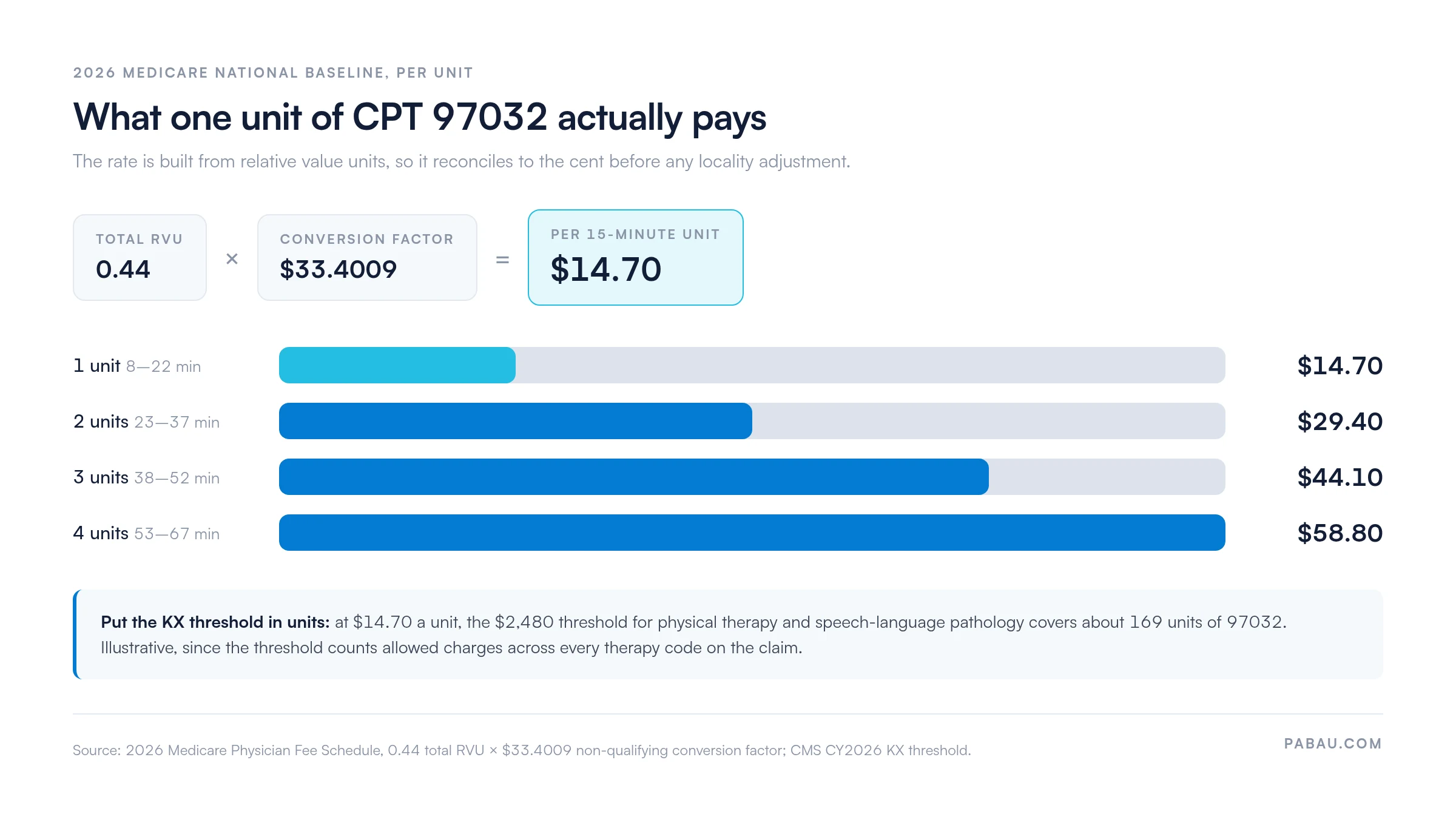
The 2026 Medicare national baseline for 97032 is about $14.70 per 15-minute unit. That figure is 0.44 total RVU multiplied by the $33.4009 conversion factor that applies outside an advanced payment model. Practices paid on the qualifying factor of $33.5675 land at roughly $14.77.
Your paid amount then adjusts by the geographic practice cost index for your locality. Check the CMS Medicare Physician Fee Schedule Look-Up Tool for your MAC jurisdiction before you bill; the CMS relative value files carry the RVU components behind it.
The chart below shows how that per-unit figure scales across a session, and what it means for the therapy threshold.
Facility rates are lower, because the facility bills its own overhead separately.
Commercial payers negotiate their own rates, typically 110% to 150% of Medicare, though this varies by payer and region.
Medicare Part B covers 97032 when it is medically necessary, subject to your MAC’s Local Coverage Determinations. Once a patient’s cumulative therapy costs reach the annual threshold, the KX modifier asserts that continued care is still warranted.
For 2026 that CMS therapy threshold is $2,480 for physical therapy and speech-language pathology combined, with a separate $2,480 for occupational therapy. A claim above it without KX is denied. Targeted medical review begins higher, at $3,000. The hard cap itself was removed in 2018, so the threshold is a checkpoint rather than a payment ceiling.
Verify your 97032 rate directly in the CMS MPFS Look-Up Tool using your MAC’s locality code before each contract renewal. Rates shift with annual conversion factor updates, and relying on the prior year’s fee schedule for negotiations can leave revenue on the table.
Documentation for 97032 has to do three jobs. It establishes medical necessity, proves the therapist was in constant attendance, and captures time accurately. Each one is separately auditable, so missing a single element creates repayment risk. Build all three into the treatment note template before the session, rather than reconstructing them later.
MAC LCDs vary by region and may add documentation requirements of their own. Review the LCD for your jurisdiction in the CMS Medicare Coverage Database before you finalize the note template. State licensing rules sit on top of Medicare’s and can shape what the board expects in the clinical record.
The diagnosis on the claim is what supports medical necessity for 97032. The ICD-10-CM code has to reflect the condition for which electrical stimulation is clinically indicated. Musculoskeletal pain, nerve-related conditions and post-surgical rehabilitation are the common contexts.
Payers cross-reference procedure against diagnosis in automated claim editing, and a mismatch is a frequent denial reason. Use the AAPC Codify CPT lookup to check crosswalk guidance for a specific pairing before you submit.
M54.5 was deleted from ICD-10-CM in FY2022, effective October 1, 2021. Claims that still carry it are rejected by payers running current edits. Use the fifth-character codes instead, such as M54.50 for low back pain, unspecified, or M54.51 for vertebrogenic low back pain.
Watch the myalgia codes as well. Myofascial pain belongs in the M79.1 myalgia subcategory, which needs a fifth character, so M79.18 goes on the claim rather than M79.1. M79.3 is panniculitis, an inflammation of fat tissue, and does not describe muscle pain. Always confirm code validity for the current fiscal year before submission.
Physical therapy sessions routinely combine several timed codes on one date of service. Knowing how 97032 sits next to its neighbors in the physical medicine range helps you avoid unbundling errors and sequence the claim correctly.
The closest neighbor by code number is 97033, iontophoresis, which shares the same constant attendance group. It also bills in 15-minute timed units, so the attendance note and clock times behind a 97032 claim carry over directly.
When several timed codes share a date, the total timed minutes must reconcile with the documented treatment time. CMS audits often target claims where the summed units exceed the length of the session. A pre-submission check on total units catches that before the claim leaves the building.
When billing 97032 alongside other timed codes in the same session, track cumulative minutes across all timed services in your documentation. Auditors look at the total timed units on the claim and compare them against the overall session length. If the units don’t add up, the whole claim is at risk, not just the 97032 line.
The most expensive 97032 problem is a documentation workflow that records the code without the evidence behind it. A therapist treats the patient, notes that e-stim ran for 20 minutes, and moves to the next room.
The claim goes out. Months later a Medicare RAC audit asks for the records supporting those attended units, and the note never mentions therapist presence. That repayment demand was created on the day of treatment.
Practice management software like Pabau closes that loop when scheduling, clinical notes and billing share one record. A note template for an e-stim session can carry a required attendance attestation and pull start and stop times from the appointment. The documentation then stops depending on what the therapist recalls at the end of the day.
Pabau aims at cleaner claims management by connecting the treatment note to the claim, so the recorded time drives the unit calculation. For a multi-therapist practice running high session volumes, that removes a round of manual entry and leaves an audit trail from note to claim.
Claims submitted through the Claim.MD integration are checked for code and modifier accuracy before they reach the payer. The most common 97032 denial triggers get caught at the source rather than on the remittance advice.

Pabau helps PT and OT practices timestamp therapist attendance, capture treatment time, and submit clean electrical stimulation claims. See how it works for your practice.

97032 is easy to bill and hard to document, which is why it draws so much audit attention. The code holds up when the therapist stayed and monitored, the minutes were recorded, and the note supports both. Miss one of those and the payment is at risk, however good the treatment was.
At about $14.70 a unit, no single 97032 line is worth arguing over. The exposure sits in volume, because a note template that omits the attendance statement repeats the same defect on every claim for months.
Fix the template once and the defect stops repeating. Book a demo to see how Pabau captures attendance and treatment time on a therapy note before the claim goes out.

Need to understand what drives claim denials in physical therapy? Denial management in healthcare covers the most common denial categories and how to build a systematic appeals process.
Looking for a complete billing compliance framework for your practice? Medical billing compliance requirements outlines the documentation and audit readiness standards that apply to rehab therapy settings.
Want the fields that decide whether a claim pays first time? What is a clean claim walks through the data payers reject most often and how to check it before submission.
New to rehab therapy billing? What is medical billing explains how a treated session becomes a claim, and then a payment.
Comparing clearinghouses for therapy claims? The Claim.MD clearinghouse covers submission, rejection handling and ERA reconciliation in one workflow.
CPT code 97032 bills attended electrical stimulation therapy. A qualified therapist must be in constant attendance, actively monitoring the patient, throughout each 15-minute unit. It is used in physical therapy, occupational therapy and some speech-language pathology settings, for conditions such as musculoskeletal pain, nerve-related conditions and post-surgical rehabilitation.
The 2026 Medicare national baseline for CPT 97032 is about $14.70 per 15-minute unit. That is 0.44 total RVU multiplied by the $33.4009 conversion factor. Your paid amount varies by locality, so check the CMS Medicare Physician Fee Schedule Look-Up Tool for your MAC jurisdiction.
Yes. Constant attendance is the defining requirement of 97032. The therapist must be in the treatment room and actively monitoring the patient for the full duration of each billed 15-minute unit. If the therapist leaves the room during treatment, the attended code no longer applies for that time period.
Required documentation includes a signed plan of care and a treatment note establishing medical necessity for electrical stimulation. The note also carries start and stop times for each billed unit, plus a statement confirming constant therapist attendance. Record the treatment parameters too, meaning waveform, electrode placement and intensity, along with the patient’s response. MAC LCDs may add requirements depending on the jurisdiction.



