



CCSD code G5100: Bypass of duodenum billing guide
CCSD code G5100 bills a bypass that leaves the duodenum in place CCSD code G5100...

Last Updated: Oct 16, 2026

CPT code 97026 describes the supervised application of infrared therapy, a physical medicine modality that does not require constant clinician attendance during treatment.
Medicare rules infrared therapy non-covered nationally under NCD 270.6, so no local contractor policy can pay for CPT code 97026 in the excluded conditions.
Documentation must capture the treatment area, duration, clinical indication, and medical necessity rationale. Missing any element is a leading cause of claim denial for this code.
For a Medicare patient, an Advance Beneficiary Notice signed before treatment is what lets the practice bill the patient after the expected denial.
Pabau’s claims management software links infrared therapy records directly to billing submissions, which cuts manual code entry and denial risk on supervised modality codes.
CPT code 97026 is classified under the Physical Medicine and Rehabilitation section of the AMA CPT codebook, within the supervised modalities subsection (codes 97010-97028). The official descriptor reads: Application of a modality to one or more areas; infrared.
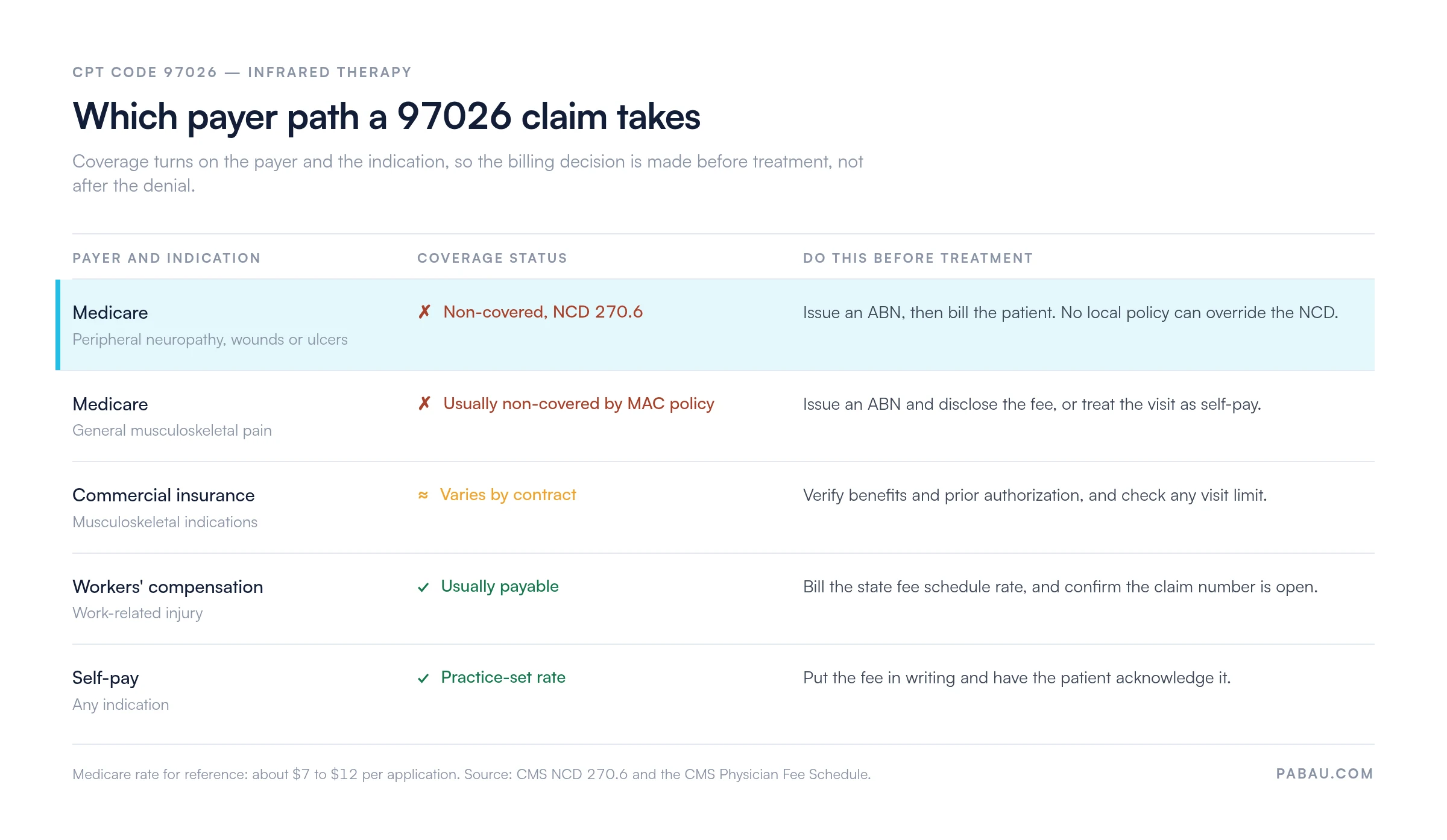
Coverage is the part worth settling first. Medicare treats infrared therapy as nationally non-covered under national coverage determination (NCD) 270.6. So payment on a 97026 claim usually comes from a commercial payer, a workers’ compensation carrier, or the patient.
The supervised designation is the most clinically significant aspect of CPT code 97026 for billing purposes. Under CMS guidelines, supervised modalities allow the qualified provider to monitor several patients at once without maintaining one-on-one contact during the procedure.
This contrasts with “constant attendance” modalities, which require the provider to be present throughout. Infrared therapy falls into the supervised category because the device delivers treatment autonomously once applied.
Clinically, infrared therapy uses wavelengths in the 700 nm to 1 mm range to penetrate superficial tissue. That promotes vasodilation, reduces muscle spasm, and supports pain management. Providers use it for musculoskeletal conditions, wound healing support, and pain relief in rehabilitation.
CPT code 97026 may be billed by qualified rehabilitation providers in both outpatient and practice settings. Eligibility varies by state licensure and payer credentialing, so confirm your own payer contracts before billing.
Facility type matters. Hospital outpatient departments, private practices, and chiropractic offices bill this code under different Medicare rate structures. Confirm whether the facility or non-facility rate applies to your setting before you quote a fee to a patient.
Insufficient documentation is the leading cause of denial for CPT code 97026. Most payers require specific elements in the clinical record to support medical necessity. A vague note like “infrared applied to lower back” will not survive a payer audit.
Capturing these elements at the point of care costs less than reconstructing them for an appeal. A clean claim for 97026 needs every one of them present and legible before the claim leaves the practice.
Medicare does not cover CPT code 97026 for the indications practices most often want to bill. National coverage determination (NCD) 270.6 rules infrared and near-infrared therapy non-covered, and it has been in force since 2006.
NCD 270.6 names the excluded conditions directly. They are diabetic and non-diabetic peripheral sensory neuropathy, plus wounds and ulcers of the skin and subcutaneous tissue, including the pain arising from them. An NCD binds every Medicare Administrative Contractor (MAC). So no local coverage determination (LCD) from Novitas Solutions, National Government Services, or any other contractor can restore coverage for those indications.
General musculoskeletal pain sits outside NCD 270.6, but it has no national coverage authority behind it either. Coverage there falls to each contractor’s own policy, and most treat supervised infrared as not medically necessary. Either way, the practical answer for a Medicare patient is the same.
An ABN is the practical answer here. Signed before treatment, it tells the patient that Medicare will probably not pay and lets the practice collect the fee directly. Without one on file, a denied 97026 claim leaves the practice with no compliant route to bill the patient.
Commercial payer coverage for CPT code 97026 is more variable than Medicare, and in some cases more favorable. Many commercial plans do cover infrared therapy for musculoskeletal indications where Medicare does not. They impose their own conditions, such as prior authorization, visit limits, or diagnosis-specific criteria.
Workers’ compensation payers tend to be the most permissive for infrared therapy billing. State-mandated fee schedules govern the rates, and the coverage restrictions are generally lighter than Medicare’s. Auto insurance and personal injury cases may also reimburse 97026 under medical payment provisions.
Verify benefits and prior authorization with the specific plan before each course of treatment. Some plans require a treating diagnosis from an approved list. Others simply want a physician referral and a documented plan of care.
Put the payers side by side and the pattern is clear. The billing decision on 97026 is made before the first application, not after the remittance advice arrives.
Reimbursement for CPT code 97026 varies by geographic location, payer type, and facility setting. The Medicare non-facility rate sits at roughly $7 to $12 per application. That figure shifts with annual RVU updates and Geographic Practice Cost Index (GPCI) adjustments. Verify the current rate for your locality and year on the CMS fee schedule search.
Because CPT code 97026 carries a low reimbursement rate, the revenue per visit is marginal when the code is billed on its own. Its value is highest inside a documented, medically necessary plan of care that also includes higher-paying timed codes. Therapeutic exercise (97110) and therapeutic activities (97530) are the usual companions, where NCCI edits permit co-billing.
Before billing CPT code 97026 to a commercial payer, check the plan’s prior authorization list. Many commercial payers require pre-authorization for physical medicine modalities and will deny without it, even when the diagnosis qualifies. A short eligibility verification call before the first infrared session prevents weeks of delayed payment.
CPT code 97026 belongs to a family of supervised physical medicine modality codes. Knowing where it sits in the 97000 series helps coders pick the right code and avoid upcoding an adjacent procedure. The table below groups the series by supervision type and billing unit.
The key difference between CPT code 97026 and codes like 97032 or 97035 is supervision versus constant attendance. Constant attendance codes require the provider to stay with the patient throughout, which makes them higher-value and more demanding to document. Billing 97026 when the provider stayed with the patient throughout, or the reverse, is a common audit finding that leads to recoupment.
Payment status splits the family as well. Medicare pays CPT code 97018 for paraffin bath as a separately payable active code, while infrared stays non-covered.
The National Correct Coding Initiative (NCCI), administered by CMS, governs which CPT codes can be billed together on the same date of service. Several bundling principles apply to CPT code 97026 before you submit a multi-code claim.
Key bundling rules for 97026:
NCCI edits update quarterly, so verify current bundling rules against the CMS NCCI Policy Manual rather than prior-year guidance. The AAPC Codify CPT lookup gives a practical crosswalk for checking code compatibility. It also shows the modifier indicators that allow billing an otherwise bundled pair when documentation supports separate services.
The denials and audit findings that follow CPT code 97026 come from a short, predictable list. Standardized documentation catches almost all of them before the claim goes out.
The remittance advice is where the pattern shows up. Map the denial codes on your rejected 97026 claims back to the documentation behind each one, and you learn which note template needs fixing.
Run a quarterly audit of your 97026 claims: Pull every denial, group them by reason, and trace each one back to the documentation. If ‘medical necessity not established’ leads that list, your intake and treatment note templates need revising before the next billing cycle.
Practices that manage modality billing manually keep two records for one visit. The treatment note lives in one system and the claim is built in another. So the diagnosis, the treated area, and the credentials all get retyped, and that retyping is where denial risk accumulates.
Practice management software like Pabau removes that second entry. When a provider records an infrared application, the entry links straight to the billing record for that visit.
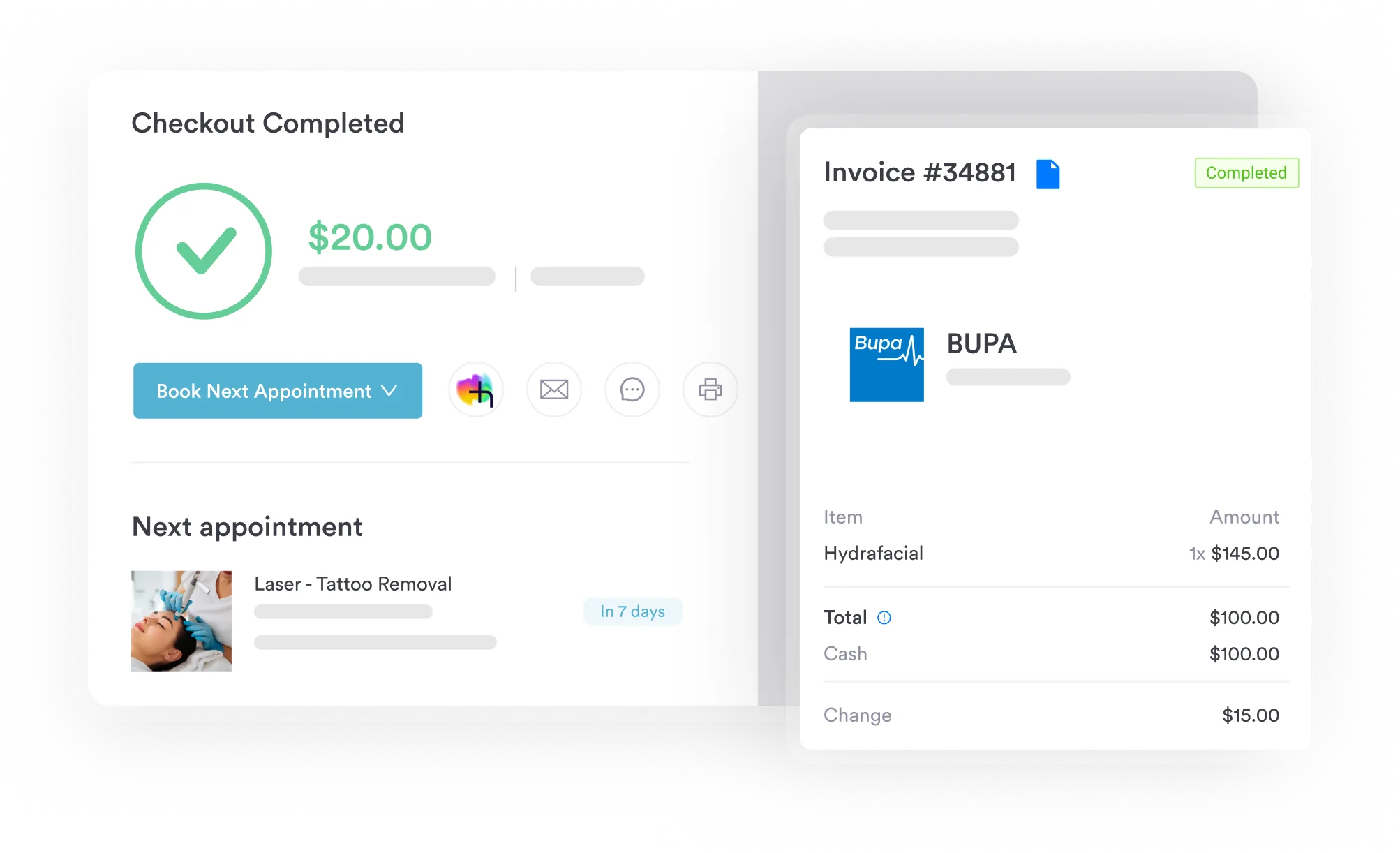
Pabau’s claims management software carries the ICD-10-CM diagnosis, the treated area, and the supervising clinician’s credentials onto the claim. Nobody rebuilds the note from memory at month end.
The outcome is a 97026 claim that already carries the evidence a payer asks for. Practices also see which modality claims are denied and why, so the fix lands in the note template instead of the appeals queue.

Pabau connects clinical documentation and claims management in one workflow. Document infrared therapy, assign billing codes, and submit clean claims without switching between systems.

Infrared therapy is a small line on a claim with a lot of policy attached to it. NCD 270.6 settles the Medicare question before any documentation argument starts, which makes the ABN conversation part of booking rather than part of collections.
Where a commercial or workers’ compensation payer does cover it, documentation decides the claim. Capture the diagnosis, the treated area, the duration, and the supervising clinician while the patient is still in the room. To see how that record flows straight into the claim, book a demo.

Need to know why a 97026 claim came back? Denial management in healthcare explains how to build a systematic denial review and appeal workflow.
Comparing clearinghouse options for your practice? Medical claims clearinghouse guide covers how clearinghouses route and validate claims before they reach payers.
Want the ground rules for modality billing? Medical billing compliance sets out the documentation and audit standards behind clean submissions.
Checking benefits before the first session? Insurance eligibility verification shows how to confirm coverage and prior authorization at intake.
Looking at the whole payment cycle? Revenue cycle management traces a claim from booking through to reconciled payment.
CPT code 97026 covers the supervised application of infrared therapy to one or more body areas in a physical medicine and rehabilitation setting. The code describes infrared as a modality that does not require constant clinician attendance. The provider must be available, but need not stay at the patient’s side throughout.
No, not for the indications the code is most often used for. National coverage determination (NCD) 270.6 makes infrared and near-infrared therapy nationally non-covered for diabetic and non-diabetic peripheral neuropathy, and for wounds and ulcers. An NCD binds every Medicare Administrative Contractor, so no local coverage determination can override it. Issue an ABN before treating a Medicare patient, then bill the visit as self-pay.
The Medicare non-facility rate for CPT 97026 is roughly $7 to $12 per application. CMS adjusts it annually and modifies it by the Geographic Practice Cost Index for your locality. Commercial rates vary by contract. Use the CMS Physician Fee Schedule search tool for the current rate. Bear in mind that a published rate is not the same as coverage.
Required documentation includes: A specific ICD-10-CM diagnosis supporting infrared therapy, the anatomical area treated, and the duration of the application. You also need a medical necessity statement, the supervising provider’s credentials and signature, and a reference to the plan of care. Missing any of these elements is a leading cause of denial.
CPT 97026 (infrared therapy) is a supervised modality billed per application. CPT 97035 (ultrasound) is a constant attendance modality billed per 15-minute time unit. The supervision distinction decides which one you bill. 97035 requires the provider to stay with the patient throughout, while 97026 only requires that a qualified provider be available. Both can usually be billed on the same date of service when the services are separate and documented as such.
Yes, in many cases. CPT 97026 can generally be billed alongside therapeutic exercise (97110) or therapeutic activities (97530) when those services are separately documented. Two supervised modality codes on the same date may also be billable when they treat different areas. Check the current NCCI edits table for specific code pair restrictions before you submit.



