HCPCS Code Q4185: Cellesta flowable amnion billing guide
HCPCS Code Q4185: definition and official descriptor HCPCS Code Q4185 is the Lev...

Last Updated: Nov 20, 2026
97024 is the CPT code for application of a modality to one or more areas; diathermy (e.g., microwave). It covers shortwave and microwave diathermy, which deliver deep heat to tissue before exercise or manual therapy.
The code sits in the supervised modalities family (CPT 97010-97028), so the therapist does not need to stay in constant attendance. It is untimed, so the length of the session does not add units.
Let Pabau's smart automation suggest the right codes, reduce claim denials, and keep your practice compliant—effortlessly.
Automate repetitive tasks and focus on what matters most—your patients.
Reduce coding errors and ensure compliance with the latest regulations.
Clean claims, fewer denials, and faster reimbursements.
Powerful insights and reporting to help your practice thrive.
HIPAA compliant SOC 2 certified GDPR-compliant Trusted by 4,000+ clinics worldwide

CPT code 97024 describes shortwave and microwave diathermy, a supervised modality where the therapist does not need to stay in constant attendance.
97024 is not a timed code. Bill 97024 once per date of service — the code covers one or more areas, so two areas treated in one session are still one unit.
Medicare covers shortwave diathermy under 97024 when it is medically necessary. Contractor policy such as LCD L33631 states that microwave is not a covered service. Auditors look specifically for contraindication screening in the record.
Pabau’s claims management software sends US claims for 97024 through Claim.MD, with eligibility checks and ERA remittances in the same system.
CPT code 97024 is officially described as “Application of a modality to one or more areas; diathermy (e.g., microwave).” The descriptor comes from the AMA’s CPT code set, which the CPT Editorial Panel maintains. The key phrase is “one or more areas,” which tells you one unit covers every area treated in the session. It also tells you the code is not time-based. Physical therapy practices need this distinction built into their billing workflow from the start.
Diathermy falls under the supervised modalities category (codes 97010-97028). The AMA’s CPT coding guidelines define supervised modalities as services that do not require constant therapist attendance. The therapist sets up the modality and monitors the patient, but active hands-on involvement throughout the session is not required. That classification is what makes 97024 a single untimed unit per date of service, not a timed 15-minute interval code.
Two thermal modalities fall under CPT code 97024. They bill identically, but the one you use changes what the note must say about clinical rationale.
Both modalities work by raising deep tissue temperature, which improves tissue extensibility, reduces muscle spasm, and supports pain reduction before therapeutic exercise. The clinical purpose documented in the note must reflect this mechanism to support medical necessity, not just name the modality applied.
CPT code 97024 is an untimed code. The 8-minute/15-minute timed billing rule that governs codes like 97110 (therapeutic exercise) or 97032 (attended electrical stimulation) does not apply here. Bill 97024 once per date of service — the code covers one or more areas, so two areas treated in one session are still one unit.
Valid modifiers for 97024: The GP modifier (physical therapy services as part of a PT plan of care) is required for Medicare claims. The GN modifier applies when a speech-language pathologist provides the service, GO when an occupational therapist provides it. Use modifier 59 to indicate a distinct procedural service when billing 97024 alongside another modality on the same date. Verify the current NCCI edit table first, because edit pairs change quarterly.
Treating two body areas in one session does not earn a second unit of 97024. The code covers one or more areas, so bill it once per date of service. Still name each area in the treatment note, with its own clinical rationale, so the single unit is fully supported.
Payers evaluate 97024 claims against the supporting diagnosis code before adjudicating medical necessity. These ICD-10-CM codes are widely accepted as supporting diathermy across commercial and government payers. Individual MAC Local Coverage Determinations may restrict or expand the list.
The diagnosis code alone does not establish medical necessity. The treatment note must connect the diagnosis to the specific clinical goal of diathermy. Take a patient coded M54.50. The note could read “shortwave diathermy to lumbar spine to reduce muscle guarding before manual therapy, per plan of care.” A diagnosis without documented rationale leaves the claim with nothing to defend it.
Medicare Part B covers shortwave diathermy billed under CPT code 97024 when the service is medically necessary and documented in a plan of care. It must also be provided under the appropriate level of practitioner supervision. Coverage is not automatic. CMS’s Medicare Benefit Policy Manual (IOM Publication 100-02, Chapter 15) requires physical therapy services, supervised modalities included, to meet its medical necessity standard.
Several MACs have issued Local Coverage Determinations (LCDs) that restrict coverage of diathermy to specific diagnoses or require that conservative measures have already been attempted. Check your MAC’s LCD for physical therapy modalities before treating. Medicare contractor policy (for example LCD L33631) states that microwave is not a covered service. NCD 150.5 extends coverage only to pulsed-wave diathermy used for the same conditions as standard diathermy. Check your MAC’s policy before billing microwave diathermy to Medicare.
CPT code 97024 carries a low RVU value. Under the CMS Medicare Physician Fee Schedule, 97024 has historically reimbursed approximately $7 per unit at the national average. That is the fee-schedule rate for the code, not a promise of coverage for every diathermy type. The exact figure varies by geographic locality and payment year. Verify the current rate in the CMS fee schedule look-up tool for your MAC jurisdiction before quoting patients or projecting revenue. Rates update each January 1.
Commercial payer rates for 97024 vary considerably by contract. Practices billing under commercial contracts often see rates 10-40% above the Medicare fee schedule rate, depending on network agreements. Use the AMA’s coding resources to access the full RVU data file if your practice management system supports RVU-based reimbursement tracking.
Documentation failures cause more 97024 denials than any other single factor. A clean claim submission for CPT code 97024 needs each of these elements in the treatment note. Write them in language that ties the service to the patient’s plan of care.
One element missing from this list produces a documentation deficiency that most payers will not waive on appeal. Build these fields into your SOAP note template so they populate by default on every diathermy visit.
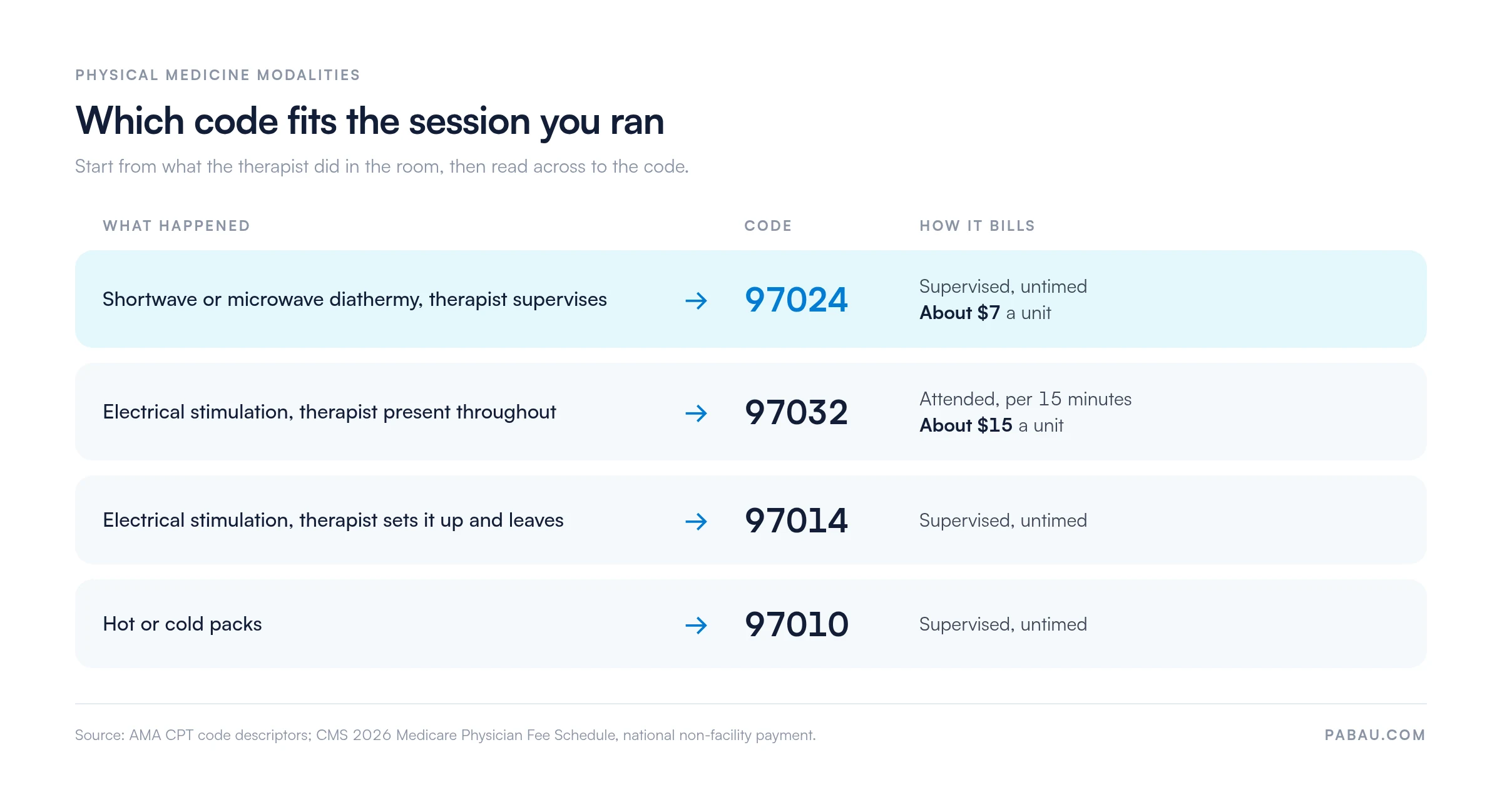
97024 and 97032 are the two most frequently confused physical therapy modality codes. 97024 is supervised and untimed; 97032 (electrical stimulation, attended) requires the therapist to be present throughout and is billed per 15-minute interval.
The clinical and billing risk runs in one direction. Billing 97032 when the therapist was not in constant attendance constitutes upcoding. If the therapist set up electrical stimulation and walked out, that is 97014 (unattended e-stim), not 97032.
Diathermy runs the other way. Even if the therapist stays in the room making adjustments throughout, 97024 is still the correct code, because diathermy is a supervised modality by definition. Read the session from what the therapist did, as the chart below lays out.
The supervised (non-timed) modality family runs from CPT 97010 to 97028. Knowing where CPT code 97024 sits within this family prevents wrong-code errors and helps practices understand why these codes cluster on the same claim.
NCCI edit pairs affect many of these codes when billed together on the same date to the same body area. Billing 97010 (hot packs) and 97024 (diathermy) to the same lumbar region on the same day may trigger a bundling edit. That depends on the current quarterly NCCI table. Use modifier 59 only when you can document that the two modalities were applied to genuinely distinct areas. Do not attach modifier 59 simply to override the edit without clinical justification.
Diathermy contraindications carry billing and audit risk as well as clinical risk. Auditors reviewing 97024 claims look specifically for evidence that the therapist screened for contraindications before applying the modality. A record that documents diathermy without any contraindication screening notation is a liability on retrospective review.
Add a contraindication checklist to every diathermy treatment note. This protects the patient and creates a contemporaneous audit trail showing that safe practice standards were followed at the time of treatment.
A well-structured denial management workflow catches these problems before the claim goes out. The table below maps the most common 97024 denial reasons to their upstream documentation or coding failures, with the prevention action for each.
Pabau, the practice management platform we build, supports US insurance billing through Claim.MD (CMS-1500/837P claims, eligibility checks, ERA remittances). That helps catch eligibility and payer issues before submission. Check modifier and coding choices in your own workflow. For historic denials, the guide to medical billing denial codes explains how to read CARC reason codes on the ERA.
Traditional Medicare does not require prior authorization for CPT code 97024. Commercial and Medicare Advantage payers differ. Many managed-care plans require PA for all outpatient physical therapy modalities, including diathermy. That is especially common when treatment is expected to run past the plan’s routine authorization window, often 10-12 visits.
When a commercial payer requires PA for 97024, the submission typically includes:
Some payers also require the therapist’s credentials and the supervising physician’s name. Refer to your medical billing compliance protocols for payer-specific PA documentation checklists.
Verify prior authorization requirements before the first visit, not at billing. Call the payer or use a real-time eligibility tool to confirm whether PA is needed for 97024 under the patient’s specific plan. A PA obtained after treatment has already started rarely retroactively covers services already delivered.
When diathermy is charted in one system and billed from another, the note, the plan of care and the claim drift apart. A denial then sends someone digging through both to find what the payer wanted.
In Pabau, treatment notes, digital forms and invoices sit on the same patient record. Its claims management software sends US claims through Claim.MD as CMS-1500/837P claims. Eligibility checks and ERA remittances run in the same system.
Prior authorization is tracked on the patient’s case, with the auth code, dates and sessions recorded and a warning when one is missing. That covers the Medicare Advantage and commercial plans that require PA for 97024, so a visit is not billed against an authorization nobody obtained.

Pabau keeps treatment notes, prior authorizations and Claim.MD claims on the same patient record. Your team can trace each 97024 claim from the visit to the remittance.

CPT code 97024 is one of the lower-reimbursing codes in physical therapy, yet incomplete documentation gives it more audit exposure than its payment suggests. Treat the diathermy note as the claim’s defense. Name the body area, the modality, the rationale and the contraindication screen on every visit, and the code stops being a write-off risk.
Pabau’s claims management software supports US insurance billing through Claim.MD, with eligibility checks and ERA remittances. Your billing team can then review denials in one place. Book a demo to see how Pabau handles physical therapy claims from the visit to the remittance.

Billing therapeutic ultrasound in the same plan of care? CPT code 97035 covers the timed ultrasound code that diathermy is often confused with.
Want to understand how the claims process works end to end? Medical billing fundamentals covers the full revenue cycle from patient encounter to payment posting.
Set up e-stim and stepped out of the room? CPT code 97014 covers unattended electrical stimulation and how it bills.
CPT code 97024 is the AMA procedure code for the application of diathermy. This supervised physical therapy modality delivers deep heat to a body area through shortwave or microwave energy. It is an untimed code in the supervised modalities family (97010-97028), billed once per date of service. The therapist does not need to be in constant attendance.
97024 is an untimed code. The 8-minute/15-minute timed billing rule does not apply. Bill 97024 once per date of service — the code covers one or more areas, so two areas treated in one session are still one unit.
Yes, for shortwave diathermy. Medicare Part B covers 97024 when the service is medically necessary, included in a plan of care, and billed with the GP modifier. Contractor policy such as LCD L33631 states that microwave is not a covered service. Check your MAC’s policy before billing microwave diathermy, and before treating diagnoses its LCD may restrict.
The national average Medicare fee-schedule rate for 97024 is approximately $7 per unit. That rate is not a coverage promise, since contractor policy may exclude microwave diathermy. The exact amount varies by geographic locality and changes annually with the Medicare Physician Fee Schedule. Verify the current rate using the CMS fee schedule look-up tool for your specific jurisdiction.
The GP modifier is required on Medicare outpatient physical therapy claims for 97024. Use GN when a speech-language pathologist provides the service, GO when an occupational therapist provides it. Modifier 59 applies when billing 97024 alongside another modality to a genuinely distinct body area on the same date, with current NCCI edit guidance verified.
97024 (diathermy) is a supervised, untimed code, billed once per date of service, that does not require constant therapist attendance. 97032 (electrical stimulation, attended) requires the therapist to remain present throughout and is billed per 15-minute interval. Billing 97032 when the therapist was not in constant attendance constitutes upcoding.
Traditional Medicare does not require prior authorization for 97024. Many commercial payers and Medicare Advantage plans do require PA, particularly for extended treatment courses. Verify prior authorization requirements per payer before the first treatment visit.