ICD-10 code I21.4: Non-ST elevation myocardial infarction
ICD-10 code I21.4: Official descriptor and code details ICD-10 code I21.4 is a v...

Last Updated: Nov 10, 2026
Billable Code Specific Code
M54.50 is the billable ICD-10-CM code for low back pain, unspecified. It covers lumbar pain when the record names no cause, such as lumbago NOS at a first visit before imaging.
The code sits in the M54.5 group with M54.51, vertebrogenic low back pain, and M54.59, other low back pain. Move to one of those, or to a disc or sciatica code, once the notes document the source.
Let Pabau's smart automation suggest the right codes, reduce claim denials, and keep your practice compliant—effortlessly.
Automate repetitive tasks and focus on what matters most—your patients.
Reduce coding errors and ensure compliance with the latest regulations.
Clean claims, fewer denials, and faster reimbursements.
Powerful insights and reporting to help your practice thrive.
HIPAA compliant SOC 2 certified GDPR-compliant Trusted by 4,000+ clinics worldwide

M54.50 is the billable ICD-10-CM code for low back pain with no documented cause, and it is valid in both FY2026 and FY2027.
The bare code M54.5 was deleted on October 1, 2021, so a claim that still carries it is rejected as invalid.
Sciatica, disc displacement, discogenic disc degeneration and low back strain are Excludes1 conditions, so each one replaces M54.50.
The note should record onset, location, a pain score, functional limitation, prior treatment and imaging status, plus why the code is unspecified.
Pabau’s claims management software sends claims through the Claim.MD clearinghouse, with eligibility checks and remittances posted to the patient record.
ICD-10 Code M54.50 is the billable ICD-10-CM diagnosis code for low back pain, unspecified. It sits in Chapter 13, Diseases of the musculoskeletal system and connective tissue (M00-M99), under category M54, Dorsalgia.
The ICD-10-CM index sends the term “lumbago NOS” to M54.50. Coders use it when a patient has lower back pain and the record names no more specific cause.
M54.50 exists because CMS deleted the parent code M54.5 on October 1, 2021, in the FY2022 update. Three billable codes replaced it: M54.50, M54.51 and M54.59. A claim that still carries the bare M54.5 fails as an invalid code.
M54.50 applies to low back pain when the record documents no structural or pathological cause. The pain may be dull, aching or sharp. It stays in the lower back, with no confirmed disc, vertebral or nerve root finding behind it.
The M54.5 group carries Excludes1 notes that coders must check before assigning the code. An Excludes1 note means the excluded condition is never coded alongside M54.50. When the record documents one, its code replaces M54.50.
Taken together, the M54.5 group and its exclusions turn on one question: what does the note document as the source of the pain? The chart below maps each finding to its code.
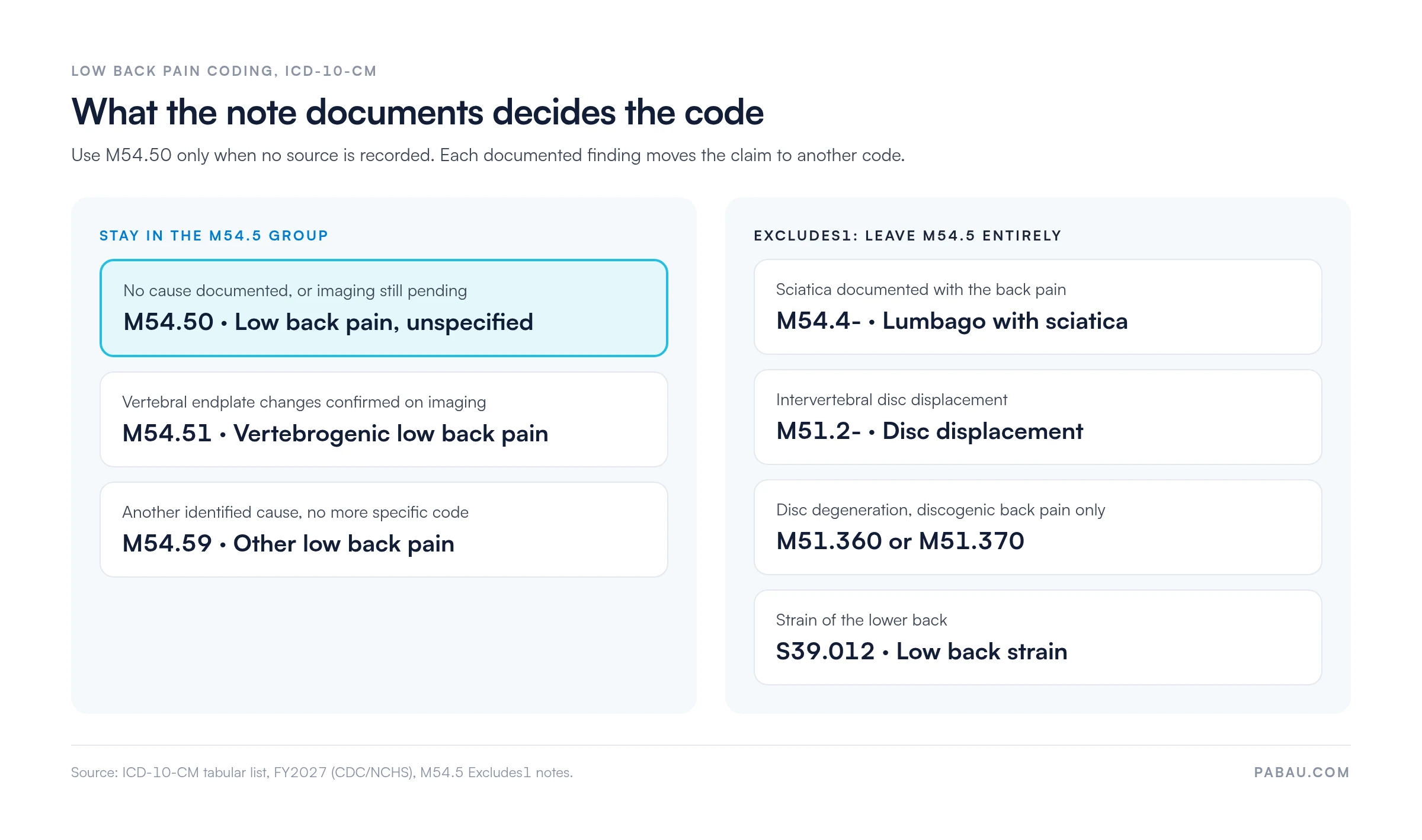
These three codes replaced the retired M54.5, and coders often confuse them. M54.50 applies when no cause is identified. M54.51 needs imaging that shows vertebral endplate changes as the pain source. M54.59 applies when a cause is identified but is neither vertebrogenic nor covered by a more specific code.
Practical rule: Start with M54.50 at the first visit when imaging is pending or not ordered. If imaging then confirms vertebral endplate pathology, move to M54.51. If the workup finds another cause with no disc (M51) or spondylosis (M47) code, move to M54.59. A claim that keeps M54.50 after the notes support a more specific code is open to denial on review.
Several musculoskeletal and nerve codes sit close to M54.50 in both clinical presentation and the code hierarchy. A wrong choice here leads to denials, audit flags and medical necessity disputes.
Run a quarterly check on M54.50 claims where imaging was ordered at the same encounter. If the report confirmed vertebral endplate pathology but the code stayed M54.50, correct it before a payer review finds it. A rule that sends every M54.50 claim with an imaging order to coder review catches these before submission.
Medical necessity for M54.50 rests on what the clinical note contains. Payers, including Medicare Advantage plans, deny claims when key elements are missing. A note that says only “back pain” does not support the services billed.
These elements should appear in the note to support M54.50 on audit:
The last element protects the claim on review. Suppose the note shows imaging with clear vertebral pathology and the code is still M54.50. The payer can then deny the claim or recover the payment on audit.
M54.50 pairs with a range of procedure codes, depending on the specialty and the visit type. The table below lists CPT codes often billed with it for low back pain. Prior authorization rules differ by payer, so check the plan before the visit.
Lumbar MRI is the pairing most likely to need prior authorization. Most payers want documented conservative care before they approve imaging for unspecified low back pain.
Coverage requirements for M54.50 vary by payer, plan type and MAC jurisdiction. The patterns below are common, but always check the LCD or payer policy that governs the patient’s plan.
Check each payer’s rules as part of your medical billing compliance process, before therapy or imaging is booked. Authorization denials are far easier to prevent than to appeal.
Before ordering a lumbar MRI with M54.50 as the primary diagnosis, check whether the payer requires 4-6 weeks of documented conservative care. Many commercial plans and Medicare Advantage products apply step therapy to imaging for unspecified low back pain. A denied MRI authorization delays the workup and leaves the patient waiting.
Low back pain is among the highest-volume diagnoses in outpatient billing, which puts it high on payers’ review lists. The denial reasons below come up most often on M54.50 claims. Each one returns with a claim adjustment reason code, and our guide to denial codes in billing explains how to read them.
A denial management workflow that sorts M54.50 rejections by reason code shows which problems repeat, so you fix the cause once. A clean claim check on the diagnosis code, modifiers and documentation before transmission keeps them off the denial list.
M54.50 is a common diagnosis on both physical therapy and chiropractic claims. The billing rules for each specialty differ in ways that affect payment.
M54.50 is an appropriate primary diagnosis for PT evaluations (97161-97163) and treatment codes such as 97110. Medicare dropped functional reporting G-codes in 2020, but the plan of care still needs measurable functional goals.
Once a patient’s therapy spending for the year passes the KX modifier threshold, each claim needs the KX modifier to confirm medical necessity. Spending well above that threshold can trigger targeted medical review.
Medicare covers chiropractic manipulation (98940-98942) only for active, corrective treatment of a spinal subluxation. The subluxation code, such as M99.03 for the lumbar region, is listed first, and M54.50 can support it as a secondary diagnosis. Each claim carries the AT modifier to show active treatment.
Once the patient reaches a maintenance plateau, Medicare stops paying for manipulation, whatever the ongoing diagnosis. Commercial payers often limit visits per episode, and some require authorization after the first evaluation.
M54.50 is active and billable in the FY2027 ICD-10-CM code set, in effect since October 1, 2026. The FY2027 update made no change to M54.50, M54.51 or M54.59, and no descriptor or guideline change affects the group.
The code was equally valid through FY2026, which ran from October 1, 2025 to September 30, 2026. The CDC/NCHS ICD-10-CM browser tool shows its current status.
The key historical change is the deletion of M54.5 on October 1, 2021. It no longer appears in the valid code list and can’t be billed. Clearinghouse edits usually reject an invalid code before adjudication. The rejection comes back faster, but the claim still needs manual correction and resubmission.
Any EHR or billing system not updated since FY2022 may still hold M54.5 in order sets or favorites. Removing those saved codes is a one-time fix that stops a steady stream of rejections.
Most M54.50 denials trace back to the note: a missing pain score, an imaging result nobody coded, or a code left unspecified after the workup. When the coder works from a re-keyed summary, those problems surface only when the payer responds.
Pabau, the practice management platform we build, keeps the clinical note and the claim in one record. Its claims management software sends US claims through the Claim.MD clearinghouse as CMS-1500/837P files. It also runs eligibility checks and posts ERA remittances back to the patient record.
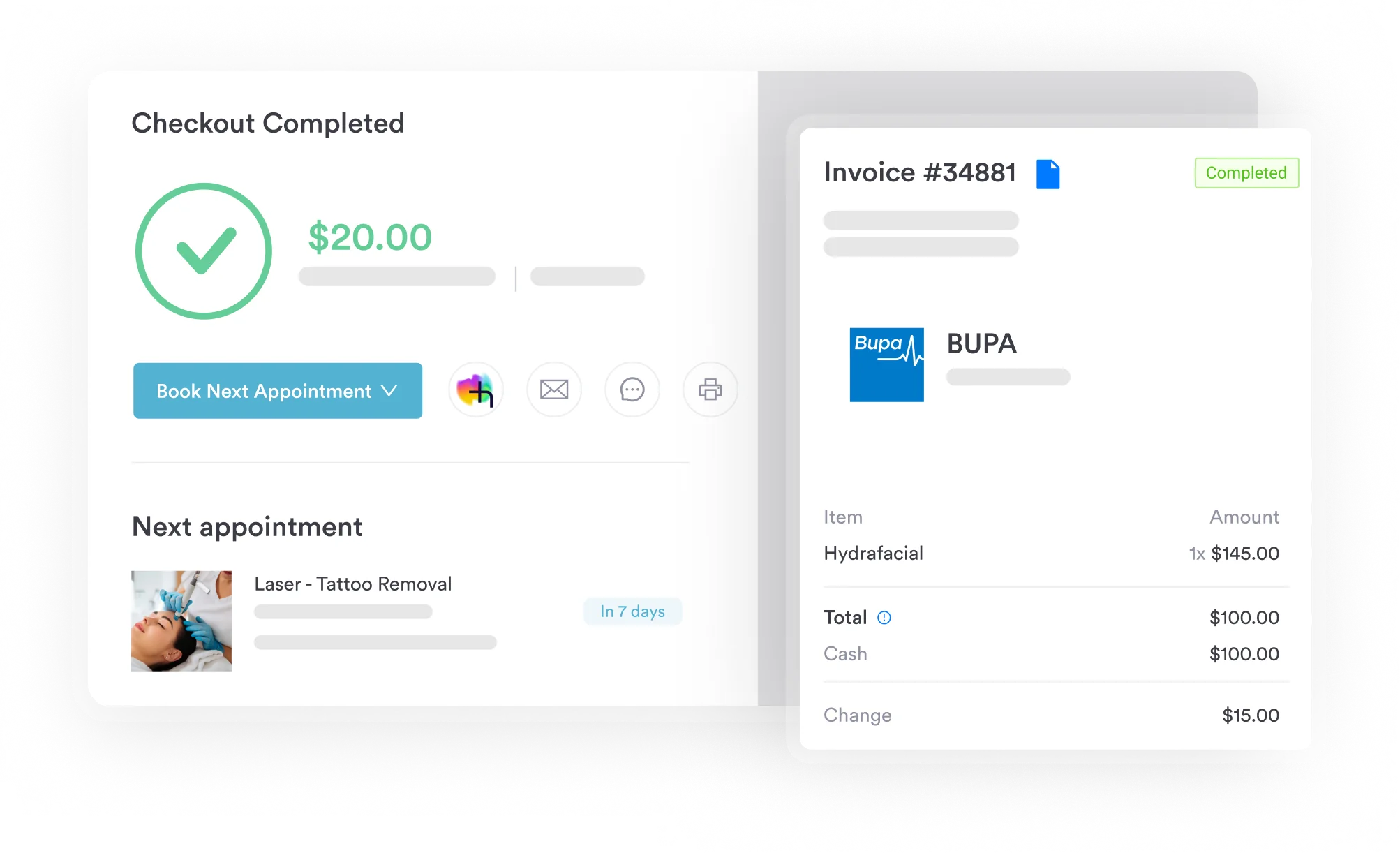
Prior authorization codes, dates and sessions sit on the patient’s case, with a warning when one is missing. That matters for physical therapy and chiropractic practices, which bill M54.50 against authorized visit counts. Denials by payer then feed the practice’s revenue cycle management reporting, so recurring problems get fixed at the source.

Pabau’s claims management software sends claims through the Claim.MD clearinghouse, checks eligibility, and tracks prior authorizations on each case. See how it keeps M54.50 claims clean the first time.

M54.50 is the right code at the start of a low back pain workup and the wrong one once the record names a cause. Treat it as a placeholder with an expiry date. Every imaging report, sciatica finding or disc diagnosis should prompt a code review before the next claim goes out.
Two habits keep M54.50 claims paid: recording why the code is unspecified, and retiring it once the notes support a more specific code. Book a demo to see how Pabau ties each clinical note to its claim, so the code changes when the diagnosis does.

Billing the physical therapy evaluation? CPT code 97161 covers the low-complexity PT evaluation often paired with M54.50.
Treating low back pain with spinal manipulation? CPT code 98940 sets out the chiropractic manipulation code and its Medicare rules.
ICD-10 Code M54.50 is the billable ICD-10-CM code for low back pain, unspecified. It covers lumbar pain with no documented structural or pathological cause. The code sits in Chapter 13 (M00-M99) under category M54, Dorsalgia. It replaced the deleted code M54.5 on October 1, 2021.
Use M54.50 when the clinical documentation identifies no structural cause for the low back pain. Use M54.51 when imaging confirms vertebral endplate (Modic) changes as the pain source. Use M54.59 when a non-vertebrogenic cause is identified and no more specific code captures it. The documentation in the note drives the code choice.
Yes. M54.50 was valid throughout FY2026 and remains active in the FY2027 code set, which took effect on October 1, 2026. Neither update changed its descriptor or the guidelines for the M54.5 group. Medicare still requires documentation that meets the applicable MAC’s LCD for the services billed.
Yes, clinically. The ICD-10-CM index sends “lumbago NOS” to M54.50, and vertebrogenic low back pain to M54.51. Lumbago is the traditional clinical term for nonspecific lower back pain. Lumbago with sciatica has its own codes, in M54.4-.
Yes. M54.50 is an appropriate primary diagnosis for physical therapy evaluations and treatment. Medicare requires a plan of care with measurable functional goals, plus the KX modifier once spending passes the annual threshold. Commercial plans may require a physician referral and limit visits per episode. Check the payer’s policy before the first visit.
The most common reason is missing medical necessity detail, such as a severity score, functional limitation or prior treatment. Others are use of the deleted M54.5 code, and billing M54.50 when the notes support M54.51 or a disc code. Payers also reject M54.50 billed with an Excludes1 code such as M54.4-, and duplicate claims.