CCSD code E2940: Partial laryngectomy billing guide
CCSD code E2940: what the code covers CCSD code E2940 is the procedure code for ...

Last Updated: Oct 15, 2026
A4429 is the HCPCS Level II code for ostomy pouch, urinary, with barrier attached, with built-in convexity, with faucet-type tap with valve (1 piece), each. It describes a one-piece urostomy pouch with a convex skin barrier built in and a drain tap at the base, billed per pouch.
The barrier decides the code. An extended wear convex barrier makes the pouch A4430, and a flat barrier makes it A4431. Medicare covers A4429 as a prosthetic device under LCD L33828, up to 20 pouches a month.
Let Pabau's smart automation suggest the right codes, reduce claim denials, and keep your practice compliant—effortlessly.
Automate repetitive tasks and focus on what matters most—your patients.
Reduce coding errors and ensure compliance with the latest regulations.
Clean claims, fewer denials, and faster reimbursements.
Powerful insights and reporting to help your practice thrive.
HIPAA compliant SOC 2 certified GDPR-compliant Trusted by 4,000+ clinics worldwide

HCPCS code A4429 bills one one-piece urinary ostomy pouch with an attached barrier, built-in convexity and a faucet-type drain tap.
Convexity separates A4429 from A4431, and an extended wear barrier moves a convex one-piece urinary pouch to A4430.
Medicare covers ostomy supplies as prosthetic devices under Social Security Act section 1861(s)(8), following LCD L33828 and policy article A52487.
LCD L33828 sets the usual maximum for A4429 at 20 pouches a month, and a higher quantity needs support in the medical record.
Policy article A52487 lists only two urinary diagnosis codes, Z93.6 and Z43.6, so cystostomy codes Z93.50 to Z93.59 do not support the claim.
HCPCS code A4429 is the Level II code for a one-piece urinary ostomy pouch with an attached barrier, built-in convexity and a faucet-type tap. Suppliers bill it per pouch to the DME MAC under the Medicare ostomy supplies policy.
The official long descriptor reads: Ostomy pouch, urinary, with barrier attached, with built-in convexity, with faucet-type tap with valve (1 piece), each. Check the wording against the CMS HCPCS Level II code file when each annual update is released.
The descriptor leaves out wear time, and that omission matters. A convex one-piece urinary pouch with an extended wear barrier is A4430, not A4429.
The urinary pouch codes run from A4428 to A4434. Three features separate them: the barrier wear rating, built-in convexity, and whether the system is one-piece or two-piece. Drainable pouches for a colostomy or ileostomy, such as A4424 to A4427, are a separate family, so a urostomy pouch never belongs there.
Three questions settle the code. First, is the barrier part of the pouch? If it is not, the system is two-piece and belongs to A4432, A4433 or A4434.
Second, does the attached barrier have built-in convexity? A flat barrier points to A4428 or A4431, and a convex one points to A4429 or A4430. Third, is that convex barrier rated extended wear? If so, the pouch is A4430. If not, it is A4429.
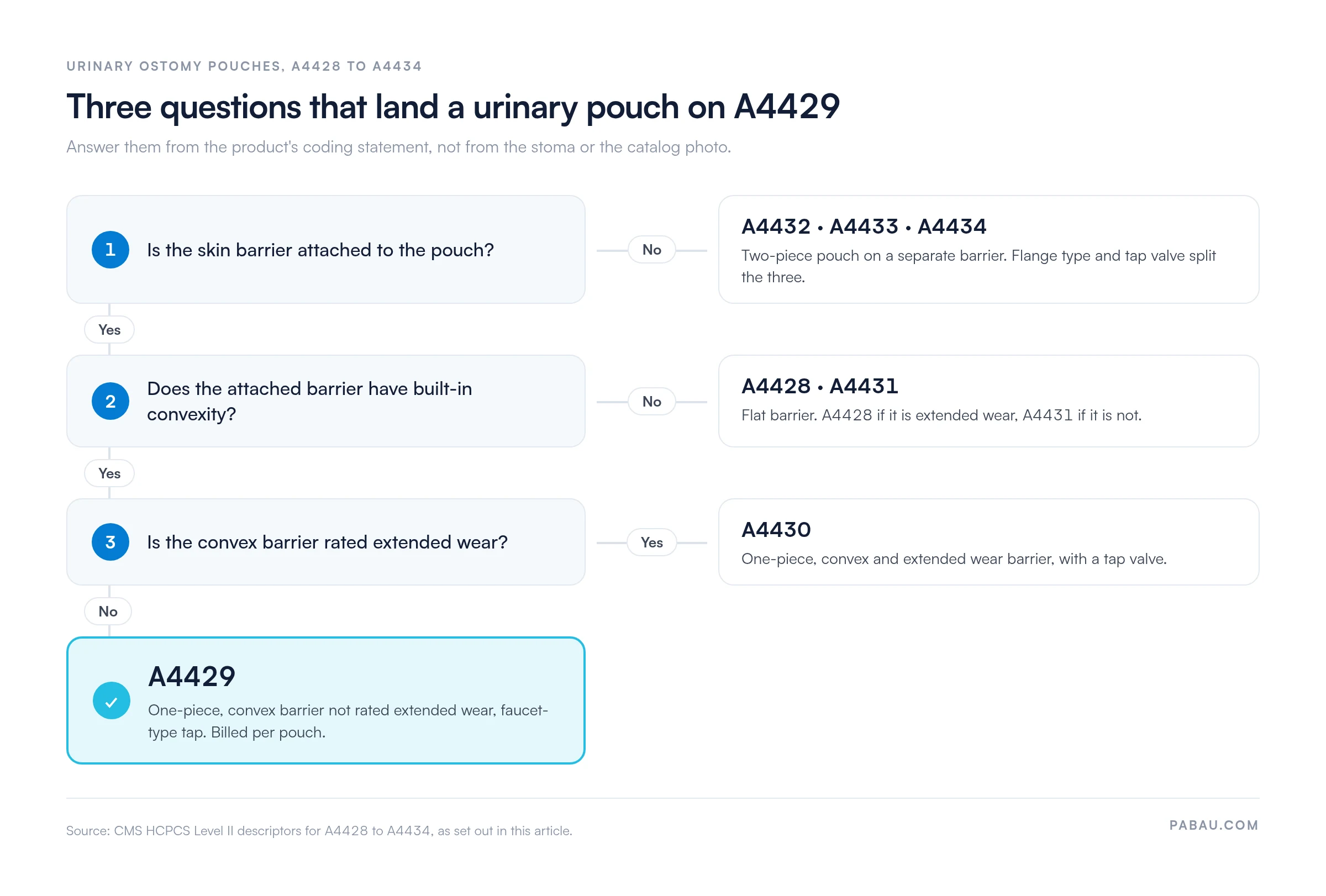
Two convex pouches can look alike on a packing list and still carry different codes. Read the manufacturer’s HCPCS coding statement for the exact product before the first claim.
Medicare Part B covers A4429 under the prosthetic device benefit in Social Security Act section 1861(s)(8). It is not covered as durable medical equipment under section 1861(s)(6), even though the DME MACs process the claims.
Coverage follows LCD L33828 (Ostomy Supplies) and its companion policy article A52487. All four DME MAC jurisdictions apply the same policy.
An A4429 claim meets the coverage criteria when these points hold:
LCD L33828 sets the usual maximum for A4429 at 20 pouches per month. The LCD ties quantity to the type of ostomy, its location and construction, and the condition of the skin around the stoma.
A higher quantity needs a clear explanation in the medical record. Units above 20 without that support are denied as not reasonable and necessary.
Shipment size is capped as well. A nursing facility resident may receive one month of supplies at a time. A beneficiary at home may receive up to three months.
Medicare Part B does not require prior authorization for A4429. Other payers set their own rules, so confirm each one before you dispense.
Policy article A52487 lists ten ICD-10-CM codes that support medical necessity for ostomy supplies. Only two describe a urinary diversion, and those are the codes an A4429 line carries.
The policy article also states that a listed code alone does not assure coverage. The underlying condition does not belong on the line by itself either. Bladder cancer, for example, is absent from the list, so a claim that carries only C67.9 invites a medical necessity denial.
Every A4429 claim rests on records that a DME MAC reviewer can follow without follow-up questions. A structured billing compliance routine keeps these items in the supplier’s file:
Ostomy supplies need no Certificate of Medical Necessity. CMS retired CMNs and DME information forms for claims with dates of service on or after January 1, 2023.
Audit five random A4429 claim files each quarter. Confirm each one has a complete standard written order, a Z93.6 or Z43.6 diagnosis, a logged refill request and a proof of delivery record. Finding a missing record internally costs far less than answering a post-payment review.
Medicare pays A4429 from the CMS DMEPOS fee schedule, not the Physician Fee Schedule. The code carries no relative value units, so a physician fee schedule lookup shows no rate for it.
Allowed amounts are published by state, with rural and non-rural columns, and CMS updates the file each quarter. The beneficiary’s permanent residence decides which amount applies.
No competitive bidding contract covers ostomy supplies today. CMS’s November 2025 final rule adds ostomy supplies to the next round as remote item delivery contracts, currently expected to start in 2028.
The steps below follow the standard DME MAC workflow for a Medicare Part B claim.
LCD L33828 and policy article A52487 set no KX modifier requirement for ostomy pouches, so a claim is not denied for leaving KX off. The only modifier the policy article names is AU, and it applies to three accessory codes rather than to A4429.
Most A4429 denials come from a short list of preventable errors. A steady denial management process catches them before the claim goes out.
The reason codes on the remittance advice point to the specific error. Map them with this guide to denial codes in medical billing before you correct and resubmit.
Medicare fee-for-service appeals run through five levels. Most A4429 appeals end at the first level, once the missing order, diagnosis or refill record is supplied.
Track each deadline per claim. A missed filing window forfeits the appeal at that level.
An A4429 claim draws on records that often sit in different places. The order arrives by fax, delivery receipts live in the shipping system, and refill calls get noted wherever the caller had a screen open.
Pabau, the practice management and billing platform we build, keeps those records on one patient file. The signed order, intake forms, clinical notes and diagnosis sit together, so pulling a year of documentation for a review takes one search.
Pabau’s claims management software sends each claim and tracks its status through to the remittance. A denial shows up while the refill cycle is still open, so you fix the record before the next shipment.

Pabau keeps orders, diagnoses and refill records on one patient file and tracks each claim to payment, so denials surface before the next shipment.

The pouch in hand and its manufacturer’s coding statement settle the code. A one-piece urinary pouch with a convex barrier that is not extended wear is A4429. Make that barrier extended wear and the code becomes A4430, and flatten it and the code becomes A4431.
Pair the line with Z93.6 or Z43.6, keep to 20 pouches a month unless the record explains more, and log each refill request. A claim built that way rarely reaches an appeal. Book a demo to see how Pabau keeps urinary ostomy supply orders, records and claims on one patient file.

Need to understand the full medical billing picture? What is medical billing covers the end-to-end revenue cycle workflow from patient encounter to payment posting.
Dealing with recurring claim rejections? Denial management in healthcare explains how to build a structured denial resolution process that reduces re-submission time.
Want to strengthen your DMEPOS compliance posture? Medical billing compliance outlines the documentation and audit-readiness standards that protect suppliers from recoupment.
Coding a flat-barrier pouch instead? HCPCS code A4428 covers the one-piece urinary pouch with an extended wear flat barrier.
Is the barrier a separate piece? HCPCS code A4432 explains how two-piece urinary pouches on a non-locking flange are billed.
A4429 is the HCPCS Level II code for a one-piece urinary ostomy pouch with an attached barrier, built-in convexity and a faucet-type tap with valve. It is billed per pouch. Medicare covers it under the prosthetic device benefit for a beneficiary with a permanent urinary stoma.
Medicare Part B does not require prior authorization for A4429. Medicare Advantage plans, state Medicaid programs and commercial payers set their own rules. Confirm each payer’s policy before you dispense.
The usual cause is a product that matches A4428, A4430 or A4431 instead, or more than 20 units in a month without support. A diagnosis outside the A52487 list, an incomplete order or a missing refill request also cause denials. Read the reason codes on the remittance, then correct the claim or request redetermination within 120 days.
You need a standard written order on file before billing, and medical records that show a permanent urinary stoma. Add a covered diagnosis code, proof of delivery and a documented refill request for each shipment. Ostomy supplies need no Certificate of Medical Necessity, and records are kept for seven years.
LCD L33828 sets the usual maximum for A4429 at 20 pouches per month. A higher quantity is covered only when the medical record explains the clinical need. Each shipment is capped at one month of supplies in a nursing facility and three months at home.