CCSD code E2940: Partial laryngectomy billing guide
CCSD code E2940: what the code covers CCSD code E2940 is the procedure code for ...

Last Updated: Oct 15, 2026
A4470 is the HCPCS Level II code for the Gravlee jet washer, a single-use device that collects endometrial cells for cytology.
Medicare's national coverage policy, NCD 230.5, covers the washer when a patient has signs of endometrial disease, such as irregular or heavy bleeding. Screening a patient without symptoms is excluded by statute. Medicare doesn't price A4470 separately, and claims submitted without the right modifier or documentation are often denied.
Let Pabau's smart automation suggest the right codes, reduce claim denials, and keep your practice compliant—effortlessly.
Automate repetitive tasks and focus on what matters most—your patients.
Reduce coding errors and ensure compliance with the latest regulations.
Clean claims, fewer denials, and faster reimbursements.
Powerful insights and reporting to help your practice thrive.
HIPAA compliant SOC 2 certified GDPR-compliant Trusted by 4,000+ clinics worldwide

HCPCS code A4470 describes the Gravlee jet washer, an A-series medical supply code used to collect endometrial cells for cytology.
Medicare covers the washer under NCD 230.5 only for patients with symptoms of endometrial disease, while Medicaid and commercial coverage varies by payer.
Claims submitted without the right modifier or documentation are often denied, as are claims that lack medical necessity or carry the wrong place of service.
Pabau’s claims management software helps ob-gyn practices submit and track claims and spot rejections early.
HCPCS code A4470 is the Level II code assigned to the Gravlee jet washer, a single-use gynecological supply device. It belongs to the A-series of HCPCS codes (A0000-A9999), which covers transportation services and medical and surgical supplies. The Centers for Medicare and Medicaid Services (CMS) maintains the range as part of the Healthcare Common Procedure Coding System.
The code is active in the 2026 HCPCS code set. Use the reference table below to confirm the core code attributes before billing.
Within the A-series, A4470 falls in the medical and surgical supplies range. It describes a single-use procedure supply, not durable medical equipment (DME) meant for use at home.
The Gravlee jet washer is a disposable device designed for endometrial lavage and sampling. It is inserted into the uterine cavity, where a fluid jet dislodges endometrial cells, which are then collected for cytological analysis. The procedure supports diagnostic evaluation without surgical entry into the uterine cavity.
The device is used in ob-gyn offices, gynecologic oncology practices, and outpatient women’s health centers. Its main clinical applications are:
The washer is consumed during the procedure, so A4470 identifies it as a supply, separate from the procedure code such as CPT 58100. Separate A4470 reimbursement depends on payer policy, and many payers bundle the supply into 58100.
Medicare covers the Gravlee jet washer under a national coverage determination, NCD 230.5, when the patient has symptoms or signs of endometrial disease. Irregular or heavy vaginal bleeding is the example the policy gives. Medicare won’t pay for the washer, or the related diagnostic services, when it’s used to examine an asymptomatic patient. That limit is the statutory exclusion for routine checkups in §1862(a)(7) of the Social Security Act.
The CMS HCPCS file gives A4470 coverage code D, meaning special coverage instructions apply. The same NCD wording governs the Vabra aspirator, billed under A4480.
Before billing, confirm with the Medicare Administrative Contractor (MAC) for your jurisdiction how it applies NCD 230.5. MACs can differ on the documentation they expect and on how they process a supply line that carries no separate price.
Medicaid coverage for A4470 is jurisdiction-specific. State programs set their own fee schedules for supply codes, and some states exclude gynecological supply codes from Medicaid reimbursement entirely. Always verify against the specific state Medicaid fee schedule rather than assuming coverage by analogy with another state.
Medicare publishes no payment allowance for HCPCS code A4470. The CMS HCPCS file gives it pricing indicator 00, which means the code isn’t separately priced under the Part B fee schedules. Ask your MAC how it handles the supply line before you bill it.
For commercial payers that do cover A4470, reimbursement rates are contract-specific and are not published in a public schedule. Contact each payer’s provider relations team or consult your contract fee schedule to determine the allowed amount.
To check the pricing indicator and coverage code for any HCPCS code, use the CMS HCPCS quarterly update files or the AAPC HCPCS code lookup. Both reflect each update. Indicators and rates can change each January 1, so verify before billing in a new plan year.
Accurate billing for HCPCS code A4470 requires documentation that connects the device to a specific clinical service. Without this link, payers have no basis for coverage review and will deny the claim on medical necessity grounds. Good medical billing compliance practices start with documentation quality before the claim is submitted.
Follow these steps to build a clean claim:
Modifier selection depends on why you expect the claim to be denied. A statutory exclusion takes one modifier, and a medical-necessity concern takes another.
For Medicare, the choice follows the reason for the expected denial. Use GY when the washer screened a patient without symptoms, because that use is excluded by statute. Use GA (ABN on file) or GZ (no ABN) when the patient has symptoms but you expect Medicare to question medical necessity. The diagram below maps the three paths.
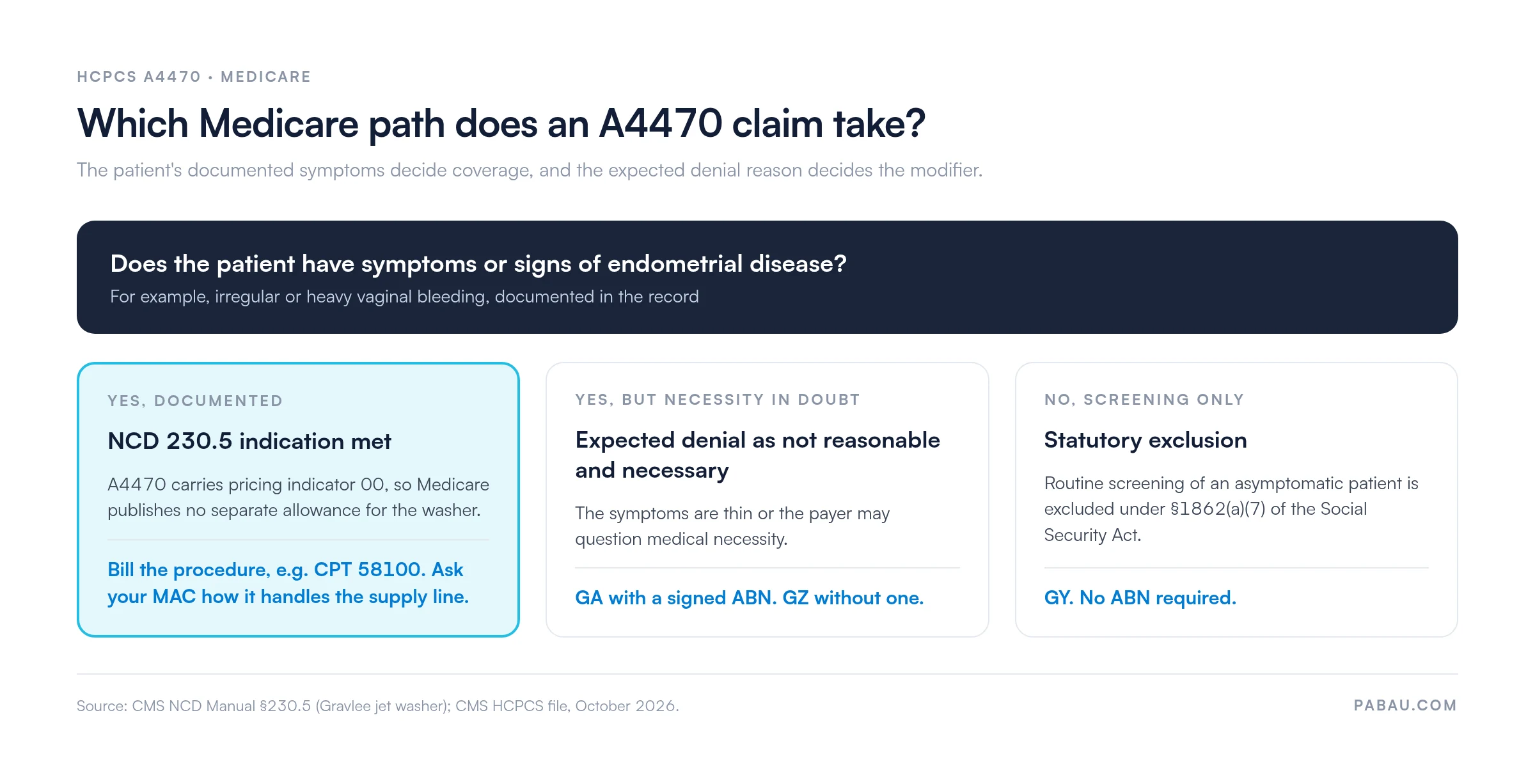
Before billing A4470 to Medicare, check the patient’s documented symptoms against NCD 230.5. Irregular or heavy bleeding meets the indication. For a screening use, append GY. Use GA or GZ when you expect a medical-necessity denial. Applying KX without a payer policy that calls for it creates false-claim risk.
A4470 sits within a sequence of A-series supply codes. Coders sometimes assign an adjacent code or a procedure code that bundles the supply, creating overpayment risk or denials. The table below maps out the most relevant adjacent codes.
One misassignment to avoid is using A9270 in place of A4470. A9270 is appropriate only when no specific HCPCS code exists for the item. Since A4470 is the designated code for this device, using A9270 is incorrect and may delay reimbursement from payers who do cover the supply. Use the PGM Billing HCPCS lookup tool to verify code assignments before submitting.
Denials on HCPCS code A4470 cluster around a few recurring causes. The CARC (Claim Adjustment Reason Code) or RARC (Remittance Advice Remark Code) on the remittance points to the fix. Our guide to denial codes in medical billing explains each one, and structured denial management strategies speed up resubmission.
Tracking denials by CARC over a rolling 90 days shows whether one payer is systematically denying A4470. Isolated errors look different, and that distinction determines whether the fix is a documentation change or a payer policy appeal.
HCPCS code A4470 turns up rarely in an ob-gyn billing queue, so its modifier and documentation rules are easy to forget between claims. Claims management software keeps each claim visible from submission to payment, so your team can fix a rejection while the encounter is still fresh.
In Pabau, the practice management platform we build, claims are submitted from the data already recorded for the encounter. Pabau’s claims management helps ob-gyn practices submit and track claims and spot rejections early. Your coder still chooses A4470 and its modifier, so the checks in this guide stay part of the routine.
Many practices bill A4470 alongside a long list of gynecological procedure codes. For them, one view of claim status across the medical billing workflow shows whether rejections cluster around one payer or one code.

Pabau’s claims management helps ob-gyn practices submit and track claims and spot rejections early, so your billing team spends less time chasing appeals.

HCPCS code A4470 turns on one question before any other: does the record show symptoms of endometrial disease? If it does, NCD 230.5 is met. If the washer was used for screening, Medicare excludes it, and GY tells the payer you know that.
Don’t expect a Medicare payment for the washer itself, since A4470 isn’t separately priced. Put the effort into the documentation and modifier that keep the claim clean. Book a demo to see how Pabau helps ob-gyn practices submit, track and resolve claims like these.

Need a complete picture of denial patterns in your ob-gyn practice? Denial management in healthcare walks through the CARC/RARC framework and how to build a systematic appeals process.
Billing a different endometrial sampling device? HCPCS code A4480 covers the Vabra aspirator and the national coverage policy behind it.
Coding the sampling procedure itself? CPT code 58100 explains how to bill an endometrial biopsy.
Want to understand how supply codes fit into the broader billing picture? Medical billing workflows explained covers the end-to-end process from encounter to payment posting.
HCPCS code A4470 is used to bill for the Gravlee jet washer. It is a disposable supply device used during endometrial lavage and sampling procedures. The code identifies the supply separately from the procedure CPT code billed for the clinical service.
Yes, when the patient has symptoms or signs of endometrial disease, such as irregular or heavy vaginal bleeding. NCD 230.5 sets that rule, and Medicare excludes the washer when it’s used to screen an asymptomatic patient. Verify with your MAC before billing, and use modifier GY for a screening use.
Medicare publishes no payment allowance for A4470. The CMS HCPCS file gives it pricing indicator 00, so the code isn’t separately priced under the Part B fee schedules. Commercial payer rates are contract-specific and not published. Check your payer contract, or ask provider relations and your MAC, before billing.
Required documentation includes a signed physician order, a procedure note confirming the device was used with a recorded clinical indication, and a supporting diagnosis code. If the payer requires prior authorization, obtain it before the procedure. The claim must also show the correct place-of-service code and quantity units.