CCSD code E2940: Partial laryngectomy billing guide
CCSD code E2940: what the code covers CCSD code E2940 is the procedure code for ...

Last Updated: Oct 15, 2026
A4628 is the HCPCS Level II code for oral and/or oropharyngeal suction catheter, each. It covers a short, usually rigid plastic catheter, such as a Yankauer-style tip, used at home to clear secretions from the mouth and throat.
Billers submit A4628 to the DME MAC. Claims are denied when the written order is missing or the quantity exceeds the LCD limit of 3 per week.
Let Pabau's smart automation suggest the right codes, reduce claim denials, and keep your practice compliant—effortlessly.
Automate repetitive tasks and focus on what matters most—your patients.
Reduce coding errors and ensure compliance with the latest regulations.
Clean claims, fewer denials, and faster reimbursements.
Powerful insights and reporting to help your practice thrive.
HIPAA compliant SOC 2 certified GDPR-compliant Trusted by 4,000+ clinics worldwide

HCPCS Code A4628 describes an oral and/or oropharyngeal suction catheter for home patients who can’t clear mouth or throat secretions on their own.
Claims go to the DME MAC, not the Part B MAC, and the billing entity must be an enrolled DMEPOS supplier.
The Suction Pumps LCD denies more than 3 A4628 catheters per week as not reasonable and necessary. A written order must support the quantity.
Pabau’s claims management software pre-fills each claim from the patient record and holds back any claim that is missing required details.
HCPCS Code A4628 is the Level II supply code for an oral and/or oropharyngeal suction catheter. It’s billed per catheter for home use under a written order. CMS policy article A52519 describes it as a short, usually rigid plastic catheter of durable construction. A Yankauer-style tip is the most familiar example.
The Centers for Medicare and Medicaid Services (CMS) maintains the HCPCS Level II code set and updates the official descriptors each year. A4628 sits in the A4206-A8004 range for medical and surgical supplies.
The table below summarizes the billing reference data a coder or DME supplier needs before submitting a claim.
A4628 covers an oral or oropharyngeal suction catheter used to clear secretions from the mouth and throat. Rigid Yankauer-style tips are the product most often billed under it. The catheter must be supplied for home use.
Two settings fall outside the code. During an acute hospital stay, the supply is bundled into the facility’s DRG payment. In a nursing facility (POS 31 or 32), Medicare denies it as noncovered, because DME items are statutorily excluded from payment there.
Use the table below to confirm whether a product belongs under A4628 or needs a different code.
A4628 is used when a patient can’t clear oral or oropharyngeal secretions independently and needs suctioning at home. LCD L33612 bases coverage on that condition, not on a list of diagnosis codes. Policy article A52519 specifies no ICD-10 requirement for A4628.
Typical patients include people with a tracheostomy, dysphagia from a neurological condition, or a history of aspiration. The treating physician documents the inability to clear secretions in the medical record before the supplier bills.
Examples of diagnoses a physician may document alongside that finding include:
None of these codes secures coverage on its own. The record has to show the functional finding the LCD describes. Some contractors also publish extra guidance, so check your DME MAC’s current LCD before billing.
A4628 sits among respiratory and airway supply codes that billers often mix up. Its closest neighbor is A4624, the long, flexible tracheal suction catheter. The closed-system tracheal version bills as A4605.
Choosing the wrong code leads to a denial or a medical necessity mismatch that delays payment. Use the comparison table below to pick the right code for each supply.
Check the product’s PDAC (Pricing, Data Analysis and Coding) coding verification before billing A4628. The PDAC contractor confirms whether a specific product, identified by manufacturer and catalog number, maps to A4628 or another code. Billing an unverified product raises audit risk, especially for high-volume DME suppliers.
Medicare reimbursement for HCPCS Code A4628 is published in the CMS DMEPOS fee schedule, which CMS updates each January and lists by state. Rates change and vary by geography, so this guide doesn’t state a dollar amount.
To find the current allowable for your state:
Medicare Part B typically covers 80% of the approved amount after the annual deductible. The beneficiary pays the remaining 20% coinsurance unless a supplemental policy covers it.
Quantity is capped as well. LCD L33612 denies more than 3 A4628 catheters per week as not reasonable and necessary. Neither the LCD nor policy article A52519 sets a prior authorization threshold for A4628.
Missing or incomplete documentation is a leading cause of A4628 denials. Good medical billing compliance means assembling the full documentation package before the supplier ships the product, not after the claim goes out.
Required documentation for a compliant A4628 claim:
Keep all documentation for at least seven years from the date of service, in line with the CMS record-retention rule for DMEPOS suppliers.
A4628 claims go to the DME MAC, not the physician’s Part B MAC. The billing entity must be an enrolled DMEPOS supplier, unless the practice is also enrolled as one. Getting this right avoids the most common routing error on A4628 claims.
Every A4628 line has to clear five checks before it goes out, and each one maps to a denial covered later in this guide.
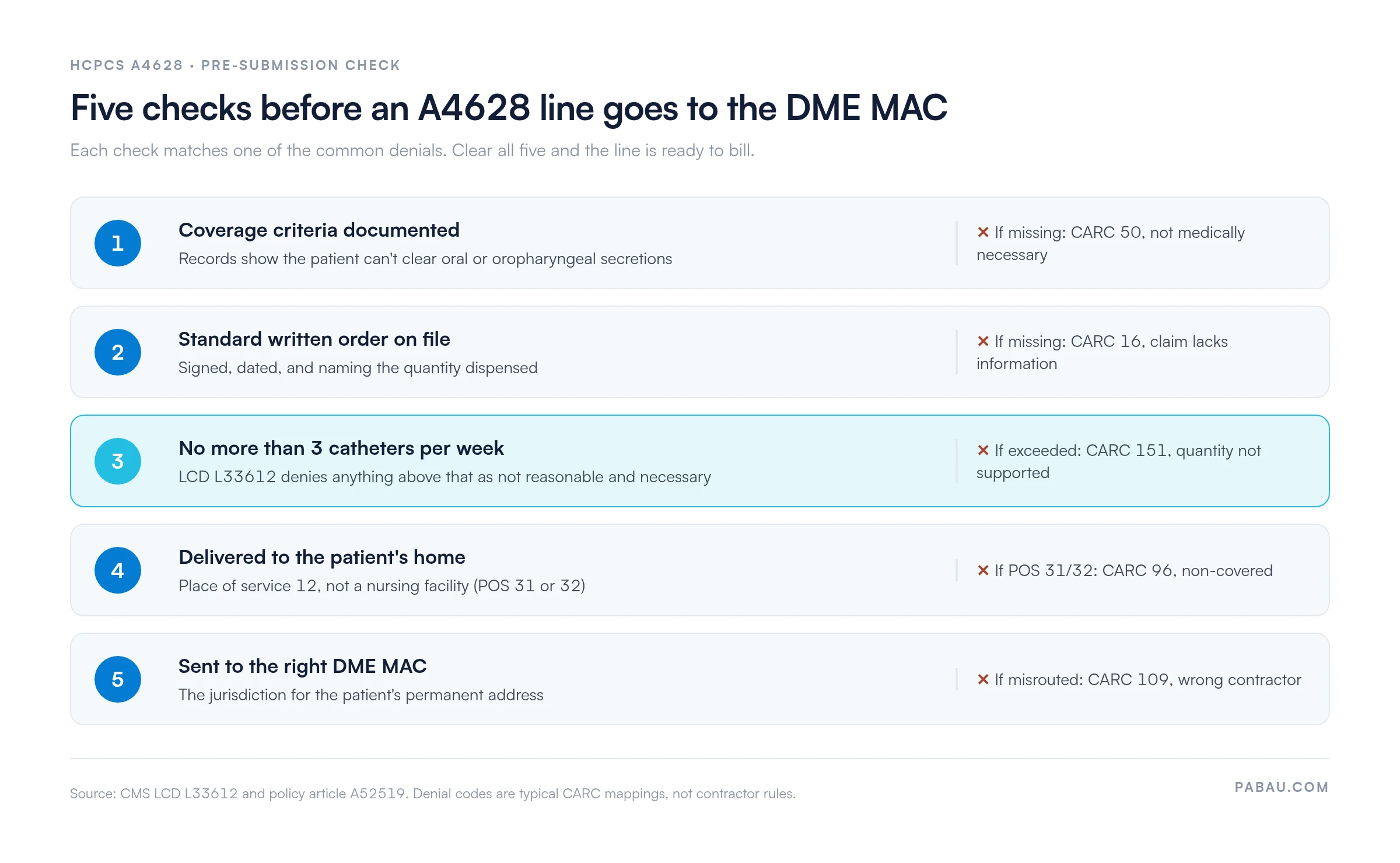
Submission checklist for HCPCS Code A4628:
Use the AAPC HCPCS code reference or the PGM Billing HCPCS lookup to confirm the current descriptor and coding notes before finalizing the claim. Dedicated claims software for billers runs the modifier and diagnosis-pointer checks automatically, so errors surface before the 837P is generated.
A4628 denials cluster around five failure points. They are undocumented coverage criteria, a missing order, quantity over the weekly cap, a nursing facility delivery, and wrong payer routing. The table below maps each pattern to its typical CARC code and the fix.
For the full CARC list and appeal workflows, see our denial codes reference and these denial management strategies.
Before appealing a CARC 50 denial, pull LCD L33612 and policy article A52519 from your DME MAC’s website, not a summary or third-party paraphrase. Together they set out the coverage criteria and documentation the reviewer checks. An appeal that cites the specific LCD section shows the reviewer exactly which criterion the records meet.
Most A4628 billing errors can be prevented at order intake, before the supply ships. These tips cover points that standard coding references rarely spell out.
Many suppliers keep orders in a spreadsheet and claims in a separate portal. A missing order or an over-cap quantity then surfaces only when the denial arrives. By then the catheters have shipped, and the fix is an appeal.
Pabau, the practice management platform we build, keeps insurer details on the patient record and pre-fills each claim from it. Background checks flag missing details, and the claim can’t be sent until they’re fixed. In the US, claims go out through Claim.MD, with real-time eligibility checks and ERA posting.
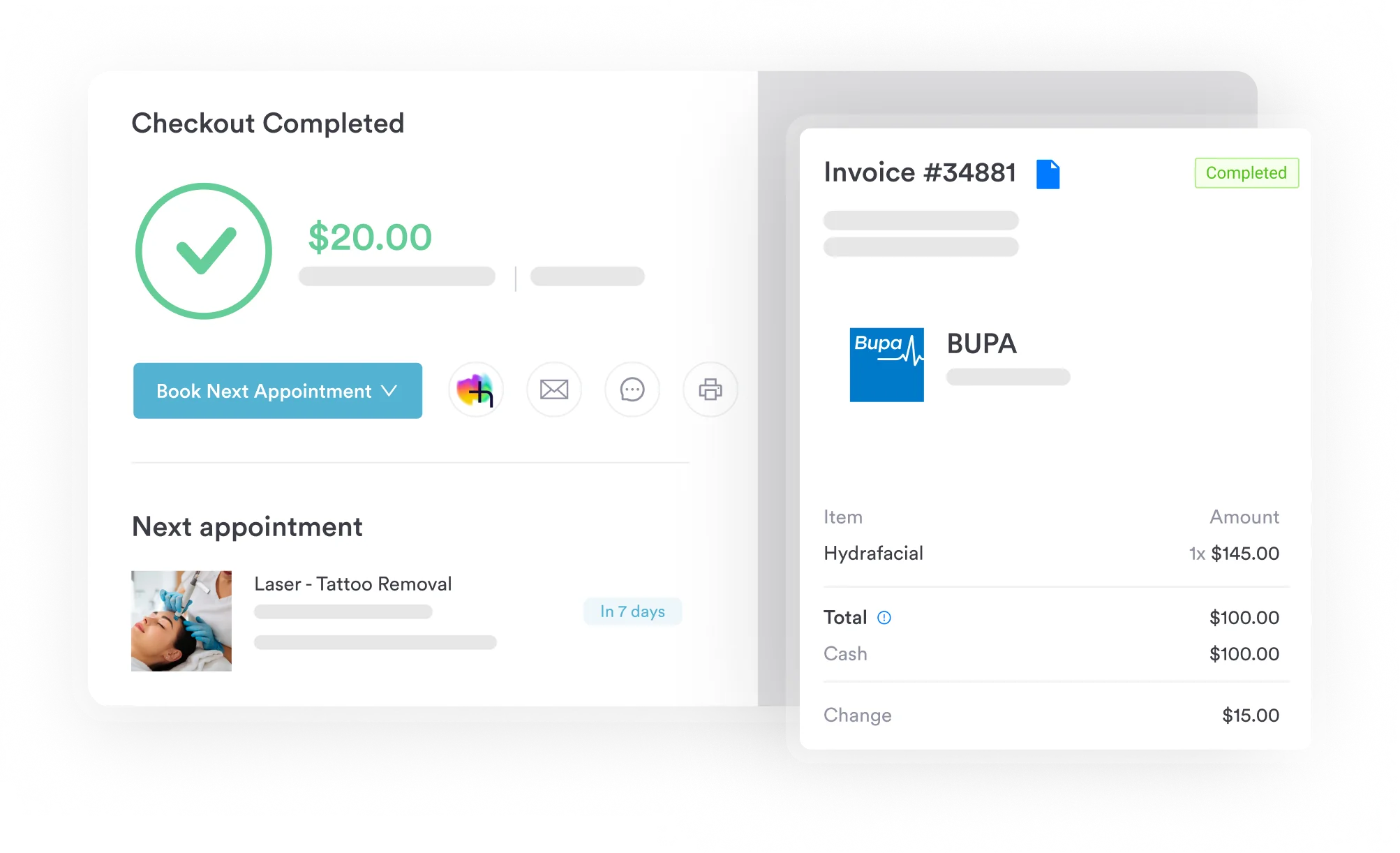
The outcome is fewer A4628 denials to chase, and every claim’s status in one dashboard, from pending to paid.

Pabau pre-fills each claim from the patient record and holds back any claim missing required details, so your DMEPOS supply claims go out complete. See it in action.

A4628 claims rarely fail on the code itself. They fail on the paperwork around it. The order doesn’t support the quantity, the notes don’t show the patient can’t clear secretions, or the catheters went to a nursing facility.
Build the weekly cap and the order check into intake, and you avoid most of those denials. The trade-off is a few minutes per order up front instead of an appeal months later.
Book a demo to see how Pabau checks supply claims for missing details before they reach the DME MAC.

Need a clean claim checklist for supply codes? Submitting a clean claim covers the elements every supply claim needs before it reaches the MAC queue.
Troubleshooting a batch of denied DME claims? Denial management strategies walks through the appeal workflow for CARC-coded rejections.
Want the full CARC reference for supply code rejections? Denial codes in medical billing maps the most common adjustment reason codes to corrective actions.
Looking up another supply code? HCPCS codes gathers our billing guides for Level II supply, drug, and equipment codes.
HCPCS Code A4628 covers an oral and/or oropharyngeal suction catheter, often a rigid Yankauer-style tip. It’s supplied for home use to patients who can’t clear secretions independently. Claims go to the DME MAC under Medicare Part B, and each one needs a written order plus records that meet the LCD’s coverage criteria.
Yes, Medicare Part B covers A4628 for beneficiaries who meet the coverage criteria in LCD L33612, the Suction Pumps LCD. Coverage isn’t automatic. The record must show the patient can’t clear oral or oropharyngeal secretions, and the supplier must be an enrolled, accredited DMEPOS supplier.
A4628 is a suction catheter that clears secretions from the mouth and oropharynx. A4617 is a mouthpiece for drug delivery through a nebulizer or inhaler. The two devices serve different clinical functions and are never interchangeable. Billing A4617 for a suction catheter misdescribes the item and invites a denial.
Medicare denies more than 3 A4628 catheters per week as not reasonable and necessary under LCD L33612 and its policy article A52519. The written order must support the quantity billed. For contractor guidance, check your DME MAC: Noridian for Jurisdictions A and D, CGS for Jurisdictions B and C.
Often, yes, but verify before billing both on the same claim. A patient with a tracheostomy who also needs oral suctioning may receive A4628 alongside tracheostomy supplies such as A4623 or tracheal catheters such as A4624. Check your DME MAC’s policy article and claim edits before submitting the codes together.
Pull LCD L33612 and policy article A52519 from your DME MAC’s website. Then check whether the record shows the patient can’t clear oral or oropharyngeal secretions independently. If it does, appeal with those clinical notes. If it doesn’t, get an advance beneficiary notice signed before the next delivery so the patient can choose to pay.