CPT code 85651: Erythrocyte sedimentation rate, non-automated
CPT code 85651: Definition, descriptor, and code summary CPT code 85651 is the p...

Last Updated: Nov 24, 2026
96373 is the CPT code for a therapeutic, prophylactic, or diagnostic injection given by intra-arterial push. It covers the administration only, so the drug is billed separately with its own HCPCS code.
Billing this code correctly depends on documenting an intra-arterial route and choosing 96373 over 96372 (IM/SC) or 96374 (IV push). Chemotherapy pushes and contrast given during imaging are reported elsewhere.
Let Pabau's smart automation suggest the right codes, reduce claim denials, and keep your practice compliant—effortlessly.
Automate repetitive tasks and focus on what matters most—your patients.
Reduce coding errors and ensure compliance with the latest regulations.
Clean claims, fewer denials, and faster reimbursements.
Powerful insights and reporting to help your practice thrive.
HIPAA compliant SOC 2 certified GDPR-compliant Trusted by 4,000+ clinics worldwide

CPT code 96373 covers a therapeutic, prophylactic, or diagnostic injection given by intra-arterial push, and no other route.
IM and subcutaneous injections go to 96372, IV push goes to 96374, and chemotherapy goes to the 96401-96549 range.
The chart note must name the intra-arterial route, the drug, the dose and the time, or the claim won’t hold up on review.
The drug is billed separately with its HCPCS code, and contrast injected during imaging is never billed as 96373.
Medicare pays roughly $20 to $25 in an office and $10 to $14 in a facility, so check your locality’s rate each January.
CPT code 96373 reports a therapeutic, prophylactic, or diagnostic injection of a drug pushed directly into an artery. The AMA’s CPT Editorial Panel maintains the code set and words the descriptor as Therapeutic, prophylactic, or diagnostic injection (specify substance or drug); intra-arterial.
Any of the three drug purposes in that descriptor can qualify.
The code describes a push, meaning the clinician delivers the drug by syringe rather than through a pump. That matters because the infusion codes 96365-96368 are intravenous only. An arterial infusion is never reported as 96373.
The injection and infusion family assigns a separate code to each route and method. Seeing 96373 next to its neighbors is the fastest way to stop upcoding and downcoding.
Read the route column first. A code that doesn’t match the route in the note is a documentation mismatch, and payers treat it as a billing error.
The boundaries matter most in the cath lab and interventional radiology, where several drugs and procedures share one session.
Supervision rules vary by payer and setting. Medicare generally requires direct supervision for in-office injection services. Hospital outpatient departments and ambulatory surgery centers may apply general supervision under specific conditions, so confirm the level with your MAC before billing.
Before submitting a 96373 claim, search the chart note for the word ‘intra-arterial’. A note that says ‘injection’ or ‘arterial’ without naming the push route is open to audit. Reviewers need the route spelled out, not implied by the clinical context.
These three codes share the same drug purposes but differ entirely by route. The same vasodilator can land on 96374 or 96373 depending on where the needle went.
The chart below maps each documented route to the code it supports.
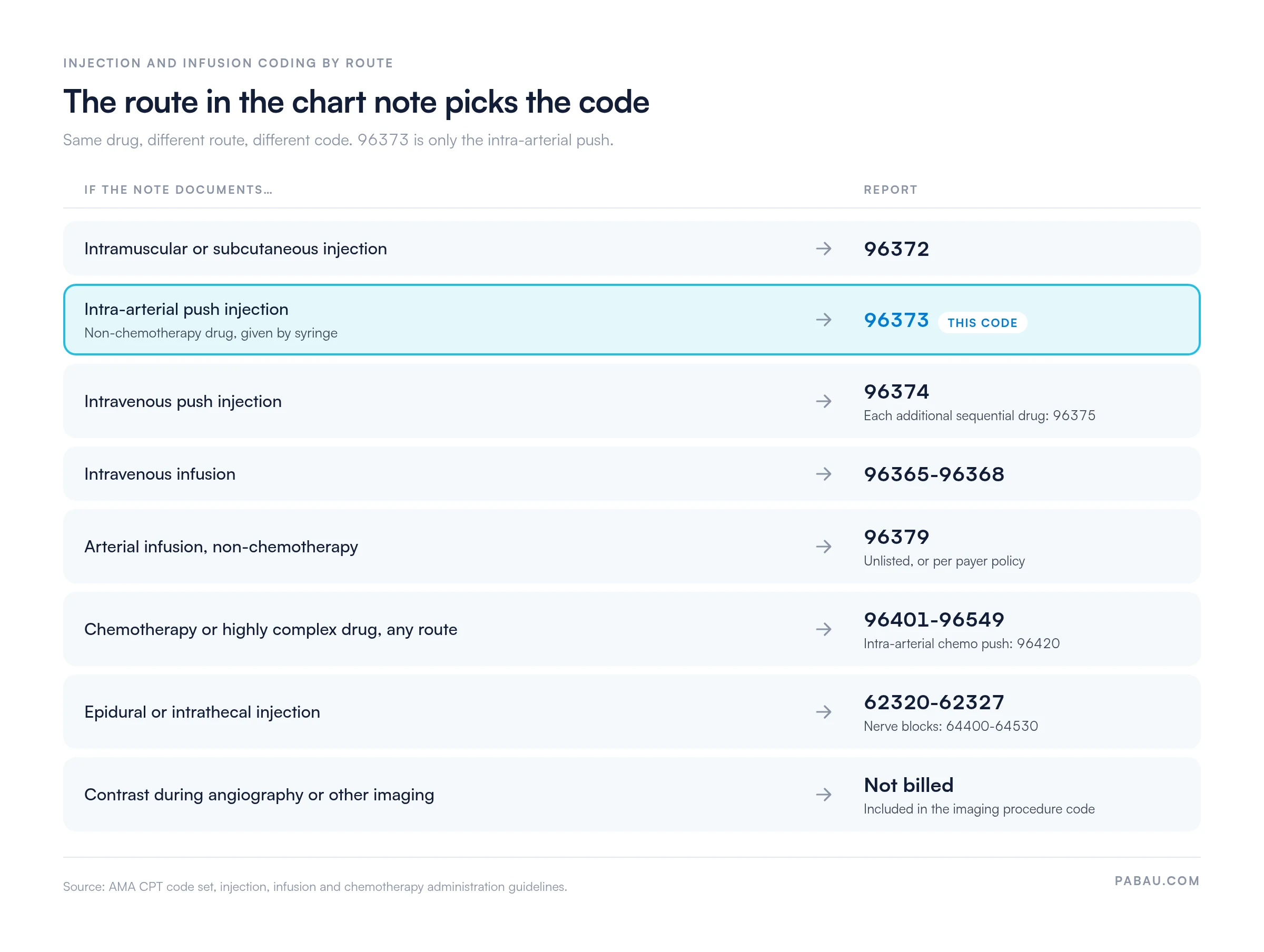
Mix-ups between 96373 and 96374 are the most frequent, because both are pushes. Billing 96374 for a documented arterial injection is a route mismatch. A coder who sees “IM” or “SC” in the note should reach for 96372 instead.
A note saying only “injection given” cannot support 96373. Before the charge goes anywhere, the note should hold these six elements.
When a session includes several intra-arterial injections, give each one its own time-stamped entry with its drug and dose. A single composite note may support only one unit on audit.
Most 96373 problems start upstream of the claim form. Here’s the path a clean claim takes, and where each step tends to break.
Three questions come up on almost every 96373 claim. How many units, which modifier, and what to do about the drug itself.
96373 is reported once per distinct intra-arterial injection, never per milligram or per vial. Two separate injections of different drugs in one session may support two units if each has its own documentation. Check the current NCCI edits and payer policy before you send more than one.
96373 pays for the administration only. The drug goes on its own line with the matching HCPCS Level II code, plus the NDC where the payer requires it. A superbill that lists both codes together is the simplest way to keep them paired. Leave the drug code off and you’ll see a denial or lose that revenue, depending on the payer.
Prior authorization for CPT code 96373 usually attaches to the drug, not to the administration code.
NCCI bundling is a separate check, and it belongs to the coder. Look up the procedure-to-procedure edits for 96373 and any same-day infusion before the claim goes out.
Medicare sets payment for CPT code 96373 each year through the Medicare Physician Fee Schedule (MPFS). Rates shift with location, through the Geographic Practice Cost Index, and with the facility or non-facility setting.
The figures below are approximate national averages. Use the CMS Physician Fee Schedule lookup tool for your locality’s exact figure.
These rates cover the administration only. Medicare pays most Part B drugs separately, typically at Average Sales Price (ASP) plus a percentage. The FastRVU lookup tool adds the geographic adjustment for your location.
Rates change every January 1, when the new MPFS conversion factor takes effect. Set a reminder to recheck your 96373 fee after each Final Rule comes out. A stale fee won’t trigger a denial, but it can undercharge or clash with your contracted rate.
Run through this list on every claim. Most items take seconds, and each one maps to a denial on the table further down.
One habit pays off more than the rest. Make route a required field in your injection note template, so the note can’t be signed without it.
Most 96373 denials trace back to a short list of causes, and each is fixable before submission. The denial codes on your remittance advice usually map to one of the patterns below.
Good denial management for injection codes starts at the charting stage. A route captured correctly the first time removes the most common cause before any rework.
In many practices, the injection note lives in one system and the claim is keyed into another. Route, drug and units get retyped, and that’s where a 96373 claim picks up errors.
Pabau, a practice management platform with built-in claims management software, pre-fills the claim from the patient record. It validates the required claim fields before sending. In the US, claims go out through Claim.MD, with eligibility checks before the visit and ERA posting when payment comes back.
Drug authorizations sit on the patient’s case, with the auth code, dates and sessions tracked and a warning when one is missing. Stock carries batch and expiry details, and the lot is recorded against the patient and the appointment. Your coders spend their time on route and modifier decisions, and the clean claim follows.
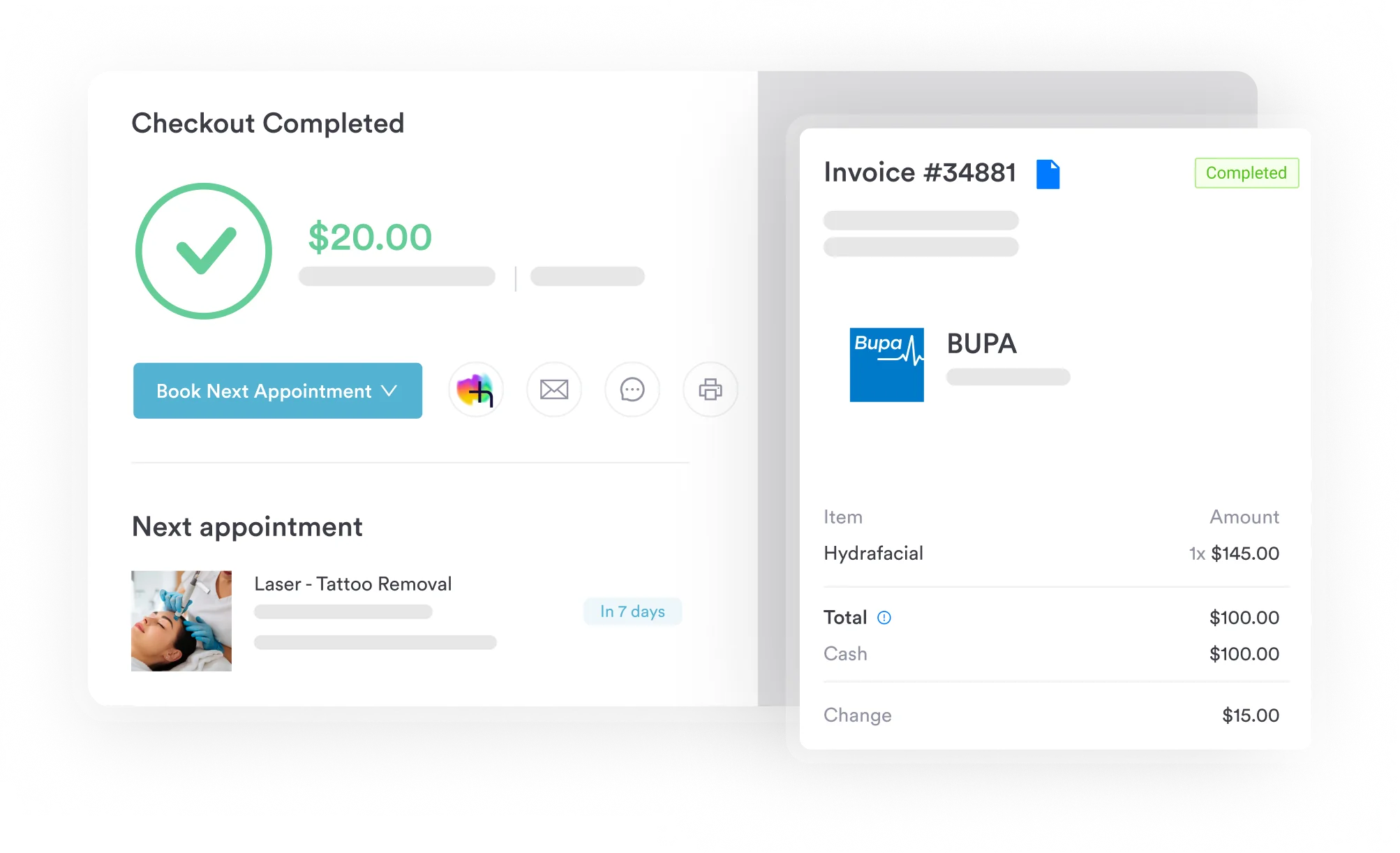

Pabau pre-fills each claim from the patient record, validates the required fields and submits through Claim.MD, with eligibility checks and ERA posting built in.

96373 rarely denies because the code is hard. It denies because the route never made it into the note, or because a chemotherapy push or imaging contrast was squeezed into it.
If you fix one thing this week, make route a required field in your injection template. Then run the checklist on your next ten 96373 claims and compare the denial rate a month later.
Book a demo to see how Pabau carries the injection note straight onto a clean claim for your billing team.

Need a framework for reducing claim denials across all injection codes? Denial management in healthcare covers root-cause analysis and appeals workflows for high-volume billing teams.
Want to see how a claim travels from charge capture to remittance? Revenue cycle management explained walks through the full claim lifecycle.
Building out your superbill to capture drug codes alongside administration codes? Superbill guide covers what to include and how to structure it for clean claim submission.
Giving more than one IV push in the same visit? CPT code 96375 explains how each additional sequential push is reported.
Running an IV infusion alongside the injection? CPT code 96365 covers the initial hour of an IV infusion and how it pairs with other services.
No. 96373 is a standalone code reported on its own line. The add-on codes in this family, such as 96375 and 96376, cover additional intravenous pushes, not arterial ones.
CPT counts an injection as a push when the clinician stays present throughout, or when it runs 15 minutes or less. Past that point, the service is an infusion and 96373 no longer fits.
No. Drawing arterial blood for a blood gas or another test is an arterial puncture, reported with 36600. 96373 is only for putting a drug into the artery.
No. A saline or heparin flush to keep a line open isn’t reported on its own. Only a separately documented drug push supports 96373.
Not for the administration code itself. The drug may need it, especially a high-cost agent, so check your MAC’s coverage rules for that drug and diagnosis before the visit.