



CCSD code G5100: Bypass of duodenum billing guide
CCSD code G5100 bills a bypass that leaves the duodenum in place CCSD code G5100...

Last Updated: Oct 16, 2026

CPT code 96361 reports each additional hour of intravenous hydration infusion beyond the first, and it must always be billed alongside 96360.
One unit of 96361 needs more than 30 minutes of infusion time beyond the first hour. Shorter sessions are a common audit trigger.
The 2026 Medicare non-facility rate for CPT 96361 is roughly $26 to $33. Facility rates run $16 to $22, depending on geographic locality.
Practice management software like Pabau keeps infusion start and stop times on the client record, then pulls them into a pre-filled claim.
CPT code 96361 is the add-on code for each additional hour of intravenous hydration infusion beyond the first. CPT 96360 covers that first hour, and 96361 picks up every hour after it. The code carries a plus symbol, so it never appears on a claim by itself.
Mobile drip services, concierge IV providers, and outpatient infusion suites all bill this pair. This guide covers the 2026 Medicare fee schedule, the time-based unit rules, documentation requirements, NCCI edit pairs, and a step-by-step claim workflow.
CPT code 96361 carries the official descriptor: Intravenous infusion, hydration; each additional hour. The American Medical Association designates it with a plus (+) symbol under the AMA CPT code set. That plus marks it as an add-on code.
Add-on codes exist to capture the time that runs past the initial billed period. That is why 96361 cannot legally appear on a claim without its parent code.
Reporting 96361 without 96360 on the same claim triggers an automatic denial. The NCCI edits treat it as a standalone submission error.
The 96360/96361 pair follows a sequential billing structure. Bill 96360 for the first hour, with a minimum of 31 minutes of infusion time. CPT 96361 then captures every subsequent hour, or any fraction of an hour that runs past 30 minutes.
CMS Article A54635 from the Centers for Medicare and Medicaid Services confirms this hierarchy explicitly. Code 96360 must be on the claim before 96361 can be reported. Payers process the two sequentially, so 96361 units only count when the preceding hour is documented and billed.
Getting the unit count wrong on CPT 96361 is one of the most common hydration billing errors. The fraction-of-an-hour rule is precise. An additional unit is billable only when infusion time runs more than 30 minutes past the preceding hour. That 30-minute threshold also governs a repeat push of the same drug, which a facility reports as 96376.
The table below converts total infusion time into the codes you bill, because total time is what the nursing record actually shows.
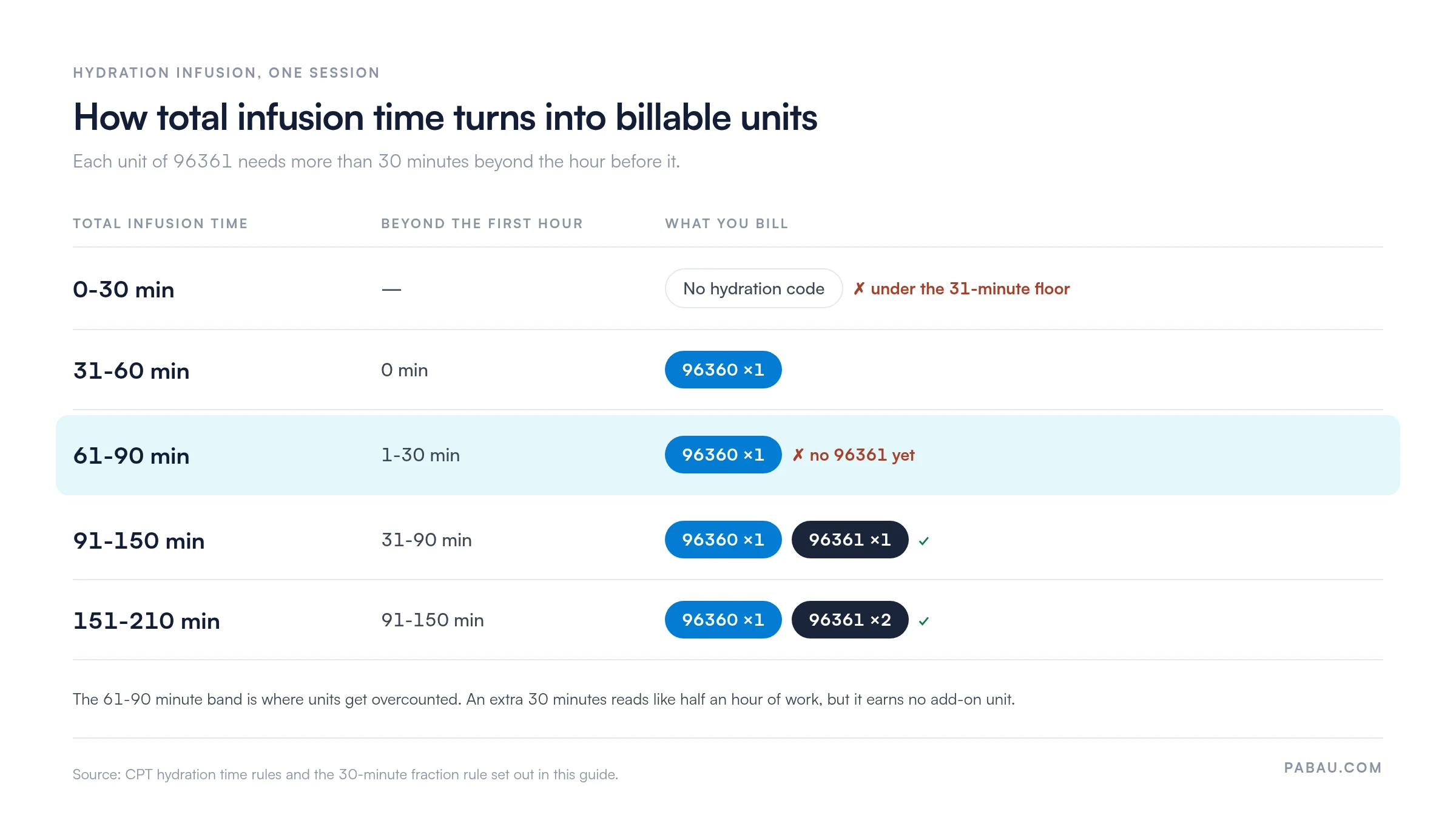
Noridian Medicare’s JF Part A hydration guidance and CGS Medicare’s correct coding article both confirm this threshold. Billers have to document the infusion start and stop times in the medical record. Estimated or rounded times are a liability during an audit.
Flag any IV session documented at exactly 30, 60, 90, or 120 minutes for a second look. Round numbers usually point to estimated times rather than recorded ones. Estimated times will not survive a medical record audit. Train nursing staff to note stop times to the minute.
Medicare reimbursement for CPT 96361 varies by place of service and geographic locality. The Medicare Physician Fee Schedule (MPFS) applies a locality adjustment to every rate. That is why two practices bill the same code and collect different amounts.
Rates below reflect 2026 MPFS data. Verify your own locality with the CMS Physician Fee Schedule Look-Up Tool before finalizing any billing assumptions.
The place of service (POS) code determines which rate applies. Non-facility rates apply in independent practices and physician offices. Facility rates apply when the infusion happens in a hospital outpatient department or an ambulatory surgery center.
These ranges reflect geographic variation across Medicare localities. High-cost regions such as San Francisco, the New York metro area, and Alaska sit toward the upper end. Rural and lower-cost areas usually fall at the lower end. Rates update annually through the MPFS, so confirm the current figures before you budget infusion revenue.
Medicare will not reimburse CPT 96361 based on patient preference alone. The service has to be medically necessary. That means a physician has determined that oral or subcutaneous hydration is contraindicated or clinically insufficient.
CMS Article A54635 and Noridian MAC guidance set out the core coverage framework. Medical necessity has to be established before the infusion begins. Retroactive justification after a denial rarely succeeds.
Local Coverage Determinations (LCDs) from each Medicare Administrative Contractor (MAC) may add more specific criteria. Practices that bill across MAC jurisdictions should read every applicable LCD before they set infusion protocols.
Every unit of 96361 you bill needs a matching documentation trail. Missing one element is enough to trigger a denial or a post-payment audit recoupment. The diagnosis matters as much as the times, so pull it from the ICD-10-CM diagnosis codes that support dehydration or intractable vomiting.
The AAPC Codify platform notes that documentation should be contemporaneous. Record it during or immediately after the infusion, not hours later. Retrospective documentation is a red flag in any Medicare audit.
The National Correct Coding Initiative (NCCI) publishes quarterly edit tables that govern which code pairs can be billed together. CPT 96361 is subject to several edit pairs that billers meet regularly. The tables change every quarter, so verify current pairings against the CMS NCCI Policy Manual rather than a static reference.
An oncology encounter raises a related boundary. Chemotherapy infusion time past the first hour reports under 96415, not as hydration add-on units.
A pre-submission edit check against the NCCI table catches most of these errors before they turn into denials. Practices running mobile IV services face extra scrutiny, because place-of-service documentation and the physician oversight chain are harder to trace off-site.
CPT 96361 sits within a broader family of infusion and injection codes. Knowing the full code set helps billers select the correct primary code and avoid bundling errors when several services happen in one encounter.
Choosing between 96360 and 96365 as the primary code depends on what is being infused. Saline or dextrose given primarily for hydration uses 96360. A medication infused for therapeutic purposes uses 96365, even when it arrives diluted in saline. Mixing the two is a frequent bundling error that triggers NCCI flags.
Accurate 96361 billing is a workflow problem as much as a coding problem. Errors almost always start in the charting process rather than at claim submission. A workflow that captures the right data at the right time is the foundation of audit-ready claims management for any infusion service.
Complete documentation does more than survive an audit. Payers process well-documented claims faster than claims that trigger a request for extra records, so the money arrives sooner.
Most infusion practices spread this work across three places. Nurses write start and stop times on a paper infusion record. A biller retypes them into the claim, and the physician order sits in a separate folder. Each handoff is a chance to lose a minute or a diagnosis.
Practice management software like Pabau keeps all three on the same client record. Staff chart the infusion times as they happen. The order and the diagnosis are attached to that same visit, and the claim is pre-filled from what is already recorded. Your biller checks the unit count instead of reconstructing it from paper.
Claims then go out through Pabau’s clearinghouse integrations, including Claim.MD for US practices, which reaches thousands of US payers. Status updates come back to the same record that holds the infusion times, so nobody hunts for the nursing note when a denial lands.

Pabau charts hydration start and stop times on the client record. Those details flow into a pre-filled claim for your biller to check and submit through Claim.MD.

The two root causes of 96361 denials are missing start and stop times and unit counts that ignore the 30-minute threshold. Both are settled at the chair, before anyone opens the claim. Practices that record times to the minute and apply the fraction-of-an-hour rule consistently see these claims pay.
The trade-off worth remembering is that a longer infusion does not always earn another unit. An extra 25 minutes of saline is unbillable time, so plan staffing and pricing around the 30-minute bands rather than the clock hour. Book a demo to see how Pabau keeps infusion times, orders, and claims on one record.

Not sure what a payer counts as a clean claim? What a clean claim looks like breaks down the fields payers check before a claim reaches an adjudicator.
Hydration claims still denying after the fix? Denial management in healthcare sets out how to triage, appeal, and track denials so the revenue comes back.
Need to understand the clearinghouse side of claims submission? Medical claims clearinghouse overview explains how clearinghouses validate, route, and track claims before they reach the payer.
New to the revenue cycle behind these codes? What is medical billing walks through the process from patient registration to final payment.
CPT code 96361 is the add-on code used to report each additional hour of intravenous hydration infusion beyond the first hour captured by CPT 96360. It applies when a saline, dextrose, or electrolyte solution is infused primarily for hydration. The session must extend 31 or more minutes beyond the initial hour. It cannot be reported without 96360 on the same claim.
No. The AMA designates CPT 96361 with a plus (+) symbol, which marks it as an add-on code. It cannot be reported on its own. The claim must include CPT 96360, the primary hydration code for the first hour. Submitting 96361 alone will result in an automatic denial under NCCI edit rules.
Three edit scenarios matter most. CPT 96361 cannot be billed without 96360. Hydration given as a flush or carrier for a therapeutic drug infusion is bundled into the therapeutic code and is not separately billable. Concurrent hydration during chemotherapy administration may also be bundled. NCCI edits update quarterly, so check the current tables through the CMS NCCI portal rather than a static list.
Required documentation includes a written physician order naming the solution and the clinical indication. You also need exact infusion start and stop times in the nursing or infusion notes. Add the total volume administered and an ICD-10 diagnosis code supporting medical necessity. All documentation must be contemporaneous. Record it during or immediately after the infusion, not once a denial arrives.



