

HCPCS Code G0163: Skilled nursing observation and assessment
What is HCPCS Code G0163? HCPCS Code G0163 is a deleted Level II code for skille...

Last Updated: Oct 15, 2026
Billable Code
96158 is the CPT code for health behavior intervention, individual, face-to-face; initial 30 minutes. A non-physician provider bills it when behavior change targets a physical condition, such as diabetes adherence or chronic pain coping.
Pairing 96158 with a psychiatric primary diagnosis is a leading cause of payer denials on this code. Each additional 15 minutes is reported with add-on code 96159.
Let Pabau's smart automation suggest the right codes, reduce claim denials, and keep your practice compliant—effortlessly.
Automate repetitive tasks and focus on what matters most—your patients.
Reduce coding errors and ensure compliance with the latest regulations.
Clean claims, fewer denials, and faster reimbursements.
Powerful insights and reporting to help your practice thrive.
HIPAA compliant SOC 2 certified GDPR-compliant Trusted by 4,000+ clinics worldwide

CPT code 96158 is the 30-minute base code for individual health behavior intervention, separate from psychotherapy and from assessment code 96156.
A physical health ICD-10-CM diagnosis must be listed first on every 96158 claim, because a psychiatric primary diagnosis is a leading denial trigger.
Under CPT’s midpoint rule, a session needs at least 16 face-to-face minutes before 96158 can be billed.
Add-on code 96159 covers each extra 15 minutes and can’t be reported without 96158 on the same claim.
Billing software such as Pabau links diagnosis codes, modifiers and 96159 units in a single claims workflow.
CPT code 96158 describes “health behavior intervention, individual, face-to-face; initial 30 minutes,” as published in the American Medical Association (AMA) CPT code set. It belongs to the Health and Behavior Assessment and Intervention (HBA/HBI) family, which the AMA introduced to replace the legacy 96150-96155 series. That range runs from 96156 to 96171 and also covers group and family sessions, all listed in our CPT reference for billers.
96158 targets health behaviors that directly affect a patient’s physical medical condition. Think cognitive-behavioral strategies for pain catastrophizing in a chronic pain patient, or adherence coaching for a type 2 diabetes patient who skips insulin doses. The aim is a better physical health outcome, and the diagnosis on the claim has to show that.
96158 is a non-physician health behavior code. It was designed for providers whose scope includes behavioral interventions tied to physical conditions, without a physician performing the service. Before billing, confirm that your state license and payer credentialing cover it.
Licensed psychologists are the primary billers. For other providers, eligibility depends on state law and on the Local Coverage Determination (LCD) of your Medicare Administrative Contractor (MAC).
Scope-of-practice rules for non-psychologist providers vary by state and by payer. Always check your MAC’s LCD before billing 96158 as an LCSW or LPC.
96156 and 96158 are paired codes in the same HBA/HBI family, but they do different clinical jobs. Coders often confuse the two because both involve the same provider, the same patient and a similar session structure.
Some payers require 96156 to be on file before authorizing ongoing 96158 services. Check your payer’s LCD for sequencing requirements before submitting a 96158 claim without a preceding 96156.
96158 and the psychotherapy codes 90832, 90834 and 90837 all involve individual face-to-face behavioral sessions. They differ on the primary diagnosis and the clinical goal, and that difference decides which code the claim carries.
A patient with a comorbid psychiatric diagnosis can still qualify for 96158. The primary diagnosis driving the service just has to be a physical health condition. The note must document that distinction clearly.
Put together with the assessment and group rules, the choice comes down to three questions asked in order, as the decision path below shows.
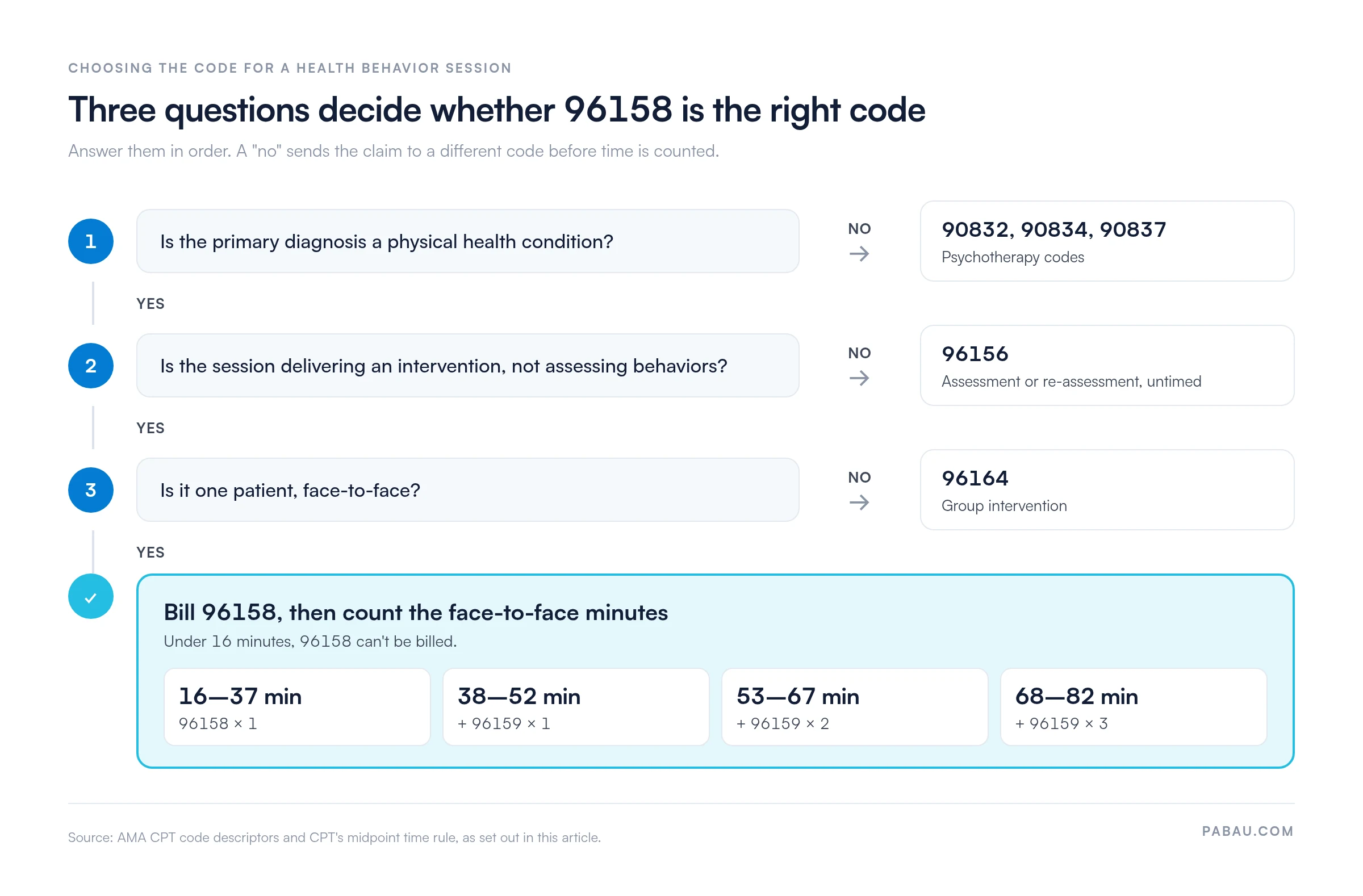
96158 is a timed code. CPT’s midpoint rule applies: Face-to-face time must reach at least 16 minutes to bill the 30-minute base code. That is just past half of the 30-minute unit.
96159 is the add-on code for each additional 15 minutes of individual health behavior intervention beyond the initial 30 minutes. It can’t be reported without 96158 as the base code on the same claim.
Payers audit time-based codes by comparing the documented face-to-face minutes against the units billed. A note that says only “60-minute session” gives an auditor nothing to check those units against.
Record the start and stop time in every 96158 note, not just the total duration. Auditors compare those minutes with the units billed. A note reading ’45 minutes face-to-face, 2:00-2:45 PM’ holds up in an audit. ’45-minute session’ does not.
The physical diagnosis is the most important element of a 96158 claim, and payers read the primary ICD-10-CM code first. A psychiatric primary diagnosis, such as F32.x (depression), F41.x (anxiety) or F33.x (recurrent depression), triggers a denial under most payer policies. Check the CrossCoder ICD-10 crosswalk tool to verify the diagnosis-to-procedure pairing before submission.
When a patient has both a physical health condition and a comorbid psychiatric diagnosis, list the physical condition as the primary ICD-10 code. The psychiatric diagnosis may appear as a secondary code, but must not be the first-listed diagnosis on the claim.
Medicare covers CPT code 96158 under Part B when medical necessity criteria are met and a qualified non-physician provider performs the service. Coverage is subject to each MAC’s LCD, so the rules can differ from one jurisdiction to the next.
The CMS Physician Fee Schedule lookup tool gives the authoritative national average payment for any year. Use the FastRVU 2026 RVU lookup to calculate the work, practice expense and malpractice relative value units (RVUs) for your locality.
Commercial payers generally follow CMS payment rates but may reimburse at a multiple of Medicare (typically 110-130%). Always verify your contracted rate rather than applying the Medicare national average directly to commercial claims.
Most payers apply a consistent medical necessity framework to 96158 claims, though the specific criteria vary by payer LCD and plan type.
Prior authorization requirements are payer-specific. Some commercial plans require authorization after the initial assessment (96156) and before ongoing intervention (96158) begins. Others require it only after a set number of sessions. Confirm the authorization pathway with each payer before scheduling ongoing services.
A compliant 96158 note needs seven elements that payers look for in audits. Missing any one of them is enough for a denial or recoupment. Review your medical billing compliance protocols so your note templates capture each one.
The note doesn’t need a psychiatric-style mental status exam, and that’s intentional. HBI codes describe a behavioral intervention for a physical condition rather than a psychiatric evaluation. Writing a full psychiatric note for a 96158 session signals diagnostic confusion and can invite payer scrutiny.
Several modifiers may apply to 96158 depending on the delivery mode, place of service and payer. Verify each modifier against your payer’s policy before appending it.
CPT code 96158 is eligible for telehealth delivery under post-Public Health Emergency CMS policy, though coverage specifics continue to evolve. Many behavioral telehealth flexibilities now run through December 31, 2027, under the Consolidated Appropriations Act, 2026. Check current CMS transmittals for the originating site and modifier requirements at the time of service. Commercial telehealth policies vary widely, so confirm them at the individual plan level.
Denials on 96158 cluster around the six triggers in the table below. A denial management workflow and a clean claim check before submission catch each one before the claim reaches the payer.
Many 96158 denials start before the claim is built, with a diagnosis typed in the wrong order or minutes rounded from memory. A clean claim takes three steps, in this order:
Pabau’s claims management software handles all three in one billing workflow. Diagnosis codes attach at the encounter level, and modifiers come from a payer-specific list. 96159 units are tracked against the session time in the clinical note.
Practices that submit through Claim.MD, Pabau’s clearinghouse integration, can send 96158 and 96159 claims directly to thousands of US payers. Real-time eligibility checks flag coverage issues before submission. Pabau can also produce a superbill carrying the billing elements a 96158 claim needs.
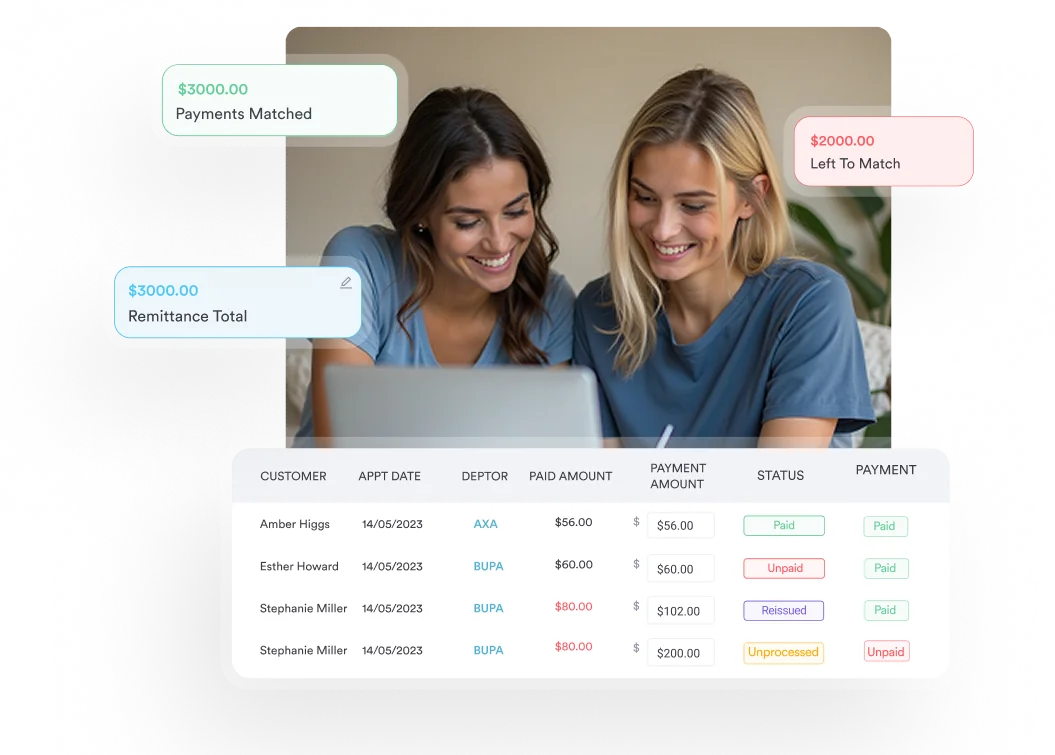

Pabau helps behavioral health practices attach diagnosis codes, apply modifiers, track 96159 add-on units and submit clean claims for CPT 96158 from one platform.

The diagnosis line decides most 96158 claims. Before a session is billed, confirm that a physical health condition sits first on the claim and that the note shows start and stop times.
Get those two right and the 96159 units follow straight from the clock. Leave either one loose, and a payer can deny or recoup the whole visit, however good the care was.
To see how Pabau ties the diagnosis, the minutes and the add-on units to one 96158 claim, book a demo with our team.

Billing the assessment that comes first? CPT code 96156 covers health behavior assessment and re-assessment, the step that usually precedes 96158.
Is the primary diagnosis psychiatric? CPT code 90832 explains the 30-minute psychotherapy code to use instead of 96158.
Need guidance on behavioral health billing compliance? Medical billing compliance covers HIPAA-aligned documentation practices, audit preparation, and claim accuracy strategies for behavioral health practices.
Want to understand how clearinghouse submission works? Claim.MD clearinghouse overview explains electronic claim routing, payer enrollment, and ERA receipt for US behavioral health billing.
Want to read payer responses faster? Electronic remittance advice breaks down ERA reading, CARC denial codes, and how to act on remittance data faster.
CPT code 96158 is the 30-minute base code for individual health behavior intervention. In this face-to-face service, a qualified non-physician provider uses evidence-based behavioral techniques on behaviors that affect a physical medical condition. Common examples include pain catastrophizing work with chronic pain patients and adherence counseling for poorly controlled diabetes or cardiovascular disease.
CPT 96156 is the health behavior assessment or re-assessment code, and 96158 is the intervention delivery code. 96156 evaluates the patient’s current health behaviors and sets the clinical plan. 96158 puts strategies such as cognitive behavioral therapy (CBT) or motivational interviewing into practice. 96156 isn’t time-based, while 96158 covers the first 30 minutes. Both can be billed on the same day when each service is separate and distinctly documented.
Yes, Medicare covers CPT code 96158 under Part B when medical necessity criteria are met. The service must be performed by a qualified non-physician provider credentialed in the applicable MAC jurisdiction. Each MAC’s Local Coverage Determination may impose frequency limits, require physician referral documentation, and specify which provider types are eligible.
The most common modifiers with CPT code 96158 are 95 for synchronous telehealth and GT for interactive audio and video. Some payers use GT instead of 95. Modifier HO marks a master’s-level clinician, and some commercial payers require it. Place of service codes 02 or 10 also apply for telehealth delivery. Modifier rules vary by payer, so always check the payer’s LCD before appending one.
One unit of 96158 covers the initial 30 minutes. For sessions longer than 37 minutes, add units of 96159, each covering an additional 15 minutes, to the same claim. A 60-minute session is billed as 96158 x 1 plus 96159 x 2. Most payers cap combined 96158 and 96159 sessions each year, typically at 20 to 30, so track cumulative session counts by patient.
CPT code 96158 pairs with physical health ICD-10-CM codes, not psychiatric primary diagnoses. Commonly paired codes include E11.9 (type 2 diabetes), I10 (hypertension), G89.29 (chronic pain), E66.01 (morbid obesity), and oncology codes such as C50.919. A psychiatric primary such as F32.x or F41.x will typically trigger a denial. It may appear as a secondary code when comorbid, but the physical condition must be listed first.




