CPT code 57283: Uterosacral ligament suspension billing guide
CPT code 57283: Official descriptor and procedure overview CPT code 57283 descri...

Last Updated: Oct 15, 2026

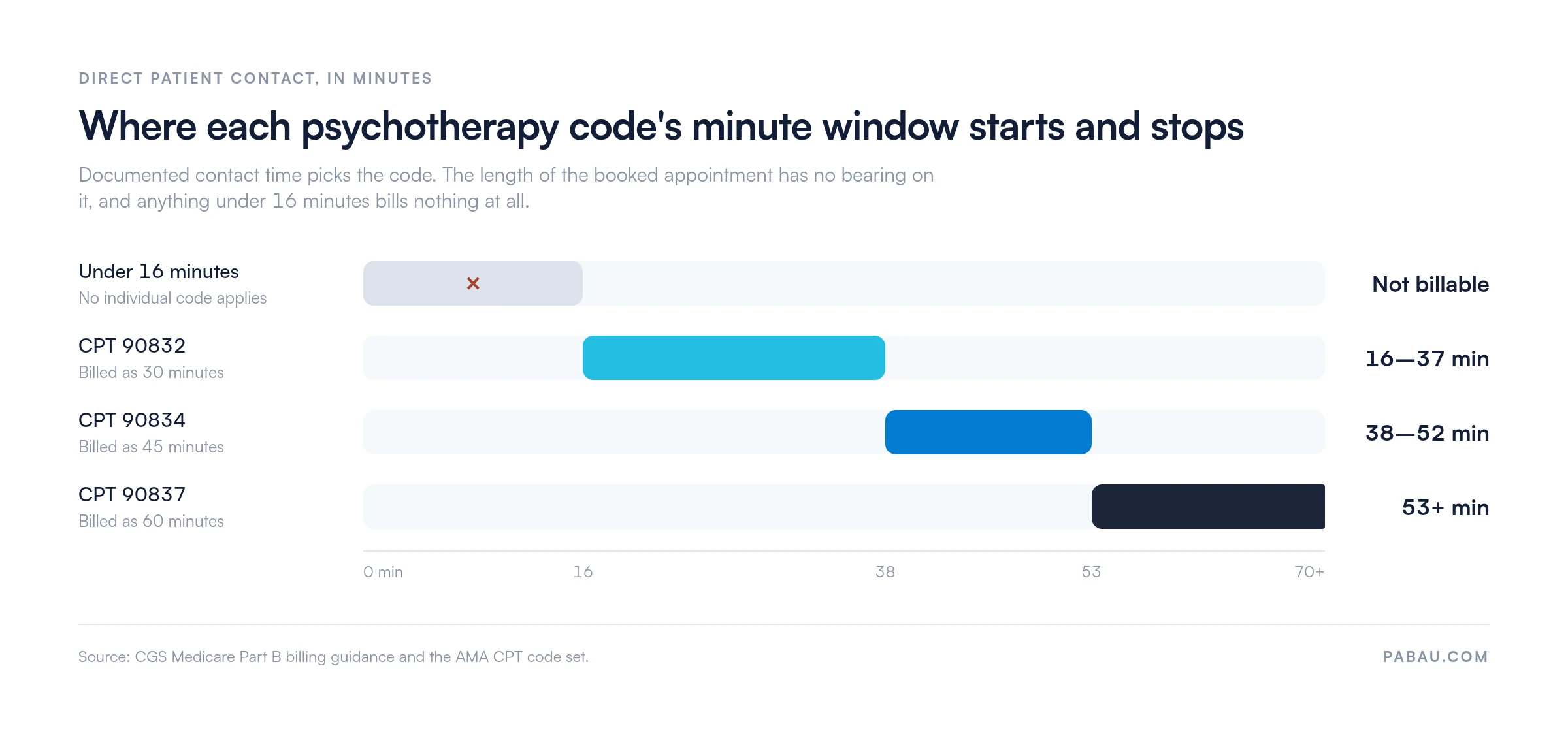
CPT code 90832 covers individual psychotherapy when documented contact time falls between 16 and 37 minutes, billed as a 30-minute service
Start and stop times belong in every session note, and leaving them out is the leading cause of 90832 denials
When psychotherapy and an E/M service fall on the same date, bill the add-on code 90833 rather than 90832
Practice management software like Pabau captures session times in the note template, then submits the claim through Claim.MD and tracks its status
CPT code 90832 is the individual psychotherapy code for sessions of 16 to 37 documented minutes. It is billed as a 30-minute service, and payers adjudicate it against the time written in the note rather than the appointment slot.
This guide covers the time thresholds, eligible providers, add-on codes, documentation requirements, and 2025 reimbursement rates for CPT code 90832. It also sets out the telehealth rules and the errors that most often trigger a denial.
According to the American Medical Association (AMA), CPT code 90832 describes individual psychotherapy provided directly to a patient and/or family member for approximately 30 minutes. The official descriptor is: Psychotherapy, 30 minutes with patient and/or family member.
The code belongs to the 90800 series of psychiatric and psychotherapy codes, which the AMA maintains annually. It is time-based, so payers adjudicate it against the documented time in the clinical note. An appointment booked for 45 minutes that ran 20 minutes still qualifies for 90832, provided the note captures the start and stop times.
The 16-to-37-minute rule decides whether 90832 is the correct code. Per CGS Medicare billing guidance, a session qualifies when direct patient contact time falls between 16 and 37 minutes.
Below 16 minutes, no individual psychotherapy code is billable. At 38 minutes or more, the session meets the threshold for 90834, the 45-minute code.
The clock starts and stops with direct patient contact. Preparation time, case review, and administrative work before or after the session do not count toward the billable duration. Record the start and stop times in the session note to support the claim.
Under Medicare, the following provider types can bill CPT code 90832. They need the appropriate Medicare enrollment, and their state scope-of-practice laws have to permit the service. Eligibility differs for Medicaid and commercial payers, so verify with each plan directly.
LPCs and MFTs gained Medicare enrollment eligibility under recent legislative changes, but some Medicare Administrative Contractors (MACs) may add credentialing requirements. Providers billing through a group practice must also ensure the supervising practitioner meets Medicare enrollment standards for the service location.
Before billing CPT 90832 under a group NPI, verify that every clinician in the practice holds individual Medicare enrollment in the correct provider type category. Group enrollment alone does not authorize each clinician to bill independently. Check your MAC’s enrollment requirements annually, as eligibility rules for LPCs and MFTs have changed in recent years.
Medicare pays CPT code 90832 at different rates depending on the place of service. Non-facility rates cover office settings, where the practice absorbs the overhead. Facility rates apply when the service is rendered in a hospital, skilled nursing facility, or another CMS-designated facility setting.
According to the CMS Physician Fee Schedule lookup tool, the 2025 national non-facility rate for CPT code 90832 is $75.52. Facility settings pay roughly $52 to $59. Both figures move with Geographic Practice Cost Index (GPCI) adjustments by locality.
These are national base figures, and payment varies by MAC jurisdiction. Private payer rates for CPT code 90832 are negotiated separately and typically exceed Medicare rates. Medicaid rates vary by state and may require prior authorization for ongoing psychotherapy.
Submit claims through a HIPAA-compliant clearinghouse to reduce the risk of technical denials on 90832 submissions. Practice management software like Pabau submits through Claim.MD, which generates the CMS-1500 claim, runs real-time eligibility checks, and tracks status and remittance advice.
The most frequent upcoding audit target in outpatient psychotherapy billing is 90837 billed on notes that document 25 to 35 minutes of contact. The three time-based psychotherapy codes form a family, and the code has to match the documented session time.
Use CPT code 90832 when direct patient contact runs 16 to 37 minutes. Use 90834 for 38 to 52 minutes, and 90837 for 53 minutes or more. The windows sit end to end, so a single minute either side of a boundary changes the code.
Billing 90837 when the documented time supports only 90832 is a compliance violation under AAPC coding guidelines and OIG fraud and abuse frameworks. Under the 2025 Medicare non-facility rates, 90837 pays $154.29 against $75.52 for 90832. That $79 difference per session is why the pattern draws audit attention across MACs.
Two add-on codes attach directly to CPT code 90832, and picking the wrong one is among the most common billing errors in behavioral health practices.
90833 is not a standalone code. It exists to capture the psychotherapy time when an E/M service is already being billed. Billing 90832 alongside an E/M code on the same date triggers a claim edit, because the psychotherapy component has to be reported through 90833.
This matters most for psychiatrists, who commonly provide both medication management and brief therapy in a single visit.
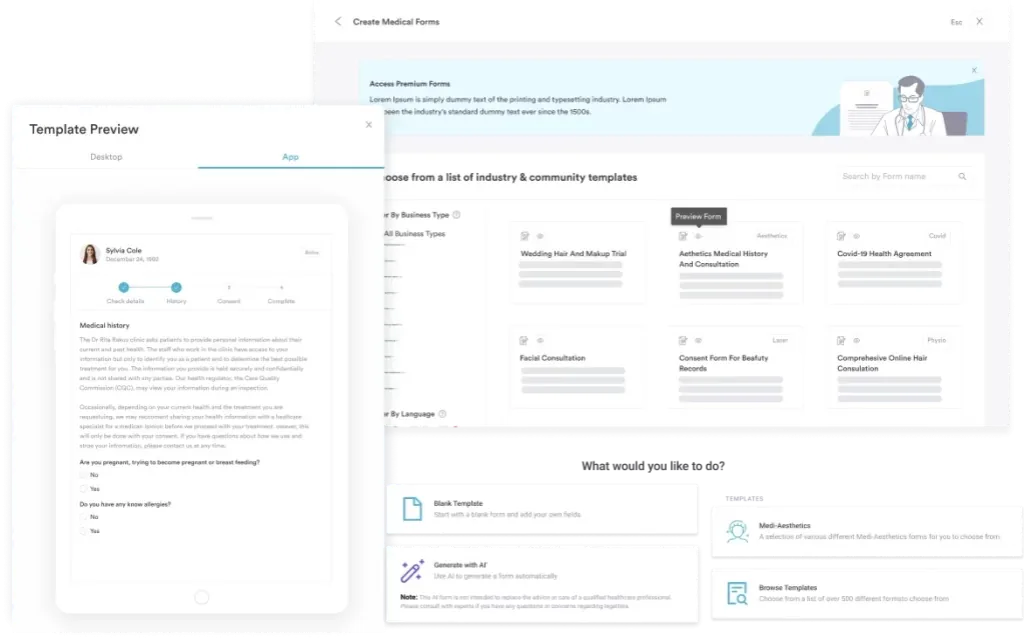
A claim for CPT code 90832 stands or falls on the session note. CMS and MAC auditors look for a specific set of documentation elements. Missing any one of them can trigger recoupment, even when the service was legitimately provided.
The diagnosis has to support the service, not simply accompany it. A single-episode depression claim commonly carries F32.9, and the note needs findings that fit the code.
Session notes also have to be stored securely and reachable only by authorized staff. That is a separate compliance layer from the quality of the billing documentation.
Psychiatrists and psychiatric nurse practitioners frequently provide both a medication management visit and a brief therapy session in the same appointment.
When both services fall on the same date, bill the E/M code for the evaluation and management component, then add 90833 for the psychotherapy. Do not bill 90832 alongside the E/M code.
The 90833 add-on captures the same 16-to-37-minute therapy time, but it is built for same-day E/M pairing. Both components need their own documentation. The E/M note must show medical decision-making or time-based criteria for its level, independent of the therapy time.
When auditing same-day E/M and psychotherapy claims, MACs look for documentation that separates the E/M content from the therapy content. Both have to be distinguishable within the same visit note. A single merged note that addresses medication, mental status, and therapy goals without distinguishing the two components is a common audit finding. Use separate note sections or sub-headings to make the distinction explicit.
CPT code 90832 is on the Medicare telehealth services list, so it can be billed for sessions delivered by audio-video technology. Telehealth eligibility for psychotherapy codes has been extended by legislative action beyond the COVID-19 public health emergency.
Verify the current status with your MAC before billing. Telehealth provisions can change with each budget cycle or CMS rulemaking.
When billing CPT 90832 for telehealth, use the following place-of-service and modifier conventions under current Medicare guidance:
Payment follows the place of service. A session billed under POS 10 pays the non-facility rate, and one billed under POS 02 pays the facility rate. Verify the current figures in the CMS fee schedule for the applicable year before submitting.
The most expensive billing mistakes on 90832 are also the most preventable. Each error below has a documented pattern in MAC audit reports and CMS guidance.
Crisis sessions sit in a separate code family, and the same CCI logic applies there. Billing 90832 with 90840, the add-on to crisis code 90839, triggers an automatic denial.
When a 90832 claim does come back denied, the remittance code names the rule the payer applied. Reading it against a reference of medical billing denial codes turns a rejection into a specific fix rather than a resubmission gamble.
Manual session-time tracking is where most 90832 billing errors originate. Providers write the appointment time into the note instead of the contact start and stop times, and the discrepancy surfaces only when an audit arrives.
Pabau’s claims management software handles the workflow side of that problem. Note templates make session start and stop times required fields, so the clinician records them while the session is still fresh. The claim is then generated as a CMS-1500 and submitted through the Claim.MD clearinghouse.
From there you get real-time eligibility checks before the visit, plus claim status and remittance advice tracking after submission. So rather than learning about a problem from a denial letter weeks later, your billing team sees where each 90832 claim stands.

Pabau’s note templates capture session start and stop times, then submit each 90832 claim through Claim.MD and track its status. See how it fits your practice.

90832 is not a hard code to get right, but it is an easy one to get wrong by habit. The habit that costs money is writing the appointment time into the note instead of the clock times the session ran.
Fix that one field in your note template and most of the 90832 denial risk goes with it. The rest is choosing between 90832, 90833, and 90785 on the facts of the visit. The documented time and the interactive complexity factors decide that for you.
Set the template up once and the compliance work stops being a per-session decision. Book a demo to see how Pabau captures session times in the note and tracks each psychotherapy claim through to payment.

Need the code for the initial assessment? CPT code 90791 covers the psychiatric diagnostic evaluation that usually precedes a course of 90832 sessions.
Running a crisis session instead? CPT code 90839 explains how crisis psychotherapy is timed and billed separately from routine sessions.
Working through a stack of denials? Denial management in healthcare sets out a process for finding the cause rather than resubmitting blind.
Choosing how claims leave your practice? Claim.MD clearinghouse review walks through what the clearinghouse does and how submissions and remittances flow.
Building out the wider billing process? Revenue cycle management explains how the cycle connects from scheduling through payment posting.
CPT code 90832 is an individual psychotherapy code for sessions of approximately 30 minutes. It applies when direct patient contact time falls between 16 and 37 minutes. It is a time-based code maintained by the AMA. Medicare Part B and most commercial plans cover it for individual psychotherapy delivered by a qualified mental health provider.
A session qualifies for CPT code 90832 when direct patient contact time falls between 16 and 37 minutes. Sessions under 16 minutes cannot be billed under any individual psychotherapy code, while sessions of 38 minutes or more qualify for CPT 90834. Providers must document start and stop times in the session note to support the claim.
Yes, CPT code 90832 is on the Medicare telehealth services list and can be billed for synchronous audio-video sessions. Use Place of Service 10 when the patient is at home and Place of Service 02 when they are elsewhere, and append Modifier 95. POS 10 pays the non-facility rate and POS 02 pays the facility rate. Telehealth eligibility has been extended beyond the COVID-19 PHE, so verify current policy with your MAC each year.
CPT 90832 is a standalone individual psychotherapy code for sessions lasting 16-37 minutes. CPT 90833 is an add-on code used only when psychotherapy is provided on the same date as an evaluation and management (E/M) service. A psychiatrist billing a medication management visit and a brief therapy session on the same day reports the E/M code plus 90833. They do not report 90832. Billing 90832 alongside an E/M code triggers a Correct Coding Initiative (CCI) edit and results in a denial.
Medicare’s 2025 national non-facility rate for CPT code 90832 is $75.52, with facility settings paying roughly $52 to $59. Payment varies by MAC locality and GPCI adjustment. Use the CMS Physician Fee Schedule lookup tool for your own location, and check the figures each calendar year.
Yes, CPT 90785 can be appended to CPT code 90832 when the session involves recognized interactive complexity factors. Those factors include a third-party communicant such as a guardian or interpreter, mandated reporting during the session, maladaptive communication, or a patient with communication barriers. The complexity must be documented in the session note, and 90785 cannot be added routinely without a documented qualifying factor.